The first thing I noticed was that my name card had been removed from the reception table.
Chapter 1
The first thing I noticed was that my name card had been removed from the reception table.
Not misplaced. Removed.
The woman behind the marble desk glanced at the guest list, then at me, then at the slim black folder under my arm. Her smile stayed on, but her hand covered the printed list like it had something to hide.
“Good evening, Ms. Vale,” she said.
She knew my name.
That made it worse.
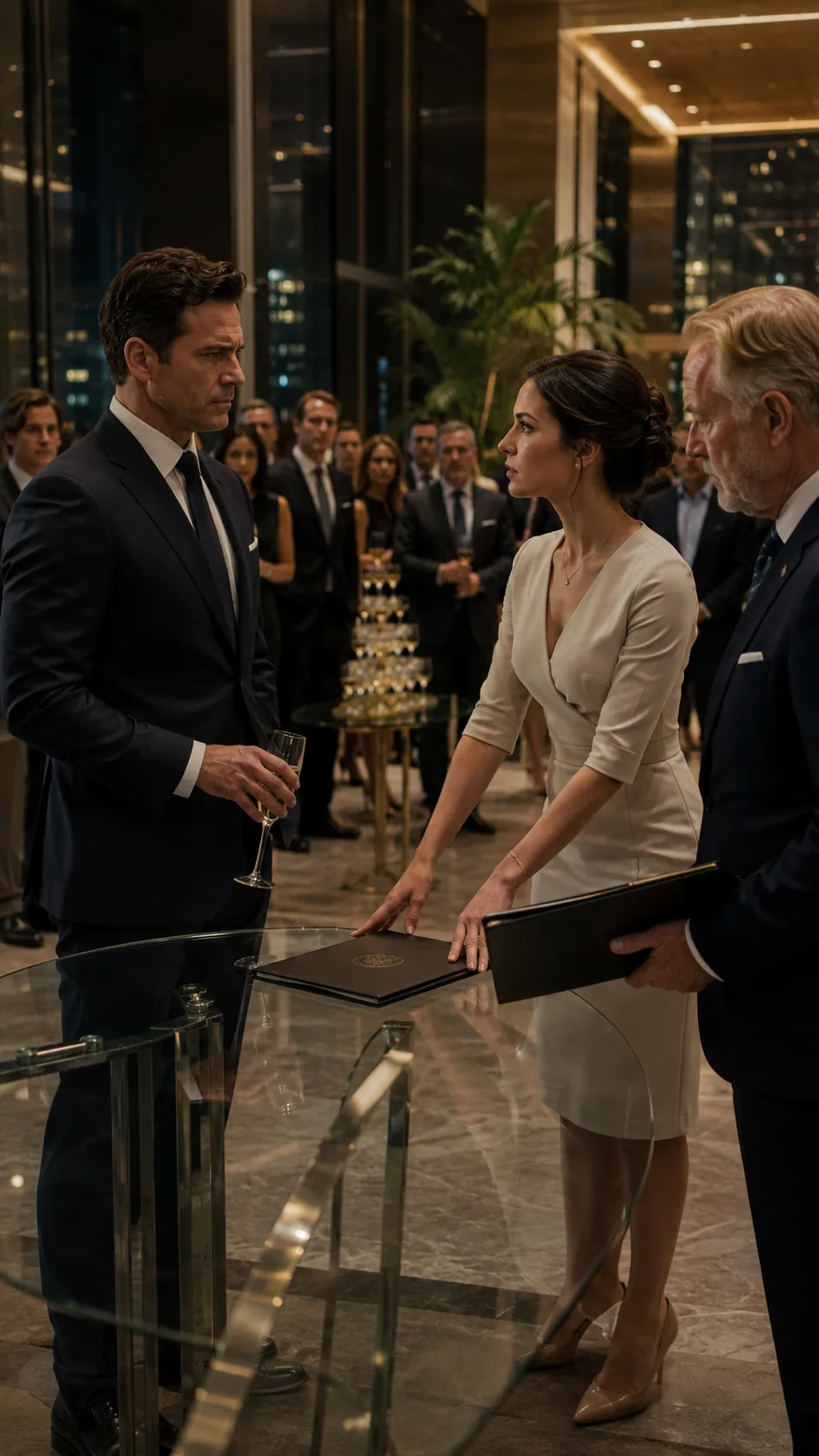
Beyond her, the lobby of Ardent Meridian looked brighter than it ever had during working hours. Gold lights ran along the glass ceiling. A champagne tower stood near the center of the room, catching little pieces of the city skyline in every glass. Investors in tailored suits gathered in soft circles. Department heads laughed too loudly. Assistants moved between them with silver trays and careful faces.
Victor Hale loved rooms like this.
He knew exactly where to stand so the light hit his jaw. He knew when to pause before speaking. He knew
how to make a toast sound like a command.
I had spent six years watching him do it.
Six years turning late-night calls into completed reports. Six years correcting pitch decks after midnight because he hated decimals but loved calling himself precise. Six years sitting behind conference room glass while men with louder voices repeated my forecasts and received applause for them.
That night, the company was celebrating the new expansion deal.
Three towers. Two cities. One press release already written.
And not one sentence had my name in it.
“Should I call someone?” the receptionist asked.
“No,” I said.
Her fingers moved off the guest list.
I walked in.
A few people noticed. Not many at first. People rarely notice the person who makes sure the lights stay on unless the lights go out.
I passed the champagne tower. Passed a senior analyst who had once asked me to
teach him the valuation model and later presented it as his own. Passed two investors who looked at my cream dress, my folder, my empty hand, then looked away.
No glass.
Victor had thought of everything.
He stood near the polished glass table at the center of the lobby with a champagne flute in his hand. Dark suit. White shirt. Navy tie. The kind of expensive watch that announced itself without needing diamonds.
Beside him stood Mr. Hayes, Ardent Meridian’s outside adviser. Older, careful, and quiet in the way men get when they know more than they say. He held a black portfolio against his side, thumb resting on the clasp.
Victor saw me.
His smile did not move. Only his eyes did.
They traveled from my face to the folder under my arm.
Then he turned away.
That was Victor’s favorite punishment. Not shouting. Not open cruelty. Dismissal. He
made people disappear while they were standing in front of him.
I stopped near one of the marble pillars.
The folder felt heavier than it should have.
Inside it was one certificate, three supporting letters, and a history Victor had spent years pretending did not exist.
My father had never worked for Ardent Meridian. Not officially.
That was the part Victor loved to repeat.
“Your father was a consultant,” he said the first time I asked why my mother’s old files contained the company’s first operating drafts. “A minor one. Don’t make it romantic.”
He said it across a conference table, in front of two junior managers who pretended not to listen.
I had been twenty-four then, newly hired, and still foolish enough to believe truth rose by itself if left in the light long enough.
It does not.
It has to be carried.
Sometimes in a black folder.
A waiter passed me with champagne.
His tray tilted toward the group behind me, not toward me.
I almost laughed.
Almost.
Victor tapped his glass once.
The sound cut through the lobby.
“Everyone,” he called.
The room turned toward him. Conversations thinned. Phones came up. A few people stepped closer to the table.
Victor waited.
He always waited until the silence belonged to him.
“Tonight,” he said, “we celebrate discipline, leadership, and loyalty.”
A few people nodded.
“Six years ago, Ardent Meridian was called reckless. Too ambitious. Too fragile.” His smile widened. “Tonight, the same people who doubted us are asking for a seat at our table.”
Soft laughter moved through the crowd.
I watched Mr. Hayes.
He did not laugh.
Victor lifted his glass higher. “This expansion belongs to the people who stayed focused. The people who didn’t confuse proximity with contribution.”
His eyes passed over me.
There it was.
A small cut, made in public.
Someone near the back looked down into his drink.
Victor continued. “To the team that actually built this company.”
Glasses rose.
Mine did not.
Because I did not have one.
The clink that followed was clean and bright and ugly.
Victor took one sip, then lowered his glass with slow satisfaction. Cameras flashed from two phones. The company’s communications director, Nina, stood near the front with a tablet tucked against her chest. She was not smiling. Her eyes kept moving between Victor and me.
Victor noticed that too.
He set his glass on the table.
A sharp click.
“Amara,” he said.
Hearing my name in his mouth made several heads turn.
He had made me visible now.
On purpose.
“Yes, Victor?”
He gave a short laugh. “I didn’t realize you were attending tonight.”
“You sent the company-wide invitation.”
“I sent it to staff.”
The room held still.
Not silent. Not yet. But still.
“I am staff,” I said.
Victor tilted his head. “Administrative staff.”
Nina’s fingers tightened around her tablet.
Someone behind me exhaled through his nose.
Victor leaned one hand on the table. “Let’s not make this awkward. This is an investor event.”
“It became awkward when my seat disappeared.”
A few eyes moved toward the reception desk.
Victor’s smile hardened. “There was no seat assigned to you.”
“There was yesterday.”
His jaw shifted once.
Tiny. But I saw it.
Victor had many gifts. Recovering quickly was one of them.
“Amara,” he said, voice lighter now, for the room, “you’ve done good support work here. No one denies that.”
Support work.
I thought of the forecasting model printed in the investor deck. The acquisition risk memo I wrote at two in the morning while Victor was in Milan. The compliance correction he ignored until I sent it to Mr. Hayes directly. The shareholder review that had saved the expansion schedule by twelve days.
Support work.
He lifted his glass again, though he had already toasted.
“But tonight is about leadership,” he said. “Not paperwork.”
The folder under my arm pressed into my ribs.
Mr. Hayes looked at it again.
Victor saw him.
That was the first crack.
His eyes sharpened. “What is that?”
I did not answer.
“Another internal complaint?” Victor asked. “A memo? An email chain?”
Someone laughed before knowing if they were supposed to.
Victor turned his head slightly, granting permission.
A few others joined in.
Small laughs. Careful laughs.
The kind people make when they are not sure who will sign their bonus letter next year.
I stepped away from the pillar.
The lobby seemed longer from the edge than it did from the center. Every shoe sound hit the marble. Every eye followed the folder.
Victor stayed by the table.
He wanted me to walk toward him.
He wanted the room to see me approach his space.
So I did.
One step.
Then another.
A man from investor relations moved aside. Not much. Just enough. The crowd opened in pieces.
Victor’s glass lowered.
“Careful,” he said.
It was not loud.
It did not need to be.
I stopped across the glass table from him. The champagne tower glittered behind his shoulder. Mr. Hayes stood to my right, close enough to read the seal if I placed the folder down.
Victor looked at me the way he looked at failing numbers.
“You don’t get a toast,” he said. “You were never part of this.”
Nina’s tablet dropped half an inch.
No one laughed this time.
The sentence stayed between us, fully formed, impossible to take back.
My hand moved to the folder clasp.
Victor’s eyes followed.
“You brought props,” he said.
“No.”
I opened the folder.
The certificate lay on top, cream paper, embossed seal, dark blue ribbon. My mother had kept the original in a fireproof box beneath old tax returns and birthday cards. I found it three months after she died, while looking for the deed to her apartment.
I had read it sitting on her bedroom floor.
Then I had read it again.
Then I had called Mr. Hayes.
He had not sounded surprised.
That told me almost everything.
I pulled the certificate free and placed it on the glass table.
Flat.
Not slammed. Not thrown.
Placed.
The sound was almost nothing.
Victor stared at it.
The seal caught the ceiling light.
Mr. Hayes took one step closer.
Victor’s hand moved toward the paper.
I slid it toward Mr. Hayes instead.
“Open the supporting file,” I said.
Victor’s fingers stopped.
Mr. Hayes set his black portfolio on the table and opened it. The clasp made a soft metal sound. He removed a stack of papers, already marked with blue tabs.
Already ready.
The room noticed.
Victor noticed the room noticing.
“What is this?” he said.
His voice had lost its shine.
Mr. Hayes unfolded the first page but did not speak yet.
Victor turned on him. “Hayes.”
Mr. Hayes did not look up.
That was new.
Victor was used to men looking up when he said their names.
I kept my palms on the edge of the glass table. The surface was cold through my skin.
“Victor,” I said, “tell them why my father’s signature is on the founding rights certificate.”
A murmur moved through the room.
Victor looked at me, then at the certificate, then back at me.
“There were many early advisers,” he said.
“Not on that certificate.”
His mouth pressed into a straight line.
Mr. Hayes turned one page.
Victor gave a quiet laugh. “This is absurd.”
“It has a state seal.”
“Old filings are often symbolic.”
“It has current standing.”
That landed.
Not because I said it loudly.
Because I did not.
Mr. Hayes finally looked up.
A woman in a silver dress lowered her champagne glass. The liquid shifted but did not spill. Behind Victor, one of the junior managers who had laughed earlier took half a step back.
Victor’s hand went to his glass.
He did not pick it up.
“Amara,” he said, “you are misunderstanding something your family kept for sentimental reasons.”
“My mother kept many things for sentimental reasons,” I said. “This was in the legal box.”
His nostrils flared.
There. Another crack.
“Your mother,” he said, “had no idea how corporate structure works.”
The words came out too fast.
Too sharp.
Too personal.
A few faces changed.
Victor had overreached.
He knew it as soon as he said it. His eyes flicked toward the investors. Then to Nina. Then to Mr. Hayes.
I felt the old version of myself rise for half a second. The one who would have defended my mother. The one who would have told the room how she worked two jobs after my father’s stroke, how she saved every letter, how she kept accounts in pencil on grocery receipts because she did not trust memory.
I said none of that.
I moved the second letter from the folder and placed it beside the certificate.
“This is your acknowledgment letter,” I said. “You signed it eighteen months after my father died.”
Victor did not look down.
That was enough.
Mr. Hayes did.
He adjusted his glasses. “It is his signature.”
The room dropped lower into silence.
Victor’s voice came out thin at the edge. “You were not authorized to review internal documents.”
“You mailed this one to my mother.”
A phone camera lifted near the back.
Nina lowered it with one hand.
Not to protect Victor.
To control the record.
Victor leaned closer over the table. “You think you can walk into my lobby with old paper and rewrite ownership?”
My lobby.
Not our lobby. Not the company lobby.
His.
I looked at the champagne tower behind him. At the glasses stacked so carefully they looked impossible. One wrong touch and the whole thing would come down.
“I don’t need to rewrite anything,” I said. “I only need you to stop hiding what was already written.”
Victor’s jaw worked.
He turned to Mr. Hayes. “Tell her.”
Mr. Hayes held the certificate with both hands.
Careful hands.
He did not turn to me.
He turned to the room.
“This certificate confirms continuing legal rights attached to the founding structure of Ardent Meridian.”
A sound moved through the crowd. Not a gasp. Something smaller. A collective shift.
Victor stepped toward him. “Say it properly.”
Mr. Hayes looked at Victor then.
“I am.”
Victor’s face changed.
Only for a second.
But in that second, the room saw the thing he had been keeping hidden under confidence: fear with a suit on.
He recovered badly.
“That certificate does not give her authority over this expansion,” Victor said.
“No,” Mr. Hayes said. “Not by itself.”
Victor seized on it. “Exactly.”
Mr. Hayes placed the certificate back on the table.
“Attached to the acknowledgment letter and the renewal filing, it confirms her legal rights were never extinguished.”
The sentence hit the glass table harder than any slammed fist could have.
Someone behind me said, “What?”
Victor turned toward the sound.
The person looked down.
Too late.
The word had already escaped.
I saw Victor calculate. Investors. Staff. Phones. Legal exposure. Press language. Internal records.
His eyes came back to me.
“You planned this.”
I almost smiled.
Almost.
“You scheduled a celebration without me,” I said. “I brought the part you forgot.”
His hand shot toward the certificate.
Mr. Hayes covered it with his palm.
Not dramatic.
Not forceful.
Just final.
Victor froze.
That was the moment the room changed sides.
Not because they loved me. Not because they knew the whole story. People do not need the whole story to recognize when a powerful man reaches for paper he does not want others to read.
One investor leaned toward Mr. Hayes. “Are we exposed?”
Victor snapped, “No.”
Mr. Hayes said, “Potentially.”
A second investor lowered his glass.
Then a third.
The champagne tower still stood behind Victor, glittering like a joke.
Victor looked at those glasses. Then at me.
“You should have come to me privately.”
“I did.”
His eyes narrowed.
“Three times,” I said. “Your assistant canceled two. You left during the third.”
Nina’s face went still.
She knew.
She had been the assistant then.
Victor’s mouth opened.
Nothing came out.
The crowd had turned fully now. Not toward me as the problem. Toward him as the explanation.
I picked up the final letter.
This one had my father’s handwriting in the margin.
My fingers did not shake.
Not anymore.
I placed it beside the certificate.
“My father asked for one thing before he died,” I said. “That my mother and I never have to beg for what he helped build.”
Victor laughed once. It cracked in the middle.
“Your father was paid.”
“Yes,” I said. “And then you kept using his rights after the payment period ended.”
Mr. Hayes turned another page. “The renewal confirms that.”
Victor pointed at him. “You work for the company.”
“I work for the company,” Mr. Hayes said. “Not for your version of it.”
That line did something no document could.
It gave the room permission to understand.
A man near the champagne tower set his glass down on the tray. The click was small, but everyone heard it.
Victor turned toward the investors. “This is a procedural issue.”
No one answered.
He looked at Nina. “Stop any recording.”
Nina held his gaze.
Then she set her tablet on the table, screen down.
Another small click.
Victor’s face tightened.
“Amara,” he said, lower now, “you are making a serious mistake.”
I looked at his hand near the certificate.
“Move your hand away from my father’s name.”
The words came out before I planned them.
Good.
Victor did not move.
So Mr. Hayes did.
He picked up the certificate, turned it toward the investors, and held it high enough for the front row to see the seal.
“Her rights are legally confirmed,” he said.
No one spoke.
The whole lobby seemed to lean away from Victor.
His hand dropped from the table.
For six years, I had watched him own rooms. I had seen him cut people off with a smile, ruin careers with a sentence, turn stolen work into leadership language. He knew how to make silence serve him.
This silence did not.
It stood against him.
Victor swallowed.
A tendon moved in his neck.
“That is not—” he started.
He stopped.
There was nowhere for the sentence to go.
Mr. Hayes lowered the certificate and placed it in front of me, not Victor.
That was the clearest thing he did all night.
I closed the folder.
Slowly.
The lobby remained still.
No applause. No dramatic shout. No one rushed forward to congratulate me.
Real rooms do not turn that quickly.
But they do turn.
One person at a time.
Nina came to the table first. She picked up her tablet, opened the event file, and deleted something with her thumb.
Victor saw it. “What are you doing?”
“Correcting the press caption,” she said.
Her voice did not shake.
Victor looked at the investors again.
One of them, a man named Mercer, stepped forward. “We need a revised disclosure before anything goes public.”
Victor straightened. “We can discuss that upstairs.”
Mercer looked at me. “Ms. Vale should be present.”
The sentence was polite.
It still cut.
Victor’s face went white around the mouth.
I picked up the certificate folder. “No upstairs meeting tonight.”
That made everyone look at me again.
I had not meant to say it until I heard myself.
Victor’s eyes sharpened. “You don’t dictate—”
“I do not need to dictate,” I said. “I need accurate minutes, legal review, and a corrected public statement before morning.”
Mr. Hayes nodded once.
Victor saw the nod.
His grip around the champagne glass tightened until his knuckles changed color.
For a second, I thought he might throw it.
He did not.
Men like Victor rarely break glass when witnesses matter.
He set it down instead.
Too carefully.
The champagne inside trembled.
People began moving after that. Not away from me. Around me. Toward Mr. Hayes. Toward Nina. Toward the investors. The celebration folded into a crisis without anyone announcing it.
Victor stayed by the table.
No one stood beside him.
That was the first true consequence.
I walked past the champagne tower on my way out of the center of the lobby. A waiter appeared at my side, tray lifted.
“Champagne, ma’am?”
I looked at the glasses.
Then at Victor, still standing under the gold lights with his perfect suit and empty circle around him.
“No,” I said.
The waiter lowered the tray.
My phone buzzed before I reached the marble pillar.
Nina had sent one line.
I’m sorry.
I stared at it.
Then typed back:
Fix the caption.
She did.
By midnight, the press release had changed.
By morning, the investor packet had been withdrawn for revision.
By noon, Victor’s name was still on the executive page, but the language underneath had shifted. Temporarily. Strategically. Quietly.
That was how companies moved when they were trying not to look like they were bleeding.
Mr. Hayes called me at two that afternoon.
“You should come in tomorrow,” he said.
“For what?”
“A formal review.”
I stood in my kitchen with the folder on the counter and my mother’s old tea mug beside it. The mug had a chip near the rim. She used to turn the chip away from her mouth without looking.
“Victor will be there?” I asked.
“Yes.”
“Then I’ll come.”
There was a pause.
“Your mother kept good records,” Mr. Hayes said.
“She kept everything.”
“I know.”
The way he said it made me stop.
“You knew her?”
Another pause.
“I met her twice,” he said. “Your father asked me to make sure the certificate language stayed intact.”
“And did you?”
“I tried.”
“Trying is what people say when they failed quietly.”
He did not argue.
That was something.
The formal review lasted four hours.
Victor arrived seven minutes late, which meant he was losing. He never arrived late when he felt strong.
He did not look at me when he entered.
He sat across from me with two attorneys, a communications consultant, and the same watch on his wrist. Mr. Hayes sat at the head of the table this time. Not Victor.
Small things matter.
The review did not end with shouting. It ended with documents being compared, timelines being corrected, and Victor learning that rooms can be taken from him without a single raised voice.
By the end of the week, the company issued a revised statement crediting the founding rights structure and naming my father’s contribution for the first time.
By the end of the month, Victor stepped back from direct control of the expansion.
The announcement called it a governance adjustment.
People love soft words for hard falls.
He did not lose everything.
Men like Victor rarely do.
But he lost the part he valued most: the ability to stand in front of a room and decide who existed.
I received a new office on the thirty-second floor.
I kept it mostly empty.
One desk. One chair. One framed copy of the corrected statement. Not the certificate. That stayed in my mother’s fireproof box, where important things belonged.
On my first morning there, I found a champagne flute on the desk.
Empty.
No note.
I thought about throwing it away.
Instead, I carried it to the small cabinet beside the window and placed it on the lowest shelf, behind a stack of old binders.
A reminder, maybe.
Not of the toast.
Of the silence after it.
That afternoon, a junior analyst knocked on my open door. He was holding a messy forecast printout and trying not to look nervous.
“Do you have a minute?” he asked.
I looked at the numbers in his hand.
Then at his face.
“Yes,” I said. “Come in.”
He stepped inside.
The glass door closed behind him.
This time, my name was on it.
Chapter complete
You have reached the end of this chapter.
Continue reading
A few more worlds to get lost in after this chapter.