Amelia woke to the small click of the balcony door.
Chapter 1
Amelia woke to the small click of the balcony door.
Not loud.
Not even enough to disturb someone who trusted the person sleeping beside her. But Amelia had not slept properly in weeks, and the apartment had trained her to notice tiny things: the shift of weight on the mattress, the pause before Noah’s feet touched the floor, the way the cold draft slipped under the bedroom door when he opened it.
She kept her eyes half closed.
Noah stood beside the bed in the dim blue light from the city outside. His phone was in his right hand. The screen was black. No ringtone. No glow. No vibration against the nightstand.
Still, he lifted it to his ear.
Amelia watched him walk to the balcony.
The curtains moved once behind him, then settled.
For three minutes, Noah stood outside with the dead phone pressed to his face. His shoulders were straight. His head was slightly lowered, like he was
listening to instructions. The glass door reflected his outline, but not enough for Amelia to see his mouth.
Then he turned.
Not toward the bed.
Toward the wardrobe.
The old walnut wardrobe stood across from Amelia’s side of the room, too large for the apartment and too dark for the rest of their furniture. Noah had insisted they keep it after moving from his parents’ storage unit two years earlier. Amelia had asked why they needed something so heavy and old.
“It belonged to my grandmother,” he had said.
That was it.
No story. No memory. No smile attached.
Now, at 3:20 in the morning, Noah stared at it like someone might answer from inside.
Amelia closed her eyes before he came back in.
The balcony door clicked again. The mattress dipped. Noah slid under the blanket with the careful movements of a man trying not to disturb his wife.
His breath slowed within minutes.
Amelia stayed awake until sunrise.
The next morning, Noah made oatmeal and placed a sliced banana on top of hers in a neat half-circle. He always did small careful things like that. He bought the brand of tea she liked. He charged her phone when she forgot. He reminded her to take the white tablets at breakfast and the blue ones before bed.
“Did you sleep?” he asked.
Amelia looked at his hands.
No tremor. No scratches. No sign that he had spent part of the night speaking into a phone that never rang.
“Not really.”
Noah set a glass of water beside her medicine box. “You’ve been restless again.”
Again.
She hated that word from him. It made everything sound like a symptom.
“I woke up around three,” she said.
His spoon paused above his bowl for less than a second.
Then it moved
again.
“You did?”
“You were on the balcony.”
Noah smiled, but only with one side of his mouth. “At three?”
“3:17.”
“That’s very specific.”
“You had your phone.”
He reached for his coffee. “I think you dreamed that.”
Amelia did not answer.
He leaned back in his chair and looked at her the way doctors looked at her in the hospital after the accident: kind eyes, measured voice, patience already prepared.
“You know what Dr. Bell said,” he continued. “Memory gaps can make your brain fill in strange things. Especially at night.”
“My brain didn’t open the balcony door.”
Noah’s fingers tightened around the mug.
Just once.
Then he got up and kissed the top of her head. “Take your medication, okay? I’ll be late tonight.”
The kiss landed too softly.
Amelia waited until the front door closed before she pushed the pills into a napkin instead of her mouth.
She did not know why she did it.
Not then.
She only knew that something in her body refused the routine that morning. The tablets looked harmless on the white paper. One oval. One round. One tiny blue half-moon. Noah had arranged them in the pill organizer every Sunday night with the same care he used for everything else.
Amelia wrapped the napkin and placed it in the back of a kitchen drawer under takeout menus.
Her hands were steady.
That made her stop.
After the accident, everyone told her she was fragile. Noah said it first, then her mother repeated it, then the doctors wrote it in softer language. She had accepted the word because it explained why rooms sometimes felt unfamiliar, why certain songs made her scalp prickle, why the smell of wet asphalt could make her stop walking in the middle of a sidewalk.
Three years earlier, she had woken up in St. Agnes Medical Center with eight stitches in her left palm and no memory of the crash.
Noah told her she had been driving alone.
Rain. A curve near Harbor Road. Hydroplaning. A guardrail.
No one else in the car.
He told the story so often that Amelia could recite it without remembering any part of it.
That afternoon, she bought a small camera from an electronics store two neighborhoods away. The clerk showed her how to connect it to her phone. He kept calling it a pet camera.
“Motion detection works pretty well,” he said.
Amelia smiled enough to end the conversation.
At home, she placed it on the bookshelf in the bedroom between a cracked copy of Wuthering Heights and a travel book about Lisbon. Noah never touched either. She angled the lens toward the bed, the balcony door, and the wardrobe.
Then she made dinner.
Noah came home at 8:40 carrying flowers from the corner shop.
Yellow tulips.
Not her favorite.
Her favorite had been white lilies before the accident. After the hospital, Noah said lilies made her uneasy. Amelia believed him because she had no memory strong enough to argue with.
“For the table,” he said.
“They’re pretty.”
He watched her too closely while she arranged them in a vase.
That night, Amelia pretended to take the blue pill.
She placed it under her tongue, drank water, turned away, and later pressed it into a tissue in the bathroom. The tablet left a chalky bitterness behind.
At 3:17, the camera recorded Noah sitting up.
Amelia watched the footage in the kitchen before dawn while he slept.
There was no hesitation in him. No sleepwalking. No confusion.
He rose, took the phone, walked to the balcony, and lifted it to his ear.
The screen stayed dark.
For most of the recording, there was no audio except the hum of the apartment heater and one car passing below. Then Noah said something.
Amelia turned the volume up.
His voice came through the speaker, low but clear.
“I know she’s still here.”
The video showed him turning toward the wardrobe.
Amelia paused it.
The frame froze on Noah’s profile, his eyes fixed on the dark wooden doors.
She carried her laptop to the bedroom and stood in front of the wardrobe for several minutes.
The brass handles were cold.
Inside were winter coats, old blankets, and two storage boxes she had not opened since they moved. The first box held tax papers and Christmas ornaments. The second held Noah’s college books, an old camera lens, and a folded gray scarf that smelled faintly of dust.
Nothing else.
At the bottom of the wardrobe, one floorboard inside sat slightly higher than the others.
Amelia pressed it.
It did not move.
She tried to lift it with her fingernail and broke the edge of her nail against the wood.
A thin red line appeared near the cuticle.
She closed the wardrobe before Noah woke.
At breakfast, he looked at her hand.
“What happened?”
“Drawer caught my nail.”
He took her fingers in his hand and examined the tiny injury.
Too long.
Then he let go.
“You should be careful. You’ve been distracted.”
Amelia set her coffee down. “Have I?”
Noah opened the pill organizer and tipped the morning tablets into his palm.
White. Round. Blue half-moon.
“I’m only trying to help you.”
“I know.”
He placed them beside her plate. “Then let me.”
She looked at the pills.
Then at him.
“Do you ever get tired of saying that?”
His expression did not change. That was the first thing she noticed. Not anger. Not surprise. Just a small stillness, like a door closing inside him.
“Of saying what?”
“That you’re helping me.”
Noah pushed the pills closer with one finger. “Only when you make it sound like a crime.”
She took the tablets.
She did not swallow them.
Not then. Not later.
For the next three nights, Amelia stayed awake.
Noah repeated the same pattern every time.
3:17.
Phone.
Balcony.
Wardrobe.
On the second night, he said, “No, she hasn’t asked about him.”
On the third, he said, “I changed the dosage already.”
That sentence stayed under Amelia’s skin all morning.
She did not confront him. She did not call her mother. She did not call Dr. Bell, because Noah had chosen him after the accident and always came to the appointments.
Instead, she went to the pharmacy.
The pharmacist, a woman with silver-framed glasses and a name tag that said LINDA, looked up the prescription and frowned at the screen.
“These were adjusted six months ago,” Linda said.
“By Dr. Bell?”
“Yes.”
“What changed?”
Linda glanced toward the back counter. “I can print the medication information sheet, but dosage questions should go to your physician.”
“Were they increased?”
Linda looked at Amelia for a moment.
Then she printed the sheet.
Amelia read it in the car with the doors locked.
Drowsiness. Confusion. Impaired recall. Vivid dreams. Disorientation.
The words were clinical, clean, harmless in black ink.
Her hands left faint half-moons in the paper.
At home, she searched Dr. Bell’s name with Noah’s.
Nothing came up at first.
Then she found a charity gala photo from six years ago. Noah stood near the edge of the frame in a dark suit, younger and thinner, holding a champagne glass. Beside him was Dr. Bell. On Noah’s other side stood a man Amelia did not recognize.
Broad shoulders. Gray hair. A square face.
The caption listed him as Victor Hale, private security consultant.
Amelia said the name once under her breath.
Nothing.
Then the smell of wet asphalt rose in her throat so sharply she had to grip the kitchen counter.
A sound came with it.
Not thunder.
A man’s voice.
“Keep her awake.”
Amelia dropped the printed sheet.
The memory did not open. It only flashed like a hallway with a locked door at the end.
That night, Noah brought home soup because he said she looked pale.
He stood over her while she lifted the spoon.
“Eat more.”
“I’m not hungry.”
“You need strength.”
“For what?”
Noah blinked.
Amelia watched the question land. It had been a small one. Barely anything. Still, he picked up his phone and placed it screen down beside his bowl.
“You’ve been different this week,” he said.
“So have you.”
He laughed once through his nose. “I’m not the one hiding things.”
The spoon stopped halfway to her mouth.
Noah looked at the kitchen drawer.
The one with the napkins.
Amelia did not move.
He knew.
After dinner, he emptied the trash. Then he wiped the counters. Then he stood in the kitchen with his back to her, looking down at something in his hand.
The napkin.
He turned.
The pills were in his palm.
Neither of them spoke.
Noah closed his fingers over the tablets. “How long?”
Amelia pushed her chair back. The legs scraped the floor.
“How long have you been checking?”
“That’s not what I asked.”
“No,” she said. “It never is.”
He walked toward her with slow steps, the kind he used when he wanted to seem calm. His body blocked the kitchen exit.
“You don’t understand what happens when you stop taking them.”
“Then explain it.”
“I’m trying to keep you stable.”
“Stable enough to forget?”
His jaw tightened.
There.
A crack.
Then his phone buzzed on the counter.
For the first time, Amelia saw him flinch before he picked it up.
Noah checked the screen. His thumb moved quickly, then stopped. He looked at her, and the soft husband mask came back over his face, but it did not fit as well now.
“I have to take this.”
“Who is it?”
“Work.”
“At 10:48?”
He slipped the phone into his pocket. “Go to bed.”
Two words.
Not a request.
That night, Amelia hid behind the curtains before 3:17.
The apartment felt colder near the balcony glass. Her phone was already recording. She could see the bed through the sheer fabric, Noah’s outline under the blanket, the wardrobe beyond him.
3:16.
The minute changed.
Noah sat up.
His feet touched the floor. He took his phone. Walked straight toward the balcony.
Amelia pressed herself into the curtain’s shadow.
The phone screen was black.
He lifted it to his ear.
For a few seconds, he only listened.
Then he spoke.
“I did exactly what you told me.”
Amelia stopped breathing through her mouth.
Noah’s back was close enough that she could see the seam on his dark T-shirt.
“She doesn’t remember anything,” he said.
A pause.
Then, lower: “Not him. Not the road. Not what I moved.”
Amelia’s fingers tightened around her phone.
Noah turned slightly.
For one second, she thought he had seen her.
But his eyes moved past the curtains.
To the wardrobe.
“She started asking about the pills,” he said. “I’ll handle it.”
The word handle sat between them in the dark.
Amelia stayed behind the curtain until Noah returned to bed.
She did not sleep after that.
At 6:12, Noah’s alarm rang.
At 6:25, he showered.
At 6:41, he left his phone on the bathroom counter while shaving, because he had never needed to hide things before. Not from the version of Amelia he believed he had built.
She took it.
His password was their anniversary.
It opened on the second try.
No call logs.
No strange contact names.
No messages that looked wrong.
But there was a locked notes app.
She tried the anniversary.
Wrong.
His birthday.
Wrong.
Her birthday.
Wrong.
Then she looked toward the wardrobe.
Noah had once told her his grandmother’s birthday while explaining the combination to an old suitcase. September 17.
The app opened.
There were grocery lists, insurance numbers, a scan of her medical card, and one audio file.
3:17.
The bathroom faucet stopped.
Amelia’s thumb hovered over the file.
Noah opened the bathroom door with a towel around his neck.
For a second, neither of them moved.
His eyes went to the phone in her hand.
“What are you doing?”
Amelia pressed the side button and locked the screen.
“Looking for the plumber’s number.”
“We don’t have a plumber.”
“The sink was making a sound.”
He held out his hand. “Give me my phone.”
She gave it to him.
Their fingers touched.
His were damp and cold.
He checked the screen immediately, but it was locked. Amelia watched the calculations move behind his eyes. He could not accuse her without admitting there was something to find.
“I’ll call someone,” he said.
“For the sink?”
“Yes.”
“It stopped.”
Noah slid the phone into his pocket. “I’m working from home today.”
Amelia looked at the razor still on the sink, white foam drying along its edge.
“Good,” she said. “We can have breakfast together.”
He did not like that.
She could tell by the way he folded the towel.
One edge over the other. Too precise.
Amelia made eggs. She burned one side and left them on the plate anyway. The coffee machine sputtered twice before filling Noah’s cup. Outside, the city moved on as if no one had ever disappeared inside a marriage.
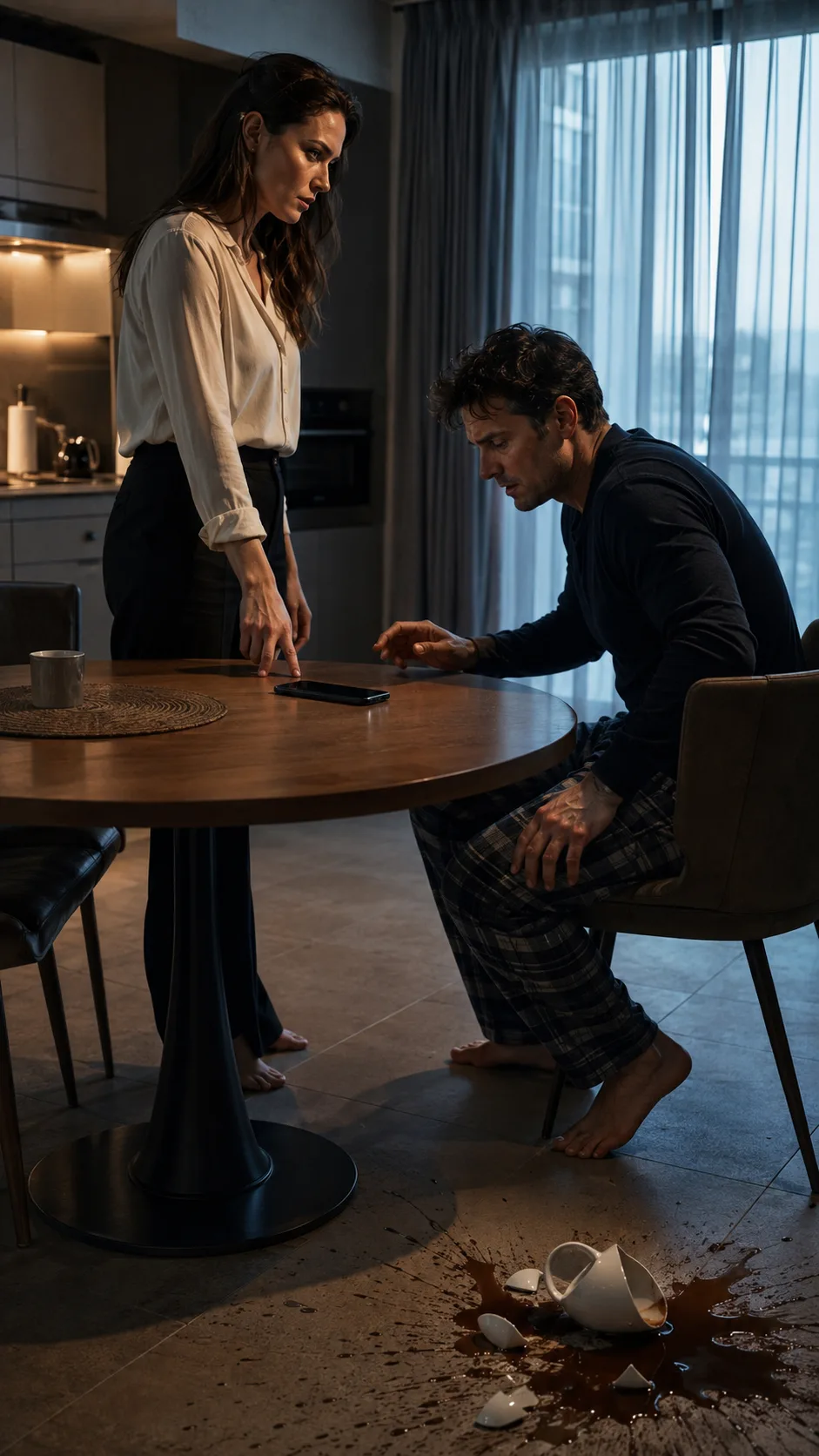
Noah sat at the table with his phone beside his plate.
Screen down.
Amelia placed her coffee across from his, but she did not sit.
“You’re making me nervous,” he said.
She smiled without showing teeth. “That must be new for you.”
His fingers moved toward the phone.
Amelia’s hand reached it first.
She picked it up.
Noah stood so fast the chair hit the wall.
“Amelia.”
She stepped back and entered 0917.
The notes app opened.
His face changed before the file played.
Not much. Just the mouth first. Then the eyes.
Amelia set the phone in the center of the breakfast table and pressed play.
For two seconds, there was static.
Then a man’s voice filled the kitchen.
“Keep controlling the medication. If she remembers that night, both of you are finished.”
Noah’s hand hit the coffee cup.
It fell.
White ceramic broke across the tile. Coffee splashed under the table and across his bare foot. He did not look down. One piece of the cup spun near the chair leg and settled with the handle still attached.
The audio continued.
“She saw Victor on the road. She saw you move him.”
Amelia looked at Noah.
Noah looked at the phone.
The man’s voice went on, calm and close, as if he had been standing in their kitchen all along.
“She remembers the rain in pieces. That means the dosage is failing.”
Noah reached for the phone.
Amelia moved it away.
Not fast.
Just enough.
His hand closed on empty air.
The phone stayed on the table between them.
Amelia placed two fingers on top of it.
“Tonight, we don’t need to wait until 3:17,” she said.
Noah’s throat moved once.
“Tell me now — what did you do to my memory?”
The refrigerator hummed behind them.
Coffee spread in a dark line toward Amelia’s foot.
Noah opened his mouth, then closed it.
The audio crackled.
A second voice entered the recording.
His voice.
“I can keep her calm,” Noah said from the phone. “She trusts me.”
Amelia did not look away from the man in front of her.
The Noah at the table seemed smaller than the Noah in the recording. The recording sounded certain. Clean. Prepared. The man in front of her had coffee on his foot and one hand gripping the chair back.
The unknown man spoke again.
“Trust is useful. Don’t waste it.”
Noah’s recorded voice answered, “What about the wardrobe?”
Amelia’s fingers pressed harder against the phone.
The wardrobe.
Even here, in the kitchen, the word seemed to pull the apartment’s walls closer.
“What did you put in it?” she asked.
Noah shook his head.
“No.”
“One question,” she said.
“Turn it off.”
“One answer.”
“Turn it off.”
He lunged.
Amelia stepped back with the phone and grabbed the heavy glass pitcher from the table. Not to throw. Not to strike. Just enough to make him stop.
He stopped.
The movement left both of them breathing hard.
The audio played on.
Victor Hale’s voice came through next, and now Amelia knew the man from the gala photo.
“If she finds the drive, we all go down. If she remembers why she took Harbor Road, we all go down. You said you could control your wife.”
Noah said nothing in the room.
On the recording, he said, “I can.”
Amelia turned toward the bedroom.
Noah moved to block her.
“Don’t.”
That was all.
Not please.
Not Amelia.
Don’t.
She walked past him anyway.
He caught her wrist at the hallway entrance. Not hard enough to bruise. Hard enough to remind her that he could.
Amelia looked down at his hand.
Then she lifted the phone closer to his face. The recording still played.
His own voice filled the narrow hall.
“She won’t know what’s missing.”
Noah let go.
The bedroom looked ordinary in the morning light. Unmade bed. One pillow on the floor. A glass of water on her nightstand. The camera still tucked between the books. The wardrobe waited against the wall.
Amelia opened both doors.
Coats shifted on their hangers.
She pulled the boxes out and dropped them on the carpet. Tax papers slid loose. Christmas ornaments rolled in red and gold flashes. Noah stood in the doorway, one hand against the frame.
“Amelia, stop.”
She ignored him.
The raised floorboard inside the wardrobe still would not lift by hand. Amelia went to Noah’s toolbox in the hall closet and took out a flathead screwdriver.
The first pry left a pale scrape in the old wood.
The second made the board groan.
The third lifted it.
Underneath was a black USB drive wrapped in a blue hospital bracelet.
Amelia picked it up.
The bracelet had her name on it.
AMELIA WARD.
Not Amelia Bennett.
Ward.
Her maiden name.
The date printed beside it was three years old.
The night of the accident.
Noah leaned against the doorway as if the frame was the only thing keeping him upright.
“Give that to me.”
Amelia closed her fist around the drive.
“No.”
“You don’t know what’s on it.”
“That’s why I’m keeping it.”
“He’ll come after you.”
“Victor?”
Noah’s silence answered.
The name did something inside her. Not enough to open the missing night. Enough to make the edges glow.
Rain on the windshield.
A man in the road.
Noah shouting.
Her own hand on the steering wheel.
Then a second car behind them, headlights too high and too close.
Amelia grabbed her laptop from the desk.
Noah stepped forward. “Don’t plug it in.”
She sat on the edge of the bed and opened the computer.
His voice dropped. “There are things you don’t want back.”
Amelia looked at him.
For three years, she had lived inside sentences he chose for her. Rest. Take this. You’re tired. You imagined it. I’m helping you.
Now he had run out of soft words.
The USB slid into the port.
A folder opened.
There were three files.
One video.
One audio recording.
One document titled SETTLEMENT_DRAFT.
Amelia opened the video.
The screen showed a dashboard view through rain.
Harbor Road.
The timestamp matched the night of the accident.
For several seconds, the camera showed only wet pavement and wipers cutting across the glass. Then Noah’s voice came from inside the car.
“Don’t pull over.”
Amelia’s voice answered, younger and sharp around the edges. “He’s hurt.”
“Keep driving.”
“Noah, he’s in the road.”
The car slowed.
A man appeared ahead in the headlights, staggering near the guardrail. His coat was torn. Blood marked one side of his forehead, but he was standing.
Victor Hale.
Amelia’s recorded voice said, “That’s the man from your office.”
Noah reached across the dashboard.
The image jerked.
“Noah, stop.”
The wheel turned.
The car struck the guardrail, not the man.
The screen flashed white.
Metal screamed.
Then the camera tilted sideways, still recording rain, glass, Noah’s hands, Amelia’s left hand bleeding where the windshield had cut her.
The passenger door opened.
Noah got out.
Another set of headlights stopped behind them.
Victor’s voice shouted through the rain. “Is she alive?”
Noah came back into frame and leaned over Amelia.
“She saw you,” he said.
Victor answered, “Then fix it.”
The video ended.
Amelia sat still with one hand on the laptop and the other around the USB drive.
Noah stood at the foot of the bed.
The apartment sounded different now. Pipes ticking. A car horn below. The soft buzz of the laptop fan.
Small things.
Real things.
“You told me I crashed alone,” she said.
Noah stared at the floor.
“You told my mother that.”
He rubbed his mouth with the back of his hand.
“You told every doctor.”
His shoulders sagged. “I was trying to protect you.”
Amelia closed the laptop halfway.
“No.”
The word cut clean.
Noah looked up.
“You were protecting him.”
He took one step toward her, then stopped when she lifted the phone.
The 3:17 audio was still open.
“Who is Victor Hale?”
Noah’s eyes moved to the balcony, as if some answer might be waiting there.
“He worked with my father,” he said.
“Doing what?”
Noah did not answer.
Amelia opened the document on the USB drive.
SETTLEMENT_DRAFT.
It was not a settlement with her.
It named Victor Hale, Dr. Marcus Bell, and Noah Bennett as cooperating parties in a private liability agreement. There were numbers. Confidentiality clauses. Medical language. A reference to ongoing cognitive management.
Cognitive management.
Amelia read that phrase three times.
Her name appeared on the second page.
Not as a person.
As an exposure risk.
Noah sat on the chair near the wardrobe without being asked. His knees parted. His hands hung between them.
“He said if you remembered, we’d lose everything.”
“What did he pay you?”
Noah’s head snapped up.
Amelia turned the laptop toward him.
Numbers sat in neat columns.
His mouth stayed open for one second too long.
Enough.
She picked up her phone and dialed her mother first.
Noah stood. “Don’t.”
Amelia put the call on speaker.
Her mother answered on the fourth ring, voice thick with sleep.
“Millie?”
“I need you to listen,” Amelia said.
Noah stepped closer.
Amelia backed toward the balcony door and lifted the phone higher.
“Noah lied about the accident.”
Her mother’s breathing changed.
Amelia continued before Noah could speak. “I have the video. I have the audio. I have the documents. I’m sending them now.”
Noah whispered her name.
She sent the files to her mother. Then to her own email. Then to a lawyer she had met once at a hospital fundraiser and never called because Noah had said they did not need legal trouble.
The emails left with soft little whooshes.
Noah sat back down.
His face had gone gray around the mouth.
The apartment did not explode. No sirens arrived in that second. No one kicked down the door. The city outside kept moving.
That made it worse for him.
There was no dramatic noise to hide behind.
Only the evidence leaving his control, one file at a time.
Amelia’s mother stayed on the line.
“Where are you?” she asked.
“At home.”
“Leave.”
Noah looked at the phone. “Don’t make this bigger.”
Amelia laughed once.
It surprised both of them.
Not because it was loud.
Because it had no fear in it.
She walked to the closet and took out a coat. Her passport was in the desk drawer. Her wallet was in her bag. The hospital bracelet went into her pocket with the USB drive.
Noah followed her to the living room but did not touch her again.
At the door, he said, “You don’t remember all of it.”
Amelia turned.
He stood barefoot in the hallway, coffee drying on one foot, his hair uncombed, the careful husband gone.
“No,” she said. “But you do.”
Then she left.
Her mother was waiting outside the building forty minutes later in an old blue sedan with a crack across the windshield. She had driven across town without changing out of her house slippers. Amelia got into the passenger seat and handed her the USB drive without speaking.
Her mother held it like it weighed more than it did.
They drove to a police station first.
Then to a lawyer.
Then to a different doctor, one who did not know Noah, Dr. Bell, or Victor Hale.
By evening, Noah had called twenty-seven times.
Amelia did not answer.
By the next morning, Dr. Bell’s office had canceled all appointments for the week. By Friday, Victor Hale’s name appeared in a local news article connected to a reopened investigation involving private security contracts, falsified medical oversight, and witness tampering.
Noah’s lawyer called Amelia once.
She let her lawyer answer.
The apartment was searched two days later. They found printed prescription notes, a second drive taped behind the wardrobe panel, and a burner phone hidden inside the lining of Noah’s winter coat. There were no call logs on his regular phone because the 3:17 calls had never been calls.
They were scheduled recordings.
Instructions.
Reminders.
A ritual built to keep him obedient and Amelia uncertain.
At 3:17 every morning, the phone played audio only through a hidden earpiece Noah wore when he stepped onto the balcony. Some nights he listened to Victor. Some nights he listened to himself. Some nights, according to the recovered files, he listened to the same phrase over and over.
She doesn’t remember anything.
The police asked Amelia if she wanted to see all the recordings.
She said no at first.
Then she said yes to one.
Just one.
It was the first 3:17 file, made two weeks after she came home from the hospital. Noah’s voice sounded tired. Younger. Afraid.
“She asked about the man in the road today,” he said. “I told her it was a dream.”
Victor answered, “Keep saying it.”
Noah said, “She trusts me.”
Victor said, “Then use that.”
Amelia removed the headphones before the file ended.
Enough.
Months passed in a way that did not feel clean or simple.
Memory did not return like a door opening. It came in fragments. Rain on glass. The smell of Noah’s jacket in the car. Victor leaning over the guardrail. Her own voice saying, “I’m calling someone.” Noah’s hand grabbing the wheel.
Some fragments stayed missing.
The new doctor told her not to force them.
Amelia stopped asking permission from rooms, from men, from blank spaces in her own head.
She moved into a small apartment on the fourth floor of a brick building with bad plumbing and good sunlight. The first night there, she placed her phone in the kitchen drawer and slept without a pill organizer on the nightstand.
At 3:17, she woke anyway.
The room was unfamiliar. The ceiling had a crack shaped like a branch. Somewhere below, a neighbor’s dog barked once, then stopped.
Amelia lay still.
No balcony door clicked.
No dark phone lifted.
No man whispered to a wardrobe.
She got out of bed and made tea. The mug was chipped on the rim because she had bought it secondhand with three plates and a lamp that leaned to one side. She stood by the window while the city lights blinked in the distance.
Her phone stayed in the drawer.
Noah pleaded guilty to evidence tampering and unlawful coercion tied to the medication scheme. Other charges moved slower. Victor fought everything. Dr. Bell resigned before the medical board hearing and then discovered resignation did not stop investigators from opening drawers.
Amelia did not attend every hearing.
She attended the one where Noah had to look across the room and hear the audio file played out loud.
“She doesn’t remember anything.”
This time, the room heard it too.
His lawyer stared at the table. The court reporter stopped typing for half a second. Noah closed his eyes.
Amelia kept hers open.
Afterward, in the hallway, Noah asked for one minute.
Her lawyer said she did not have to give him anything.
Amelia looked at the man who had built three years of her life out of locked doors and careful lies.
“One minute,” she said.
Noah stood with his hands folded in front of him. He looked thinner. Older. Not harmless. Never that.
“I loved you,” he said.
Amelia adjusted the strap of her bag on her shoulder.
“No,” she said. “You kept me.”
He had no answer for that.
She walked away before the minute ended.
That night, Amelia went home and opened the wardrobe she had bought for herself. Not walnut. Not antique. Cheap white wood from a furniture store, with one handle slightly crooked because she had installed it alone and refused to fix it.
Inside were coats, a suitcase, and one box of documents.
On the top shelf sat the blue hospital bracelet and the black USB drive in a clear evidence bag returned by her lawyer after copies had been made.
She did not hide them under the floor.
She did not lock the door.
At 3:17, Amelia was awake, sitting at the kitchen table with a cup of tea cooling beside her.
The city outside was quiet.
Her phone lay face up in front of her.
Dark.
Silent.
She picked it up, opened the old audio file, and deleted it.
Then she deleted the copy.
Then the backup.
The screen asked if she was sure.
Amelia pressed yes.
No voice answered.
Chapter complete
You have reached the end of this chapter.
Continue reading
A few more worlds to get lost in after this chapter.




