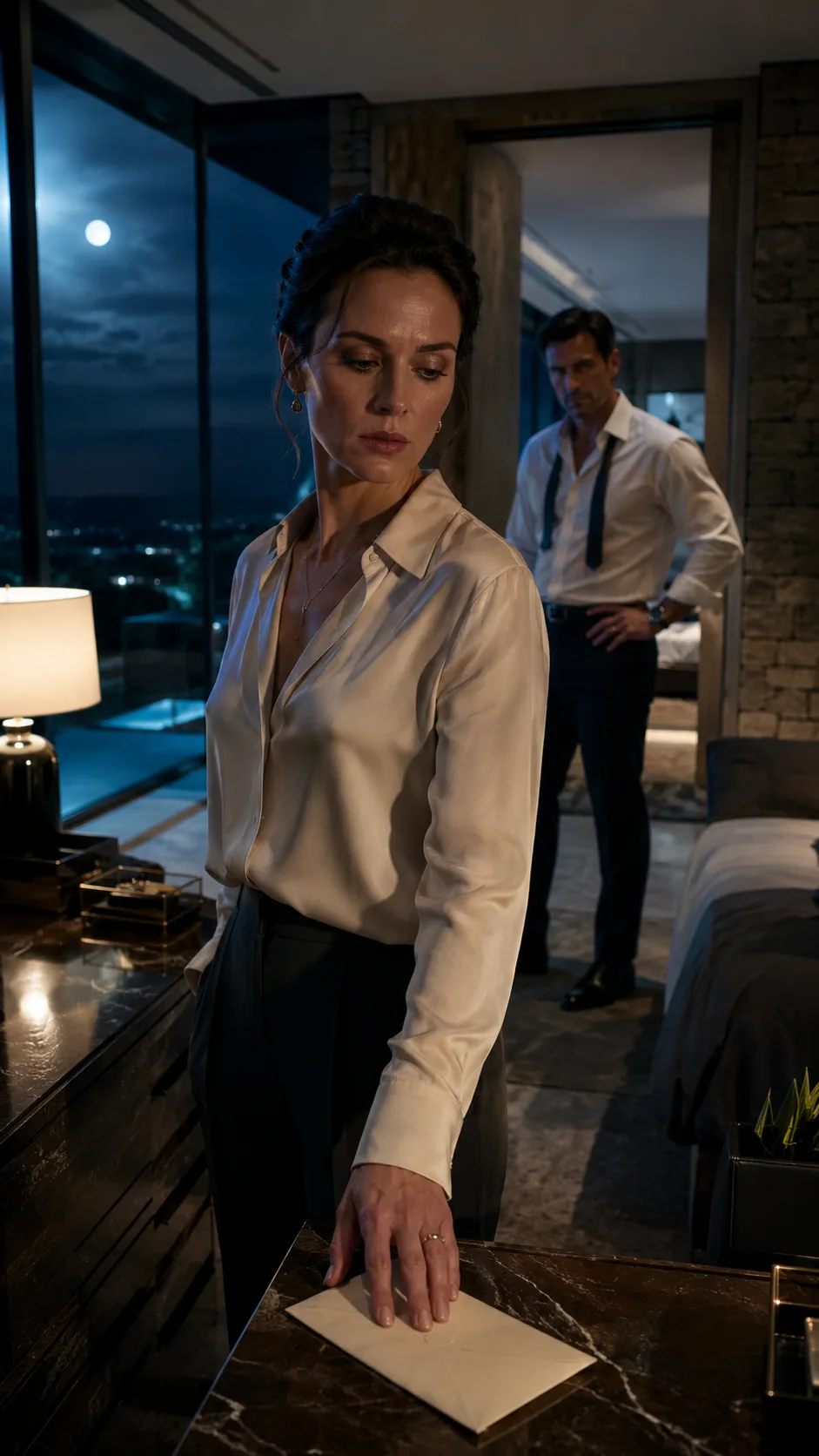
The first thing Andrew did that night was place the envelope on my dresser like it belonged there.
Chapter 1
The first thing Andrew did that night was place the envelope on my dresser like it belonged there.
Not on the bed.
Not in my hand.
On my dresser.
He set it beside the black marble tray where I kept my watch, my reading glasses, and a small silver fountain pen my father had given me when I closed my first serious client. The pen was old now, slightly scratched near the cap, the kind of object Andrew never noticed unless someone important commented on it.
He straightened the envelope with two fingers.
Then he stepped back and waited.
I was sitting by the window with my laptop open, answering a message from Zurich. The bedroom was quiet except for the soft hum of the air conditioning and the faint tick of the brass clock on the bookshelf. Outside, the lights of Austin blinked below the hill, scattered and distant behind the glass walls.
Andrew stood in the doorway.
His tie was loosened. His shirt was unbuttoned at
the collar. His watch flashed each time he moved his wrist, a ridiculous thing with a complicated face and too much gold. He had bought it after his promotion, then told three different versions of the story at three different dinners.
In every version, he sounded taller.
“You’re unstable,” he said.
I looked up from my screen.
He had rehearsed it. I could hear that in the spacing between the words.
“I’ve already filed for divorce,” he continued. “Be out of here by tomorrow.”
The clock ticked once.
Then again.
I did not close my laptop right away. That irritated him. I could see it in the way his jaw pressed to one side.
Andrew liked control in visible forms. A signature. A reservation. A man opening a door after he had already decided who could enter. He did not enjoy silence unless it belonged to him.
“You heard me,”
he said.
“I heard you.”
My voice made him blink.
He expected something smaller.
A question, maybe.
A gasp.
A wife asking what she had done wrong, although he had already decided the answer months before.
He stepped into the room, carrying his confidence like a briefcase. “My attorney is prepared to be very clear. I don’t want this to get ugly, Elena.”
He always used my name when he wanted to sound reasonable.
Never when he was.
I looked down at the open email on my laptop.
The message was only three lines long. A board member in Geneva needed confirmation that I would attend an emergency call the next morning regarding a restructuring package worth more than Andrew’s entire department would touch in a year.
I typed: Confirmed.
Then I closed the laptop.
Soft click.
Andrew’s eyes moved to the screen, then back to me.
A small thing.
He noticed it anyway.
Six years of marriage had taught me what Andrew noticed and what he refused to see.
He noticed labels on wine bottles.
He noticed which banker had a better table at charity dinners.
He noticed whether waiters called him sir fast enough.
He never noticed when I left the room to take a call in German. He never noticed the documents couriered to my office under company names he assumed were boring. He never noticed the lawyers who called me by my title and him by his first name when they made the mistake of meeting us together.
He had built an entire marriage around not noticing.
For a while, I let him.
At first, I told myself it was easier.
Andrew had met me at a fundraiser for a children’s hospital, standing beside a silent auction table and pretending to understand a sculpture made of brushed steel. He was handsome in a careful way, the kind of man who spent money to look like money had chosen him. He laughed at my dry comments. He asked about my work, but only enough to seem interested.
“Consulting?” he had said that night. “That’s broad.”
“Strategic advisory,” I said.
“Corporate?”
“Sometimes.”
He smiled as if he had solved me. “So, long calls and expensive coffee.”
I laughed then.
I should have paid closer attention.
Three months into dating, I mentioned a contract that had taken almost a year to negotiate. He leaned back in his chair, lifted his glass, and said, “Your little side of the world is getting serious.”
My little side of the world.
I let the phrase pass because the waiter had arrived with dessert, and because Andrew had that soft public charm men learn when they believe charm is the same as kindness.
But I remembered.
I always remembered.
By the time we married, my “little side of the world” had already become a private advisory practice with clients whose names rarely appeared on websites. Sovereign wealth offices. Tech founders. Family holdings with more layers than wedding cake. Boardrooms where people did not raise their voices because too much money was at stake.
My income was complicated.
Protected.
Quiet.
Andrew’s was simple enough to brag about.
That made him comfortable.
He liked being the visible provider in rooms where nobody had asked for the truth. He liked placing his hand on my back at events and saying, “Elena keeps busy with consulting,” as if I made schedules and color-coded spreadsheets between yoga classes.
I never corrected him.
Not there.
Not in front of people whose attention he needed the way some men need air.
Instead, I built.
The house outside Austin had been purchased through an LLC I formed before the marriage. The cars were leased through my management company. The private investment accounts were held in structures Andrew would have needed patience to understand.
He had none.
So he mistook the life around him for his own.
That was his habit.
That was also his mistake.
He crossed the bedroom and stopped near the foot of the bed. “I’m willing to be generous if you cooperate.”
“Generous,” I repeated.
His mouth tightened. “Don’t turn this into one of your word games.”
I stood.
He watched me carefully.
The room seemed suddenly too polished. Too expensive. The bed had been made with the gray throw he insisted was Italian, although I had ordered it from a small shop in Santa Fe after a conference. His cuff links sat in a dish on my side of the vanity. A half-empty glass of water left a ring on the dresser.
He had done that for years.
Left marks on things and assumed someone else would wipe them away.
I walked past him toward the dresser.
My bare feet made almost no sound against the stone floor.
Andrew turned with me.
“Where are you going?” he asked.
“To read what you brought me.”
“It’s standard.”
I picked up the envelope.
“Is it?”
His eyes narrowed. “My attorney drafted it.”
“That wasn’t my question.”
I slid my finger under the flap and opened it. The paper inside was thick, expensive, and cold from the room. Andrew had always liked documents that looked important. He respected weight, embossing, signatures, seals. Things that made insecurity look official.
The petition was inside.
So were preliminary claims.
I read the first page slowly.
He shifted behind me.
“Don’t pretend you’re surprised,” he said. “This has been coming.”
I turned the page.
He waited for me to defend myself.
That was another thing Andrew loved: creating a courtroom anywhere he wanted and assigning himself the judge’s seat.
“You’ve been erratic,” he continued. “Distant. Secretive. Emotionally unavailable.”
I kept reading.
His attorney had written it neatly. Too neatly. The language around instability was careful, not quite accusatory enough to be reckless, not quite soft enough to be harmless.
I could picture the meeting.
Andrew leaning back.
His lawyer nodding.
A yellow legal pad on the desk.
Words like optics, pattern, narrative.
Men like Andrew loved the word narrative because it sounded cleaner than lie.
“You’re not going to say anything?” he asked.
I set the first page down.
Then the second.
Then I looked at the rest.
He had made claims regarding the house.
Not ownership, exactly.
Occupancy.
Marital lifestyle.
Expected settlement.
Temporary possession.
There it was.
The shape of the thing.
He did not just want a divorce. He wanted a stage. He wanted me removed from the house before I could make the room look different. He wanted momentum. He wanted me embarrassed, displaced, and grateful for anything he allowed me to keep.
I folded the papers back into alignment.
“You told your attorney this house was marital property?”
Andrew’s expression changed only by a fraction.
Enough.
“It’s our home,” he said.
“That wasn’t my question.”
His hand went to his hip. “We’ve lived here for five years.”
“Yes.”
“We hosted parties here.”
“Yes.”
“I paid household expenses.”
I looked at the water ring on the dresser.
“You paid the cable bill for nine months after your assistant set it up on autopay.”
Color rose in his neck.
“That’s not the point.”
“It rarely is.”
He exhaled through his nose. “This is exactly what I mean. This attitude. This superiority. You act like you’re above everything.”
I almost smiled.
Not because it was funny.
Because he had come so close and still missed.
Behind him, the bedroom door remained open. Downstairs, I heard the faint sound of a car pulling into the driveway. Tires over gravel. The gate closing after it.
Andrew heard it too.
His shoulders eased.
That was when I understood he had brought someone.
Not the paralegal. He was vain, not reckless enough to bring her into my bedroom before papers were signed.
No.
Someone else.
A witness.
A voice floated from downstairs.
“Andrew?”
Male.
Older.
His attorney.
I looked toward the hallway.
Andrew did not look ashamed.
He looked relieved.
“I asked Martin to stop by,” he said. “Just to make sure this remains civil.”
Civil.
The word always arrived late in rooms where men had already done damage.
“You brought your divorce attorney to my house at night?”
“Our house.”
I turned back to him.
The air between us thinned.
Andrew lifted his chin.
He thought the correction had landed.
It had.
Just not where he imagined.
Footsteps came up the stairs. Slow, cautious, expensive shoes against stone. Martin Wells appeared in the doorway behind Andrew, gray-haired, trimmed beard, leather folio under one arm. I had met him twice at banking events. He had smiled too hard both times.
Tonight, he did not smile.
“Mrs. Ward,” he said.
“Mr. Wells.”
His eyes moved from Andrew to me, then to the papers on the dresser. He was calculating already. Lawyers always did. Good ones calculated before they spoke.
Andrew gestured at the room. “Elena is having trouble accepting the reality of the situation.”
Martin’s eyelids shifted.
A small warning.
Andrew missed it.
“I see,” Martin said.
“No,” I said. “You don’t.”
Andrew laughed once. “There it is.”
Martin looked at him.
Andrew continued anyway. “This is what I’ve been dealing with. She refuses to engage. She sits on calls at all hours, disappears into work, hides accounts—”
“Hides accounts?” I asked.
“You tell me nothing.”
“You never asked.”
“That’s absurd.”
“You asked what time dinner was. You asked if my dress was appropriate for your firm’s gala. You asked whether I could avoid talking too much about work around your managing director because it made him uncomfortable.”
His face hardened.
Martin’s fingers adjusted on the folio.
I kept my voice even. “You did not ask what I built.”
Andrew stepped closer. “I know enough.”
“No.”
I opened the top drawer of the dresser.
Andrew’s hand twitched.
Inside were ordinary things. A watch box. A spare charger. A packet of receipts I had been meaning to sort. Beneath them sat a black folder with a silver clasp.
I lifted it out.
Martin’s eyes fixed on it.
Andrew frowned. “What is that?”
I placed the folder beside the divorce petition.
The black cover looked plain under the lamp. No logo. No title. Nothing to announce itself.
That was how I liked important things.
Quiet.
I opened the clasp.
Andrew took half a step forward.
Martin did not move.
The first document was the operating agreement for Halcyon Ridge Holdings LLC.
The second was a property acquisition record.
The third was a deed.
I set them down one by one on the dresser, aligned with Andrew’s divorce papers.
No drama.
Just paper.
Andrew stared at them, impatient at first, then annoyed, then less certain as the words began to arrange themselves in front of him.
Martin reached for his glasses.
I let him.
He picked up the top page and read.
Andrew looked from him to me. “What is this supposed to be?”
I did not answer.
Martin turned the page.
His face did not change much.
That told me he understood.
Andrew did not like being outside a silence. “Martin?”
The attorney swallowed once.
“Andrew,” he said, “we should step out.”
Andrew gave a short laugh. “Why?”
Martin lowered the document. “Because I need to review this.”
“Review what?”
I picked up the deed and held it so the light caught the printed name clearly.
Andrew stared.
His eyes moved across the legal description, the county recording stamp, the owner of record.
Halcyon Ridge Holdings LLC.
Manager: Elena Ward.
The room became very still.
Even the clock sounded careful.
Andrew reached for the paper.
I let him take it.
He read the first page. Then the second. Then he flipped back to the first as if the words might have rearranged themselves while he wasn’t looking.
“This is wrong,” he said.
Martin did not answer.
Andrew looked at him sharply. “Tell her this is wrong.”
Martin removed his glasses. “I can’t say that.”
The corner of Andrew’s mouth moved, but no word came out.
I lifted another page.
“The house was purchased before our marriage through an entity I formed three years before I met you. You moved in after we married. You contributed to household expenses. You did not acquire ownership.”
He looked at me as if I had spoken another language.
“You let me think—”
“I let you live here.”
His hand tightened around the deed.
The paper bent slightly.
Martin noticed.
So did I.
“Careful,” I said.
Andrew looked down and loosened his grip.
That tiny obedience told me more than any apology would have.
His voice dropped. “The cars.”
“Company leases.”
“The lake property.”
“My trust.”
“The investment account.”
“Which one?”
That landed.
For a second, Andrew’s face emptied.
Not fear.
Not yet.
Something closer to arithmetic.
The room he had built in his mind began losing walls.
Martin stepped closer to the dresser and looked at the documents again. “Mrs. Ward, may I ask who prepared these?”
“Bennett, Loew & Hart.”
Martin’s jaw moved once.
He knew the firm.
Most people in his world did.
Andrew did not.
That had always been part of the problem.
He mistook unfamiliar for unimportant.
I opened the folder farther and removed the final sheet. A short letter. Clean formatting. Direct language. It had been delivered to my attorney that afternoon, after Andrew’s attorney filed the petition and before Andrew walked into our bedroom with his performance.
I placed it on top of his papers.
“This is from my counsel,” I said.
Andrew did not touch it.
Martin did.
He read the first paragraph, then the second. His expression remained professional, but one thumb tapped once against the paper.
Andrew saw it.
“What?” he demanded.
Martin looked at me.
I nodded once.
He turned to Andrew. “Your petition makes several assumptions that are not supported by the ownership records.”
Andrew’s face sharpened. “Meaning?”
“Meaning you should not have represented the property as available for temporary possession without verification.”
“I told you it was our house.”
“And I asked for documents.”
“I said we lived here.”
“That is not the same thing.”
Andrew’s head turned slowly toward me.
There it was.
Not the full collapse.
The first crack deep enough to show.
“You set me up,” he said.
I almost laughed then, but only almost.
“No. You filed for divorce based on things you never checked.”
“You hid everything.”
“I protected what I built.”
“You’re my wife.”
“I was.”
He flinched.
Barely.
But I saw it.
Martin closed the folder halfway. “Andrew, we need to leave.”
Andrew did not move. His eyes stayed on me, bright and hard. “You think this makes you untouchable?”
“No.”
I reached back into the drawer and took out the old silver pen.
Andrew glanced at it, confused by the ordinary motion.
I set it beside the petition.
“I think it makes tomorrow inconvenient for you.”
His face tightened. “What does that mean?”
“It means the house staff has already been instructed not to admit guests not approved by management after tonight. It means the cars you use are being collected by the leasing company in the morning. It means your personal belongings will be packed by a professional service and delivered to the address your attorney provides.”
His mouth opened.
No sound came.
Martin lowered his head slightly, as if wishing he were anywhere else.
Andrew found his voice in pieces. “You can’t throw me out.”
“I’m not throwing you out. I’m declining to host you.”
“You’re insane.”
Martin said his name once. “Andrew.”
He ignored him. “This is my life too.”
I looked around the room.
At the bed he had slept in.
At the lamp he had never switched off.
At the closet where his suits occupied the center space because he liked seeing them first.
“Yes,” I said. “That was the misunderstanding.”
He stepped toward me.
Not close enough to touch.
Close enough to try power again.
“You think money makes you better than me?”
“No.”
The answer was immediate.
That seemed to bother him more.
I picked up his petition and slid it back toward him.
“I think attention would have made you better than this.”
Andrew looked down at the papers between us.
His divorce petition.
My deed.
His claims.
My records.
His performance, folded open under warm light.
For six years, he had lived inside a version of our marriage where I was smaller because it made him comfortable. He had invited friends into my home and corrected the wine temperature. He had used my silence as decoration. He had mistaken my privacy for dependence.
Now he had brought a lawyer upstairs to watch him learn the difference.
Martin gathered the documents carefully, but I placed one hand on the deed before he could lift it.
“That stays.”
He nodded.
Andrew stared at my hand.
At the ring.
At the envelope.
At the pen.
He looked suddenly tired in a way expensive shirts could not hide.
“You planned this,” he said.
“I prepared for it.”
“That’s the same thing.”
“No.”
I closed the black folder.
“Planning is what you did when you brought an attorney to my bedroom. Preparation is what I did when I built a life you couldn’t take apart by raising your voice.”
Martin’s eyes dropped to the floor.
Andrew’s skin had gone pale under the lamplight.
The clock ticked again.
Outside the windows, the city lights stayed distant and indifferent.
For a long moment, nobody spoke.
Then Andrew reached for the divorce petition. His hand was less steady now. He folded the papers badly and shoved them back into the envelope, bending one corner. The man who had placed that envelope so carefully on my dresser could not make it neat anymore.
That, more than anything, looked like truth.
Martin touched his sleeve. “We should go.”
Andrew pulled away from him, but he walked toward the door.
At the threshold, he stopped.
I knew he wanted a final line.
Men like Andrew needed exits to sound like victories.
He turned back. “You’ll regret humiliating me.”
I looked at the water ring beside the lamp.
Then at him.
“You did that yourself.”
He left without closing the door.
Martin remained one second longer.
“Mrs. Ward,” he said, “your counsel will hear from us.”
“I expect so.”
He gave the smallest nod and followed Andrew down the hall.
The house absorbed their footsteps.
One flight.
Then another.
The front door opened.
Voices murmured below, Andrew’s sharper than Martin’s. The door closed too hard. A few seconds later, car headlights swept across the bedroom wall and disappeared down the drive.
I stood by the dresser for a while.
The envelope remained there.
So did the black folder.
So did the water ring.
I took a cloth from the vanity drawer and wiped the ring away.
It took two passes.
The next morning, Andrew’s car was gone before eight.
Not because he returned it willingly. He called twice, then six times, then sent a message that began with “We need to be adults about this,” and ended with a threat so clumsy I forwarded it to my attorney without typing a reply.
At nine-thirty, a professional packing team arrived.
Three people. Quiet shoes. Clear labels. No gossip.
I walked them to his closet and opened the doors.
His suits hung in perfect rows, navy and charcoal and the occasional expensive mistake. His shoes lined the bottom shelves. On the center island sat the cologne he wore too much of and the watch box he used whenever friends came over.
The woman from the packing service held a tablet. “Everything on this side?”
“Yes.”
She pointed with the stylus. “And the cuff links?”
“His.”
“The framed photo?”
I looked at it.
A picture from our second anniversary. Napa. Late afternoon. Andrew smiling into the camera, one arm around my waist. I was looking slightly away, toward something outside the frame.
I had forgotten that detail.
“Pack it,” I said.
The woman nodded and wrapped it in paper.
By noon, the closet looked strange.
Not empty.
Honest.
Spaces appeared where his things had been, clean rectangles in dust and light. A drawer that had always jammed closed easily for the first time in years. A cedar block rolled from behind a row of shoes and landed near my foot.
I picked it up and set it on the shelf.
Downstairs, the housekeeper, Rosa, found me near the kitchen island sorting mail.
She had worked for me since before Andrew moved in. He had always called her “the housekeeper” at parties, although he knew her name. She knew it. I knew it. Neither of us corrected him in public.
Now she stood with a dish towel folded over one arm.
“Should I change the gate code?” she asked.
“Already done.”
Her mouth twitched.
Not quite a smile.
“The bedroom linens?”
“Replace them.”
“All of them?”
“All of them.”
She nodded once and walked away.
Later that afternoon, my attorney called.
Andrew had retained a second lawyer.
Then called the first one back.
Then demanded mediation.
Then threatened litigation over “financial concealment,” a phrase that would have sounded stronger if he had ever asked to see a financial statement and been refused.
My attorney read me the email.
I listened from the terrace with a cup of coffee cooling beside my hand.
“Do you want to respond?” she asked.
“Yes.”
I looked through the glass at the house.
At the clean lines.
At the stone wall Andrew used to brag about as if he had quarried it himself.
“Tell them we welcome disclosure.”
There was a short pause.
My attorney made a small sound that was almost a laugh.
“I’ll send that.”
The following weeks were not clean.
People like stories where the bad man loses and the good woman walks into sunlight with perfect hair. Real life is more paperwork than sunlight.
Andrew fought over furniture he had never sat on.
He claimed emotional investment in art he had once called depressing.
He asked for access to accounts he could not name.
He told mutual acquaintances I had hidden a fortune from him, as if my income had been a drawer he was entitled to open without learning where the handle was.
Some believed him.
Briefly.
Then documents began doing what documents do best.
They stood still while people talked around them.
Dates.
Signatures.
Formation records.
Separate property.
Pre-marital assets.
Company leases.
Operating agreements.
Email trails.
The marriage reduced itself to paper, and the paper did not flatter him.
The paralegal left his firm before the first hearing.
I heard that from someone who did not mean to tell me.
I did not ask for details.
I did not need them.
On the day of temporary orders, Andrew wore the same navy suit he wore to banking conferences. He sat at the opposite table and avoided looking at me until the judge asked about the residence.
Then he looked.
Only once.
I was wearing the cream blouse from that night. Not for symbolism. Not for drama. It was clean, and it fit well, and I liked the way the collar sat under my blazer.
Andrew noticed.
His mouth flattened.
The judge reviewed the documents. Asked three questions. Received three answers.
The house remained mine.
The cars remained company property.
Andrew was ordered to retrieve any remaining personal items through counsel.
It took less than twenty minutes.
Afterward, in the hallway, he approached me.
My attorney shifted beside me, but I raised one hand slightly.
Andrew stopped two feet away.
He looked thinner. Or maybe just less inflated.
“You could have told me,” he said.
I looked at him.
“I did tell you things,” I said. “You didn’t keep them.”
His eyes moved over my face, searching for the version of me that used to soften his landings.
She was not available.
“I loved you,” he said.
The words came out wrong. Not false, exactly. Just late. Like mail delivered to a house after the owner had moved.
I held my folder against my side.
“You loved the life.”
He started to answer.
No answer came.
My attorney touched my elbow. We walked away first.
That evening, I returned to the house alone.
The gate opened under a new code.
Inside, the bedroom smelled faintly of fresh linen and lemon oil. The dresser had been polished. The black folder was locked in the safe. The silver pen sat in its tray, cap aligned with the edge.
I opened the window even though it was warm outside.
The city below shimmered in the dark.
For the first time in years, there were no footsteps behind me. No voice asking who I was emailing. No watch left on the counter. No glass ring drying into stone.
I made coffee at ten at night because I wanted to.
Then I carried it upstairs and sat by the window with my laptop open.
Zurich had sent another message.
Singapore too.
The world I had built was still there, humming quietly beneath the surface, waiting for me to return to it without apology.
Before I answered, I looked toward the dresser.
The envelope was gone.
The ring was gone.
The room was still mine.
That was enough.
Chapter complete
You have reached the end of this chapter.
Continue reading
A few more worlds to get lost in after this chapter.




