He Offered the Boy a Home for One Song
The ballroom of the Moreau Estate had never looked more perfect.
Chapter 1
He Offered the Boy a Home for One Song
The ballroom of the Moreau Estate had never looked more perfect.
Crystal chandeliers burned above polished marble floors. Tall windows poured pale afternoon light across the room. Wealthy guests stood in small circles, holding champagne glasses, speaking in quiet voices that sounded expensive even when they laughed.
Everything was elegant.
Everything was controlled.
Except for the boy sitting at the black grand piano.
He looked completely out of place.
He was no older than nine, with messy light-brown hair, a faded gray hoodie, worn jeans, and sneakers marked with dust from the road. His small backpack sat beside the piano bench like the only thing in the world that belonged to him.
People stared at him.
Some looked curious.
Some looked annoyed.
Some smiled with the kind of pity that never reached their eyes.
Behind the boy stood Adrian Moreau.
Billionaire. Widower. Owner of the estate. A man who had spent years building hospitals, funding shelters, and donating money to orphan
programs while living inside a house that still felt empty.
To the guests, Adrian looked calm.
But his hand was tight around the edge of his jacket.
Because that morning, this child had appeared outside his gates.
Not crying.
Not begging.
Just standing there with a backpack, asking one strange question.
“Does the man who owns this house still have a piano?”
The guards had tried to send him away.
The housekeeper had offered food.
But the boy had refused to leave.
“I only need to play one song,” he had said.
Adrian had heard him from the staircase.
One song.
Such a simple request.
Such a dangerous one.
The grand piano in the ballroom had not been played in five years. Not since Adrian’s wife, Elise, died. Before that, she had played it every evening. After her death, it became more than furniture.
It became a grave no one
dared touch.
Now this strange little boy sat before it, fingers hovering above the keys.
Adrian stepped closer.
“If you can play,” he said, his voice low enough to silence the room, “I’ll give you a home.”
The boy looked up quickly.
His gray-blue eyes studied Adrian’s face, not with hope, but with suspicion. Like he had heard promises before. Like he knew adults could make beautiful words sound real.
“You mean that?” the boy asked.
A few guests whispered.
Adrian did not move.
“Yes,” he said. “Play.”
The ballroom fell silent.
The boy turned back to the piano. His shoulders were stiff. His fingers trembled slightly.
For a moment, he did nothing.
Then he pressed the first key.
The note was soft.
Almost uncertain.
Then another note followed.
And another.
The melody rose through the ballroom slowly, fragile at first, then clearer. It was not a performance made for
applause. It was not polished or perfect. The boy missed one note and recovered carefully.
But the song was real.
Adrian froze.
The room disappeared around him.
The guests vanished.
The chandeliers, the marble floor, the champagne, the expensive silence — all of it blurred.
Only the music remained.
It was a lullaby.
Not famous.
Not written in any music book.
Not something a teacher could have shown him.
It was Elise’s lullaby.
The song she had created years ago, late at night, when she used to sit in the nursery with their newborn son in her arms. She would hum it while the rain touched the windows. Adrian had tried to sing along once, badly, and Elise had laughed until she cried.
Only three people had ever known that song.
Adrian.
Elise.
And their baby boy, Noah.
The son who had disappeared from Saint Catherine’s Hospital seven years earlier.
Adrian took one slow step toward the piano.
The boy kept playing.
His face changed as the melody continued. Fear still sat in his eyes, but something else moved beneath it. Something older than a child should carry.
Without turning around, the boy whispered, “My mom used to sing this when I was sick.”
Adrian’s fingers curled around the piano.
“Your mother?” he asked.
The boy nodded, still playing.
“She wasn’t my real mom,” he said. “She told me that. But she said this song was the only thing I had when she found me.”
The guests stopped whispering.
Adrian stared at the boy’s small back.
“What was her name?”
The boy’s fingers slipped across one wrong note.
Then he continued.
“Mara.”
Adrian searched his memory.
Mara.
The name meant nothing.
And somehow, it felt like it meant everything.
“Where is she now?” Adrian asked.
The boy’s shoulders tightened.
“Gone.”
The word dropped into the room.
Adrian’s voice softened. “Gone where?”
The boy stopped playing.
The last note trembled in the air, then faded.
Slowly, he turned on the bench and looked at Adrian.
“She died last winter,” he said. “Before she died, she told me to find the big house with the black piano. She said the man there might hate me… or he might save me.”
Adrian could barely breathe.
“Why would I hate you?”
The boy swallowed hard.
“Because she said I was stolen.”
A woman near the back gasped.
Someone’s glass touched too hard against a tray.
The boy reached into the front pocket of his hoodie and pulled out a folded letter. The paper was old, soft from being opened too many times. He held it out with both hands.
Adrian took it.
The handwriting was uneven and rushed.
The letter was addressed to him.
Mara had written that the boy’s real name was not Leo, though that was what she had called him. She had been too afraid to use the name Noah. She claimed she had not taken the baby from the hospital herself. Her sister had. Someone had paid her sister to do it. Two nights later, the sister had arrived at Mara’s door with a baby wrapped in a blanket and warned her that if she went to the police, they would both disappear.
Mara had kept the child.
She had fed him.
Protected him.
Loved him.
And hidden him.
Every year, she had wanted to return him.
Every year, fear had stopped her.
Near the end of the letter, Adrian found the line that made his blood turn cold.
The person who paid for him was inside your family.
Adrian read it once.
Then again.
Then a third time.
Inside your family.
The ballroom suddenly felt too bright.
Every face became sharp.
Every breath became loud.
Near the champagne table stood Adrian’s younger brother, Vincent.
Perfect black suit.
Perfect posture.
Perfect expression.
For seven years, Vincent had stood beside Adrian. He had attended Elise’s funeral. He had offered support. He had helped fund the search. He had played the role of grieving uncle so well that no one had questioned him.
But now Vincent was staring at the boy.
His face had lost all color.
Adrian saw it.
The fear.
“Vincent,” Adrian said.
The name cut through the room.
Vincent straightened quickly. “Adrian, don’t do this.”
Adrian lifted the letter.
“Did you know?”
Vincent gave a short laugh. “You cannot be serious. A dead woman’s letter? A street child with a sad story? You are letting grief humiliate you in front of everyone.”
The boy flinched at the words.
Adrian noticed.
His voice dropped.
“Do not call him that.”
Vincent looked around, trying to gather the guests to his side.
“This is manipulation,” he said. “You promise some homeless child a mansion, and suddenly he gives you a fairytale? Convenient, don’t you think?”
The boy stood from the piano bench.
His voice shook, but he did not look away.
“I didn’t ask for a mansion,” he said. “I asked for the piano.”
Vincent’s eyes snapped to him.
And in that instant, Adrian saw the truth again.
Not anger.
Not disgust.
Fear.
Adrian turned back to the boy.
“Leo,” he said carefully, “did Mara give you anything else?”
The boy hesitated.
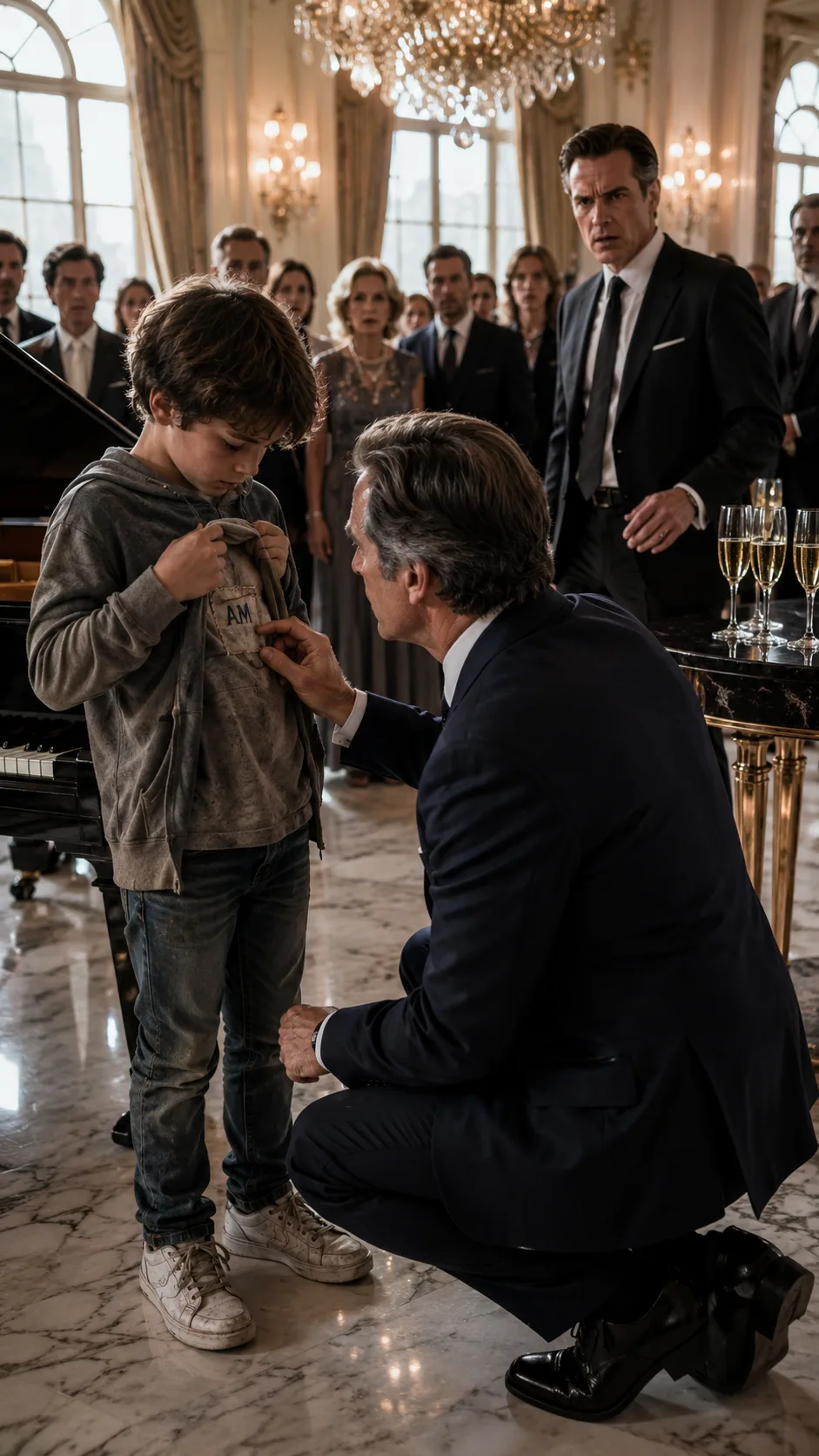
Then he reached beneath the collar of his hoodie and tugged at the inside seam.
Adrian stopped breathing.
Sewn into the fabric was a small piece of old white cloth.
On it were two faded blue initials.
A.M.
The room erupted into whispers.
Madame Claire, the oldest housekeeper, covered her mouth.
“The blanket,” she whispered. “Madame Elise’s blanket.”
The boy looked confused.
“Mara cut it,” he said. “She sewed it into my hoodie. She said if I ever found the right man, he would know.”
Adrian dropped to one knee.
For seven years, he had imagined finding his son in every possible way. He had imagined airports, police stations, hospitals, distant towns, locked rooms, and impossible miracles.
But not this.
Not in his own ballroom.
Not with strangers watching.
Not with a thin, frightened child standing in front of him, waiting to see if he would be thrown away again.
Adrian raised one trembling hand.
Then he stopped before touching the cloth.
“May I?” he asked.
The boy stared at him.
No adult had ever asked him permission like that.
After a moment, he nodded.
Adrian touched the stitched initials.
The thread was faded.
But he knew it.
Elise had embroidered those initials herself. Adrian had tried to help and had made one crooked stitch. Elise had laughed and refused to fix it.
Now his finger rested on that same crooked stitch.
His stitch.
A broken sound escaped him.
“Noah,” he whispered.
The boy’s eyes filled.
“My name is Leo.”
Adrian nodded quickly. “Yes. Leo. Whatever name you choose. But you were born Noah Moreau.”
The boy looked at him as if the words were too big to fit inside his life.
Vincent stepped forward.
“This is insane,” he said. “You cannot possibly believe—”
“Security,” Adrian said.
Two guards moved.
Vincent’s face changed.
The mask disappeared.
“You always were weak,” he hissed. “One song and a dirty scrap of cloth, and you are ready to hand over everything?”
The room went still.
Adrian rose slowly.
“What did you do?”
Vincent’s mouth twisted.
“What did I do?” he said. “I saved this family from your softness.”
Adrian stared at him.
Vincent’s voice grew louder. “Father built this empire, and he gave it to you. The company. The estate. Elise. Then your son was born, and everything would pass through your line. I would become nothing.”
Adrian’s voice was low.
“You took my child.”
Vincent looked at the boy.
Then back at Adrian.
“I removed an obstacle.”
A woman cried out.
Leo stepped backward from the piano.
Adrian’s face turned pale.
Vincent kept speaking, as if years of poison had finally found air.
“The baby was supposed to disappear overseas. Clean. Quiet. No scandal. No inheritance issue. No golden son to replace me before he could even walk.”
Adrian’s hands shook at his sides.
“You let Elise die believing her baby was gone forever.”
Vincent looked away for one second.
Then his jaw hardened.
“She was never strong enough for this family.”
Adrian moved so fast the guards tensed, but he stopped himself inches from his brother.
“No,” Adrian said. “She was the only decent thing this family ever had.”
Behind him, Leo stood near the piano, crying silently.
Not loudly.
Not like a child asking the world to notice.
Like a child who had learned to hide pain before it made anyone angry.
Adrian turned away from Vincent and went back to him.
“I looked for you,” he said. “Every day. I never stopped.”
Leo wiped his face with his sleeve.
“Mara said you might not want me anymore.”
Adrian knelt again, lowering himself beneath the boy’s eye level.
“Listen to me,” he said. “Nothing that happened was your fault. Not your name. Not where you slept. Not what anyone told you. You were wanted before you were born. You were loved before you could breathe. And you have been missed every day of your life.”
Leo’s lips trembled.
“You really mean that?”
Adrian nodded.
“Yes,” he said. “I mean every word.”
Leo took one step forward.
Then another.
Adrian waited.
Then the boy ran into his arms.
Adrian caught him and held him tightly.
The ballroom disappeared.
The chandeliers, the guests, the marble floor, the brother being restrained behind them — all of it faded into silence.
There was only a father holding the son he had mourned while the boy was still alive.
And for the first time in seven years, Adrian Moreau cried without trying to hide it.
Three days later, the DNA results confirmed what the crooked stitch had already told him.
Leo was Noah Adrian Moreau.
Vincent was arrested before sunrise.
The newspapers called it the scandal of the decade. They wrote about betrayal, inheritance, hospital corruption, and the billionaire whose missing son returned by playing a forgotten lullaby.
But they did not write about Leo’s first night in the estate.
They did not see him standing at the nursery door, staring at the small wooden horse on the shelf.
They did not hear him whisper, “Was this mine?”
Adrian stood beside him.
“Yes,” he said.
Leo walked inside slowly, touching nothing at first. Then he saw the rocking chair near the window.
“Mara had a chair like that,” he said.
Adrian nodded.
He had promised himself he would not turn Mara into only a villain. She had kept his son alive. She had loved him. She had also kept him hidden.
Some sins were too tangled for easy names.
On the fourth day, Adrian brought Leo to Elise’s grave.
The cemetery stood on a hill above the sea. White roses moved in the wind. Leo stood before the stone with both hands in his hoodie pockets.
“Elise Moreau,” he read. “Beloved wife and mother.”
Adrian placed a hand on his shoulder.
“She sang to you every night,” he said. “Even after you were gone.”
Leo looked at the grave for a long time.
Then he whispered, “I think I remember her voice.”
The wind moved softly between them.
Then Leo began to hum.
The lullaby.
Adrian closed his eyes.
This time, the grief did not feel like a locked room.
It felt like a door opening.
Weeks passed.
Leo did not heal all at once. Real children did not become whole because of one embrace. He hid food under his pillow. He woke from nightmares. He apologized when he laughed too loudly. He asked permission before sitting on expensive chairs.
Every time, Adrian answered the same way.
“This is your home.”
Again.
And again.
And again.
One evening, Leo found Adrian sitting alone at the black grand piano.
The ballroom was empty now. No guests. No judgment. No challenge. Only warm evening light and the quiet sound of the house settling around them.
Adrian touched one key awkwardly.
“I was never very good,” he admitted.
Leo climbed onto the bench beside him.
“I can teach you.”
Adrian smiled. “Can you?”
Leo nodded seriously. “But you have to practice.”
“That sounds strict.”
“It is.”
For the first time, Leo grinned.
A small, real grin.
So much like Elise that Adrian had to look away for a second.
Then Leo placed his small hand over Adrian’s and guided one finger to the first note.
Together, they played the lullaby.
Badly at first.
Then better.
Then beautifully.
Not because it was perfect.
Because it no longer belonged only to loss.
It belonged to return.
To truth.
To a boy with two names.
To a father who had kept one locked room in his heart open just long enough for his son to find his way back.
Years later, when people asked Leo Moreau when his life changed, he never talked about the headlines, the DNA test, or the fortune waiting behind the estate gates.
He only said one thing.
“My father asked me to play one song. But what he really gave me was the ending I never knew I was searching for.”
THE END.
Chapter complete
You have reached the end of this chapter.
Continue reading
A few more worlds to get lost in after this chapter.




