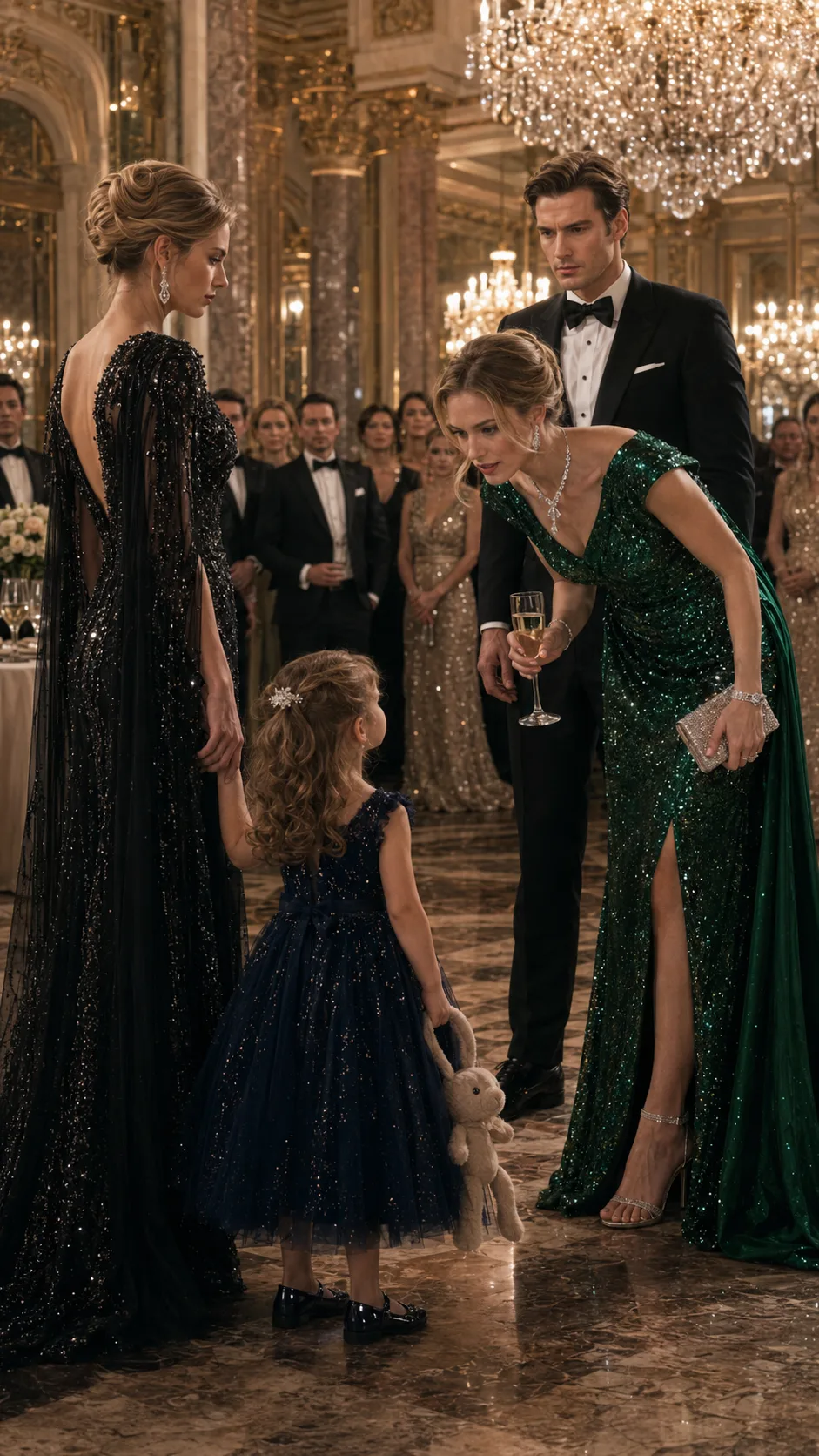
He Left His Pregnant Wife, Then Met His Secret Daughter At His Own Gala
Harper Wolfe was holding the pregnancy test so tightly that the plastic edge left a pale crescent mark across her thumb.
Chapter 1
Harper Wolfe was holding the pregnancy test so tightly that the plastic edge left a pale crescent mark across her thumb.
Two pink lines.
She stared at them until the bathroom tiles beneath her feet seemed to tilt, until the heated floor no longer felt warm, until the silence in the glass-and-stone house around her became louder than any sound.
For three years, she had imagined this moment.
Not like this.
Never like this.
She had imagined calling Caleb from the bathroom, laughing before she could speak. She had imagined him pushing open the door, seeing the test in her hand, and breaking into the kind of smile he used to have before money, before boardrooms, before disappointment began sleeping between them.
She had imagined him picking her up.
She had imagined his face wet against her neck.
She had imagined him saying, “We did it, Harper. We finally did it.”
But the house did not answer her.
The master bathroom smelled faintly of eucalyptus from the shower oil she had
used that morning. A folded white towel sat on the marble counter, too perfect, too hotel-like, as if no one with a real life lived there. Beside the sink were Caleb’s cufflinks, one on its side, the other upright, small silver squares catching the light.
Harper looked at them and swallowed.
The test still had not changed.
Pregnant.
After all the calendars, all the injections, all the appointments where doctors spoke gently and never looked directly at her when they said “unexplained,” after all the months of waiting and bleeding and pretending hope was not humiliating, a cheap drugstore test had told her the truth in less than three minutes.
She pressed one hand against her stomach.
There was no bump. No proof. No movement. Nothing anyone could see.
Only a secret.
A miracle.
A beginning so small it could be carried in silence.
“Caleb,” she called.
Her voice came
out thin.
No answer.
She slipped the test into the pocket of her silk robe and opened the bathroom door.
The hallway outside was dim, lit by recessed gold lights along the floor. Their house sat above Lake Washington, all glass walls and black steel beams, the kind of place people called “architectural” because they did not know Harper had designed half of it herself before Caleb had enough money to hire anyone better than her.
The house was usually alive at night in small, expensive ways.
A glass clinking in Caleb’s office.
A financial news anchor murmuring from a wall-mounted screen.
The dishwasher humming behind custom walnut panels.
His footsteps crossing the polished concrete floor.
Tonight, nothing.
The quiet felt arranged.
Harper walked toward the staircase.
Halfway down, she heard his voice.
Low.
Careful.
Not the voice he used with contractors. Not the voice he used with investors. Not
even the voice he used with her anymore.
This voice was warm.
Private.
“I can’t keep doing this, Sarah.”
Harper stopped with one hand on the banister.
Sarah.
Sarah Bennett.
Caleb’s development director.
Twenty-nine years old, blonde, sharp, always immaculate in cream blouses and narrow skirts, always leaning a little too close when Caleb spoke. Sarah had a laugh that started half a second before the joke became funny, a hand that touched forearms lightly, and the kind of ambition that knew how to disguise itself as admiration.
Harper had invited her to Thanksgiving.
She had poured Sarah wine in her own kitchen.
She had told Sarah which gallery Caleb liked best because Sarah said she wanted to buy him a birthday gift “from the team.”
Downstairs, Caleb’s office door was not closed.
It never fully shut unless he was angry.
“No,” Caleb said. “I’m telling her tonight. Russell already has the papers ready.”
The house seemed to pause around Harper.
Her hand tightened on the banister.
Papers.
One word. Flat. Practical.
Like invoices.
Like permits.
Like a marriage could be filed, stamped, and removed from the active project list.
“I want a divorce,” Caleb said.
Harper did not breathe.
The pregnancy test sat in her pocket, warm against her thigh.
“She wants a child more than she wants me,” he continued. “I’m tired of living in a house that feels like a funeral for a baby that never existed.”
Harper looked down at herself.
The baby that never existed was there.
A tiny secret beneath her palm.
A life that had arrived too quietly to defend itself.
Sarah said something Harper could not hear.
Caleb’s answer came softer.
“I choose you.”
There it was.
Not confusion.
Not guilt.
Not a mistake he had stumbled into and regretted.
A choice.
Harper stepped back from the stairs.
The floor did not creak. The house was too well built for that. She hated it for being so silent.
In the bedroom, she stood before the mirror.
Thirty-two. Bare face. Robe tied loosely at the waist. Hair twisted into a careless knot. One hand in her pocket, fingers around the test like she was holding evidence.
When Caleb entered fifteen minutes later, his face had been arranged.
Harper saw the work immediately.
The lowered eyebrows.
The careful mouth.
The wounded posture of a man who wanted to look like he had been forced into cruelty by circumstances beyond his control.
“Harper,” he said. “We need to talk.”
She turned.
“No,” she said. “You need to talk. I need to listen.”
He blinked.
A small thing.
But she saw it.
He had prepared for tears. He had prepared for accusations, pleading, maybe a thrown ring, maybe a call to his mother. Caleb knew what to do with Harper’s pain. He could soften his voice, touch her shoulder, wait until she made his guilt easier for him.
But he did not know what to do with her calm.
“I didn’t want it to happen like this,” he said.
Harper reached into the pocket of her robe.
Her fingers brushed the pregnancy test.
She did not take it out.
“How did you want it to happen?”
He looked toward the windows. Beyond the glass, the lake was black, broken by strips of reflected light from houses on the opposite shore.
“I’ve been unhappy.”
“So have I.”
The words landed harder than she expected.
Caleb’s eyes flicked back to her.
“You never said that.”
“You never asked.”
He pressed his lips together.
“There’s someone else,” he said.
Harper almost laughed.
The politeness of it.
Someone else.
Not Sarah.
Not my employee.
Not the woman I was speaking to ten minutes ago in the office you designed.
Someone else.
“I know.”
His face changed.
“How?”
“This house carries sound,” she said. “So do guilty men.”
A flush climbed his neck.
“Harper.”
“Say it properly.”
He stared at her.
She waited.
The ice maker dropped a cube downstairs.
A small sound.
A stupid sound.
A normal sound.
Caleb’s jaw tightened.
“I’m in love with Sarah.”
Harper nodded once.
The motion felt clean.
“Then call Russell.”
“You’re not going to fight?”
There it was.
Not relief.
Not remorse.
Offense.
He did not want her, but he wanted her destroyed by losing him.
Harper looked at the man she had once loved enough to build a life around. The man whose first investor deck she had designed at their kitchen table in their old apartment. The man who had once kissed the inside of her wrist at an airport because he said he could not wait until the hotel. The man who had held her after the second failed fertility treatment and said, “Next time,” as if hope were something he could promise.
Then she thought of the life inside her.
Her first act as a mother could not be begging.
“No,” she said. “I’m not going to fight for a man who left before the miracle arrived.”
His eyes narrowed.
“What does that mean?”
She gave him a small smile.
“Call your lawyer.”
Caleb did not sleep in their room that night.
Harper did not sleep at all.
She packed one suitcase slowly, not because she planned to leave immediately, but because folding kept her hands from shaking. A navy sweater. Two pairs of trousers. A white blouse Caleb had once said made her look “too serious.” She folded that one carefully.
At dawn, she made coffee and did not drink it.
At seven, she called Vivienne Hart.
Vivienne was not Caleb’s golfing friend Russell Crane. She did not wear pastel ties or laugh too loudly at men who billed by the hour. She was fifty-four, silver-haired, calm-eyed, and famous in Seattle for speaking so gently in court that people leaned forward before she ruined them.
She answered on the third ring.
“Mrs. Wolfe?”
“I need a divorce attorney.”
A pause.
“Are there children involved?”
Harper’s hand went to her stomach.
“No,” she said.
The lie tasted metallic.
Not because it was shameful.
Because it mattered.
It was the first wall she built around Elena before Elena had a name.
Vivienne arrived at the house that afternoon.
She wore a charcoal suit, low black heels, and no jewelry except a watch with a narrow leather band. When Caleb saw her step into the foyer, something small shifted in his face.
He knew her reputation.
Good.
Russell came twenty minutes later with a leather briefcase and a sympathetic smile.
“Harper,” he said, reaching for her hand. “I’m sorry we’re meeting under these circumstances.”
Vivienne looked at his outstretched hand until he lowered it.
They sat in Caleb’s office.
Harper took the chair closest to the door.
Caleb sat behind the desk as if position could still help him.
Russell opened his briefcase and slid a proposal across the glass surface. The document made a soft, expensive sound.
Harper did not touch it.
Vivienne did.
Her eyes moved down the first page.
Then the second.
Then she laughed.
Once.
Caleb’s mouth tightened.
“What exactly is amusing?”
Vivienne placed the proposal on the desk.
“You are offering Mrs. Wolfe the guesthouse furniture, six months of support, and a confidentiality clause broad enough to prevent her from admitting she has ever seen you in daylight.”
Russell cleared his throat.
“It’s a starting point.”
“It’s a warning label.”
Caleb leaned forward.
“The house belongs to Wolfe Development Holdings.”
Harper looked at him then.
“The house I designed?”
“The company funded it.”
“The company you built with the first three hotel concepts I drew while you were still pitching investors in coffee shops?”
Russell looked at Caleb.
Caleb did not look back.
“You were my wife,” he said. “Not my business partner.”
That sentence did more damage than the affair.
The affair was betrayal.
That sentence was erasure.
Vivienne opened her folder and slid a document onto the desk.
“Actually,” she said, “Mrs. Wolfe is named as a silent equity partner in the original formation agreement. Twelve percent. Signed, notarized, and filed.”
Caleb stared.
Then memory entered his face.
Then anger.
“That was symbolic.”
Vivienne tilted her head.
“A candlelit anniversary dinner is symbolic. Equity is equity.”
Caleb’s eyes snapped to Harper.
“You kept that?”
Harper looked at the formation agreement, then at him.
“I’m an architect,” she said. “I keep foundations.”
The divorce did not stay polite after that.
It became paperwork by day and silence by night.
Caleb moved into the guest room for exactly three days before he stopped pretending and began staying elsewhere. Harper did not ask where. She did not need to.
Sarah began appearing in places she should not have been.
A call on Caleb’s phone at 6:13 a.m.
A scarf in the back seat of his car.
A calendar invite with her initials beside his.
Once, Harper found a lipstick mark on a coffee cup in Caleb’s office. The shade was too coral for her. She washed it herself because she did not want the housekeeper to know before the lawyers did.
By the third week, Caleb became suspicious of her calm.
“You’re making this too easy,” he said one evening from the guest room doorway.
Harper was folding clothes into a second suitcase.
Sleeve over sleeve.
Cotton over silk.
A life packed into clean lines.
“You wanted a divorce.”
“I expected you to care.”
She looked up.
There it was.
The small cruelty beneath the polished man.
He wanted freedom, but he also wanted an audience for the pain he caused.
“I did care,” she said. “That was the problem.”
His face changed.
Wounded.
Only for half a second.
Then pride covered it.
“Sarah thinks this is for the best.”
Harper placed a folded sweater into the suitcase.
“Sarah thinks a lot for someone wearing another woman’s future.”
He flinched.
Good.
Not because it hurt him.
Because it proved he could still recognize truth when it was said clearly enough.
Harper hid the pregnancy like a second life.
Loose coats.
Strategic scarves.
Appointments across town.
No photos.
No visits from anyone Caleb’s mother might call “family friends.”
Only three people knew.
Her mother, Elaine.
Nora, her best friend since college.
Vivienne.
Elaine arrived after Harper signed the temporary agreement, carrying soup, vitamins, and rage in a canvas grocery bag.
“That man,” she said, placing apples into a bowl as if each one were Caleb’s head, “is lucky I believe prison should reform people.”
Harper laughed.
Then sat on the kitchen floor and cried into her mother’s sweater until she could no longer breathe through her nose.
“What are you going to do?” Elaine asked.
Harper placed both hands over her stomach.
“I’m going to build a life so strong no one can knock on its door and claim it.”
The divorce finalized faster than anyone predicted.
Caleb’s guilt made him generous.
His arrogance made him careless.
Vivienne made him afraid.
Harper kept her architectural studio, the settlement, the Bainbridge cottage Caleb had once called “too small to matter,” and enough equity in Wolfe Development to remind him that kingdoms are never built by one man, no matter how often he poses alone in magazine spreads.
On the courthouse steps, Sarah waited beside Caleb.
Cream coat.
Pearl earrings.
Blonde hair tucked neatly behind one ear.
A woman dressed like innocence after walking through someone else’s marriage with wet shoes.
“Harper,” Sarah said. “I hope someday you understand this wasn’t meant to hurt you.”
Harper looked at Sarah’s hand on Caleb’s arm.
“No,” she said. “You meant to win. Hurting me was just the method.”
Sarah’s cheeks colored.
Caleb stepped forward.
“Enough.”
Harper looked at him.
Once, that word would have stopped her.
Not anymore.
She walked away before either of them could see her hand move to her stomach.
Three months later, Caleb married Sarah in Italy.
People sent Harper photos.
No one ever admits to sending cruelty. They package it as concern.
Just thought you should know.
Didn’t want you to hear it from strangers.
Are you okay?
There were pictures.
Sarah in white lace beneath a Tuscan sky.
Caleb in a black tuxedo, smiling so widely he looked like a man who had never held his wife through a failed fertility treatment. Her hand rested on his chest. His mouth was near her temple. Behind them, vineyards rolled into gold light.
Harper deleted every message.
Then she vomited into the kitchen sink.
Pregnancy was not the glowing miracle she had once imagined.
It was nausea that made her grip doorframes. It was waking at 2:00 a.m. to check if she was still bleeding. It was fear so quiet it became part of the furniture. It was whispering, “Stay. Please stay,” into the dark while rain tapped at the cottage roof.
The Bainbridge cottage became her first refuge.
Small.
Salt-worn.
Imperfect.
The cedar shingles had silvered with age. The porch sagged slightly on the left. The pipes complained every morning. The floors creaked in a way Caleb’s perfect house never had.
Harper loved it.
At twenty weeks, she learned the baby was a girl.
She sat in the clinic parking lot with the ultrasound photo pressed against her chest and laughed until the laugh became something else.
“A daughter,” she said.
The word felt like a door opening.
She painted the nursery herself.
Not pink.
Not blue.
A soft yellow, like morning before anyone had ruined it.
Elaine protested when Harper climbed the step stool.
“You are pregnant, not retired from common sense.”
“I’m two feet off the ground.”
“That’s where disasters begin.”
Nora came with takeout and spent four hours assembling a crib backward.
Vivienne stopped by with legal documents and ended up holding a paint roller.
“No one may speak of this,” she said.
“You have yellow paint on your shoe,” Nora said.
Vivienne looked down.
“One of you will pay for that.”
Elena Grace Hart arrived during a storm.
The power flickered twice in the hospital.
Rain struck the windows hard enough to sound like thrown gravel. Elaine held one of Harper’s hands. Vivienne held the other because, by then, terrifying attorneys could apparently become family. Nora paced at the foot of the bed, telling every nurse that Harper preferred ice chips crushed, not whole, which Harper had never once said.
At 2:17 a.m., Elena cried.
Sharp.
Furious.
Alive.
The nurse placed her on Harper’s chest.
Everything narrowed.
The storm.
The room.
The years of waiting.
The marriage.
The betrayal.
All of it moved away.
Elena was small and red-faced and furious about being born. She had Caleb’s dark lashes, Harper’s mouth, Elaine’s stubborn chin. When she opened her eyes, they were cloudy and unfocused, but Harper still felt seen.
Not by Caleb’s child.
Not by a Wolfe heir.
By her daughter.
“My girl,” Harper said. “My brave girl.”
“What’s her name?” the nurse asked.
“Elena Grace Hart.”
Elaine looked up.
“Not Wolfe?”
Harper kissed Elena’s forehead.
“No. She won’t carry the name of a man who left before he knew she existed.”
Outside, rain washed the hospital glass clean.
Inside, Elena wrapped one impossibly small hand around Harper’s finger and held on.
Two years passed like a secret learning to walk.
Elena became sunlight with opinions.
She ran before she mastered stopping. She hated peas because they “felt suspicious.” She believed thunder was furniture being moved in the sky. She put blueberries in socks because she was “saving them.” She could stare down a grown man at the grocery store until he let her go ahead with one banana and a packet of crackers.
“She has your eyes,” Elaine said.
“She has Caleb’s confidence,” Vivienne said, watching Elena negotiate for a second bedtime story with alarming precision. “Tragic, but potentially useful.”
Harper built a life out of small, steady things.
A coastal house in Oregon with cedar beams, wide windows, and a studio facing the sea.
A kitchen drawer that stuck when it rained.
A hallway floor that creaked outside Elena’s room.
A blue mug chipped at the handle.
Morning coffee that went cold because Elena needed help finding Captain Oats, the plush rabbit who somehow disappeared every day despite never leaving the house.
Work returned slowly.
First a seaside inn renovation.
Then a library restoration.
Then a boutique hotel owned by a woman who told Harper, “Your designs look like they survived something.”
That line stayed with her.
Her studio grew.
Not quickly.
Honestly.
Clients learned to stop introducing her as Caleb Wolfe’s ex-wife when her buildings began appearing in magazines under her own name.
Harper Hart.
Architect.
Mother.
Woman who slept badly and still answered emails.
Woman who no longer checked Caleb’s public life unless someone put it in front of her.
Unfortunately, someone always did.
Caleb and Sarah were everywhere.
Business magazines.
Charity boards.
Ribbon cuttings.
Annual donor lists.
Sarah became vice president of strategic partnerships within a year. Then “the driving force behind Wolfe Development’s community vision.” Then, in one glossy profile Harper read while Elena smeared banana into her hair, “Caleb Wolfe’s greatest source of inspiration.”
Harper laughed so hard Elena jumped.
Nora looked up from across the kitchen.
“What?”
“Apparently inspiration wears stolen earrings now.”
Nora reached for the magazine.
“I still vote tire slashing.”
“No.”
“One tire.”
“No.”
“A symbolic tire.”
Harper took the magazine back and dropped it into recycling.
Caleb never called.
Never wrote.
Never asked how she was.
Why would he?
In his mind, he had left behind an empty marriage and a barren wife.
Sarah had given him a cleaner story.
A new beginning.
A woman who stood beside him well in photographs.
A woman who knew how to smile at cameras without looking like she had survived anything.
Harper did not tell Elena about Caleb at first.
What language was there for a child that young?
Your father did not know.
Your father did not ask.
Your father left before your first heartbeat was heard.
Instead, Elena knew her mother, grandmother, Aunt Nora, and Vivienne, whom she called “Vivi” despite Vivienne’s repeated objections.
“She cannot call me Vivi in court,” Vivienne said.
“She’s two,” Harper said.
“That is how habits begin.”
Elena called her Vivi anyway.
Then came the invitation.
It arrived on heavy cream paper, gold lettering pressed deep enough to feel under Harper’s thumb.
THE WOLFE FOUNDATION GALA
Honoring Excellence in Urban Renewal and Community Design.
Harper almost dropped it into the recycling bin.
Then she saw the nominees.
Wolfe Development.
And beneath it:
Harper Hart Studio.
For a long moment, she stood in the kitchen, the invitation in one hand, a spoon with Elena’s yogurt in the other.
Elena sat in her booster seat, using two fingers to remove blueberries from the bowl and line them along the table.
“Blueberry train,” Elena said.
Harper did not answer.
“Mama?”
“Yes, bug?”
“Train stuck.”
Harper placed the spoon down.
“So am I.”
Vivienne came that afternoon after Harper sent a photo of the invitation.
She arrived in a black coat and sunglasses, looking like she had come to deliver either legal documents or a death sentence.
“No,” Harper said before Vivienne spoke.
Vivienne removed her sunglasses.
“You haven’t heard my argument.”
“I know your argument.”
“Then you can save me time by accepting it.”
“No.”
Vivienne glanced toward the living room, where Elena was building a tower from wooden blocks and scolding it for being “wobbly.”
“You were nominated for the Meridian Design Award,” Vivienne said. “The award comes with national press, museum contacts, and developers who currently pretend not to know your number.”
“Caleb will be there.”
“Yes.”
“Sarah will be there.”
“Almost certainly dressed like a jewel-toned apology.”
Harper folded her arms.
“I have nothing to prove to them.”
“Correct. That is why you should go.”
“I don’t want Elena anywhere near them.”
“Then don’t bring her.”
From the living room came a crash.
Elena shouted, “Gravity is rude!”
Vivienne looked toward the sound.
“She is not wrong.”
Harper spent the next week saying no in different forms.
No to Nora.
No to Elaine.
No to Vivienne.
No to the black gown hanging at the back of her closet that Elaine insisted made her look “like a woman who could bankrupt a man with eye contact.”
Then the gala committee called to confirm her attendance.
Harper looked at Elena asleep on the sofa, one sock on, one sock missing, Captain Oats tucked under her chin.
The nomination was not about Caleb.
It was about every night Harper worked after Elena slept. Every meeting she attended on three hours of rest. Every client who underestimated her until they saw the drawings. Every version of herself she had carried from that bathroom floor to this house by the sea.
“Yes,” Harper said into the phone. “I’ll be there.”
Elena was supposed to stay with Elaine.
But on the evening of the gala, Elaine developed a fever.
“I can watch her,” Elaine insisted from the sofa, wrapped in a quilt.
“You cannot watch a houseplant right now.”
“I raised you.”
“You were healthier then.”
Harper called three babysitters.
No answer.
The car waited outside.
Vivienne was already at the venue handling award logistics.
Nora was stuck on a delayed flight.
Harper stood in her bedroom wearing the black gown, one earring in, the other on the dresser beside the invitation. Her hair was pinned up. Her lipstick was darker than usual. In the mirror, she looked unfamiliar.
Not younger.
Not untouched.
Better than that.
Still standing.
Elena appeared in the doorway wearing the navy dress Elaine had bought “for someday.” The skirt had tiny crystal details. Her blonde curls were brushed. Captain Oats hung from one hand.
“I can be good,” Elena said.
Harper turned.
“No champagne towers,” she said.
Elena nodded.
“No wandering.”
Nod.
“No negotiating cake with strangers.”
A pause.
“Friends?”
“Limited negotiations.”
Elena smiled.
Harper knelt and fastened Elena’s shoe.
It was black patent leather with a tiny buckle.
Elena immediately frowned.
“No shoes.”
“Yes shoes.”
“No.”
“Yes.”
She looked so much like Caleb for half a second that Harper’s hand stopped.
The chin.
The stubborn brow.
The refusal to surrender before trying diplomacy.
Harper finished the buckle.
Then she took Elena’s hand.
“Tonight, you stay with me.”
“I stay with you,” Elena repeated.
Together, they walked toward the night Caleb Wolfe would finally see the life he had erased from his own story.
Seattle glittered under rain.
The gala venue rose above the street in glass and stone, warm light spilling through tall windows. Valets moved beneath black umbrellas. Cameras flashed near the entrance. Women lifted gowns above wet pavement. Men adjusted cufflinks and checked reflections in dark car windows.
Harper stepped out of the car with Elena on her hip.
The black crystal gown caught the light in tiny, restrained sparks. Elena’s navy dress shimmered when she moved. Her small hand rested against Harper’s shoulder, Captain Oats trapped between them.
“Pretty house,” Elena said.
“Not a house.”
“Big house.”
“Fair.”
Inside, the ballroom glittered like money trying to look innocent.
Crystal chandeliers hung from a painted ceiling. Marble columns framed the room. White roses climbed silver stands. Champagne towers rose near the terrace doors. A string quartet played something soft enough to disappear beneath conversation.
The air smelled of perfume, polished wood, and chilled wine.
At first, no one noticed them.
Then one woman near the entrance stopped speaking.
A man beside her turned.
A waiter with a tray slowed.
Whispers began in small pieces.
“Is that Harper Wolfe?”
“Hart now, I think.”
“She disappeared after the divorce.”
“Who is the child?”
Harper kept walking.
Elena looked up at the chandeliers.
“Mama,” she said, “the lights look like frozen rain.”
Harper’s throat tightened.
“Yes,” she said. “They do.”
Vivienne appeared near the floral arch with two glasses of sparkling water and the expression of a woman watching a controlled explosion begin.
“You brought the child.”
“My mother is sick.”
Vivienne looked at Elena’s face.
Her eyebrows rose a fraction.
“Well,” she said. “This evening just became legally fascinating.”
“Do not start.”
Vivienne crouched slightly.
“Elena, remember what we discussed.”
Elena nodded.
“No talking to wolves.”
Harper closed her eyes.
“Vivienne.”
“What?” Vivienne said. “It is practical advice.”
Then the room shifted.
Not physically.
Attention moved.
The grand staircase curved down from the upper mezzanine, and Caleb descended with Sarah on his arm.
Caleb wore a black tuxedo perfectly tailored to his shoulders. He looked older than Harper remembered. Not much. Enough. Lines near his mouth. A harder set to his jaw. A man sharpened by winning too often.
Sarah was radiant in emerald sequins.
Tall. European. Blonde. Diamond necklace at her throat. Hair swept into an elegant twist. She looked proud, aristocratic, almost untouchable, the kind of woman who entered rooms as if they had been reserved for her by bloodline.
She saw Harper first.
Her smile froze.
Only briefly.
But Harper saw it.
Then Sarah’s gaze dropped to Elena.
The emerald woman went still.
Caleb continued speaking to a donor on his left, unaware that the past had just entered the room in black crystal with his daughter’s hand in hers.
Sarah moved first.
She crossed the marble floor with the careful grace of a woman who had never rushed toward anything unpleasant in public. Champagne glass in one hand. Silver clutch under the other arm. A polished smile returning to her mouth, piece by piece.
The guests closest to them stopped talking.
Harper did not move.
Elena pressed closer to her gown.
Sarah stopped several feet away.
Her eyes stayed on Elena.
“And who is this?” Sarah asked.
The words were polite.
Too polite.
Elena looked up.
For one second, she gripped Harper’s hand tighter.
Then she answered clearly.
“I’m Elena Grace Hart.”
The silence did not fall.
It spread.
A waiter stopped with a silver tray.
A woman near the roses lowered her glass.
Someone’s laugh ended too quickly.
Caleb turned.
At first, his face held only confusion.
Then he saw Elena.
The soft blonde curls.
The dark lashes.
The serious eyes.
The shape of her mouth.
The little crease between her brows as she studied him.
His hand tightened around his glass.
Sarah looked from Elena to Caleb.
Then back to Harper.
Her perfect smile cracked at the edges.
Caleb took one step forward.
“Harper.”
She did not answer.
His eyes returned to Elena.
“How old is she?”
Elena held up two fingers.
“Almost three. Mama says almost doesn’t count for cookies, but it counts for birthdays.”
A woman behind Caleb made a small sound and swallowed it.
Caleb’s face lost color.
The math unfolded between them.
The night of the divorce.
The papers.
The silence.
The daughter.
His daughter.
His mouth opened.
Closed.
Then he looked at Harper.
“Is she mine?”
Harper placed one hand on Elena’s shoulder.
Small.
Protective.
Final.
“This is not the place.”
Caleb stepped closer.
“Answer me.”
Vivienne moved between them so smoothly she seemed to appear from the marble itself.
“Careful,” she said. “This is a gala, not a deposition.”
Caleb barely looked at her.
“When did you know?” he asked.
Harper held his gaze.
“The night you asked for the divorce.”
The words struck him harder than a slap.
Sarah’s champagne glass dipped.
“You knew,” Sarah said. “You knew and you didn’t tell him?”
Harper turned to her.
The emerald sequins glittered. The diamonds shone. None of it helped.
“You were on the phone with my husband while he explained that I wanted a baby more than I wanted him,” Harper said. “Did you expect me to send a birth announcement?”
The people around them went completely still.
Sarah flushed red from throat to cheek.
Caleb closed his eyes.
Only for half a second.
“I would have stayed,” he said.
That hurt more than Harper expected.
Not because she wanted it.
Because she believed him.
He would have stayed.
For duty.
For his father.
For the Wolfe name.
For the heir his family had wanted more than they had ever wanted Harper.
She looked down at Elena, who was touching the crystal beads on Harper’s sleeve.
Then Harper looked back at Caleb.
“That is exactly why I didn’t tell you.”
Caleb stopped moving.
Sarah stared at him.
The room watched the life he had abandoned stand between his first wife and his second.
Elena tugged Harper’s hand.
“Mama,” she said, “is he sad because there’s no tiny cake?”
Someone near the flowers laughed once, then covered it badly.
The gala host’s voice boomed from the stage.
“Ladies and gentlemen, please take your seats. The Meridian Design Award announcement will begin shortly.”
Vivienne touched Harper’s elbow.
“Come.”
Harper lifted Elena into her arms.
Caleb reached out.
“Harper, please.”
She stepped back before his hand could touch either of them.
“No.”
His face changed.
Not anger.
Not ownership.
Something smaller.
Too late.
Harper walked away with Elena on her hip while the entire ballroom watched.
She won the award twenty minutes later.
She barely heard her name.
She remembered Elena standing on a chair beside Vivienne, clapping both hands above her head and shouting, “That’s my mama!”
People laughed.
This time, kindly.
Harper walked to the stage.
The award was glass and steel, shaped into an ascending line. It was heavier than she expected. Under the lights, she saw fragments reflected in it.
The bathroom tile.
The pregnancy test.
A suitcase.
A storm-lit hospital room.
Elena’s navy dress.
Caleb’s face when she said her name.
Harper leaned toward the microphone.
“Architecture teaches you that what stands beautifully is not always what was built easily,” she said.
The room quieted.
“Some structures survive because they were reinforced in places no one saw. Some must be abandoned before they collapse. And some are built from scratch, with courage, cracked sleep, and hands small enough to fit inside yours.”
Her eyes found Elena.
“This award belongs to every woman who has redesigned her life while people were still standing in the ruins calling her dramatic.”
Applause rose.
Strong.
Real.
Caleb stood at the back of the ballroom.
Unmoving.
Sarah sat beside an empty champagne glass, her emerald dress glittering under the lights like a costume that no longer fit.
After the ceremony, people surrounded Harper.
Congratulations.
Business cards.
Museum contacts.
Developers who had discovered her existence now that an award had made it respectable.
Elena accepted compliments as if she had personally supervised the architecture.
Then Sarah appeared.
No Caleb.
No smile.
Just emerald satin, pale lips, and eyes bright with something dangerous.
“You humiliated me,” Sarah said.
Vivienne, speaking to a museum trustee nearby, turned her head slowly.
Harper placed her award on the table.
“No, Sarah. I attended an event.”
“You brought her on purpose.”
“My babysitter canceled.”
“You expect me to believe that?”
“No.”
Sarah’s nostrils flared.
“You wanted him to see her.”
Harper looked across the room.
Caleb stood near a marble column, watching Elena show Captain Oats to Vivienne.
“Yes.”
The honesty startled Sarah.
Harper did not soften it.
“I wanted him to see what his choices made him miss. Not because I want him back. Not because I want your life. Because my daughter should never be treated like a secret created for someone else’s convenience.”
Sarah’s mouth trembled.
“You think you won tonight.”
Harper looked at her gown, her diamonds, her shaking hand.
“No. I think you finally understood what losing looks like.”
Sarah took one step closer.
“For two years, I listened to him mourn a marriage he told me was already dead. Do you know what that was like? Living with a ghost in my bed?”
Harper said nothing.
Sarah’s voice dropped.
“He said you were cold. Obsessed. That you pushed him away.”
“He lied because the truth made him look ordinary.”
Sarah flinched.
Behind her, Caleb approached.
“Sarah,” he said. “Enough.”
She turned on him.
“Enough?” Her laugh was sharp enough to cut glass. “You looked at that child like the last two years disappeared.”
Caleb said nothing.
That silence answered her.
Sarah looked at Elena.
For a second, her face changed.
Not cruel.
Not proud.
Hollow.
“She should have been mine,” Sarah said.
Harper’s body went cold.
“What did you say?”
Sarah looked startled by her own words, then angry that anyone had heard them.
“Not her. Not that child. That life. The house. The family. The legacy. I thought if I loved him hard enough, I could become the woman he regretted losing.”
Caleb closed his eyes.
Elena stepped slightly forward, still holding Captain Oats.
“You can’t take people’s mommies,” she said.
The entire circle went silent.
Sarah stared at her.
Elena continued with grave authority.
“And you can’t be somebody else by wearing shiny clothes.”
Vivienne murmured, “Good Lord, I love this child.”
Sarah’s face collapsed.
Not prettily.
Not dramatically.
Like a mirror finally telling the truth.
She turned away through the crowd, one hand over her mouth.
Caleb started after her.
Then stopped.
His gaze returned to Elena.
“May I speak to her?” he asked.
“No,” Harper said.
Pain crossed his face.
“Harper.”
“You do not get to meet her because regret arrived in formalwear.”
“I’m her father.”
“You are the man who created her. Father is a title earned at three in the morning when a child has a fever. Father is knowing which cup she refuses because it is too orange. Father is showing up before applause.”
His throat worked.
Then he said something she did not expect.
“Let me earn it.”
Harper had prepared for demands.
Lawyers.
Anger.
The Wolfe instinct to claim.
Not that.
Not a quiet plea.
Before she could answer, a crash sounded near the terrace doors.
Glass scattered across marble.
Someone gasped.
Sarah stood beside the champagne tower, breathing hard, one hand gripping the table edge. Her eyes were fixed not on Harper, not on Caleb, but on the ballroom entrance.
Arthur Wolfe had arrived.
Caleb’s father.
Seventy years old, silver-haired, immaculate, and cold enough to make wealth look like discipline. He walked with a cane he did not need. Beside him stood a woman in a navy suit holding a folder.
Vivienne went very still.
Harper saw it.
“What?”
Vivienne’s eyes narrowed.
“That woman is federal.”
Arthur Wolfe possessed the kind of presence that made rooms rearrange themselves around him.
He entered without hurry.
The woman in the navy suit scanned the room with calm official eyes.
Caleb stiffened.
“Dad?”
Arthur ignored him.
His eyes went first to Harper.
Then to Elena.
Something flashed across his face.
Recognition.
Not surprise.
Recognition.
Harper’s stomach tightened.
He knew.
Somehow, Arthur Wolfe already knew about her daughter.
The woman in the navy suit stepped forward.
“Mr. Caleb Wolfe?”
Caleb looked at her.
“I’m Special Agent Maren Cole. I need you to come with me to discuss financial records related to Wolfe Development Holdings and the Wolfe Foundation.”
The ballroom erupted in whispers.
Cameras lifted.
Caleb looked stunned.
“What? There must be a mistake.”
Vivienne’s expression hardened.
“There usually isn’t.”
Arthur tapped his cane once against the marble.
“No mistake.”
Caleb turned to him.
“What did you do?”
Arthur smiled thinly.
“Saved what I could.”
The truth came out in pieces.
First in the hallway.
Then in conference rooms.
Then in headlines.
Wolfe Development had been rotting long before Harper’s divorce. Arthur had used foundation money to cover private losses, bribed zoning officials through consulting firms, buried debt beneath shell companies, and forged approvals when signatures were inconvenient.
But the worst part was not Arthur.
It was Sarah.
Sarah Bennett had not only been Caleb’s mistress.
She had been useful.
Arthur had encouraged her promotion. Fed her access. Praised her ambition. Suggested Caleb needed a woman who understood legacy. Sarah believed she was securing Caleb’s future, but she had been placed inside his life like a match in a dry room.
She gathered passwords.
Forwarded internal emails.
Listened at doors.
Reported moods, meetings, weaknesses.
By the time she understood Arthur had been using her too, she was already tied to the scandal by a hundred small choices she could not explain as love.
When Caleb was escorted from the gala for questioning, he looked at Harper with a face emptied of polish.
“I swear I didn’t know.”
Harper believed him.
That was the awful part.
He had been selfish.
Weak.
Unfaithful.
But he had not built this ruin.
Arthur had.
As Arthur attempted to leave, Elena pointed at him from Harper’s arms.
“That man has mean eyebrows.”
A stunned laugh moved through the room.
Arthur looked down at her.
Then at Harper.
“You should have told us,” he said. “A Wolfe child belongs with her family.”
Vivienne stepped forward.
“She is with her family.”
Arthur’s eyes chilled.
“Blood matters.”
Harper lifted her chin.
“Then it should have taught your son loyalty and you honesty. Apparently blood is a poor curriculum.”
For the first time all night, Arthur Wolfe had no reply.
The months that followed were chaos.
Caleb was cleared of criminal wrongdoing but lost his position while the investigation continued. Arthur was indicted. Sarah disappeared from Seattle society within a week. Wolfe Development fractured. The Wolfe Foundation collapsed under public scrutiny and federal review.
Reporters called Harper nonstop.
She refused every interview that mentioned scandal.
She accepted only interviews about architecture.
Nora called this “weaponized boredom.”
Vivienne called it “excellent strategy.”
Caleb wrote letters.
Not emails.
Not texts.
Letters.
The first arrived two weeks after the gala.
Harper left it unopened for three days.
Then she read it at the kitchen table while Elena napped.
Harper,
I have written this seven times. Every version sounds like a man trying to polish a broken mirror.
I betrayed you. I abandoned you. I spoke about our grief as if it belonged only to me. I used Sarah to escape a life I was too cowardly to repair.
I will not ask for forgiveness.
I am asking permission to send Elena a birthday gift. Nothing extravagant. No Wolfe name attached. Just a book.
Caleb.
Harper read it twice.
Then put it in a drawer.
The second letter came a month later.
The third after that.
No demands.
No lawyers.
No threats.
Just the awkward, uneven record of a man learning humility later than anyone should.
He moved out of the penthouse.
Sold two cars.
Resigned from boards.
Started working with a nonprofit designing emergency housing for families displaced by fire.
Vivienne remained suspicious.
“Men love redemption arcs,” she said. “They are cheaper than accountability.”
Nora agreed.
“I can still slash one tire.”
“He sold the cars,” Harper said.
“Then I’ll improvise.”
But Caleb did not push.
He asked.
He waited.
He accepted silence without turning it into punishment.
On Elena’s third birthday, Harper allowed the book.
It arrived wrapped in brown paper.
The Velveteen Rabbit.
Inside, Caleb had written:
For Elena Grace.
May everything loved become real.
No signature.
Elena loved it immediately.
“Who gave me this?” she asked, sitting on the rug in her yellow socks.
Harper sat beside her.
“A man who knew me a long time ago.”
“Is he nice?”
Harper looked toward the ocean.
“He is trying to be.”
That night, after Elena fell asleep, Harper stood in the hallway holding the book against her chest.
Some endings are easy when people stay villains.
It is much harder when they begin to change.
Caleb met Elena for the first time in a public garden on a bright April morning.
Not because he demanded it.
Because Elena asked.
By then, she knew small pieces of the story in the gentle language children are owed. She knew some families began with sadness and grew toward kindness. She knew her mother had once been married. She knew the man who sent books was connected to her in a way that mattered.
One morning, while eating toast cut into stars, she asked, “Can I meet the book man?”
Harper said no.
Then not yet.
Then she called Vivienne, who said, “Public place. Daytime. I’ll be twenty feet away pretending not to carry pepper spray.”
So there they were.
Elena wore yellow boots and a serious expression.
Caleb stood beside a bench with no flowers, no gifts, no dramatic gesture. Just himself. Thinner than before. Navy sweater. Dark jeans. Hands open at his sides like he was afraid of using them wrong.
When he saw Elena, his face changed.
Not joy.
Awe.
Like a man seeing the ocean after years underground.
Elena studied him.
“You’re tall.”
Caleb swallowed.
“You’re small.”
“I’m growing.”
“I can see that.”
She narrowed her eyes.
“Do you like rabbits?”
His gaze flicked to Harper, then back to Elena.
“Very much.”
Elena handed him Captain Oats.
“This is Captain Oats. He can tell if people are lying.”
Caleb accepted the rabbit with both hands.
“Then I’ll be careful.”
That was how it began.
Not forgiveness.
Not reunion.
A rabbit in a garden.
Months became seasons.
Caleb visited once a month, then twice. He never missed a scheduled call. He learned Elena liked pancakes cut into moons, hated peas because they felt suspicious, and believed thunder was furniture being moved in the sky. He learned not to bring expensive gifts. He learned to ask Harper before promising anything. He learned that showing up quietly mattered more than apologizing loudly.
He did not call himself her father.
Not once.
Then Elena did.
It happened almost a year later at her preschool art show.
She had painted three figures beneath a purple sun: Harper, herself, and Caleb, who had extremely long arms and blue hair.
Her teacher smiled.
“Tell us about your picture.”
Elena pointed proudly.
“That’s Mama. That’s me. And that’s my dad, Caleb. He used to be lost, but now he knows where we are.”
The room tilted.
Caleb turned away and pressed one hand over his mouth.
Harper stood frozen with a paper cup of lemonade in her hand.
Later, he walked them to the car.
“I don’t deserve that word,” he said.
“No,” Harper replied. “But she gave it to you. Treat it better than you treated mine.”
He nodded.
“I will.”
Years passed.
Not like a fairy tale.
Like real life.
Messy.
Tender.
Uneven.
There were cautious dinners and missed cues. School plays where Caleb sat three rows back because Harper still needed space. Holidays divided by rules Harper wrote down and Caleb followed without complaint. Questions from Elena that came at inconvenient times, usually while brushing teeth or buckling car seats.
“Did Daddy make you sad?”
“Yes.”
“Did he say sorry?”
“Yes.”
“Did that fix it?”
“No.”
Elena thought about that with toothpaste foam at her lip.
“Then he should keep saying it.”
Harper handed her a towel.
“He does.”
Caleb never moved back into Harper’s house.
Harper never became Harper Wolfe again.
But somewhere between Elena’s ballet recital and the summer she lost her first tooth biting into corn, they became something no one had a clean name for.
Not husband and wife.
Not strangers.
Not enemies.
Family, perhaps.
Rebuilt differently.
With wider windows.
Stronger beams.
No hidden rooms.
Then Arthur Wolfe died in prison.
Three weeks later, a letter arrived from his estate attorney. Cream paper. Sharp handwriting. Harper almost threw it away.
Vivienne told her not to.
Inside was a confession.
Arthur had known about Harper’s pregnancy before the divorce was final. A private investigator hired to monitor settlement negotiations had discovered her medical appointments. Arthur chose not to tell Caleb.
Not out of kindness.
Out of calculation.
He believed a child would pull Caleb back toward Harper and complicate the financial scheme already underway. After Caleb stayed with Sarah, Arthur decided the hidden child might be more useful later.
A secret heir.
A future bargaining chip.
He created a trust beneath false structures.
Not for love.
For control.
At the bottom of the confession was one final line:
The child is the only Wolfe who may still be clean.
Harper read it twice.
Then laughed.
Not because it was funny.
Because the old man had died still believing he could name what Elena was.
Caleb stood across the kitchen.
“What?”
She handed him the letter.
He read it.
His face went white.
“I’m sorry.”
Harper looked out the window.
Elena was in the backyard running through sprinklers in a paper crown, shrieking because Nora had declared herself queen of the hose.
For years, Harper thought the shocking truth was that Caleb had lost a daughter he never knew existed.
But the deeper truth was stranger.
Elena had not been hidden only from Caleb.
She had been hidden from a legacy waiting to use her.
And because Harper walked away that night, because she chose silence over desperation, because she refused to turn pregnancy into a chain, she had saved her.
The trust Arthur left was enormous.
Old Wolfe money.
Land shares.
Accounts nested beneath accounts.
Caleb wanted to reject it.
Harper said no.
“Arthur doesn’t get to decide what this money means.”
So they changed its meaning.
They created the Elena Grace Foundation.
Housing for single mothers.
Legal aid for women leaving dangerous marriages.
Scholarships for girls in architecture and design.
The first shelter opened on a bright spring morning.
Elena, now seven, cut the ribbon with safety scissors while wearing a yellow dress and mismatched socks.
“This house,” she announced to the crowd, “is for people who need a new beginning.”
The applause rose around her.
Caleb cried openly.
Not beautifully.
Not subtly.
Just honestly.
Harper watched him and did not look away.
Later that night, after Elena fell asleep in the back seat, Harper and Caleb stood outside the coastal house beneath a sky full of stars.
The hallway floor inside still creaked outside Elena’s room.
The kitchen drawer still stuck when it rained.
The house was still imperfect.
It had held.
“I loved you badly,” Caleb said.
Harper nodded.
“Yes.”
“I love you differently now.”
The ocean moved in the dark beyond them.
Harper thought of the woman she had been on the staircase, listening to him choose someone else. She thought of the pregnancy test in her robe pocket. She thought of Sarah’s emerald gown, Arthur’s cold eyes, Elena’s small hand in hers, every version of herself that had carried the next version forward.
She reached for Caleb’s hand.
Not as a wife returning.
Not as a woman forgetting.
As someone who had learned love did not always mean rebuilding the same house.
Sometimes it meant standing beside the ruins and choosing a new design.
Years later, people still told the story wrong.
They said Caleb Wolfe lost everything the night his daughter walked into the gala.
They said Sarah Bennett finally understood what she had stolen could never become hers.
They said Harper Hart got revenge.
They were wrong.
Harper did not get revenge.
She got free.
And in that freedom, she built a life so beautiful that even the man who left her had to learn how to enter it gently.
On the morning the third Elena Grace shelter opened, Elena stood before the building holding Harper’s hand on one side and Caleb’s on the other. Sunlight struck the glass doors. Women waited outside with children, bags, folded papers, and the tired posture of people who had carried too much for too long.
Elena looked up at the building.
Then at Harper.
Then at Caleb.
“See?” she said. “Broken things can turn into houses.”
Harper looked at the open doors.
And they did. THE END.
Chapter complete
You have reached the end of this chapter.
Continue reading
A few more worlds to get lost in after this chapter.




