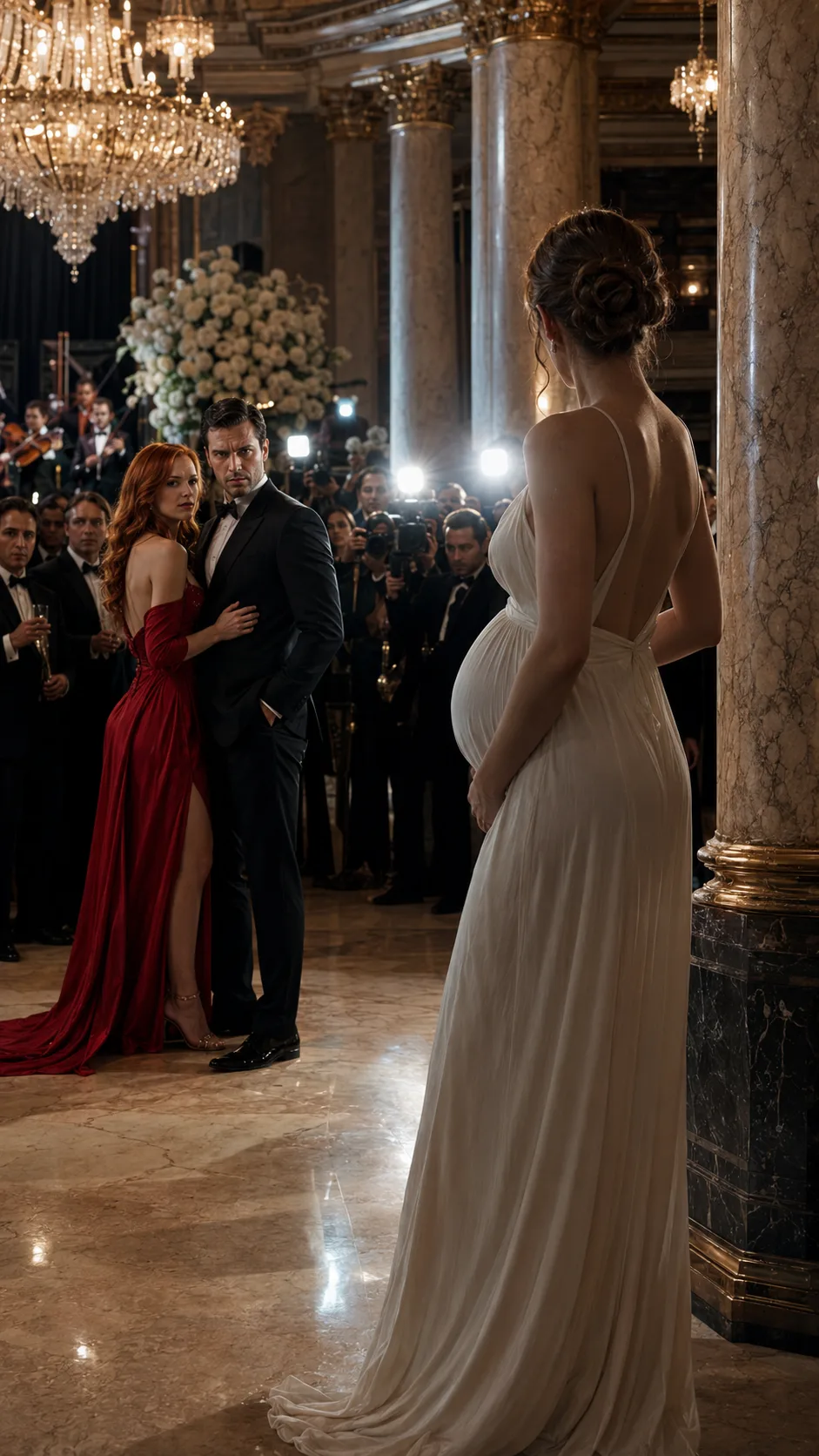
Emma Weston found the missing cufflink under the nursery chair.
Chapter 1
Emma Weston found the missing cufflink under the nursery chair.
It was not a nursery yet, not properly. The walls were still bare except for three paint swatches taped near the window: soft cream, muted sage, and a pale yellow Andrew had dismissed as “too sentimental.” A white crib waited in pieces against one wall, still wrapped in plastic. The instruction booklet lay folded on the floor where Emma had left it two days earlier after trying to assemble the frame alone.
She had been on her knees, reaching beneath the rocking chair for a fallen screw, when her fingers touched gold.
Andrew’s cufflink.
Tiny. Heavy. Initialed.
A.W.
She held it in her palm and looked at the doorway.
Andrew had not been in the nursery for weeks.
Not since the night he stood there with his phone in one hand and said, “Do whatever you want with this room. Just don’t make it look cheap.”
Then he had left
before she could ask whether he wanted to help choose the crib.
The cufflink was warm from her palm by the time she stood. For a while, she simply held it. Outside the penthouse windows, Manhattan glittered through a thin veil of evening rain. Traffic moved below in red and white lines. Somewhere far beneath her, a siren rose and fell.
The baby shifted.
Emma pressed one hand to her stomach.
Six months.
The doctor had said the baby was healthy. Strong heartbeat. Good movement. Andrew had been in London that day, though his assistant later mentioned he had taken a dinner meeting in Miami instead. Emma had not asked about it.
Questions had become expensive in that house.
Not because Andrew shouted. He rarely needed to. He had a quieter way of punishing a room. A pause too long. A look across the dinner table. A hand resting on
the back of her chair while he told guests, “Emma doesn’t like to involve herself in business.”
The first time he said it, she had laughed with everyone else.
The tenth time, she looked down at her plate.
By the hundredth, she no longer reacted.
That was marriage, according to Andrew’s mother. A woman learned where the seams were. She did not pull at them in public.
Emma placed the cufflink on the nursery windowsill and opened her phone.
Three messages waited from Andrew.
Be ready by seven.
No pale blue dress.
Wear the ivory one.
No “please.” No “how are you.” No mention of the baby.
The Bright Horizons Charity Ball was that night at the Manhattan Grand Hotel. Andrew cared about Bright Horizons because its board included people he needed. The foundation raised money for children’s medical programs, and Andrew liked charity when it came with cameras.
Emma
had once liked the event.
During their first year of marriage, she had sat beside him at the gala and believed every light in the room belonged to their future. Andrew had introduced her as “my wife” with a hand at her back. He had brought her sparkling water without being asked. He had bent close during the speeches and whispered that the violinist looked half-asleep.
She had laughed into her napkin.
That had been before late flights and locked phones. Before a second perfume began appearing in his car. Before the name Lila Summers floated into conversations like smoke.
Lila from the young patrons committee.
Lila from the Miami dinner.
Lila from the rooftop after-party Andrew said Emma would find too loud.
Emma opened her closet and looked at the ivory gown.
It was simple. Soft. Elegant in a way Andrew’s world treated as a flaw. No sequins. No slit. No sharp designer label visible from across a room.
She took it off the hanger.
The zipper caught halfway up, and she stood alone in front of the mirror, one hand reaching awkwardly behind her, the other supporting the curve of her stomach. For a second, she waited for a knock on the bedroom door. For Andrew to enter. For him to see her struggling and cross the room.
No sound came.
She managed it herself.
On Andrew’s desk, three rooms away, sat a black leather blotter, two silver pens, a crystal paperweight, and a framed photograph from their wedding. Emma in lace. Andrew in white tie. His hand around her waist, his smile perfect.
She had taken the divorce papers from her lawyer that morning.
A manila envelope. Clean corners. No drama.
Her lawyer had asked if she was sure.
Emma had looked at the pen on his desk. It had a tiny crack along the cap.
“Yes,” she said.
Now she stood inside Andrew’s study in the ivory dress he had chosen and placed the envelope in the exact center of his desk. Not crooked. Not pushed to the side. Right where he would see it when he came home.
She did not leave a note.
A note could be argued with. Folded. Misread. Quoted later by attorneys.
Her signature could not.
The penthouse was too quiet when she left.
The driver helped her into the car. He was an older man named Samuel who had driven Andrew for five years and Emma for two. He never asked questions, but his eyes moved once to her bare ring finger.
She had taken it off in the elevator.
It was in her clutch, wrapped in a tissue.
“Manhattan Grand, Mrs. Weston?” Samuel asked.
Emma looked at the dark glass separating them from the street.
“Yes.”
He nodded.
The ride took twenty-seven minutes. Emma counted eleven red lights and three flower shops still open after dark. At one intersection, a little girl in a yellow raincoat tugged her father’s sleeve and pointed at the car. Her father lifted her into his arms before the light changed.
Emma looked away.
At the hotel, the entrance had been transformed into a theater of wealth. Black cars pulled up one after another. Women stepped out beneath umbrellas, diamonds catching the camera flashes. Men adjusted cuffs. Assistants carried garment bags, gift boxes, emergency makeup cases.
Emma waited for Andrew at the top of the ballroom stairs.
Seven ten.
Seven twenty.
Seven forty-five.
Guests passed her with smiles that lasted half a second too long.
“Emma, darling. You look radiant.”
“Where’s Andrew?”
“He must be trapped on a call.”
“How exciting for you both. Six months already?”
She answered each one with practiced calm.
“Yes.”
“Any day now, I suppose.”
“No, not quite.”
“Thank you.”
By eight, she stopped checking her phone.
The ballroom glowed under chandeliers heavy enough to look dangerous. White roses climbed silver stands near every table. The orchestra played near the far wall. Waiters moved with trays of champagne and tiny spoons of caviar. On the stage, a screen cycled through photographs of children helped by the foundation.
Emma stood beside a marble column where she could see the entrance.
Her back hurt. She shifted her weight slowly from one foot to the other. The baby moved whenever the music swelled.
A woman from Andrew’s bank walked by with her husband and lowered her voice too late.
“Isn’t that her?”
The husband glanced over.
Emma kept her eyes forward.
The first flash came from the entrance.
Then another.
Then a cluster of photographers turned as if pulled by wire.
Andrew had arrived.
He looked flawless. Black tuxedo. White shirt. Hair smoothed back. Smile wide enough for cameras, controlled enough for investors. He moved like a man who believed every doorway had been built for him.
Lila Summers was on his arm.
Crimson silk. Red hair. Bare shoulders. A diamond bracelet Emma recognized from a magazine spread about Andrew’s newest hotel investment.
Lila leaned into him with the ease of someone who had already been received privately and was ready to be accepted publicly.
The room changed.
Not loudly.
No one wanted to be the first to gasp.
Instead, the silence slipped between tables and folded itself into the music. Heads turned. Conversations thinned. A champagne flute paused near a woman’s mouth. One of the junior reporters near the stage lifted her phone and pretended to check a message while filming.
Emma did not step back.
Her hand rested on her stomach.
Andrew saw her after greeting a senator’s wife.
His gaze passed over her face, her dress, the curve of her belly. Then his mouth tightened, not with regret, but with annoyance.
Emma knew that look.
It was the look he gave staff who used the wrong glassware.
Lila followed his eyes and found Emma.
For one brief second, the younger woman’s smile sharpened.
She did not let go of Andrew’s arm.
Emma waited.
Andrew could have crossed the room. He could have said her name. He could have removed Lila’s hand. He could have done one small thing, any small thing, to acknowledge the wife carrying his child.
He turned away.
A waiter stopped beside Emma with a tray.
“Sparkling water, ma’am?”
She took one glass, though her throat had closed around nothing. The glass was cold. Tiny bubbles climbed the inside.
At the nearest table, a woman in emerald satin whispered, “Poor thing.”
Emma placed the glass back on the tray.
Not poor.
Not anymore.
Across the ballroom, Lila rose onto her toes and spoke into Andrew’s ear. He listened. The angle was intimate. Deliberate. Familiar.
Emma saw his hand move to Lila’s waist.
That hand had once rested on Emma’s lower back in crowded rooms. It had once guided her through doorways. It had once pressed gently against her stomach the night they first heard the baby’s heartbeat.
The memory stood there for half a second.
Then it left.
A photographer called out from the entrance rope.
“Mr. Weston, over here!”
Andrew turned toward the camera.
Lila turned with him.
The flash lit them both.
Someone near the orchestra lowered a violin bow too soon, then raised it again.
Emma felt the baby move.
Small.
Certain.
Lila tilted her face up.
Andrew bent his head.
Emma did not blink.
He kissed her.
Not a mistake. Not a brush of lips that could be denied later in a statement. A full kiss beneath the chandeliers, framed by white roses, watched by donors, investors, senators’ wives, gossip columnists, waiters, musicians, and a room full of people trained to pretend cruelty was elegance if the money was old enough.
Flash.
Flash.
Flash.
A fork slipped from someone’s hand and hit the marble floor.
The sound traveled farther than it should have.
Emma’s fingers curled once over her belly. No tears came. Her body had gone strangely quiet, as if some inner room had closed its door.
Andrew pulled away first.
Lila kept one hand on his chest.
Then Andrew looked across the ballroom.
Straight at Emma.
His eyes held no apology.
No panic.
Only irritation, thin and cold, as if she had chosen the worst possible place to witness what he had done.
Emma looked at him until his jaw tightened.
Then she turned.
Her heels clicked against the marble floor. Steady. One step. Then another. The guests parted, not enough to help, just enough to avoid being touched by the scene. The orchestra began again too loudly, filling the ballroom with polished noise.
At the entrance, Samuel appeared before she asked.
He must have been waiting near the lobby.
He opened the umbrella outside, but the April rain still reached her wrists. New York blurred into silver lines and taxi lights.
“Home, Mrs. Weston?”
Emma looked back once through the glass doors.
Inside, the chandeliers still shone.
“No,” she said.
Samuel did not ask again.
He opened the car door.
She slid inside, one hand under her stomach, the other still around her clutch. Her phone buzzed before the door shut.
Andrew.
She watched his name glow on the screen.
Then she turned the phone face down.
Samuel pulled away from the curb.
For several blocks, neither of them spoke. The city moved past in wet streaks. A couple argued under a deli awning. A cyclist shouted at a cab. Steam rose from a manhole and broke apart in the rain.
Emma’s phone buzzed again.
Unknown number.
She almost ignored it.
Then something made her look.
Mrs. Weston, your jet is ready. Private terminal, Gate 4. Everything you need is waiting.
Emma read the message twice.
Her jet?
The driver’s eyes flicked to the rearview mirror.
“Ma’am?”
She stared at the screen until another message appeared.
Your father asked us to make sure you were not followed.
Emma’s fingers tightened around the phone.
Her father.
A man who wore the same brown work coat every winter and kept a chipped mug beside the farmhouse sink. A man Andrew had once called “pleasantly provincial” after two glasses of wine.
Her parents lived in Lancaster County, Pennsylvania, in a white farmhouse with blue shutters and a porch that smelled like rain-soaked wood. They had never liked Andrew, but they had never said so loudly. Her mother had folded dish towels too neatly whenever Andrew visited. Her father had spent long minutes checking the barn latch with nothing wrong with it.
Before the wedding, her father had taken Emma aside and placed a bank envelope in her hand.
“Keep this separate.”
“Dad.”
“Separate,” he said.
She had argued. He had not.
Later, when Andrew laughed about “farm money,” Emma tucked the account away and never mentioned it again.
But a private jet was not farm money.
Samuel turned onto the FDR.
“Where should I take you?”
Emma read the message one more time.
Private terminal, Gate 4.
She lifted her eyes.
“LaGuardia.”
Samuel nodded as if she had asked for a grocery store.
The phone rang.
Andrew again.
She let it ring.
A minute later, a message appeared.
Where the hell are you?
Then another.
Do not embarrass me tonight.
Emma looked out at the river.
Embarrass him.
The word sat on the screen like a stain.
She turned the phone off.
At the private terminal, everything was too calm. No crowds. No security lines. Just glass doors, warm lighting, a desk with fresh flowers, and a woman in a navy suit who stood the moment Emma entered.
“Mrs. Weston?”
Emma hesitated.
“Yes.”
“This way.”
Samuel carried nothing because Emma had brought nothing. Not a suitcase. Not a coat beyond the one around her shoulders. Not the nursery swatches. Not the wedding photo. Not the cufflink.
Only her clutch.
Only the ring wrapped in tissue.
Only the child inside her.
They guided her through a quiet corridor toward the tarmac. Rain tapped against the glass. Beyond it, a white jet waited under floodlights, stairs lowered, engines humming softly.
Emma stopped at the door to the outside.
Her reflection looked back at her in the dark glass. Ivory gown. Pregnant belly. Hair pinned too carefully. Face too still.
The woman in navy said, “We can wait a few minutes.”
Emma shook her head.
“No.”
Outside, the rain was colder. A crew member held an umbrella over her as she crossed the tarmac. Her gown brushed damp concrete. The hem darkened at the edges.
At the foot of the stairs, she turned to Samuel.
He stood beside the car, cap in hand.
“Thank you,” she said.
His mouth moved once before he spoke.
“Take care of yourself, Mrs. Weston.”
Emma nodded.
Then she climbed.
Inside the jet, a blanket waited on one cream leather seat. A glass of water. A small plate with crackers, grapes, and sliced apple. On the table beside the seat was an envelope with her name written in her mother’s handwriting.
Emma sat down carefully.
The door closed.
The cabin became quiet enough to hear her own breathing.
She opened the envelope.
Emmie,
Your father found out before you told us. Don’t be mad at him. He still knows three people in places he never talks about.
Come home.
No explanations tonight. No proving anything. No being polite.
Just come home.
Mom
Emma pressed the paper flat against her knee.
The jet began to move.
She turned her head toward the window. Rain ran sideways over the glass. The lights of the terminal stretched and broke.
Her phone remained off in her clutch.
Somewhere in Manhattan, Andrew would be returning to the penthouse. He would throw his keys into the silver bowl by the door. He would loosen his bow tie. He would walk into his study angry enough to rehearse his first sentence before he found her.
Then he would see the envelope.
Emma pictured his hand picking it up.
His thumb breaking the flap.
His eyes moving over the first page.
The jet lifted.
Manhattan dropped beneath the clouds.
For the first time all night, Emma took a full breath.
By morning, Andrew Weston had called thirty-seven times.
Emma knew because her mother counted them while making coffee.
The farmhouse kitchen looked almost exactly as it had when Emma was seventeen. Blue curtains. White cabinets. A small crack in one floor tile near the stove. A rooster-shaped timer on the windowsill that had never worked properly. Her father sat at the table reading the same page of the newspaper for fifteen minutes.
Nobody asked her to explain.
That was the kindness that undid her.
Her mother set a plate in front of her: toast, scrambled eggs, sliced tomatoes. Emma ate two bites and stopped. The baby kicked when she sipped orange juice.
Her father folded the newspaper.
“Lawyer called,” he said.
Emma looked up.
“Mine?”
“Yours.”
The word landed gently.
Yours.
Not Andrew’s. Not the family’s. Not someone Andrew approved.
“Andrew’s team called too,” her mother said from the sink.
Emma’s fingers stilled around the glass.
“And?”
“I told them you were sleeping.”
Her father took off his glasses.
“You weren’t. But it sounded better than what I wanted to say.”
Emma almost smiled.
A car came down the gravel drive just after eleven.
All three of them looked toward the window.
Not Andrew.
A black sedan stopped near the porch. A woman in a gray coat stepped out with a leather briefcase. Emma’s lawyer, Marjorie Vale, had iron-colored hair and the posture of someone who had watched powerful men underestimate paperwork for thirty years.
Emma met her in the sitting room.
Marjorie did not waste time.
“Your husband received the documents at 1:14 a.m. His attorney contacted my office at 6:03. Your phone records show repeated calls, then messages. We’ll preserve everything.”
Emma sat with both hands around a mug of tea.
“What did he say?”
“Which version?”
Emma looked at her.
Marjorie opened the briefcase.
“The first version was that you were unstable.”
Emma’s mother stopped moving in the doorway.
“The second version was that you were manipulated by your parents. The third was that you abandoned the marital home without cause. The fourth was a settlement offer so insulting I assume it was written before coffee.”
Emma looked down into her tea.
“Did he mention the kiss?”
Marjorie placed a folder on the coffee table.
“Every entertainment outlet in Manhattan did.”
Emma did not touch the folder.
Her father came in from the hall and stood behind her chair.
Marjorie continued, “There is video. Multiple angles. There are witness statements already appearing online. His publicist released a sentence about a ‘private marital matter.’ It’s not going well.”
Emma stared at the steam rising from the mug.
Private.
He had kissed Lila in front of cameras and called the aftermath private.
“What happens now?” Emma asked.
“Now we do not respond emotionally. We respond accurately.”
Marjorie slid a document toward her.
“You left a signed petition. We proceed. You have separate funds. You have family support. You have medical documentation. And you have evidence of public misconduct severe enough to make his threats look exactly like what they are.”
Emma placed one hand on her stomach.
The baby kicked again.
Marjorie’s eyes softened for half a second, then sharpened back into business.
“Also, one more thing. The jet.”
Emma looked up.
“My father—”
Her father cleared his throat behind her.
Marjorie turned to him with the smallest smile.
“Mr. Hale made a call. The aircraft belongs to an old client of his.”
Emma twisted toward her father.
“Old client?”
He looked uncomfortable.
“Years ago, I fixed a foundation problem on a property outside Philadelphia. Man owned half the street and none of the tools. We stayed friendly.”
“You borrowed a private jet from someone because Andrew kissed another woman?”
Her father’s face did not change.
“I borrowed a private jet because my pregnant daughter needed to leave a building where a man thought money made him untouchable.”
No one spoke for a moment.
The old rooster timer on the windowsill clicked once though nobody had touched it.
That afternoon, Andrew arrived.
Not alone.
Two black SUVs rolled into the driveway, throwing gravel against the grass. Andrew stepped out of the first wearing a navy coat over a wrinkled dress shirt, his hair less perfect than usual. Behind him came a security man Emma recognized from corporate events and a younger attorney carrying a folder.
Emma watched from the upstairs bedroom window.
Her childhood room still had a pale mark on the wall where a poster had hung. Her mother had put fresh sheets on the bed and a vase of daffodils on the dresser. The sight of Andrew below, standing beside her father’s muddy pickup truck, made the whole house feel smaller for one second.
Then her father walked onto the porch.
He did not invite Andrew in.
Emma could not hear the first words through the closed window, but she saw Andrew’s gestures. Sharp. Controlled at first. Then wider. He pointed once toward the house.
Her father did not move from the top step.
Andrew looked past him toward the windows.
Emma stepped back before he could see her.
Her phone was still off. Marjorie had told her to keep it that way unless they needed records. Andrew had already sent emails, voicemails, messages through assistants, messages through his mother, one message through a florist with white lilies Emma had always hated.
She had not opened the florist card.
Downstairs, a door shut.
Her mother called up, “Emma?”
She came down slowly.
Andrew stood in the entryway.
So her father had let him inside after all. Or maybe Andrew had stepped in without waiting. His coat was damp from the drizzle. His eyes found her immediately.
For a second, he looked at her stomach.
Then her face.
“You need to come home,” he said.
No hello.
No apology.
Emma stopped at the bottom step.
Marjorie stood near the sitting room doorway, arms folded. Andrew’s attorney looked irritated to find another lawyer already present.
“This is my home,” Emma said.
Andrew gave a short laugh with no humor in it.
“Don’t do that.”
Her mother’s jaw tightened.
Andrew glanced around the hallway: the old family photos, the umbrella stand, the worn runner rug. His mouth compressed as if the house itself had insulted him.
“You made your point,” he said.
Emma rested one hand on the banister.
“What point?”
He stared at her.
“The papers. The disappearing act. The jet.” His eyes narrowed. “Nice touch, by the way. Very theatrical.”
Her father took one step forward.
Emma lifted her hand slightly. Not to stop him. Just enough.
Andrew saw it and misread it as weakness.
His voice dropped.
“Do you understand what you’ve done? There are cameras outside my office. Reporters. Board members calling. My mother is furious.”
Emma looked at him for a long second.
“Your mother?”
His nostrils flared.
“This is exactly why I didn’t want you listening to outside people. You’re emotional. You’re pregnant. You’re not thinking clearly.”
Marjorie moved before anyone else could.
“Mr. Weston, choose your next sentence carefully.”
Andrew turned on her.
“This is between me and my wife.”
“No,” Emma said.
The word was quiet.
Andrew looked back.
She came down the last step and stood in the hallway, close enough to see the faint shadow under his eyes. He had not slept. His cuff was missing one link.
The gold one.
The one still on the nursery windowsill.
“It stopped being between us when you kissed her in front of an entire ballroom.”
Andrew’s face hardened.
“That meant nothing.”
Emma nodded once.
“That’s worse.”
He opened his mouth.
Nothing came out.
For once, no polished answer arrived quickly enough to save him.
His attorney stepped in. “Perhaps we can all sit down and discuss a reasonable temporary arrangement.”
Emma looked at the folder in his hand.
“Temporary?”
Andrew’s attorney cleared his throat. “For optics and stability, it may be beneficial for Mrs. Weston to return to the marital residence while negotiations—”
“No.”
Andrew exhaled through his nose.
“Emma.”
She looked at him.
“You don’t get to say my name like that anymore.”
Her mother turned toward the kitchen sink and gripped the counter.
Andrew lowered his voice.
“You’re carrying my child.”
“Our child,” Emma said.
His eyes flickered.
There it was again.
The word he never used unless a lawyer was in the room.
Marjorie stepped forward and handed Andrew’s attorney a sealed packet.
“My client will not return to the marital residence. All communication goes through counsel. Any further attempt to contact her directly will be documented.”
Andrew ignored the packet.
“You think you can raise a Weston baby on a farm?”
The room went still.
Emma’s father’s hand closed around the back of a chair.
Emma looked at Andrew. Really looked at him.
The expensive coat. The tired face. The anger disguised as concern. The man who had once made her believe safety could wear a tuxedo and say forever in front of three hundred people.
She walked to the hall table and opened the small drawer.
Inside was the tissue-wrapped ring.
She had placed it there that morning because keeping it in her clutch felt like carrying a splinter.
She unwrapped it.
Andrew’s eyes dropped to the diamond.
Emma held it out.
He stared.
Then he took it because men like Andrew always took what was offered.
“I don’t know what kind of baby I’m raising yet,” she said. “But I know where I’m not raising one.”
Andrew’s hand closed around the ring.
For a moment, his face shifted. Not regret. Not love. Something closer to surprise that an object he had given could come back to him without begging attached.
The baby moved again beneath Emma’s palm.
A small, firm kick.
Andrew noticed.
His eyes lowered.
Emma stepped back before he could reach.
Marjorie opened the front door.
The drizzle had turned the porch steps dark.
Andrew stood in the hallway for two more seconds. Long enough for everyone to see that he had expected to leave with her and had not planned what to do without that ending.
Then he turned and walked out.
His attorney followed.
The security man shut the door behind them with more care than Andrew had shown entering.
Emma stood where she was until the SUVs left the driveway.
Then she sat on the bottom stair.
Her mother came to her side but did not touch her right away.
“Tea?” her mother asked.
Emma looked up.
Her father stood near the window, watching the road.
The rooster timer clicked again.
Emma laughed once. It came out uneven and small.
“Yes,” she said. “Tea.”
Two weeks later, the nursery in the penthouse was photographed through the window by a tabloid.
The headline said Andrew Weston’s Pregnant Wife Flees Marriage.
By then, Emma had already chosen sage paint for the farmhouse guest room.
Her father did the first coat badly. He left streaks near the corner and got paint on his sleeve. Her mother complained, then fixed the edges while pretending not to enjoy having a project.
Emma sat in the rocking chair they had moved from the attic. It had belonged to her grandmother. One arm creaked when anyone leaned too far left.
A cardboard box sat beside her.
Inside were the things Marjorie had arranged to collect from the penthouse: medical records, a few dresses, her grandmother’s pearl earrings, a stack of baby books, and the three paint swatches from the unfinished nursery wall.
At the very bottom lay the gold cufflink.
Andrew’s.
Emma picked it up.
For a while, she considered mailing it back.
Then she walked to the kitchen junk drawer and dropped it inside among rubber bands, takeout menus, batteries, and a screwdriver with a cracked handle.
Her mother watched from the stove.
“Keeping it?”
“No,” Emma said.
She closed the drawer.
“Losing it properly.”
Outside, spring moved across the farm in quiet pieces. Mud dried near the fence posts. Daffodils opened along the porch. The gravel driveway kept the faint tracks from Andrew’s SUVs until rain washed them away.
The divorce did not become simple.
Andrew fought. Then negotiated. Then fought again. His mother gave one interview too many and called Emma “fragile.” Marjorie answered with medical records, financial statements, and a timeline that made fragile look like another word for patient.
Lila disappeared from Andrew’s public events by May.
By June, gossip columns moved on.
By July, Emma stopped reading them.
One night near the end of summer, she woke before dawn with a pain that came and went like a hand closing around her spine. Her mother drove. Her father forgot his shoes and came to the hospital in slippers.
The baby arrived after eighteen hours.
A daughter.
Small. Furious. Perfectly loud.
Emma held her against her chest while morning light filled the hospital room. Her mother stood by the window with both hands over her mouth. Her father sat in a chair, holding one tiny sock as if it were made of glass.
The nurse asked for the baby’s name.
Emma looked down at the dark hair, the clenched fist, the wrinkled red face that had entered the world making demands.
“Grace,” she said.
Her father wiped his eyes with the heel of his hand and pretended he had not.
Later that day, flowers arrived from Andrew.
White lilies.
Emma read the card once.
Congratulations on our daughter.
She handed it to her mother.
Her mother dropped the card in the trash and gave the flowers to the nurses’ station.
That evening, when the room was quiet and Grace slept against her, Emma looked at the hospital window. Her reflection stared back: tired hair, pale face, hospital gown, one hand curved around the baby’s back.
No chandelier.
No cameras.
No man deciding whether she had become inconvenient.
Just the soft weight of her daughter breathing.
Emma lowered her face and kissed Grace’s forehead.
Outside, the sun slipped behind the buildings and left the room in gentle blue light.
The baby opened one eye, then closed it again.
Emma smiled.
This time, nobody told her how.
Chapter complete
You have reached the end of this chapter.
Continue reading
A few more worlds to get lost in after this chapter.




