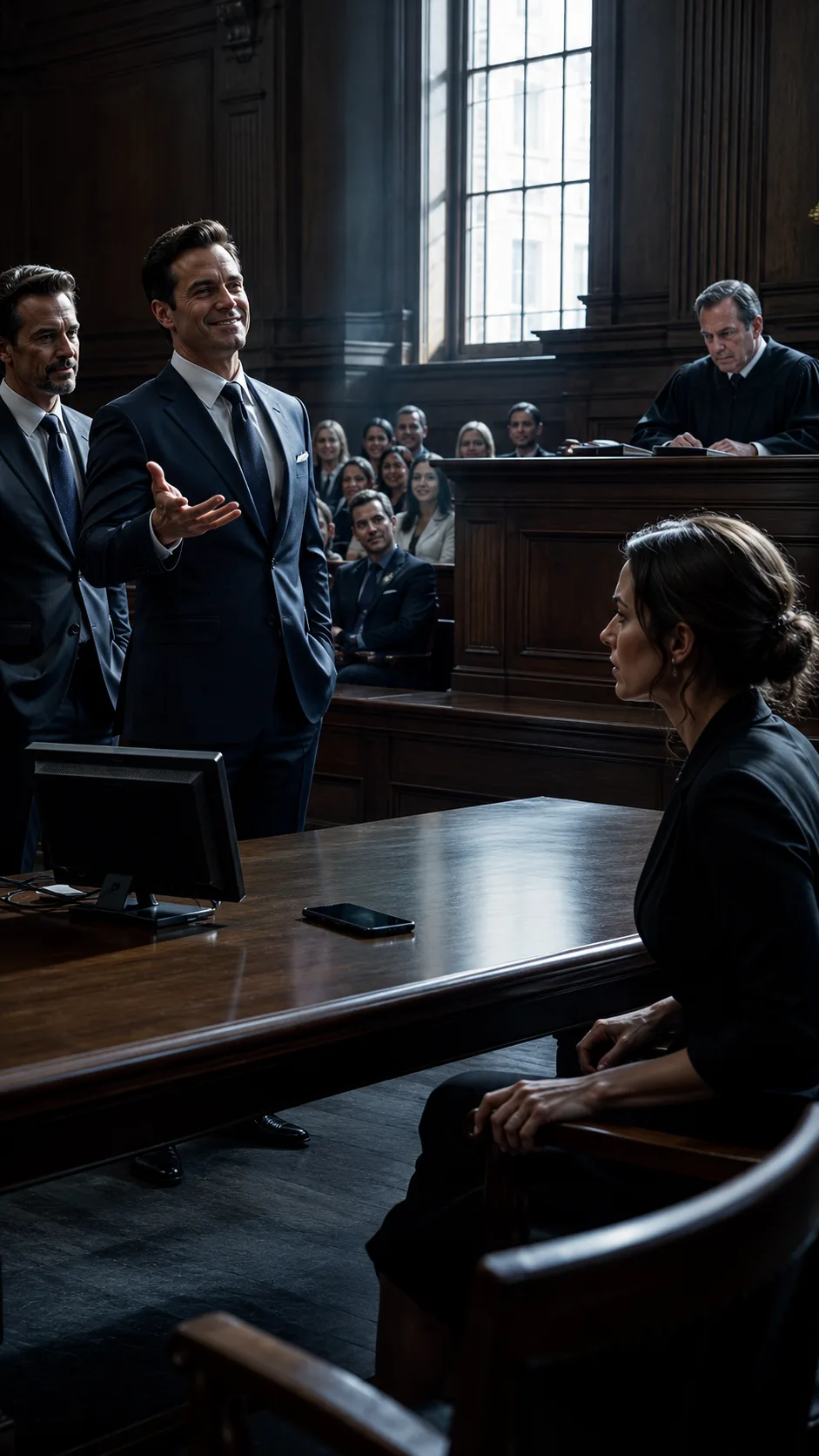
Sarah Walker noticed the scuff on the courtroom table before she noticed Ethan smiling.
Chapter 1
Sarah Walker noticed the scuff on the courtroom table before she noticed Ethan smiling.
It was a pale scrape in the dark wood, shaped like the corner of a box dragged too hard across the surface. Someone had tried to polish it away. They had failed. The mark sat between her bottle of water and the thick stack of papers her attorney had arranged in perfect, nervous rows.
Sarah kept her hands in her lap.
Across the aisle, Ethan Walker leaned back in his chair as if the courtroom had been reserved for him personally.
He wore a navy suit, a silver tie, and the same expression he had worn at every family gathering for the past seven years. Polite when people were watching. Sharp when they were not. He had one arm resting behind his attorney’s chair, his wrist loose, his wedding ring catching the cold light from the tall courthouse windows.
Family court had a smell Sarah had never expected to remember.
Old paper. Floor polish. Coffee gone stale in paper cups.
Her sister, Laura, sat two rows behind Ethan with her coat folded over her knees. She did not look at Sarah. Not once. Her eyes stayed on Ethan’s back, as if he were the only steady object in the room.
That was how it had started, really.
Not with court. Not with accusations. Not with a judge.
With Laura looking at Ethan every time she should have been looking at her own sister.
Three months earlier, Sarah had still been trying to keep the family together. She answered Laura’s calls at midnight. She watched her nephew Caleb when Laura said she needed “one quiet afternoon.” She kept the key to Laura’s house on the same brass ring as her own, because that was what sisters did when life got messy.
Then Ethan called her a liar at their mother’s dining
table.
He did it calmly.
He waited until the plates were cleared and their mother had gone to the kitchen for pie. Caleb was asleep upstairs. Laura sat beside Ethan with both hands wrapped around a mug she had not taken a drink from.
Ethan placed his phone on the table.
“Sarah has been sending messages to herself,” he said.
Laura looked up.
Sarah’s fork stopped halfway to the sink.
Ethan did not raise his voice. He did not need to. That was one of his talents. He could slice a room open without moving much more than his mouth.
He showed Laura a screenshot.
Sarah’s name appeared at the top of the conversation. Under it were messages that sounded cruel, frantic, desperate. Messages about Laura being unstable. Messages about Caleb being safer away from her. Messages about Ethan having to “protect the family” from Sarah.
Sarah had never written
them.
The first thing she said was too small.
“That isn’t mine.”
Ethan tilted his head.
The corner of his mouth moved.
Laura stood from the table so quickly her chair legs scratched the floor. Their mother came in holding a pie knife and stopped beside the doorway.
Nobody ate dessert.
After that night, Ethan moved fast.
He filed statements. Submitted screenshots. Told relatives Sarah had become obsessed with controlling Laura’s life. He called her interference dangerous. He used the word “pattern.” He said it often enough that people began repeating it.
A pattern of interference.
A pattern of manipulation.
A pattern of instability.
Sarah heard the phrases come back to her through cousins, neighbors, one former friend from church who touched her arm in the grocery store and said, “Maybe give Laura space right now.”
Space.
Sarah stood in the cereal aisle holding a box of oatmeal squares and watched the woman walk away.
She gave Laura space.
For nine days.
Then Caleb called her from the school office.
His voice was thin over the line. “Aunt Sarah, Mom forgot pickup again.”
Sarah drove straight there.
Caleb was sitting on a plastic chair beside the secretary’s desk, backpack on his lap, sneakers crossed at the ankles. He was eight years old, with Laura’s brown eyes and the careful posture of a child who had learned not to take up too much room.
On the drive home, he said, “Uncle Ethan told Mom you hate us now.”
Sarah gripped the steering wheel.
The turn signal clicked too loudly.
“He said that?”
Caleb nodded, looking out the window. “He said you write messages and then pretend you didn’t.”
Sarah pulled into a gas station and parked beneath a flickering canopy light. She did not cry. She did not speak for almost a full minute.
Then she took out her phone and called a lawyer.
Her attorney’s name was Marlene Price. She was fifty-eight, wore square black glasses, and had a habit of tapping documents into alignment before saying anything important.
When Sarah first sat in her office, Marlene listened without interrupting.
That made Sarah trust her more than sympathy would have.
Marlene asked for the screenshots. The phone records. The dates. The family group messages. Every device Sarah had used in the past year.
Sarah brought everything in a grocery bag from home because she did not own a briefcase.
Marlene spread the papers across her desk.
Tap. Tap. Tap.
“Screenshots are easy,” Marlene said.
Sarah looked up.
Marlene adjusted her glasses. “Origins are not.”
That was the first small breath Sarah had taken in weeks.
The investigation did not move like it did on television. No dramatic call. No sudden confession. Just requests, delays, fees, and waiting. Ethan’s attorney objected to everything. Laura stopped answering Sarah entirely. Their mother began leaving voicemails that started with prayer and ended with silence.
Then came the first strange detail.
One of the messages Ethan claimed Sarah had sent showed a time stamp of 11:48 p.m. on March 14.
Sarah had been at an urgent care clinic with Caleb at that exact time.
The clinic’s waiting room camera showed her sitting under a blue television screen, holding Caleb’s hoodie while he leaned against her shoulder. Her phone was visible on the chair beside her. Screen dark. Untouched.
Ethan said she could have scheduled the message.
Marlene said nothing in the room.
Afterward, in the parking lot, she stood beside Sarah’s car and handed her a copy of the clinic footage receipt.
“He knew that date mattered,” Marlene said.
Sarah folded the paper once. “How?”
Marlene looked toward the courthouse doors. “That is the question.”
The second strange detail came from Laura.
Not on purpose.
Laura had sent Sarah one message after weeks of silence.
Stop digging. You’re making it worse.
Sarah stared at it for a long time before she noticed something off.
The punctuation.
Laura never used periods in text messages. Not with Sarah. Not with anyone. She sent fragments. Emojis. Half-thoughts. Too many exclamation points when she felt guilty. But never clipped, finished sentences like that.
Sarah forwarded the message to Marlene.
Ten minutes later, Marlene called.
“Do not reply.”
So Sarah did not.
The third detail arrived from Ethan himself.
At a preliminary hearing, Ethan made one mistake. It was small. So small the judge barely reacted.
He referred to one of the messages before his attorney had entered it into the record.
Marlene’s pen stopped moving.
Sarah saw it.
Ethan kept talking.
“The March 14 message was especially concerning,” he said, sitting upright, voice smooth. “She wrote that Laura needed to be isolated from the family.”
Marlene looked down at her notes.
Then at Ethan.
Then at the evidence list.
That specific message was not listed there.
Not yet.
Sarah watched Marlene circle something so hard the pen nearly tore the paper.
After the hearing, Ethan smiled at Sarah in the hallway.
Laura stood beside him with Caleb’s small hand in hers. Caleb looked at the floor tiles.
“You should stop,” Ethan said.
Sarah kept walking.
He stepped slightly closer, not enough to block her path, just enough to make the space smaller.
“You’re embarrassing yourself.”
Marlene turned back.
Ethan smiled at her too.
Marlene did not smile back. “See you at the final hearing.”
The final hearing was scheduled for a Thursday morning.
Sarah arrived forty minutes early and sat in the courthouse lobby beside a vending machine that hummed like an old refrigerator. A man in a gray hoodie bought peanut crackers, opened them, then forgot to eat them. A toddler somewhere down the hall kept repeating the word “mine” until a tired woman picked him up.
Marlene arrived with a black leather case.
Not a grocery bag. Not loose folders.
A case.
Sarah noticed because Marlene had never brought that one before.
“What is that?” Sarah asked.
Marlene set it beside her chair.
“Something we may not need.”
Sarah looked at her.
Marlene tapped the top once. “But if we do, I want it within reach.”
Inside the courtroom, Ethan was already there.
Of course he was.
He sat with his attorney, Daniel Pierce, a narrow man with silver hair and a voice that sounded practiced even when he cleared his throat. Laura sat behind them in a cream coat, hands folded around a tissue. Caleb was not there. Sarah had asked that he be spared the hearing, and for once, everyone had agreed.
Their mother sat in the back row.
Alone.
Sarah saw the small purse on her lap, the same purse their father had bought her in 1999. Its clasp did not close properly anymore. Their mother kept pressing it shut with her thumb.
The judge entered at 9:03.
Everyone stood.
Judge Harrison was not dramatic. He was a broad-shouldered man in his early sixties with gray hair, a lined face, and little patience for performance. He adjusted the microphone on his bench, reviewed the first file, and began.
The morning passed in pieces.
Ethan’s attorney presented the screenshots again. He spoke of concern. Safety. Boundaries. A family member crossing lines. He said Sarah’s behavior had become “increasingly troubling.” He used the phrase with a slight turn toward the gallery, as if offering it to the relatives seated behind him.
Sarah heard someone shift behind her.
A whisper.
A sleeve brushing wood.
Marlene did not object to most of it.
That worried Sarah at first.
Then she saw Marlene’s hand resting on the black case beneath the table.
Tap.
Once.
Ethan testified before lunch.
He looked excellent on the stand. That was the worst part. Calm. Measured. Respectful. He called Laura “my wife” in a way that made it sound like ownership wrapped in concern. He said Sarah had once been close to them, but boundaries had become necessary.
Boundaries.
That word again.
Marlene asked him only a few questions.
“Mr. Walker, did you personally receive these messages?”
“Yes.”
“On your own phone?”
“Yes.”
“Did you preserve the device?”
“Yes.”
“Did anyone else have access to it?”
“No.”
Ethan’s answer came too quickly.
Marlene paused.
Judge Harrison looked up.
Ethan corrected himself. “Not to my knowledge.”
Marlene nodded and sat down.
Sarah wanted more. She wanted Marlene to press. To corner him. To make the room see the neat little crack in that answer.
But Marlene closed her folder.
The lunch break lasted forty-five minutes.
Sarah ate nothing. She sat in a hallway chair near a window while Marlene spoke with a court technician at the far end of the corridor. Ethan passed once with Laura beside him. He held a paper coffee cup. His free hand rested lightly at Laura’s back.
He saw Sarah.
Lifted the cup.
A toast.
Small.
Private.
Cruel.
Sarah turned toward the window. Outside, a maintenance worker scraped old gum from the sidewalk with a flat metal tool. The sound carried through the glass in faint, ugly strokes.
Scrape.
Scrape.
Scrape.
When court resumed, Daniel Pierce looked more relaxed. Ethan looked almost bored. Laura kept twisting the tissue until it split down the middle.
Marlene opened the black case.
Inside was a tablet, a slim folder, and a printed report bound with a black clip.
Sarah saw the title only for a second.
Device Extraction Summary.
Her throat tightened around a breath she did not let out.
Daniel Pierce began his closing argument with the ease of a man walking a path he knew well.
He said Sarah had failed to disprove the messages.
He said Ethan had acted responsibly.
He said Laura and Caleb deserved peace.
At the word peace, Laura lowered her head.
Ethan watched the judge.
Not Laura.
Never Laura.
Judge Harrison took notes.
When Pierce finished, Ethan leaned back. His shoulders dropped a fraction, his face loosening into triumph before the judge had spoken.
He thought it was over.
Several relatives behind him seemed to think so too. One of Ethan’s cousins leaned toward another and whispered something that made both of them look at Sarah.
Sarah placed both feet flat on the floor.
Marlene stood.
She did not rush.
“Your Honor,” she said, “before the court makes any final determination, we request review of the native message data from Mr. Walker’s preserved device.”
Daniel Pierce stood immediately.
“Objection.”
The word snapped through the room.
Judge Harrison looked at him. “On what grounds?”
Pierce’s hand moved to the top button of his jacket, then away. “The screenshots already establish the relevant communication.”
Marlene turned one page. “Screenshots establish appearance. Not origin.”
Ethan’s head tilted.
Just slightly.
Judge Harrison leaned back. “Was the device preserved?”
Pierce hesitated.
Ethan looked at him.
Marlene looked at Ethan.
“Yes,” Pierce said.
“Was the device provided for extraction?”
Pierce’s mouth opened.
Closed.
“Yes, Your Honor, for limited verification.”
Marlene lifted the printed report. “The verification was not limited in the way Mr. Pierce is implying.”
Ethan reached for his attorney’s sleeve.
Hard enough that the navy fabric wrinkled.
Sarah saw it.
So did Judge Harrison.
A quiet spread across the courtroom, but it was not empty. It had weight. It settled into the benches and along the floorboards and between the people who had spent months believing the easiest version.
Judge Harrison extended one hand.
“Approach.”
The attorneys stepped forward.
Sarah stayed seated.
Ethan stayed seated too, but his body changed. His left knee started bouncing under the table. His fingers moved toward his phone, then stopped. He looked at the evidence table where the court technician had placed the extracted device beside the monitor.
The phone looked ordinary.
Black case. Slight scratch near the camera. A faint smear across the glass.
A thing people carried every day without thinking.
Marlene and Pierce returned to their tables.
Judge Harrison read the first page of the report.
Then the second.
Nobody moved.
One woman in the gallery coughed into her fist and seemed to regret making the sound.
Judge Harrison looked over his glasses at Ethan.
“Mr. Walker,” he said, “you testified that no one else had access to your phone.”
Ethan sat taller. “Correct.”
Judge Harrison turned a page.
“And that the messages in question were received by you from Ms. Sarah Walker.”
“Yes.”
Marlene placed one hand on Sarah’s shoulder. Not comfort. A signal.
Stay still.
Judge Harrison looked toward the technician. “Display the message record for March 14.”
The monitor flickered awake.
Sarah did not look at Ethan.
She looked at Laura.
For the first time all day, Laura was looking back.
The court technician opened a file. Rows appeared on the screen. Numbers. Time stamps. Device IDs. Origin fields. Nothing dramatic to most people. Just dry information in boxes and columns.
But Marlene had once told Sarah that the truth often arrived dressed badly.
Judge Harrison pointed to one line.
“Enlarge that.”
The technician did.
Daniel Pierce stood halfway. “Your Honor, I renew my objection.”
“Sit down, Mr. Pierce.”
Pierce sat.
Ethan’s hand flattened against the table.
The monitor showed the March 14 message.
The one Ethan said Sarah had sent.
The one that claimed Laura needed to be isolated.
The one that had started the worst of it.
Judge Harrison read silently.
The courtroom waited.
A pen rolled off someone’s lap and struck the floor.
Nobody picked it up.
Judge Harrison looked at the technician. “Show the source field.”
The technician clicked once.
A new line expanded.
Sarah heard Laura inhale.
Not loudly.
But enough.
Ethan’s face did not fall all at once. It failed in pieces. The smile went first. Then the lift in his chin. Then the smoothness around his eyes. His attorney leaned toward him, but Ethan did not lean back.
Judge Harrison’s voice cut across the room.
“The message originated from Mr. Walker’s own device.”
No one spoke.
Sarah’s mother pressed both hands over her broken purse clasp.
Laura stood up halfway, then sat down again, tissue crushed in her fist.
Ethan shook his head once. Not denial for the room. Calculation. His eyes moved from the judge to the monitor to Pierce.
Pierce was staring at the screen.
Marlene did not move.
Judge Harrison continued. “Display the next disputed message.”
The technician clicked.
Another message.
Another source field.
Same device.
A murmur rose in the gallery and died before it became sound.
Judge Harrison looked at Ethan. “And the next.”
Click.
Same device.
Sarah finally looked at him.
For months, he had filled rooms with words until people forgot to examine the floor beneath them. Now the room had no use for his words. The screen did not perform. It did not persuade. It only displayed what had been there all along.
Ethan pushed back from the table.
His chair scraped hard.
Pierce caught his arm. “Sit.”
Ethan sat.
The command did not come from the judge. That made it worse.
Judge Harrison folded his hands on the bench. “Mr. Walker, the court will hear an explanation.”
Ethan’s mouth opened.
Nothing came out.
Not at first.
He swallowed. His tie had shifted crooked against his collar.
“I don’t know how that happened.”
Marlene stepped forward. “Your Honor, the extraction also shows draft creation and deletion events on the same device within minutes of each outgoing message.”
Pierce stood again. “Objection, Your Honor, this is beyond—”
Judge Harrison raised one hand.
Pierce stopped.
Marlene held the report at her side. “The messages were composed, sent, captured as screenshots, and deleted from the same phone.”
Laura made a sound then.
Small.
Not a word.
Their mother turned toward her, but Laura was looking only at Ethan.
Ethan’s face tightened. “That’s not true.”
Judge Harrison looked at the technician. “Display the deletion log.”
The technician clicked.
Sarah watched Ethan’s hand move toward his pocket.
Marlene saw it too.
“Your Honor,” she said, “the device currently in evidence should remain untouched.”
Judge Harrison looked at Ethan’s hand.
Ethan froze.
His fingers hovered above his pocket, curled slightly, as if the air itself had caught them.
That was the moment the room turned.
Not when the data appeared.
Not when the judge spoke.
When everyone saw Ethan reach for the only thing that could not save him anymore.
A cousin in the second row lowered his eyes.
Another relative slowly leaned away from Laura’s side of the bench.
Sarah’s mother stood, then gripped the pew in front of her and sat back down.
Laura stepped into the aisle.
“Ethan,” she said.
He did not turn around.
That told Sarah more than any answer would have.
Judge Harrison’s voice stayed even. “Mr. Walker, do not touch your phone.”
Ethan lowered his hand to the table.
The courtroom monitor glowed pale against his face.
Marlene walked back to Sarah’s table and placed the report in the center, just beside the sealed water bottle Sarah had not opened all day.
Tap.
The pages aligned.
Judge Harrison recessed the hearing for twenty minutes.
No one stood at first.
Usually, a recess broke a room open. People whispered, gathered bags, checked phones, stretched stiff knees. This time, the room stayed seated for several seconds after the judge left the bench.
Then movement returned badly.
A purse strap slipped off a shoulder.
A chair bumped the rail.
Someone whispered Ethan’s name and stopped before finishing whatever came next.
Laura walked past him without touching his chair.
That was the first thing she did right.
Sarah saw it, but she did not follow. She stayed seated because her legs did not feel ready for the floor. Marlene closed the black case. The court technician disconnected the monitor with careful, ordinary movements, as if he had not just pulled a pin from the center of a family.
Ethan remained at his table.
Pierce bent close and spoke into his ear. Ethan stared straight ahead. His hands were clasped together now, too tight, the knuckles pale under the courtroom lights.
The relatives who had sat behind him did not gather around him.
They stood in separate clusters.
Farther away.
Sarah’s mother came down the aisle slowly, one hand on each bench as she moved. She stopped beside Sarah, opened her purse, then closed it again without taking anything out.
“I didn’t know,” she said.
Sarah looked at the scuff on the table.
“I know.”
Her mother nodded once. It was not enough. It was something.
Laura stood near the courtroom doors with both arms wrapped around herself. She looked smaller without Ethan beside her. Not innocent. Not absolved. Just smaller.
Sarah did not go to her yet.
The water bottle was still sealed.
Sarah twisted the cap open at last.
The crack of the plastic ring sounded too loud.
When the hearing resumed, Judge Harrison did not allow the room to settle into its old shape.
The screenshots were removed from consideration. Ethan’s testimony was marked for review. The court ordered a full independent examination of the device records and related filings. Any temporary arrangements based on the disputed messages were suspended pending that review.
He did not shout.
He did not need to.
Every sentence landed like a door closing.
Ethan tried once to speak.
Judge Harrison stopped him with a look.
Pierce placed a hand on Ethan’s forearm, and this time Ethan obeyed before the hand tightened.
Laura sat in the back row with their mother. Not behind Ethan. Not beside Sarah either. In the middle, where nobody had made room for her yet.
Afterward, in the hallway, Caleb’s school called Laura.
Sarah watched her answer.
Her voice shook around the first word, then steadied when she said his name.
Caleb.
That was where the day became real again.
Not with the judge. Not with the report. Not with Ethan’s face on the other side of the aisle.
With an eight-year-old boy asking who was picking him up.
Laura looked at Sarah from across the hall.
For a second, neither of them moved.
Then Sarah held out her hand.
Not to Laura.
For the car keys.
Laura placed them in her palm without a word.
Ethan’s consequences did not arrive all at once.
They came in envelopes, court notices, missed calls, unanswered messages, and the quiet disappearance of people who once laughed too quickly at his jokes. The independent review confirmed what the first extraction had shown. More messages. More deletions. More carefully built lies arranged to look like concern.
Pierce withdrew from representation.
Laura moved into their mother’s spare room with Caleb for six weeks. She did not ask Sarah to forgive her. That helped. She drove Caleb to school herself every morning, even when she had to sit in the parking lot for ten minutes before going inside.
Ethan tried to call Sarah twice.
She did not answer.
He left one voicemail.
Marlene told her to save it.
So she did.
Months later, Sarah returned to the courthouse for a final administrative hearing. Different room. Smaller table. No gallery full of relatives. No one smiling across the aisle.
Ethan was not there.
His new attorney appeared on his behalf and spoke in careful, narrow sentences. The judge listened, made notes, and issued orders that sounded dry enough for paper but heavy enough for life.
Sarah signed nothing that day.
She only received copies.
On her way out, she passed the same vending machine in the lobby. It still hummed. Still offered peanut crackers in the second row. Someone had taped a handwritten sign to the coin slot.
CARD ONLY.
Sarah almost smiled.
Outside, Laura waited near the curb with Caleb. He had grown taller, or maybe Sarah had forgotten how quickly children do that when adults are busy breaking things around them.
He ran to her.
She bent and caught him against her coat.
His backpack hit her knee. One zipper was open. A pencil fell out and rolled toward the courthouse steps.
Caleb pulled back. “Mom says we’re having dinner at Grandma’s.”
Sarah looked at Laura.
Laura held her gaze this time.
No tissue. No folded coat. No eyes searching for Ethan before choosing where to stand.
“Only if you want to come,” Laura said.
Sarah looked down at the pencil near her shoe.
She picked it up and handed it to Caleb.
“Zip your bag first.”
He did.
Carefully.
The three of them walked toward the parking lot. Not close enough to look fixed. Not far enough to look broken beyond repair.
At their mother’s house that evening, the dining table had been set for four. The old scrape from Ethan’s phone was gone because it had never been there. That table had different marks. A ring stain from iced tea. A nick from a dropped serving spoon. A faint line where Caleb had once pressed too hard with a blue crayon.
Their mother served pie after dinner.
Nobody mentioned the night Ethan had ruined dessert.
Sarah took a slice anyway.
Laura washed the plates.
Caleb fell asleep on the couch with one sneaker still on.
Before Sarah left, her mother handed her the spare key to Laura’s house. The same brass one Sarah had removed from her key ring months before.
Sarah held it in her palm.
Then she placed it on the kitchen counter.
Not yet.
Her mother nodded.
Laura dried her hands on a towel and did not argue.
Outside, the porch light buzzed above Sarah’s head. She walked to her car alone, unlocked the door, and sat for a moment before starting the engine.
Her phone lit up once in the cup holder.
Unknown number.
She let it ring until it stopped.
Then she drove home through the quiet streets, both hands steady on the wheel.
No message needed answering.
Chapter complete
You have reached the end of this chapter.
Continue reading
A few more worlds to get lost in after this chapter.




