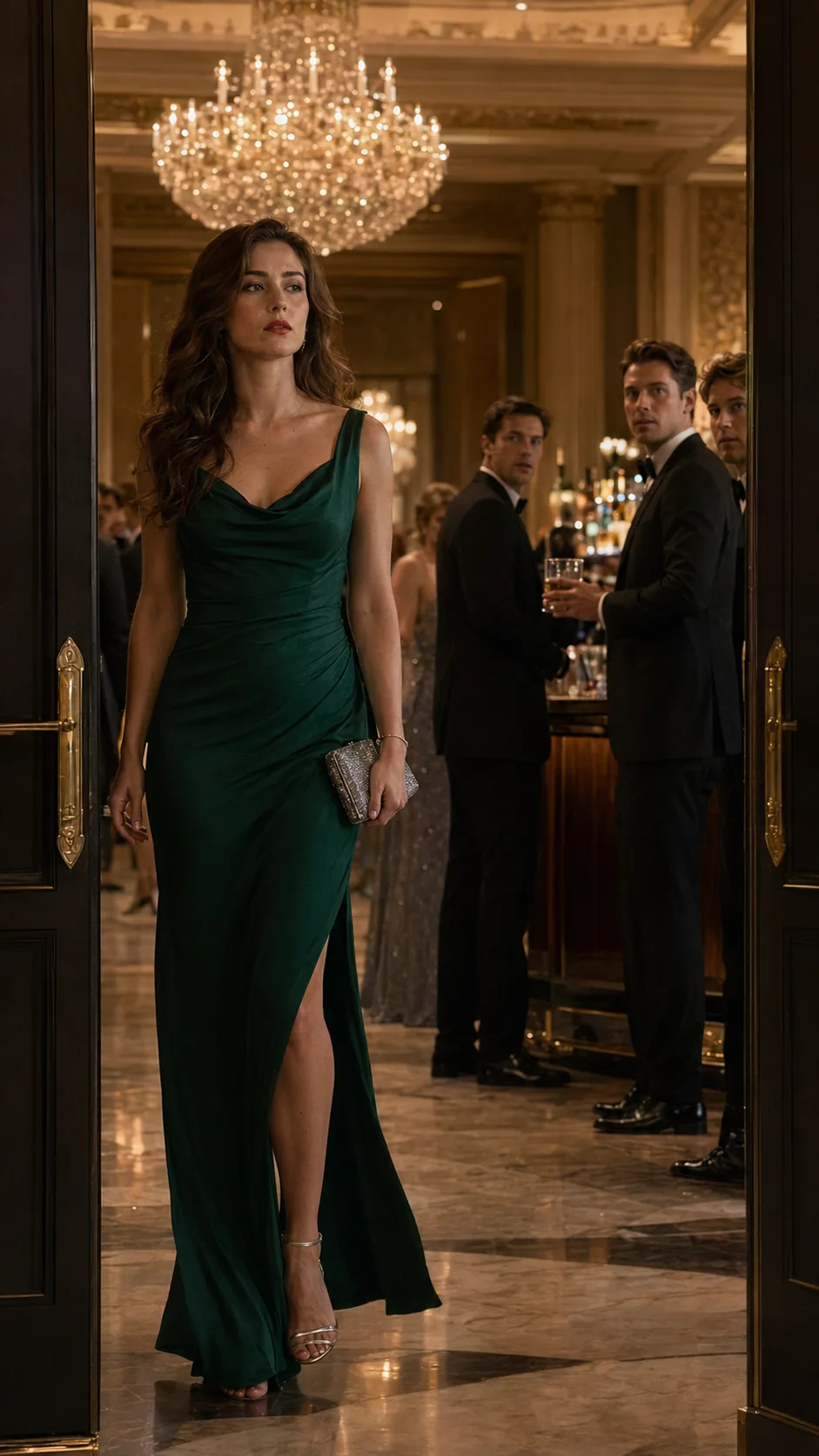
He Called His Secretary Ugly for a Bet, Until She Walked Into the Gala and Destroyed His Pride
Rachel Appleton had spent five years teaching herself how to disappear.
Chapter 1
Rachel Appleton had spent five years teaching herself how to disappear.
Not vanish in a dramatic way. Not run away. Not hide in shadows.
Just become forgettable enough that men stopped noticing.
At Wescott Global, where money moved faster than mercy and glass walls made every office feel like a stage, Rachel had perfected the art of being present without being seen. She wore thick black glasses that covered half her face. She chose loose gray trousers, shapeless cardigans, dull blouses buttoned too high at the throat. Her brown hair, which naturally fell in soft waves past her shoulders, was always twisted into a tight bun so severe it made her scalp ache by noon. She never wore lipstick. Never wore perfume. Never wore anything that invited a second glance.
People thought she had no vanity.
They were wrong.
Rachel knew exactly what she looked like. That was why she hid.
At her last job, being noticed had become dangerous. Her
former manager had complimented her too often, stood too close, touched her arm when there was no reason, and called her “pretty girl” in front of clients as if beauty were a job title. When she rejected his invitations, her assignments changed. Her reports were questioned. Her mistakes were magnified. Her confidence was slowly dragged through humiliation until she learned the lesson every woman should never have to learn.
Sometimes competence was not enough if men decided your body was more interesting than your work.
So Rachel built armor.
Ugly glasses. Baggy clothes. No softness. No invitation.
It worked.
For three years, she had worked as senior executive assistant and unofficial analyst to Elijah Wescott, the thirty-four-year-old millionaire CEO whose name appeared in financial magazines beside words like ruthless, brilliant, and untouchable. Elijah was handsome in the effortless way wealth protected: dark hair always neat, suits always perfect, shoes polished
enough to reflect boardroom lights. He could silence a room with one lifted eyebrow. He could charm investors with a smile and destroy competitors with a sentence.
Rachel knew his calendar better than he did. She knew which investor lied when nervous, which client preferred tea over coffee, which reports Elijah would forget to request until five minutes before a meeting. She fixed problems before they reached him. She rewrote presentations at midnight. She caught errors that would have cost the company millions.
Elijah often said she was the most efficient assistant he had ever had.
He never said she was irreplaceable.
Rachel told herself she did not care.
Then, two days before the annual Wescott Foundation charity gala, she learned exactly what he saw when he looked at her.
It was Thursday evening, nearly seven. The office had emptied except for a few late-working executives and the cleaning crew
moving quietly near the elevators. Rachel sat outside Elijah’s glass-walled office, finishing a donor analysis report for the gala. Her fingers moved quickly over the keyboard, her glasses sliding down her nose as she checked numbers and corrected formatting.
Inside Elijah’s office, laughter burst through the partially open door.
Greg Harrison and Tyler Moore had arrived twenty minutes earlier, both CEOs, both rich, both carrying the careless confidence of men who believed expensive watches made them interesting. Rachel had never liked them. Greg was loud but not cruel. Tyler smiled too much and listened too little. Around Elijah, they behaved like boys who had never been told no.
“Friday night,” Greg said, his voice carrying through the doorway. “Big charity gala. Who are you bringing?”
“No one,” Elijah replied. “I have enough obligations without dragging some clingy woman around all night.”
Tyler laughed. “You? Alone? That’s bad branding.”
“Elijah Wescott doesn’t need branding,” Greg said. “But he does need entertainment.”
There was a pause.
Rachel continued typing.
Then Greg’s voice dropped into a teasing tone.
“Take your secretary.”
Rachel’s hands stilled for half a second.
Elijah laughed.
Not a small laugh. Not a surprised one. A real laugh, sharp and amused, as if the idea itself were ridiculous.
“Rachel?” he said. “Absolutely not.”
Rachel lowered her eyes to the keyboard. She forced herself to keep breathing.
“Why not?” Tyler asked. “She runs your life. You always say she’s brilliant.”
“She is brilliant,” Elijah said.
For one foolish moment, Rachel waited.
Maybe he would say she was professional. Reliable. Important. Maybe he would say that bringing an employee would be inappropriate, and that would be the end of it.
“But come on,” Elijah continued, still laughing. “She’s dull. Ugly, honestly. Those massive glasses, those old-lady clothes, that hair scraped back like she’s punishing herself. She looks like she walked out of a tax office in 1982.”
Something inside Rachel went cold.
Greg made an uncomfortable sound. “That’s harsh.”
“It’s accurate,” Elijah said. “She’s the best assistant I’ve ever had, but she makes zero effort. A woman could at least try to brighten up the office.”
Rachel’s throat tightened so hard she could barely swallow.
Brighten up the office.
As if she were a lamp.
Tyler hesitated, then said, “Still, betting on her would be cruel.”
Rachel’s fingers hovered above the keys.
“Betting?” Greg asked.
Elijah’s chair creaked. “I’ll bet a thousand dollars that if Rachel Appleton walked into the gala, no man would ask her to dance.”
There was silence.
Rachel heard the hum of the office lights. The faint buzz of the printer. Her own heartbeat, loud and humiliating.
“Elijah,” Greg said slowly, “you’re being a real jerk.”
“I’m being realistic.”
“She might hear you,” Tyler muttered.
“She’s always working,” Elijah said carelessly. “She doesn’t listen.”
Rachel stared at the report on her screen until the numbers blurred.
Greg sighed. “Fine. I’ll take the bet, but only because I want you to lose.”
“You won’t,” Elijah said. “Rachel Appleton is invisible by choice or by nature. Either way, no one looks twice.”
The three men left Elijah’s office moments later. They passed Rachel’s desk without looking at her. Elijah adjusted his cufflinks and said, “Finish the donor projections before you leave.”
Rachel nodded.
“Yes, Mr. Wescott.”
Her voice did not break until the elevator doors closed.
Then the tears came.
They fell silently at first, slipping behind her thick glasses, running down her cheeks onto the collar of her plain blouse. She hated herself for crying. She hated that his words hurt. She hated that after years of training herself not to care about how men saw her, one careless conversation had cut straight through every layer of armor she owned.
“Rachel?”
She looked up quickly.
Moren Vale stood near her desk, holding a stack of folders against her chest. Moren worked in operations, but more importantly, she was Rachel’s closest friend in the company. Sharp-eyed, warm-hearted, and impossible to fool.
The moment Moren saw Rachel’s face, her expression changed.
“You heard them.”
Rachel removed her glasses and wiped her eyes.
“Every word.”
Moren set the folders down with a force that made the desk shake. “I’m going to report him.”
“No.”
“Rachel—”
“No,” Rachel said, and surprised herself with how steady her voice became. “Not yet.”
Moren stared at her. “Not yet?”
Rachel looked toward the elevators where Elijah and his friends had disappeared. Something bitter and powerful rose beneath the hurt.
For years she had hidden to survive. For years she had made herself small so men would stop deciding what she was worth based on what they wanted from her.
And now Elijah Wescott, the man whose empire she quietly held together, had mistaken her survival for ugliness.
He had mistaken her silence for emptiness.
He had mistaken her discipline for dullness.
A slow smile touched Rachel’s lips.
Moren took a step back. “That expression scares me.”
“Do you have a ticket to the gala?”
“Yes. Why?”
“I have one too. I always decline because I hate those events.”
Moren’s eyes narrowed. “Rachel.”
“This year,” Rachel said, closing the report on her computer, “I’m going.”
Moren’s mouth opened slightly.
Rachel stood, gathering her bag.
“And he won’t recognize me.”
By eight that night, Rachel was standing in Nomi Park’s design studio while her best friend circled her like a general inspecting a battlefield.
Nomi was a fashion designer, dramatic by nature, terrifying when angry, and the only person who had seen Rachel before the armor. She had spent years begging Rachel to stop hiding. Rachel had always refused.
Until now.
“He said what?” Nomi demanded.
Rachel repeated the conversation.
By the time she finished, Nomi had gone dangerously quiet.
“I need his home address.”
“No.”
“Office address?”
“You already know it.”
“Good. I’ll make it look like an accident.”
“Nomi.”
Her friend exhaled sharply, then crossed her arms. “Fine. We won’t destroy him legally or physically. We’ll destroy him socially.”
“I don’t want to destroy him,” Rachel said softly.
Nomi softened.
Rachel looked at herself in the studio mirror. Baggy cardigan. Severe bun. Glasses. A woman built to be overlooked.
“I want him to see what he chose not to see.”
Nomi’s smile returned, slow and wicked.
“Then we’re going to make you unforgettable.”
The next forty-eight hours became a storm.
Nomi rejected twelve dresses in one afternoon. Too obvious. Too sweet. Too desperate. Too red. Too black. Too much revenge, not enough dignity.
Then she pulled a bolt of emerald silk from a shelf and held it against Rachel’s chest.
The room went silent.
“That,” Nomi whispered, “is the color of a man’s regret.”
The dress was made overnight by three seamstresses who looked at Rachel, heard a shortened version of the story, and worked as if they had personal grudges against Elijah Wescott.
Rachel learned contact lenses with the determination of a soldier. She sat in an ophthalmologist’s office, blinking furiously, nearly giving up after the tenth failed attempt.
Nomi leaned close and said, “Imagine his face.”
Rachel got the lens in on the next try.
The hairstylist released Rachel’s hair from its bun and actually looked offended.
“You have been hiding this?”
Rachel almost apologized.
He cut just enough to shape it, then styled it into glossy waves that fell around her shoulders. The makeup artist used a light touch: warm skin, defined eyes, red lips that looked less like decoration and more like a warning.
On Friday evening, Rachel stood before Nomi’s full-length mirror.
For a moment, she did not breathe.
The woman in the mirror looked familiar and impossible at the same time. Tall. Elegant. Poised. The emerald dress moved like water over her body, fitted but not vulgar, powerful but not loud. Her eyes, freed from the prison of thick glasses, seemed sharper, greener, alive. Her hair softened the angles of her face. Her mouth, painted deep red, made her look like someone who knew a secret and had decided not to share it.
Rachel touched the silver clutch in her hand.
“Is this too much?”
Nomi stood behind her. “No. This is exactly enough.”
“What if I freeze?”
“Then freeze beautifully.”
Rachel laughed despite the nerves.
Nomi placed both hands on her shoulders. “Listen to me. You are not going there to beg to be wanted. You are not going there to prove you’re pretty. You are going there to show a room full of blind people that they don’t know the difference between invisibility and value.”
Rachel swallowed the sudden tightness in her throat.
“Thank you.”
“Go,” Nomi said. “Make him regret having eyes.”
The Grand Meridian Hotel glittered like a palace carved from gold.
Crystal chandeliers poured warm light over marble floors. Champagne moved through the room on silver trays. Women in gowns laughed beneath enormous floral arrangements. Men in tuxedos stood near the bar, pretending business was more interesting than gossip.
Rachel paused just outside the ballroom entrance.
Her heart hammered.
Then she heard Elijah’s voice.
“So where is your invisible secretary?” Greg asked, his tone edged with sarcasm.
Rachel stopped behind the open doors.
Elijah stood near the bar with Greg and Tyler, a glass of whiskey in his hand. He looked perfect, relaxed, untouchable.
“Probably at home,” Elijah said. “She never comes to these things.”
Tyler shifted. “You were cruel the other day.”
“I was honest.”
Greg’s voice hardened. “You called her ugly.”
“I said what everyone thinks and no one says.”
Rachel’s fingers tightened around her clutch.
Tyler muttered, “Maybe she has emotions, Elijah.”
Elijah took a sip of whiskey. “Rachel has work ethic. Emotions are not her department.”
That was the moment Rachel stepped into the ballroom.
No thunder cracked. No music stopped. The room did not freeze the way stories pretended rooms froze.
But attention shifted.
A man near the entrance turned first. Then a woman beside him. Then two guests near the champagne table. A small ripple moved through the ballroom, quiet but unmistakable.
Rachel lifted her chin.
She walked.
Every hour Nomi had spent teaching her posture returned to her body. Shoulders relaxed. Spine long. Steps slow. Not a performance. Not a plea. A procession.
Greg saw her first.
His mouth parted.
Tyler followed his gaze and went still.
Elijah had his back to her.
Greg whispered something Rachel could not hear.
Elijah turned.
Their eyes met.
For one second, his expression was simply appreciative. Polite male interest, surprised and shallow.
Then confusion entered.
His gaze dropped briefly to the dress, returned to her face, lingered on her eyes.
Rachel kept walking.
She passed close enough for him to smell her perfume, close enough for him to see that her green eyes were not new. They were the same eyes that had looked over his contracts, caught his mistakes, and waited outside his office for three years.
Recognition broke across his face slowly.
First curiosity.
Then disbelief.
Then something like fear.
Rachel smiled.
Not warmly.
Not cruelly.
Just enough.
Then she walked past him.
“Elijah,” Greg said under his breath.
Elijah did not blink. “Who is she?”
Tyler answered, quiet but sharp.
“That’s Rachel.”
Elijah’s hand tightened around the whiskey glass.
“No.”
“Yes,” Greg said. “That’s your secretary. The woman you bet no one would dance with.”
Elijah stared after her.
Rachel knew, without turning, that men were already approaching. One asked for her name. Another offered champagne. A third, Daniel something from a nonprofit board, asked if she would dance.
Rachel accepted.
Not because she needed to prove Elijah wrong.
Because for the first time in years, she wanted to move through a room without shrinking.
She danced under the chandeliers while Elijah watched from the bar like a man witnessing the collapse of a building he had designed himself.
During the second song, Daniel smiled gently. “You seem like someone is trying very hard not to look at someone else.”
Rachel almost laughed.
“Am I obvious?”
“Only to people who pay attention.”
Before she could respond, Elijah appeared at Daniel’s shoulder.
“Rachel.”
Daniel’s hand tightened politely at her waist before he released her.
Elijah looked pale.
“Can we talk?”
Rachel considered refusing.
Then she saw the panic in his eyes and decided he deserved ten minutes of the truth.
“Fine.”
She followed him through the ballroom doors onto the terrace.
Outside, the city shone beneath a cold sky. The music became muffled behind glass. Moonlight touched the stone railing and made Elijah’s black tuxedo look severe.
For a moment, neither of them spoke.
Then Elijah said, “You look incredible.”
Rachel folded her arms.
“That’s unfortunate.”
His brow furrowed. “Unfortunate?”
“Because now you’re sorry.”
He flinched.
“Rachel—”
“Tell me something, Elijah. If I had walked in tonight wearing my usual glasses and cardigan, would you have apologized?”
He opened his mouth.
Nothing came out.
Rachel smiled sadly. “Exactly.”
“I didn’t know it was you.”
“No. You didn’t know it was me because you never looked at me long enough to recognize me without the costume you mocked.”
“I was wrong.”
“You were cruel.”
“Yes.”
“You made a bet about me like I was a horse at a race.”
His face tightened.
“You called me ugly,” she continued. “You called me boring. You said I should dress better to brighten the office. Do you have any idea what that felt like after three years of working beside you?”
“I didn’t know you heard.”
“That doesn’t make it better. It makes it worse. You only regret being caught.”
“No,” he said quickly. “That’s not true.”
Rachel stepped closer, her voice low.
“You saw me in a dress, and suddenly I became a person.”
Elijah looked as if she had struck him.
“That is not—”
“Don’t lie to me,” she said. “Not tonight.”
The wind moved through her hair. She hated that tears had begun to burn behind her eyes, but she let them stay there. Let him see them. Let him understand that dignity did not mean the absence of pain.
“I hid because at my last job, being noticed made me unsafe,” she said. “I wore ugly clothes because I wanted men to stop treating my body like office property. I wore glasses because I wanted people to read my reports before they looked at my face. And you, after three years, decided the armor I built to protect myself made me worthless.”
Elijah’s face changed.
All the polished CEO confidence drained away.
“I didn’t know.”
“No,” Rachel said. “You didn’t care.”
He looked down.
She let the silence hurt him.
Then she said, “Enjoy your gala, Mr. Wescott. And congratulations on losing your bet.”
She turned toward the doors.
“Rachel, wait.”
She stopped, but did not look back.
“You had three years,” she said. “That was your chance.”
Then she walked back into the light and left him outside with his own reflection in the glass.
Monday arrived like punishment.
Rachel stood in front of her mirror at home with her hair loose and her face bare. For a moment, she almost went to work as herself.
Then memory returned.
The old job. The glances. The hands. The way professionalism had been stolen from her and replaced with caution.
She put on the glasses.
She chose loose navy trousers and a blouse that hid her shape. She twisted her hair back into a bun.
Invisible Rachel returned.
But not completely.
Her shoulders stayed straight.
At Wescott Global, Elijah’s blinds were closed. That alone told her he was unsettled. He liked visibility. He liked control. He liked seeing everything before it reached him.
At nine fifteen, his office door opened.
“Rachel.”
She did not look up. “Yes, Mr. Wescott?”
He visibly recoiled at the formality.
“Can we speak?”
“About work?”
He hesitated. “No.”
“Then no.”
“Rachel, please.”
She lifted a folder from her desk and handed it to him. “Your marketing briefing. Investor lunch is confirmed for twelve thirty. New York call moved to three fifteen. The legal team wants your approval on the revised vendor clause.”
Elijah took the folder slowly.
“I deserve this,” he said.
Rachel met his eyes.
“Yes.”
He went back into his office.
For the next week, Elijah tried to apologize in pieces.
He praised her analysis in meetings. She thanked him without warmth. He brought coffee. She accepted it like office supplies. He asked if she needed anything. She said no. He tried to explain himself. She redirected him to his calendar.
By Thursday, she heard him through the glass door, speaking to Greg on the phone.
“I don’t know how to fix it,” Elijah said. “She treats me like a stranger. Like I’m just another executive she has to manage.”
A pause.
“I know I earned it. Don’t tell me I earned it. I know.”
Another pause.
“I called the most important woman in my company ugly because I was too arrogant to understand what I was looking at.”
Rachel froze over her keyboard.
The most important woman in my company.
Not assistant.
Not secretary.
Woman.
She hated that the words affected her.
At lunch, Moren dropped into the chair across from her.
“He looks terrible.”
“Good.”
“He brought you coffee from Bean There.”
“I noticed.”
“You love Bean There.”
“I love professionalism more.”
Moren leaned forward. “Rachel.”
“What?”
“Do you think he’s sorry because he hurt you, or because he saw you beautiful?”
Rachel looked through the glass at Elijah. He sat alone at his desk, tie loosened, one hand over his eyes.
“That’s the problem,” she whispered. “I don’t know.”
“Then test him.”
Rachel turned back. “How?”
“Stay exactly like this. Glasses. Bun. Baggy clothes. No gala dress. No red lips. If he still respects you, defends you, learns who you are, and keeps showing up when you look like the woman he dismissed, then maybe he changed.”
Rachel considered it.
“And if he doesn’t?”
“Then you’ll finally know he only loved the dress.”
The test began quietly.
Elijah failed at first in small ways, not because he was cruel, but because he was clueless. He bought expensive flowers—red roses. Rachel sent them to reception. He tried to compliment her appearance. She walked away. He invited her to dinner in a way that sounded too much like a CEO making a decision. She declined before he finished the sentence.
Then he disappeared for an afternoon.
Rachel only learned where he had gone because Nomi called her that evening, laughing so hard she could barely speak.
“Your idiot came to my studio.”
Rachel sat up on her couch. “What?”
“Elijah Wescott. Tall. Expensive suit. Terrified eyes. Asked if I made the emerald dress.”
Rachel closed her eyes. “Please tell me you didn’t hurt him.”
“Physically? No.”
“Nomi.”
“I called him the asshole.”
Rachel pinched the bridge of her nose. “Of course you did.”
“He accepted the title.”
Despite herself, Rachel smiled.
Nomi’s voice softened. “He asked me how to know you. Not how to impress you. How to know you.”
Rachel went quiet.
“I told him you love historical romances,” Nomi continued. “That you hate red roses. That Bean There is your favorite coffee. That Scotland is your dream. That money means nothing if the gesture has no thought behind it. And I told him if he hurt you again, I would ruin him.”
“Thank you for that last part.”
“My pleasure.”
The next Monday, Rachel arrived to find a book on her desk.
It was a beautifully bound illustrated edition of Pride and Prejudice, one she had mentioned once in passing during a marketing discussion about literary adaptations. Not to Elijah directly. To the room. He must have heard. He must have remembered.
A note lay on top.
I remembered you said this edition was beautiful. No obligation to forgive me. I just thought you should have it. —E
Rachel stared at the note for a long time.
Moren appeared beside her. “That’s not a generic billionaire gift.”
“No,” Rachel said softly. “It isn’t.”
The next morning, coffee from Bean There waited on her desk. The correct cappuccino. Still hot. No dramatic note. Just a small card.
Good morning.
On Wednesday, another coffee.
On Thursday, a link arrived in her inbox: an article about women authors of the nineteenth century and how their work had been dismissed in their own time.
Subject: Thought you might find this interesting.
Rachel read the entire article.
On Friday, Elijah did something no apology could have accomplished.
They were in a conference room with Victor Lang, a potential client whose account was worth nearly two million dollars. Victor had the smug posture of a man who had spent decades confusing wealth with intelligence.
Rachel presented the market forecast because she had built the forecast. She stood at the screen in her plain blouse, glasses on, hair tied back, speaking clearly through the numbers.
Victor interrupted halfway through.
“Sweetheart,” he said, waving one hand, “this is a lot of decoration. Why doesn’t your boss explain the real figures?”
The room went silent.
Rachel’s face heated, but she kept her voice calm. “I created the model. I can answer any question you have.”
Victor smiled at Elijah. “She’s loyal. That’s cute. But I prefer to speak to decision-makers.”
Elijah stood.
Not quickly.
Slowly.
The room chilled.
“Mr. Lang,” Elijah said, his voice soft enough to be dangerous, “Rachel Appleton is the reason this meeting is happening. She built the model. She corrected the projections your team sent us. She found three errors in your expansion assumptions that your own analysts missed.”
Victor blinked.
Elijah walked to the door and opened it.
“If you cannot respect the most capable person in this room because she is a woman and because you made assumptions about her title, then we have nothing to discuss.”
Victor’s face turned red. “Are you ending a two-million-dollar negotiation over an assistant?”
“No,” Elijah said. “I’m ending it over incompetence. Yours.”
Rachel stopped breathing.
Victor grabbed his briefcase and stormed out, muttering threats.
The door closed.
Elijah turned to Rachel, anger fading into concern.
“Are you okay?”
She stared at him. “You just lost a major account.”
“I lost a client who insulted you. That is not the same thing.”
Then he left before she could answer.
That was the moment Rachel’s defenses began to crack.
Not because of the book. Not because of the coffee. Not even because he had remembered Scotland and lilies and all the little pieces of her life.
Because when it cost him something, he had chosen her dignity.
The following Monday, Rachel stepped off the elevator and found Moren waiting with an expression of barely contained excitement.
“Come with me.”
“Moren, I have reports.”
“Reports can wait.”
She dragged Rachel down the hallway to a small office that had been empty the week before. The door now held a silver nameplate.
Rachel Appleton
Senior Analyst
Rachel stood completely still.
Inside, the office had a city view, a proper desk, two monitors, an ergonomic chair, a small bookshelf, and a heater near the window because she was always cold. On the desk stood a vase of white lilies.
No red roses.
A note leaned against the vase.
You should have had this office years ago. I’m sorry it took me so long to see what was obvious. —E
Rachel touched the nameplate with shaking fingers.
“He promoted me.”
Moren smiled. “He corrected what he should have done years ago.”
Rachel spent the morning moving into the office, though there was not much to move. She had never allowed herself to accumulate personal things at the desk outside Elijah’s office. A mug. A few pens. A drawer of emergency painkillers for the headaches caused by her bun.
Now, for the first time in years, she placed the illustrated Pride and Prejudice on her shelf.
At eleven, Elijah knocked on the open door.
Rachel looked up.
He did not enter.
“May I?”
That one question did more to move her than all the gifts.
“Yes.”
He stepped inside carefully, stopping a respectful distance from her desk.
“Do you like it?”
Rachel looked around.
“The office?”
“Yes.”
“I like being recognized for work I have already been doing.”
He nodded, accepting the sting. “You’re right.”
“I know.”
A faint smile touched his mouth, then disappeared. “I won’t pretend this fixes anything.”
“It doesn’t.”
“I know,” he said again. “But I want the company to reflect the truth, whether you forgive me or not. You were never just my assistant.”
Rachel looked at him for a long moment.
“Thank you for the lilies.”
His eyes softened.
“You’re welcome.”
For the next several weeks, Elijah did not ask for forgiveness.
He earned quiet.
He listened when she spoke in meetings. He credited her ideas publicly. He asked for her opinion before making decisions and, more importantly, used it. He implemented an internal conduct policy that made every manager attend harassment prevention training, including himself. He removed two department heads after anonymous complaints surfaced.
Rachel noticed everything.
She also noticed he never touched her without permission. Never stepped too close. Never commented on her body. When he complimented her, it was about clarity, strategy, courage, insight.
One Friday evening, he knocked on her office door after everyone else had left.
“Can I speak to you? Not as your boss. Just as Elijah.”
Rachel closed her laptop.
“One conversation.”
He sat on the chair across from her desk, hands clasped tightly.
“I need to tell you why I became that man,” he said. “Not to excuse it. There is no excuse. But you deserve an explanation.”
Rachel waited.
“My parents worshipped image,” he said. “My mother was beautiful and unhappy. My father was powerful and empty. In our house, appearance was treated like morality. A beautiful wife meant success. A polished suit meant discipline. A perfect event meant respect. I grew up believing surfaces were signals of worth.”
He looked at the floor.
“When I met you, I saw the surface you chose and decided it told the whole story. I reduced you to it. That was my failure. Not yours.”
Rachel’s throat tightened.
“I spent years trying not to be seen that way.”
“I know.”
“No,” she said. “You know now. You didn’t know then.”
“You’re right.”
His eyes lifted to hers, wet but steady.
“At the gala, I was shocked by your beauty. I won’t lie and pretend I wasn’t. But afterward, when you came back to work as you always had—glasses, bun, plain clothes—and refused to give me anything but professionalism, I started seeing the woman I should have seen all along. The way you protect people from problems. The way you remember everyone’s birthdays. The way your sarcasm appears only when someone earns it. The way you make this company smarter just by being in the room.”
Rachel blinked hard.
“I don’t want you to love the version of me in the green dress.”
“I don’t,” Elijah said. “I admire her. I’m terrified of her. But I’m in love with the woman who built armor and still stayed kind.”
The room went very quiet.
Rachel’s heart beat too loudly.
“Elijah.”
“I’m not asking you to say it back. I’m not even asking you to believe me tonight. I’m asking for one chance to keep proving it.”
She looked at him, searching for arrogance, performance, possession.
She saw fear.
And patience.
“One coffee,” she said.
His eyes widened.
“Outside work,” she added. “Neutral place. No pressure. If you make me feel like a project, a prize, or a guilty conscience you’re trying to soothe, we’re done.”
He nodded quickly. “Understood.”
“Saturday. Ten. Bean There.”
He smiled, small and disbelieving. “I’ll be there.”
Elijah arrived twenty minutes early.
Rachel arrived ten minutes early and found him already seated at a corner table, looking more nervous than he had during hostile takeovers.
He stood too fast and nearly knocked over his chair.
“Hi.”
Rachel wore jeans, a cream sweater, her glasses, and her hair loose because she had chosen to wear it that way. No armor. No performance. Just comfort.
“Hi.”
“I ordered your cappuccino, but if you want something else—”
“It’s fine.”
They sat.
The first ten minutes were awkward. Then Rachel asked about his parents, and Elijah answered honestly. He told her they had died in a car accident five years earlier. He told her work had become easier than grief. He told her he did not know how to be loved without achievement attached.
Rachel told him about her sister Emma, her parents’ small house in the countryside, her childhood dream of seeing Scotland, the book she wanted to write but never started because practical women did not chase impractical dreams.
“You should write it,” Elijah said.
“You haven’t read a word.”
“I don’t need to. I know you.”
She looked at him over her coffee.
He corrected himself immediately.
“I’m learning you.”
That was the first time Rachel truly smiled at him.
Their relationship began slowly.
Very slowly.
Coffee became dinner. Dinner became museum visits. Museum visits became walks through city parks where Elijah learned to let silence exist without filling it with ambition. Rachel learned that trust did not return all at once. It returned in fragments: a door held open without expectation, a hand offered but not taken until invited, a disagreement that did not become punishment.
At work, she remained Senior Analyst. Elijah remained CEO. They were professional enough to bore the gossip out of most people.
Moren, however, was insufferable.
“I told you he was trainable,” she said one afternoon.
“He is not a dog.”
“No. Dogs learn faster.”
Rachel laughed so hard she nearly spilled coffee on a report.
Months passed.
Rachel stopped wearing armor every day. Some mornings she wore glasses because she liked them. Other days she wore contacts. Sometimes she dressed plainly. Sometimes she wore fitted blazers and soft colors. The difference was choice.
That was what Elijah learned to respect.
One year after the gala, the Wescott Foundation invitations arrived again.
Elijah came to Rachel’s office holding one like it was a court summons.
“Would you come with me?”
Rachel raised an eyebrow.
“As what?”
His throat moved. “As the woman I love. Publicly. Proudly. If you want.”
Rachel leaned back.
“Can I wear the green dress?”
Elijah looked almost wounded by the memory, then smiled. “If you want to give me a heart attack in front of donors, yes.”
“Nomi already adjusted it.”
“You planned this?”
“I considered it.”
That Friday, Rachel wore the emerald dress again.
But this time, she did not wear it as revenge.
She wore it as history.
When she stepped into the same ballroom beside Elijah, the memory of the previous year moved through them both. The bar. The chandelier. The terrace doors. Greg and Tyler standing in nearly the same place, watching them approach.
Greg lifted his glass. “Well, well. The most expensive lost bet in history.”
Elijah smiled. “Best money I never won.”
Tyler looked at Rachel. “For what it’s worth, I’m still ashamed.”
Rachel accepted the apology with a nod. “Good. Stay that way.”
Elijah laughed.
Later, he led Rachel to the terrace.
The city glittered beneath them exactly as it had a year before. The air was cold. The music muffled. The stone railing pale under moonlight.
Rachel looked at him. “This is where I told you the truth.”
“This is where I deserved every word.”
“And now?”
He turned toward her fully.
“Now I’m hoping you’ll let this be where something better begins.”
Rachel’s breath caught when he lowered himself to one knee.
“Elijah.”
He took out a small velvet box. His hands trembled.
“A year ago, I looked at you and saw nothing because I was too shallow to understand value. Then you walked into this ballroom and humiliated my pride without raising your voice. You made me face the man I had become.”
He opened the box.
The ring was beautiful, but Rachel barely saw it through her tears.
“I don’t want to promise I’m perfect,” he said. “I’m not. I don’t want to promise I’ll never make mistakes. I will. But I promise I will see you. Every day. In every version of yourself. Glasses, no glasses, silence, anger, brilliance, fear, softness, strength. I promise to spend my life earning the chance you gave me.”
Rachel laughed through tears.
“You really chose the same terrace.”
“I thought poetic symmetry might help.”
“You’re still an idiot.”
“Yes.”
“My idiot?”
“If you’ll have me.”
She held out her hand.
“Yes.”
Applause erupted from inside the ballroom before Elijah even stood. Apparently, Greg and Tyler had failed to be subtle near the glass doors.
Elijah slipped the ring onto her finger and kissed her gently, carefully, like he was still asking permission even after she had already said yes.
Their wedding was small.
Nomi designed the dress, of course. Not white. Not entirely. It was ivory with emerald detailing along the bodice and sleeves, a quiet tribute to the night Rachel had stopped disappearing.
Moren cried openly and denied it to everyone.
Greg gave a surprisingly decent toast.
Tyler did not mention bets.
During the vows, Elijah held Rachel’s hands and spoke without notes.
“You taught me that love begins when pride ends. You taught me that seeing someone is an action, not a feeling. I promise to keep choosing that action. I promise to honor the woman you were when you protected yourself, the woman you became when you reclaimed yourself, and the woman you will become next.”
Rachel looked at him and smiled.
“Elijah, when I met you, you were arrogant, shallow, and emotionally underdeveloped.”
The guests laughed.
Elijah nodded solemnly. “Accurate.”
“But you changed,” Rachel continued. “Not because I became beautiful enough to deserve respect, but because you finally became humble enough to give it. I promise to love you, challenge you, correct you, and remind you when you’re being an idiot.”
“Fair.”
“And I promise never to disappear again for someone else’s comfort.”
That promise received the loudest applause.
Two weeks later, they stood in the Scottish Highlands beneath a gray sky, wind moving through Rachel’s hair as an old castle rose behind them. She wore glasses that day because the wind made contacts annoying. Elijah wore a ridiculous scarf she had bought him at the airport.
Rachel looked across the misty hills and felt something inside her settle.
For years, she had believed safety required hiding.
Now she knew safety required choosing the right people to be seen by.
Elijah came up beside her and handed her a coffee from a tiny village café they had found that morning.
“Not Bean There,” he said, “but I tried.”
Rachel tasted it. “Acceptable.”
“High praise.”
She leaned against him.
“Thank you for bringing me here.”
“Thank you for letting me.”
She looked up at the castle, then at the man beside her.
“You know, the worst thing you ever said about me changed my life.”
His face tightened. “Rachel—”
“I don’t mean it was good,” she said. “It hurt. It was cruel. But it forced me to ask why I had let fear choose my reflection for so long.”
Elijah took her hand.
“And it forced me to ask why I thought appearance gave me the right to judge anyone.”
Rachel smiled faintly.
“So we both learned.”
“I learned more.”
“You needed to.”
He laughed. “Also accurate.”
The wind lifted around them. Somewhere in the distance, sheep moved across the hills like small pale clouds. Rachel looked out at the landscape she had dreamed of since childhood and felt the quiet miracle of being fully present in her own life.
Elijah had once called her ugly because he had not known how to see.
Rachel had once hidden because being seen had hurt too much.
Neither of them became new people overnight. Real change was not a dress, a proposal, a grand gesture, or an apology spoken under moonlight. Real change was repetition. Respect practiced daily. Courage chosen in small moments. Love proven when no one was watching.
Rachel kept her glasses.
She kept the green dress.
She kept the office with her name on the door.
And she kept the memory of the woman who walked into a ballroom not to be admired, but to reclaim the truth.
She had never been invisible.
They had simply been blind.
And Elijah Wescott spent the rest of his life proving he would never make that mistake again.
THE END.
Chapter complete
You have reached the end of this chapter.
Continue reading
A few more worlds to get lost in after this chapter.