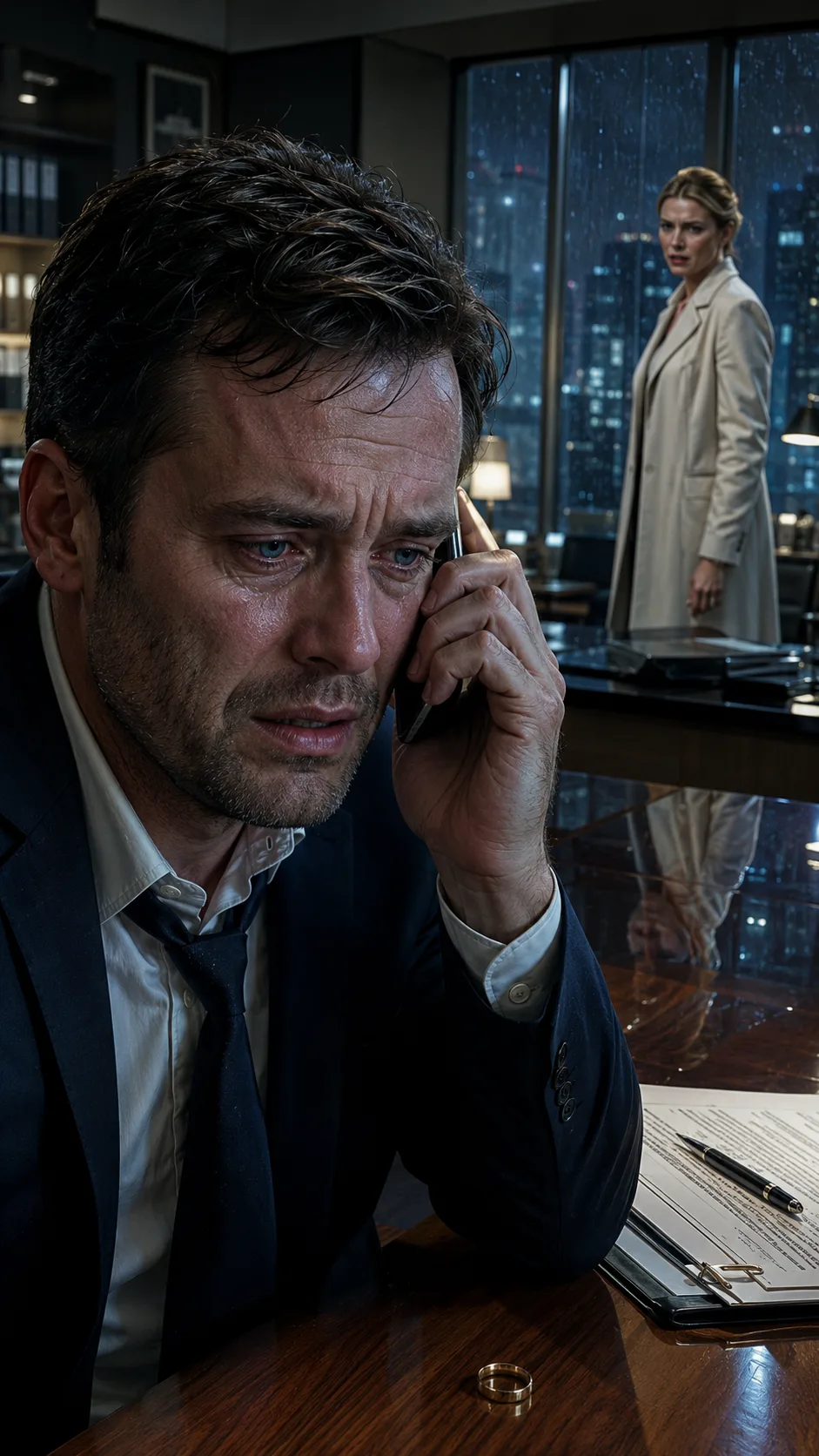
For the first time that night, Claire looked afraid.
Chapter 3
For the first time that night, Claire looked afraid.
Not sad.
Not sorry.
Afraid.
That was when David knew the truth was bigger than thirty-four thousand dollars.
The lawyer, Mr. Morrison, removed his glasses slowly. He had the expression of a man who had just realized a divorce meeting had become something much darker.
“Mrs. Hayes,” he said carefully, “did you obtain those funds directly from Mrs. Eleanor Hayes?”
Claire lifted her chin. “This is a marital matter. It has nothing to do with his mother.”
David almost didn’t recognize his own voice when he answered.
“You made it about my mother when you stole from her.”
Claire’s eyes flashed. “I did not steal. She gave that money willingly.”
“My mother gave it because you lied.”
“She is a grown woman.”
“She is a lonely woman who trusted you because you were my wife.”
That landed.
Claire looked toward the glass wall, where the city lights trembled behind rain.
For one second, David saw the old Claire, the woman he had proposed to beside Lake Michigan, the woman who cried during hospital commercials, the woman who used to bring Eleanor soup when she was sick.
Then the mask returned.
“You want the truth?” Claire said. “Fine. Your mother was always in our marriage.”
David stared at her.
Claire’s voice rose, but not with pain. With resentment that had been rehearsed alone for years.
“Every birthday, she called first. Every holiday, you worried about whether she felt included. Every decision, you thought about her. When we bought the house, you asked if the guest room would be comfortable for her. When we planned vacations, you checked whether she needed anything before we left.”
David shook his head slowly.
“She was my mother.”
“She was your first wife,” Claire snapped.
The words disgusted even the lawyer. His face tightened.
David stepped
back as if she had struck him.
On the phone, Eleanor began to cry quietly.
That sound ended the conversation.
David lifted the phone closer to his mouth. “Mom, I’m still here.”
“I’m sorry,” Eleanor whispered. “I’m so sorry.”
“You did nothing wrong.”
“I never wanted to cost you your marriage.”
David looked at Claire.
“You didn’t.”
Then he hung up gently, not because he was done with his mother, but because he did not want her to hear what came next.
He turned to Mr. Morrison.
“I need copies of everything in that folder. And I need a referral to an attorney who handles financial exploitation of elders.”
Claire laughed once, brittle and stunned. “You’re going to accuse your own wife of elder abuse?”
David did not blink.
“I’m going to tell the truth.”
Her confidence started to collapse.
“David, stop. You’re emotional.”
“No,” he said. “I was emotional
when I let you convince me that my mother was a problem. I’m clear now.”
He took the bank statement and laid it flat on the table.
“Did you ask my mother for money?”
Claire pressed her lips together.
“Did you tell her I was too embarrassed to ask?”
No answer.
“Did you tell her we might lose the house?”
Still nothing.
“Did you make her promise not to tell me?”
Claire’s jaw trembled.
Mr. Morrison reached for his notepad.
Claire saw it and snapped, “Don’t write that down.”
The lawyer paused.
David gave a tired, humorless smile.
“That’s the first honest thing you’ve said tonight.”
Claire’s anger broke open.
“You have no idea what it’s like being married to a man who still belongs to the woman who raised him.”
David’s face hardened.
“She raised me because my father walked out. She worked nights so I could sleep. She skipped meals so I could eat. She wore shoes with holes so I could have a winter coat. And you stood here tonight asking me to prove I loved you by abandoning her.”
Claire’s eyes filled with tears then, but David no longer trusted tears that arrived only when consequences did.
“I was drowning,” she whispered. “The credit cards, the house, the image we had to keep—”
“We?” David said. “I didn’t know we were keeping an image.”
“You liked the life too.”
“I liked being married. I didn’t know I was funding a performance.”
Mr. Morrison quietly opened another file.
“There is something else,” he said.
Claire spun toward him. “No.”
David looked at the lawyer. “What?”
Mr. Morrison hesitated, then slid forward a printed email chain.
Claire reached for it, but David took it first.
The emails were between Claire and a real estate agent.
Subject line: Quick sale options — senior property.
David read the first few lines and felt his stomach turn.
Claire had asked how quickly a small house owned by an elderly widow could be sold if the widow entered assisted living. She had attached a photo of Eleanor’s house. She had asked whether “an adult child with power of attorney” could speed up the process.
David looked up slowly.
“You were trying to sell my mother’s house.”
Claire whispered, “Only as a backup plan.”
“You don’t have power of attorney.”
“I thought you would sign it once she moved.”
The room went silent.
There it was.
The full shape of it.
Claire had not wanted boundaries.
She had wanted access.
She wanted Eleanor isolated, ashamed, moved away, and legally dependent. Then she wanted David to sign papers he would barely read because he trusted his wife more than his own discomfort.
David felt sick.
Not because the marriage was ending.
Because he had almost helped her.
He remembered every time his mother sounded small on the phone. Every time she said, “I don’t want to bother you.” Every time David accepted that sentence because it was easier than asking who had taught her to say it.
He gathered the documents.
Claire’s tears fell now.
“David, please. We can fix this.”
He looked at her for a long moment.
“There are some things you don’t fix,” he said. “You confess them.”
Within an hour, David was at his mother’s house.
Eleanor opened the door before he knocked, still in her gray cardigan, her white hair pinned loosely at the back of her head. She looked smaller than he remembered. Or maybe guilt made him see what he had missed.
The moment she saw him, she covered her mouth.
“Oh, David…”
He stepped inside and wrapped his arms around her.
For a while, neither of them spoke.
He felt her trembling against him. This woman who had survived abandonment, poverty, years of hard work, and loneliness still trembled because she feared being a burden to her own son.
David held her tighter.
“I’m sorry,” he whispered.
She shook her head. “No.”
“Yes,” he said. “I let someone make you feel unwanted.”
Eleanor cried into his suit jacket.
In the kitchen, he found the truth in pieces.
A drawer full of unpaid medical bills because she had given Claire her savings.
A broken heater she had been too ashamed to ask him to repair.
A notebook where she had written down every call she wanted to make to him, then crossed most of them out.
Beside one crossed-out line, she had written: He has his own life now.
David sat at the table and wept silently.
The next morning, Claire called sixteen times.
He did not answer.
By noon, Mr. Morrison had connected David with an attorney named Rebecca Sloan, who specialized in elder financial abuse. By Monday, a demand letter was sent. By Wednesday, Claire’s accounts were frozen pending investigation. By Friday, David filed for divorce with evidence attached.
Claire tried to rewrite the story.
She told friends David had “chosen his mother over his wife.” She told her sister Eleanor had manipulated him. She posted a vague quote online about toxic family bonds.
Then Rebecca sent one document to Claire’s attorney.
The email chain about selling Eleanor’s house.
Claire deleted the post within ten minutes.
The divorce was ugly, but short.
People who lie well often collapse when paperwork begins speaking for them.
Claire agreed to repay every dollar she had taken from Eleanor, plus legal fees. The house David and Claire had lived in was sold. David used his share not for a bachelor apartment downtown, not for a new car, not for revenge.
He repaired his mother’s roof.
Replaced her heater.
Paid her medical bills.
Then he bought the small empty house next door to hers.
Eleanor protested, of course.
“You don’t have to live beside your old mother,” she said, standing in the yard while contractors carried lumber past them.
David smiled.
“I’m not living beside my old mother.”
She looked at him, confused.
He put an arm around her shoulders.
“I’m living beside the woman who never made me choose.”
A year later, David received a letter from Claire.
No perfume. No dramatic handwriting. Just a plain envelope forwarded through attorneys.
He almost threw it away.
Instead, he opened it at his mother’s kitchen table.
Claire wrote that she had started therapy. That she finally understood love was not supposed to be a competition. That she had confused being second with being unloved. That none of it excused what she had done.
At the bottom, she wrote:
I lost because I tried to make you prove love by betraying it.
David folded the letter and placed it back in the envelope.
Eleanor, who was making tea, asked, “Was it from her?”
“Yes.”
“What did she say?”
David looked out the kitchen window.
Rain tapped softly against the glass, but inside the house, the heater hummed, the lights glowed warm, and his mother’s hands no longer shook when she poured tea.
“She finally told the truth,” he said.
Eleanor set a mug in front of him.
“And how did that feel?”
David thought about the lawyer’s office. The ultimatum. The phone call. The ring on the paper. The moment he almost lost the only person who had never once asked him to earn her love.
Then he reached across the table and squeezed his mother’s hand.
“Like coming home.”
THE END
Chapter complete
You have reached the end of this chapter.
Continue reading
A few more worlds to get lost in after this chapter.




