He Called Another Woman His Wife in Front of Me.
Chapter 1
He Called Another Woman His Wife in Front of Me. That Was the Day He Lost Everything
4,844 words
That Was the Day He Lost Everything
The ultrasound consent form had a coffee stain on the bottom corner.
Valeria noticed it before she noticed anything else that afternoon. A small brown crescent near the line where she was supposed to sign her name. The paper smelled faintly of printer ink and hospital disinfectant, and the pen chained to the clipboard did not work unless she pressed hard enough to leave dents.
She pressed hard.
Her hand rested on the curve of her stomach between each line. Six months. Twenty-four weeks. A small person turning and shifting beneath the cream dress Ricardo had once said made her look like something out of a painting.
He was supposed to be there.
He had promised the night before, standing at the kitchen sink with his sleeves rolled up, rinsing a plate he had not used.
“I’ll make it this time,” he said.
Valeria had looked at him over the rim of her water glass. “You said that last time.”
“I know.”
“And the time before that.”
He shut off the tap. Water dripped from his fingers into the sink. “Tomorrow. I swear.”
She wanted to believe him. Want was not the same as trust, but some mornings it wore the same clothes.
So she dressed carefully. She tied her hair back. She wore the small gold earrings his mother had given her on their wedding day. She drove herself to the General Hospital of Guadalajara because he had texted at 11:17 a.m. that a client call was running late, but he would meet her there.
She did not reply right away.
At 11:22, she wrote: I’ll wait.
Now it was almost one.
A child across from her kicked the leg of a plastic chair. His mother told him to stop without looking
up from her phone. An older man held a yellow envelope against his chest. A nurse at the desk called names in a voice that had learned not to carry anyone’s fear home.
Valeria checked her phone again.
No message.
The baby shifted under her palm.
“I know,” she said under her breath. “Me too.”
The hallway doors burst open.
At first it was only noise. Shoes scraping tile. A nurse calling for a wheelchair. A woman crying out with the kind of pain that made everyone in the waiting area go still.
Then Valeria heard her husband’s voice.
“Make way! My wife is going to give birth!”
The pen slipped from her fingers and swung from the clipboard chain.
Ricardo came through the corridor with his arm wrapped around a pregnant woman.
Not a stranger he was helping. Not a woman he happened to guide through the emergency entrance.
His hand was firm at her waist. His body leaned into hers with an intimacy too practiced to mistake. Her face was damp, her hair loose around her cheeks, one hand gripping his shirt so tightly the fabric pulled against his chest.
The hallway shrank.
Valeria stood.
Ricardo turned his head while shouting something at the nurses, and his eyes landed on her.
His mouth stopped moving.
The woman sagged against him. “Ricardo, please.”
She knew him.
Of course she knew him.
But then her eyes flicked toward Valeria, and something else passed across her face.
She knew Valeria too.
The nurse pushed the wheelchair between them. “Sir, step aside. Ma’am, sit down. We need to move.”
Ricardo did not move.
“Valeria,” he said.
People watched. They tried not to, which made it worse. A woman by the vending machine lowered her water bottle. The older man with the X-ray envelope stared at the floor. The child stopped kicking the chair.
Private ruin had walked into a public hallway wearing a wrinkled blue dress and holding Valeria’s husband by the shirt.
Valeria looked at Ricardo’s hand.
It was still on the woman’s back.
She should have screamed. She should have thrown the clipboard at him. She should have asked him what kind of man called another woman his wife while his real wife sat three chairs away, carrying his child.
Her mouth did not choose any of those things.
It smiled.
Not wide. Not kind.
Just enough.
“Go,” she said.
Ricardo blinked. “Listen to me.”
“Go. Your wife needs you.”
The woman let out another cry. The nurse shoved the wheelchair forward. Ricardo moved with it because the body often confesses before the mouth is ready.
He looked back once.
Valeria watched him disappear through the maternity doors.
The clipboard remained on the chair behind her.
She left it there.
Outside, the afternoon sun slapped the hospital entrance white. Cars crawled past the curb. A vendor at the corner sold cups of fruit under a red umbrella, and the smell of lime and chili drifted through the heat.
Valeria walked to her car with one hand under her belly.
She unlocked the door.
Then she stood there.
The parking lot shimmered. Someone honked. A woman laughed into her phone near the pharmacy entrance.
Valeria lowered herself into the driver’s seat and shut the door.
No sound came out.
Not at first.
She placed both hands on the steering wheel, ten and two, the way her father had taught her when she was seventeen and terrified of merging into traffic. Her wedding ring clicked softly against the leather.
That click did something.
One breath broke loose. Then another. She bent forward until her forehead touched her hands.
The baby moved.
Valeria straightened.
“No,” she said.
One word.
She drove home.
The house looked exactly the same, which felt like an insult.
The fern by the window leaned toward the light. Ricardo’s shoes sat near the couch, one tipped sideways. A delivery menu from the restaurant they liked was still on the coffee table. Their wedding photo hung in the hall: Valeria in ivory lace, Ricardo laughing as if joy had been invented for him personally.
She stopped in front of it.
His face in the photo looked younger. So did hers. Her hand rested on his chest. His ring caught the light.
She remembered that day because it had rained for ten minutes after the ceremony, hard enough to send guests running under the awning. Ricardo had taken off his jacket and held it over her head. His shirt soaked through. He kissed her in the parking lot while her mother shouted that her hair would fall apart.
That man had seemed real.
Maybe he had been.
Maybe the worst part was not that people lied. It was that they could also tell the truth sometimes, and you were left sorting through both piles with bleeding hands.
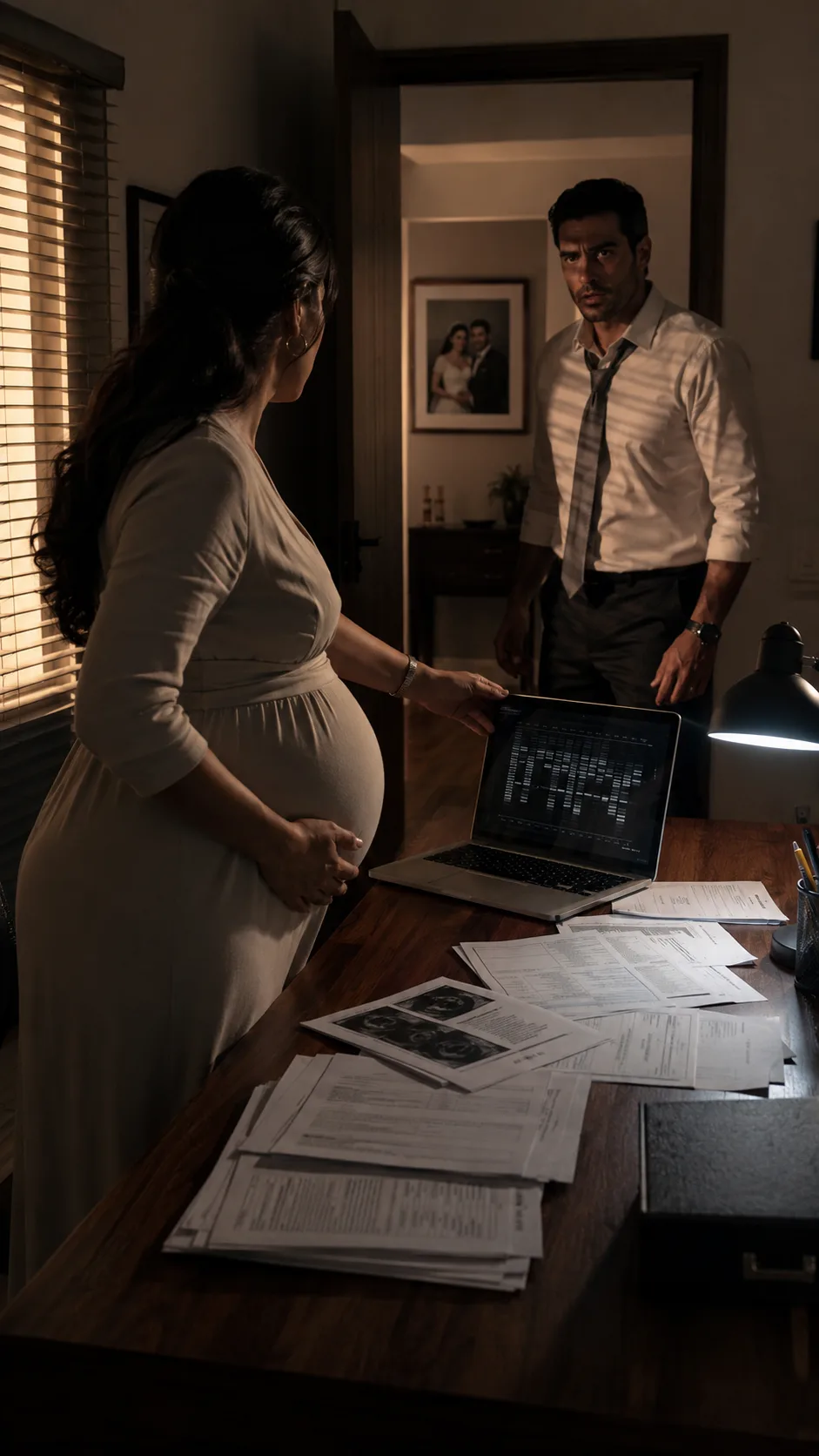
Valeria went to the study.
Ricardo’s laptop sat closed on the desk.
He treated it like a locked room inside their marriage. Client files, he said. Contracts. Sensitive financial documents. Real estate deals with people who loved secrets more than numbers.
He changed the password every few months.
At first, he used dates from their life.
Their anniversary.
Her birthday.
The day they bought the house.
Then he stopped telling her when it changed. He laughed when she noticed.
“You don’t need to get into my work laptop,” he said once, kissing her temple.
She had been making tea. Peppermint, because the nausea was bad that week.
“I don’t need to,” she said.
It had sounded healthy at the time.
She opened the laptop.
Password.
She typed their anniversary.
Wrong.
Her birthday.
Wrong.
The name they had chosen for the baby if it was a girl.
Wrong.
Valeria sat back. The study smelled like cedar polish and old paper. A pen rolled slowly toward the edge of the desk because one leg was uneven, and Ricardo kept saying he would fix it.
She stared at the blinking cursor.
Then she typed the date of her first miscarriage.
The laptop unlocked.
Her fingers lifted from the keys.
The room did not move, but she felt the floor change beneath her.
That date had lived in their house like a locked cabinet. They did not speak of it anymore. The baby they lost at ten weeks. The white hospital bracelet. The nurse who brought her a paper cup of water she never drank. Ricardo sitting beside the bed with his head bowed, both hands over hers.
“I’m here,” he had said then. “I’m not going anywhere.”
He had used that date to hide another woman.
Valeria opened the files.
The first ten minutes showed nothing. Real estate contracts. PDFs. Client folders. Spreadsheets. Then she noticed a folder named “M.”
Too plain.
She clicked.
Inside it was another folder.
“Receipts.”
Inside that was another.
“L.C.”
Hotel bookings. Bank transfer confirmations. Photos from restaurants cropped badly enough to cut off a woman’s face but not her hand on the table beside Ricardo’s. Ultrasound images. A private clinic invoice.
Valeria’s hands stayed still.
Stillness became useful.
She opened the messages synced to his laptop.
Lucía.
The name appeared hundreds of times.
The first message she clicked was six months old.
I hate hiding.
Ricardo’s reply sat under it.
I know.
You promised you’d tell her after the first trimester.
I will.
When?
Valeria’s pregnancy complicates everything.
Valeria read that line four times.
Her name had become a scheduling problem.
She kept reading.
Lucía worked in property development. She had met Ricardo at a conference in Monterrey. At first their messages were light, almost ridiculous in their caution. Then the tone changed. Dinner became hotel. Hotel became weekends disguised as client trips. There were complaints, promises, apologies, pet names.
Valeria did not cry.
She clicked and clicked.
At some point, the study door creaked because the air conditioner turned on downstairs.
She did not look up.
Lucía knew about Valeria from the beginning. That fact settled into the room with a weight of its own.
You said she couldn’t have children naturally, Lucía wrote in one message.
Ricardo answered: Don’t talk about her.
The defense almost made Valeria laugh.
Almost.
Lucía pushed. Ricardo soothed. Then Valeria got pregnant, and the messages changed. Lucía became sharp. Ricardo became careful. The two of them discussed timing, announcements, money, clinics, delivery plans.
Then came another name.
Mateo.
Valeria stopped scrolling.
Who is Mateo?
She searched within the thread.
Mateo lands Friday.
Mateo suspects something.
I can’t keep lying to him.
He deserves to know before the babies are born.
Babies.
Not baby.
Valeria leaned closer.
Ricardo’s reply came three nights before.
Absolutely not. If Mateo finds out, everything explodes. We stick to the plan.
She searched the name in the inbox.
Mateo Salazar.
Lucía’s husband.
Valeria stood up too fast. The chair legs scraped the floor. She placed both hands on the desk until the room steadied.
Lucía was married.
Ricardo had known.
They had not been two tragic lovers trapped in unhappy marriages, not that it would have changed anything. They had been two adults building a bridge out of lies and asking everyone else to walk over it blindfolded.
Valeria sat down again.
There was an unopened PDF in Ricardo’s email, attached to a chain from a private laboratory.
Prenatal Paternity Panel.
The file had arrived that morning.
Before the hospital.
Before he shouted.
Before he called Lucía his wife.
Valeria clicked.
The PDF loaded one page at a time. Header. Patient identification. Alleged father. Sample numbers. Lab seal.
Her eyes moved down.
Probability of paternity: 0.00%.
Alleged father Ricardo Castañeda is excluded.
Valeria stared at the result.
Lucía’s baby was not Ricardo’s.
For a few seconds, the betrayal rearranged itself into something uglier. Ricardo had risked their marriage, their child, their life, for a baby that was not even his. He had made Valeria into the obstacle between himself and a fantasy built on another man’s child.
A sound came from her throat.
Not a sob.
Not a laugh either.
Something cracked and dry.
She scrolled lower.
There was a note beneath the lab result. A routine flag, almost buried under technical language.
Maternal sample reveals prior fertility treatment markers. Review of assisted reproduction records recommended.
Valeria stopped breathing properly.
Fertility treatment.
She and Ricardo had spent two years inside clinics. Blood tests before breakfast. Hormone injections in hotel bathrooms. Waiting rooms full of women who looked away from each other because hope made everyone too exposed.
Their final embryo transfer had been at San Gabriel Fertility Center.
Valeria remembered the day too clearly.
The blue paper gown. The nurse who kept checking a clipboard. A delay of forty minutes. A whispered argument beyond the half-closed door. Ricardo squeezing her hand.
“Almost there,” he said.
The doctor had come in smiling too hard.
Valeria searched Ricardo’s files again.
San Gabriel.
Cryostorage.
Transfer.
Nothing obvious.
Then she searched Salazar.
A file appeared in an administrative email chain buried under invoices.
Internal Review — Storage Transfer Incident.
The attachment opened.
She read the first paragraph.
Then the second.
Two couples.
Cryostorage transfer.
Similar labeling sequence.
Potential specimen mislabeling.
Immediate internal containment.
Legal consultation advised.
One couple: Castañeda.
The other: Salazar.
Valeria lowered herself onto the floor beside the desk.
Her body did not ask permission. Her knees simply gave out. She sat with one hand pressed over her mouth and the other clamped to her stomach.
The baby moved under her palm.
She looked at the wedding photo on the shelf beside Ricardo’s books. Smaller than the one in the hall. A candid shot from the reception. Ricardo’s mother dancing with a glass of champagne. Valeria laughing at something out of frame.
People loved to say children saved marriages.
Valeria had always hated that sentence.
Children were not glue. They were not rope. They were not repayment for pain.
But this child had been the one place she had still allowed light.
Now even that light had a name written over it in clinic language and legal caution.
Potential specimen mislabeling.
The front door opened downstairs.
Valeria did not move.
Ricardo called her name.
No answer.
His footsteps crossed the living room, paused near the staircase, then came up too quickly. The rhythm was uneven. He hit the top step and stopped outside the study door.
“Valeria?”
She rose from the floor using the edge of the desk.
He appeared in the doorway.
He looked worse than he had in the hospital. His shirt was wrinkled at the sleeves. His tie hung loose. His hair had been pushed back by nervous hands. There was a red mark near his collar where Lucía must have grabbed him during the contractions.
Valeria noticed that too.
He looked from her face to the laptop.
Then to the papers.
“Please,” he said. “Let me explain.”
She stood behind the desk.
The room had become very quiet. The air conditioner hummed through the vent. A car passed outside. Somewhere down the street, a dog barked twice and stopped.
Ricardo stepped inside.
“Lucía is—”
“Pregnant,” Valeria said. “Yes. I saw.”
His throat moved.
“She went into labor early.”
“So you called her your wife.”
He closed his eyes for half a second. “I panicked.”
“You held her like you practiced.”
That hit him. Not enough to make him speak truth, but enough to make his shoulders tighten.
“I never wanted you to find out like that.”
Valeria looked at him.
“Did you want me to find out at all?”
He had no answer ready.
Good.
She turned the laptop toward him.
His eyes dropped to the screen.
At first, he only looked confused. Then he leaned closer. His hand reached for the chair but caught the backrest awkwardly. He read the lab header, the names, the result.
Probability of paternity: 0.00%.
His face emptied.
“No.”
Valeria said nothing.
He read again.
“No, that’s not right.”
She watched him move through denial like a man feeling for a wall in the dark.
“You didn’t open it,” she said.
His eyes lifted.
“The result came this morning. You didn’t open it.”
“I was at the hospital.”
“You were with your wife.”
He flinched.
The word had teeth now.
“She told me the baby could be mine.”
“And you believed her.”
“I had reason to.”
“Because you were sleeping with her while I was taking hormone shots in our bathroom?”
Ricardo’s mouth opened. Then closed.
Valeria picked up one sheet from the desk and set it beside the laptop.
“That baby is not yours.”
He stared at the paper as if it might change out of pity.
It did not.
“The baby you humiliated me for,” Valeria said, “is not yours.”
He sank into the chair.
Not fully. His knees bent, then he caught himself and remained half-standing, one hand on the desk, one hand loose at his side.
“Valeria.”
“Don’t say my name like it belongs in your mouth.”
His face pulled tight.
She opened the second document.
The fertility clinic incident report filled the screen.
Ricardo’s eyes moved slowly across the words.
This was different. The paternity result had struck him. The clinic report entered him more quietly, and Valeria watched the blood leave his face line by line.
He saw their surname.
Then Salazar.
Then the phrase that had put Valeria on the floor.
Potential specimen mislabeling.
“No,” he said.
One word.
Barely there.
Valeria waited.
He leaned closer, reading again, his breath coming shorter now. “This is internal. This isn’t final.”
“No.”
“They would have contacted us.”
“Would they?”
He looked up at her.
The question hung between them because both of them knew the answer. Clinics had lawyers. Lawyers had clocks. Patients had bodies already changed by decisions made in rooms they were never allowed to enter.
Ricardo shook his head once. “No. No, this can’t be.”
Valeria placed her palm over her stomach.
For the first time since the hospital, her hand trembled.
“If this report is true,” she said, “then the child inside me may not be yours.”
Ricardo stared at her hand.
Not at her.
At the child.
His face did something strange then. It folded inward without sound. He looked like a man watching a house burn from the inside while still standing in the living room.
“You don’t know that,” he said.
“No.”
“We need another test.”
“Yes.”
“We need to call the clinic.”
“Yes.”
He gripped the desk. “You should have called me before opening all this.”
Valeria smiled again.
That same small hospital smile.
“There he is.”
Ricardo’s eyes sharpened. “What?”
“There’s the man who thinks the worst part is that I read the evidence.”
His jaw worked.
She picked up the printed paternity report and held it between two fingers.
“Tell me something.”
He said nothing.
“When you were at the hospital, when you called her your wife, what was I supposed to be?”
The question moved through the room slowly.
Ricardo looked toward the hall, where the smaller wedding photo sat crooked on the shelf. He had knocked it slightly when he came in. In the picture, his own smile watched him from five years ago.
“I made a mistake.”
Valeria lowered the paper.
“A mistake is forgetting milk.”
He closed his eyes.
“A mistake is putting salt in coffee because you’re tired. A mistake is missing an exit.”
She set the report down.
“You built a second life and made me wait in the lobby.”
He covered his mouth with one hand.
Maybe he was crying. Maybe he was trying not to be sick.
Valeria no longer needed to know which.
The phone on the desk buzzed.
Both of them looked down.
Ricardo’s phone.
The screen lit up with an unknown number.
For one second, neither moved.
Then another message appeared.
This is Mateo Salazar. I think your husband has been sleeping with my wife. We need to talk about the babies.
Valeria read it once.
Ricardo read it too.
The whole house seemed to go quiet around that sentence. The refrigerator downstairs clicked off. The blinds tapped once against the window frame.
Valeria reached for the phone.
Ricardo moved at the same time.
She got there first.
His fingers closed around empty air.
“Don’t,” he said.
She looked at him.
“Don’t what?”
“Don’t make this worse.”
The sentence left his mouth and died between them.
Valeria held the phone in her hand. Its screen glowed against her palm, lighting the thin gold band on her finger.
Worse.
She looked at the ring.
Then she slid it off.
It took effort. Her fingers had swollen in pregnancy. The ring resisted for a second, then came free.
She placed it on the desk beside the paternity report.
A small sound.
Metal on wood.
Ricardo looked at it like it was a verdict.
Valeria typed one reply to Mateo.
Come to the house.
Ricardo grabbed the edge of the desk. “No.”
She sent it.
Then she turned the phone face down.
The next twenty minutes were not dramatic.
That was the part Valeria would remember later.
No shouting. No thrown glass. No begging on knees. Ricardo paced from the window to the door and back again. Valeria sat in the chair he had used every night to answer emails while she washed dishes downstairs.
She opened a new folder on the laptop and copied every file onto a drive.
Paternity report.
Clinic incident report.
Messages.
Transfers.
Invoices.
Screenshots.
Ricardo watched.
“Are you sending those to a lawyer?”
“Yes.”
“You don’t even know what happened with the embryos.”
“I know what happened with you.”
He stopped pacing.
That was enough.
Mateo arrived in a dark gray suit with no tie.
He was taller than Valeria expected, clean-shaven, carrying the kind of controlled stillness that people get after they have already broken something in private and have nothing left to perform in public. His eyes went first to Ricardo, then to Valeria’s stomach.
He did not stare.
He looked away quickly.
“Mrs. Castañeda?”
“Valeria.”
He nodded once. “Mateo.”
Ricardo stood near the bookcase like furniture.
Mateo stepped into the study. His gaze moved across the desk: laptop, papers, ring, phone.
He understood the arrangement before anyone explained it.
“Lucía had the baby,” he said.
Valeria’s hand tightened on the armrest.
“A boy.”
Ricardo’s face changed.
Mateo looked at him then.
“She asked for you.”
Ricardo did not move.
Mateo pulled an envelope from his jacket pocket and placed it on the desk.
“I had my own doubts,” he said. “Not about the affair. About the dates.”
Valeria looked at the envelope.
Mateo tapped it once.
“My attorney requested records two weeks ago. I didn’t know about the clinic report until this morning.”
Ricardo’s voice came out rough. “You knew?”
Mateo did not answer him right away.
He turned to Valeria instead.
“I’m sorry you found out at the hospital.”
That was the first apology anyone had given her that day.
It came from the wrong husband.
Valeria nodded once because she did not trust her mouth with kindness yet.
Mateo opened the envelope.
Inside were copies of forms from San Gabriel Fertility Center. Consent documents. Storage receipts. A timeline of transfers. Names blacked out in places, but not enough.
“The clinic contacted my lawyer when he pushed,” Mateo said. “They said there may have been a labeling irregularity affecting two families.”
Ricardo sat down.
This time, fully.
His body made the chair creak.
Mateo looked at him again. “My wife is recovering. She still thinks you might be the father.”
“He’s not,” Valeria said.
Mateo’s eyes moved to the paternity report.
He read it.
His hand stopped on the paper.
No triumph crossed his face. No relief either. Only the arithmetic of a life becoming more complicated.
“The baby is mine,” he said.
“Maybe,” Valeria said.
He looked up.
She turned the clinic report toward him.
Mateo read.
The room became a place where men stopped having answers.
Valeria almost laughed again. Not because anything was funny. Because for years, the men around her had spoken in decisions. We’ll wait. We’ll try again. We’ll not tell her yet. We’ll stick to the plan.
Now all their plans sat under a desk lamp like dead insects.
Mateo lowered the report.
“We need legal counsel,” he said.
“Yes.”
“And independent testing.”
“Yes.”
“And no one speaks to the clinic alone.”
Valeria looked at Ricardo.
He did not look back.
Good.
Mateo gathered his papers slowly. “Lucía doesn’t know about the paternity result?”
Ricardo rubbed both hands over his face.
“No.”
Mateo nodded once.
A muscle moved in his jaw.
“Then I’ll tell my wife.”
My wife.
The words landed differently this time. Not like Ricardo’s performance in the hospital hallway. Mateo said them like a burden he had chosen before the truth and still had to carry after it.
He walked to the doorway, then stopped.
“Valeria.”
She looked at him.
“No matter what the tests say, the children are not evidence. They’re children.”
For the first time all day, Valeria’s hand moved to her stomach without fear.
“Yes,” she said.
Mateo left.
Ricardo remained in the chair.
The study grew darker as the sun shifted. The striped shadows from the blinds climbed the wall and broke across the wedding photo. Valeria stood and turned on the overhead light. It made everything look plain. Paper. Wood. Skin. Dust on the bookshelf.
Ricardo looked older under it.
“What happens now?” he asked.
Valeria picked up her ring from the desk.
For a second, he looked hopeful.
She placed it inside the top drawer, beside an old tape measure and a box of spare keys.
“Now I sleep in the guest room.”
His face tightened.
“Valeria.”
“Tomorrow I call a lawyer.”
He stood. “Please don’t do this tonight.”
She looked at him for a long time.
“You did not start today.”
He had no answer.
She collected the drive, the printed reports, and her phone. At the doorway, she stopped beside the small wedding photo on the shelf. It was still crooked.
She straightened it.
Then she turned it face down.
The guest room smelled faintly of lavender sachets and unused linens. Valeria sat on the edge of the bed without turning on the lamp. Her cream dress was wrinkled across her stomach. Her earrings pinched. She removed them and placed them on the nightstand.
The baby shifted.
She waited.
A small kick pressed against her palm.
There you are.
She did not say it out loud.
Down the hall, a floorboard creaked. Ricardo did not knock.
Good.
Valeria opened her phone and found the ultrasound clinic number. She would need to reschedule. She would need a lawyer. A doctor. A test no one connected to San Gabriel could touch. She would need to speak to Mateo again, and maybe one day to Lucía, though not today.
Not tonight.
Tonight there was only the guest room, the small kick beneath her hand, and the knowledge that motherhood had been dragged into a battlefield by people who mistook secrecy for control.
The next morning, Ricardo was asleep on the living room couch.
Valeria saw him on her way to the kitchen. His shirt was still wrinkled. One arm hung off the cushion. His shoes remained by the couch where she had seen them the day before.
She made coffee.
Only one cup.
The machine sputtered too loudly in the quiet house. She opened the drawer for a spoon and found the tiny yellow rubber duck they had once bought as a joke after their first fertility consultation. Ricardo had placed it there, saying the baby would need options for bath time.
She held it in her palm.
Small. Ridiculous. Bright.
Then she set it beside her cup.
Her phone buzzed.
Mateo.
I have a lawyer. I also have an independent clinic willing to test both children after birth and run prenatal confirmation for you if your doctor approves.
Valeria read the message twice.
She typed back: Send the information.
Then she deleted the period and sent it without one.
Ricardo appeared in the kitchen doorway.
His hair was flattened on one side. His face looked hollow.
“Can we talk?”
Valeria poured milk into her coffee.
“No.”
“Please.”
She stirred once. Twice. The spoon clicked against ceramic.
“I need to know if you’re leaving me.”
She looked at him over the cup.
“You already left. I’m just changing the locks.”
His mouth closed.
The baby kicked again.
Valeria placed one hand on her stomach and picked up the rubber duck with the other.
She walked past Ricardo into the hall.
The wedding photo still lay face down on the shelf.
She did not turn it back over.
Outside, Guadalajara had started another ordinary morning. Traffic moved. A neighbor watered plants in blue slippers. Somewhere nearby, a child laughed too loudly for the hour.
Valeria stood at the front door with her coffee cooling in her hand.
For years, she had thought the worst thing a marriage could do was end.
Now she knew better.
The worst thing was to continue as if the ending had not already arrived.
She opened the door.
Light came in.
Not soft.
Real.
THE END.
Chapter complete
You have reached the end of this chapter.
Continue reading
Find your next story
A few more worlds to get lost in after this chapter.




