He Asked His Son to Choose a New Mother.
Chapter 1
He Asked His Son to Choose a New Mother.
The Child Chose the One Woman No One Dared to See
Emily Carter found the first broken glass at 7:12 in the morning.
It lay beneath the crystal breakfast cart in the east dining room, one thin crescent of it shining under the tablecloth like a little moon. She crouched, pinched it carefully between two fingers, and dropped it into the folded napkin in her palm.
The Harrington estate had rules for everything.
Silverware faced inward. Fresh flowers were replaced before the petals curled. Shoes were never heard on the marble after ten at night. Staff did not linger in hallways. Staff did not use the front staircase. Staff did not ask why five guest suites had been prepared with silk sheets, fresh perfume trays, and new ivory stationery embossed with the Harrington crest.
Emily knew all of those rules.
She had learned them the hard way.
Three years in
that house had taught her that wealth did not make people louder. It made them quieter. A raised eyebrow could dismiss a person. A pause before saying someone’s name could reduce them to dust. A door closed with no sound could still feel like a slap.
She tucked the napkin of broken glass into her apron pocket and turned toward the window.
Outside, the long driveway curved through two rows of black cypress trees. The morning was pale and clean. Too clean. The sort of morning that made every shadow look deliberate.
A small voice came from the doorway.
“Did you cut yourself?”
Emily turned.
Noah Harrington stood barefoot on the threshold in blue pajamas, hair sticking up on one side, one hand wrapped around the stuffed rabbit he denied still sleeping with.
“No,” Emily said. “Just found a piece before someone stepped on it.”
He looked at the floor,
then at her apron pocket.
“You always find things first.”
Emily smiled a little. “That is my job.”
“No,” he said. “It’s different.”
He did not explain.
Noah often didn’t. He had learned silence from the adults in the house. But his silence was not like theirs. Theirs had locks on it. His had bruises.
Emily crossed to him and knelt, careful not to touch him without permission. “Breakfast in ten minutes. Your father asked for you in the morning room.”
Noah’s face changed.
Only a small change.
His fingers tightened around the rabbit’s ear.
“Is he mad?”
“No.”
“Is he busy?”
Emily glanced toward the hall.
Michael Harrington was always busy. Even standing still, the man looked like a decision had just been made somewhere and he owned the consequence. He ran Harrington Global with the same polished severity he used at home: few words, clean lines, no visible
disorder.
“No,” Emily said. “He wants to talk to you.”
Noah looked down at his bare feet. “That’s worse.”
Emily had no answer for that.
The first car arrived at nine.
Then the second.
Then the third.
By the time the fifth rolled up the drive, Emily was standing behind the dining room doors with a silver tray in both hands, listening to the low purr of engines settle into silence outside.
The women entered like they had been selected by committee.
Vanessa Montgomery wore cream silk and pearls at her ears, though it was not yet lunch. She moved with the kind of beauty that expected rooms to rearrange themselves around it. Olivia Prescott came next, blonde, narrow-eyed, dressed in black with a leather folder under one arm. Cassandra Vale wore blush pink and smiled so brightly it looked rehearsed.
There were two others. Grace Halden, widow of a senator. Beatrice Shaw, art patron, thin as a knife and twice as sharp.
All five looked around the Harrington foyer.
All five saw the chandelier, the marble, the curved staircase, the portraits, the money.
Only Cassandra noticed Noah hiding behind the upstairs railing.
She waved.
Noah did not wave back.
Michael stood beside him, one hand at the small of his son’s back. Not pushing. Not exactly. But enough.
“Come down,” Michael said.
Noah obeyed.
Emily watched from the side corridor, tray held against her waist.
The boy descended the staircase as if each step had been numbered for inspection. His white shirt was buttoned wrong at the cuff. Emily noticed immediately. Michael did not.
Vanessa noticed Emily noticing.
Her eyes moved over the maid uniform, the plain black dress, the white apron, the pinned hair. Then her gaze slid away.
Staff.
Not worth holding.
Michael introduced the women one by one.
Noah said, “Nice to meet you,” five times.
Vanessa bent slightly. “Your father has told us so much about you.”
Noah looked at Michael.
“He has?”
A tiny pause.
Michael’s jaw set.
Emily lowered her eyes before anyone could catch her watching.
The month began that way.
With polished smiles and quiet tests.
Vanessa claimed the sunroom every morning and had coffee sent there at exactly eight. The first time it arrived with one sugar instead of two, she sent the cup back untouched and told the footman that details separated a household from a hotel.
Olivia asked for Noah’s school records by the second afternoon.
“Not to intrude,” she told Michael over lunch, though her pen was already uncapped. “But a boy in his position should have a structure that prepares him for influence.”
Noah sat across from her, pushing peas into a line with his fork.
Cassandra brought him an antique puzzle box from Vienna and clapped when he opened it in under a minute.
“My goodness,” she said. “You’re clever.”
Noah glanced at Emily, who was refilling water near the sideboard.
Emily gave no sign.
But that evening, she found the puzzle box abandoned beneath a library chair.
Noah was in the greenhouse.
He sat behind the lemon trees where the light came through green and soft. His knees were pulled to his chest. A half-eaten jam pastry rested in a napkin beside him.
Emily stopped at the edge of the tiled path.
“Too much?”
Noah shrugged.
“She talks like I’m a dog that learned a trick.”
Emily looked at the pastry. “Dogs don’t usually solve Viennese puzzle boxes.”
“They might.”
“Fair.”
He picked at the crust.
“Do I really have to choose one?”
Emily’s hands tightened around the watering can.
The rule in the Harrington house was simple: staff did not comment on family matters.
The rule inside Emily was older: a child who asked for help deserved the truth, even when truth had to be small.
“I think your father wants what he believes is best.”
Noah’s mouth twisted. “That’s what people say when they don’t want to answer.”
Emily almost smiled.
Almost.
“He loves you,” she said.
Noah nodded once, like that had been filed away under facts he could not use.
“But he doesn’t know me.”
Emily had no safe reply.
A bee tapped against the greenhouse glass. Once. Twice. Then found the open vent and disappeared.
Noah watched it go.
“My mom would know.”
Emily’s throat tightened before she could stop it.
She turned toward the fern shelf and adjusted a pot that did not need adjusting.
“What do you remember about her?”
Noah looked down at the rabbit in his lap. He had brought it after all.
“Her hands. Her singing. The smell of orange soap. I don’t remember her face unless I look at pictures.”
Emily closed her eyes for one second.
One second only.
Then she opened them and said, “Those are good things to remember.”
He studied her. “Did you know her?”
The watering can slipped slightly in Emily’s grip.
“No.”
The lie landed between them and stayed there.
That night, Emily took the small gold locket from beneath her pillow.
She sat on the edge of her narrow bed in the staff wing, the old radiator hissing beside her, and held the oval shape against her palm until the metal warmed.
Inside was the tiny painted magnolia.
Under it, the words were still there.
Come back to me.
Eleanor had laughed when Michael gave it to her. Emily remembered that laugh from before the Harrington name had swallowed her sister whole.
Before the coastal road.
Before the funeral.
Before the closed coffin.
Before the Harrington family declared the past finished and paid people well to agree.
Emily closed the locket.
“Not yet,” she said.
No one answered.
The first public cruelty happened on the fourth day.
Emily was carrying a welcome tray through the foyer when Vanessa stepped suddenly into her path. Not enough to make it obvious. Just enough.
The crystal glass slid.
Emily caught the tray, but not the glass.
It struck the marble and exploded into bright pieces.
The sound carried through the front hall.
Vanessa looked down at the shards.
Then at Emily.
“You stupid girl.”
Emily dropped to her knees at once.
“I’m sorry. It slipped.”
“Slipped?” Vanessa let out a little laugh. “Fine things don’t just slip. People like you shouldn’t be touching them.”
The other women appeared as if summoned by the sound.
Olivia crossed her arms.
Cassandra pressed a hand to her mouth, but her eyes were bright.
Michael came from the study.
“What happened?”
Vanessa turned toward him and became softer at once. “Your maid dropped my glass.”
Emily kept her head down.
One shard had sliced her finger. Blood gathered in a clean red bead, then ran along the side of her hand.
Michael saw it.
Before he could speak, Noah moved past him.
The boy crossed the marble floor, ignoring the broken crystal, and crouched beside Emily.
“Are you hurt?”
Emily shook her head. “It’s nothing.”
“You’re bleeding.”
Vanessa’s smile thinned. “That is sweet, Noah, but she’s staff.”
Noah looked up.
“She’s a person.”
The foyer changed after that.
Not loudly.
The Harrington house never changed loudly.
But Michael looked at his son, then at Emily, then at Vanessa.
Emily wrapped her injured finger in her apron before anyone could offer help she would not be allowed to accept.
Later, in the pantry, Mrs. Bell, the head housekeeper, shut the door behind her and said, “You need to be careful.”
Emily was rinsing blood from the cut.
“I know.”
“No, you don’t.” Mrs. Bell lowered her voice. “That boy cares for you. People like them don’t forgive that.”
Emily turned off the tap.
The water stopped.
Her finger still stung.
“People like them?”
Mrs. Bell gave her a look.
Emily dried her hand.
“I know exactly what people like them do.”
Mrs. Bell did not ask what that meant.
For the next two weeks, the women competed in different ways.
Vanessa filled the house with perfume and orders. She corrected Noah’s posture at dinner, his speech at breakfast, his silence in the afternoon.
Olivia treated him like a project. She presented Michael with schedules, tutors, summer programs, leadership camps, language instructors. She spoke about Noah’s future as if the boy were not sitting three chairs away.
Cassandra tried warmth. Too much warmth. She laughed before Noah finished sentences. She called him darling after knowing him for six days. She touched his shoulder once and he stepped back so sharply his chair hit the wall.
Emily saw.
Michael saw.
Neither said anything.
One rainy afternoon, Noah disappeared again.
The house searched the library, the music room, the gallery, the second-floor sitting room.
Emily found him under the grand piano.
His knees were pulled in. His suit jacket was wrinkled. There was a small rip at the cuff.
She sat on the floor beside the piano but did not crawl under.
The rain tapped the windows.
Tap.
Tap.
Tap.
“I hate choosing,” Noah said from the shadows.
Emily folded her hands in her lap. “Most people do.”
“No. I hate when people make me choose things they already decided.”
That was different.
Emily looked toward the closed music room doors.
“What would you choose if no one watched?”
He did not answer for a while.
Then his hand came out from beneath the piano. Small. Pale. Open.
Emily took it.
He squeezed once.
“You.”
The word struck her so hard she nearly pulled away.
“Noah.”
“You already know when I’m scared. You already know I hate crust. You know I don’t like people touching my hair. You know I pretend not to hear thunder.”
Emily looked down at their joined hands.
“You need more than that.”
“No, I don’t.”
“Yes,” she said. “You do.”
He slid out enough for her to see his face.
“Then why does everyone who has more feel worse?”
Emily had no answer.
That evening, Michael found her in the hall outside Noah’s room.
She had just left a cup of warm milk on the bedside table. Noah had fallen asleep with one hand under his pillow, where he hid the rabbit during the day.
Michael closed the bedroom door behind him.
“Emily.”
She turned. “Sir.”
He hated that word from her. He did not know when he had started hating it.
“My son trusts you.”
Emily looked at the carpet runner. “He is kind.”
“That is not what I said.”
“No.”
“Why?”
The question was too large for the hallway.
Emily folded her hands in front of her apron.
“Children trust people who listen.”
Michael’s face tightened.
“I listen.”
Emily said nothing.
That silence did what no accusation could.
Michael looked toward Noah’s door.
“I am trying to give him stability.”
“Stability is not the same as safety.”
The words left her before she could stop them.
Michael turned back.
For a moment, he looked less like a man who owned companies and more like a father standing in a hallway with no map.
“You speak as if you know what he needs.”
Emily met his eyes.
“I know what children need when adults decide grief is inconvenient.”
Michael went still.
The air between them sharpened.
Then Emily lowered her gaze. “Forgive me. I spoke out of place.”
“Yes,” he said.
But he did not sound sure.
The gala was announced two days later.
Mrs. Bell received the order at breakfast: every room opened, silver polished, terrace inspected, florals delivered by noon, live quartet by six, private security doubled.
“Mr. Harrington wants the west terrace available,” Mrs. Bell said, scanning the list. “Weather permitting.”
Emily looked up.
The west terrace.
Her stomach tightened.
Six years earlier, Eleanor had stood on that terrace in a pale blue dress and told Emily she was afraid.
Not of Michael.
Not exactly.
Of the family.
Of Margaret’s silence. Of the old lawyers. Of the sealed trust papers. Of the way people began finishing her sentences after Noah was born.
“I need time,” Eleanor had said. “If anything happens to me, you take this.”
She had pressed the locket into Emily’s palm.
Emily had laughed then because fear sounded ridiculous under chandeliers.
Three days later, the car went over the coastal road.
The world said Eleanor died instantly.
The world never asked who else had been in the car.
Emily still carried a thin scar beneath her ribs where the glass had gone in.
The gala night arrived under rain.
Not a soft rain. A steady one. Hard enough to turn the driveway black and make every guest hurry beneath umbrellas held by staff they did not thank.
The mansion burned with light.
Flowers filled silver urns. Champagne moved through the ballroom in crystal flutes. Women leaned close to one another and spoke behind diamonds. Men laughed with their mouths and calculated with their eyes.
Noah stood beside Michael near the center of the room.
Navy suit. White shirt. Hair combed flat until one stubborn piece lifted again.
Emily saw it from the second-floor gallery.
Her fingers moved before she remembered she was too far away to fix it.
Vanessa stood near Michael in dark emerald silk, one hand resting lightly on his arm. Olivia spoke with a senator near the fireplace. Cassandra laughed too loudly beside the quartet.
Society had already chosen finalists.
Noah looked like he wanted the floor to open.
Emily had been assigned upstairs.
Away from guests.
Away from the women.
Away from the decision.
She carried fresh hand towels to the west powder room, then paused near the gallery window.
Below, in the ballroom, Michael bent toward Noah.
The boy shook his head.
Michael said something.
Noah stepped back.
Then vanished into the crowd.
Emily set down the towels.
No one noticed her move.
She knew where he would go before anyone called his name.
The west gallery was dim, lit only by portrait lamps and the spill of gold from the ballroom behind. At the far end, the terrace doors stood open.
Rain blew in across the floor.
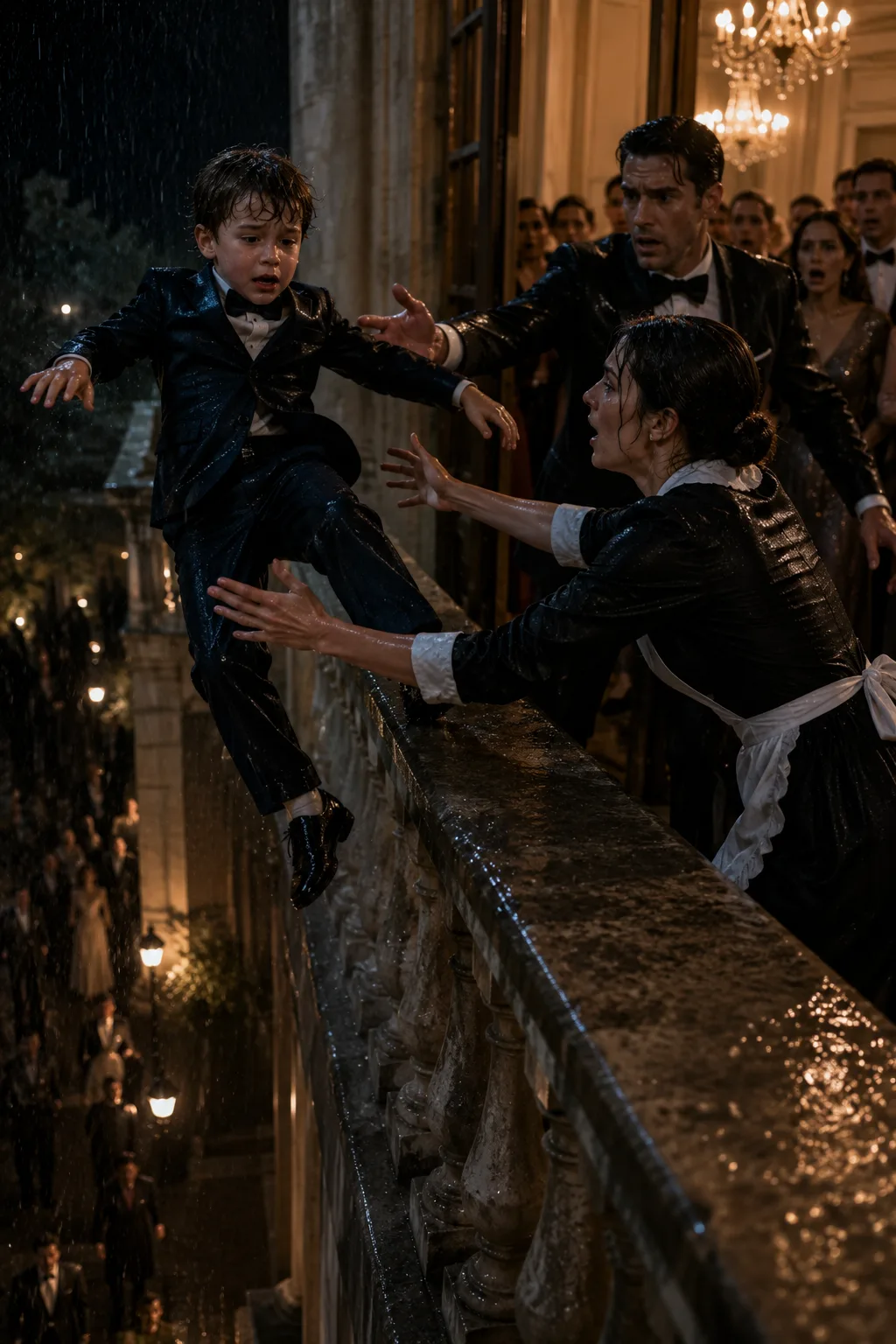
Noah stood beyond the railing.
Emily’s body stopped before her mind did.
For one second, the house went silent inside her.
Then she screamed his name.
The sound tore through the gallery and into the ballroom.
Michael arrived first.
“Noah.”
The boy turned.
His face was wet, but not only from rain.
“You said I had to choose.”
Michael took one step forward.
“Come down. We’ll talk.”
“No.” Noah shook his head hard. “You never talk. You decide.”
Guests gathered behind Michael. Their reflections trembled in the dark windows. Security moved in from the side, but Michael lifted a hand to stop them.
Vanessa pushed through the doorway.
“For heaven’s sake,” she said, voice tight, “someone get him down.”
Noah flinched.
His shoe slid on the wet stone.
Emily moved past Michael.
“Stop,” he said.
She did not.
She stepped into the rain and held both hands where Noah could see them.
Empty.
“Noah.”
He looked at her.
The courtyard below had filled with faces. White shirts. Dark umbrellas. Open mouths.
Emily kept her eyes on the boy.
“Remember the greenhouse?”
His fingers gripped the stone.
“You told me you hated when people made you choose.”
His lips moved. No sound came.
“And you told me something else.”
Rain ran down Emily’s cheek and under her collar.
“You said if your mother were here, she would know already.”
Noah’s face folded inward.
Emily took one slow step.
“Let me know for her.”
Michael stared at her.
Margaret Bellamy had arrived at the terrace doors without a sound. Eleanor’s older sister stood with one hand against the frame, pearls bright at her throat.
Noah shifted his weight.
One foot came back over the railing.
A camera clicked.
It came from the gallery entrance.
A hired photographer. Young. Pale. Camera raised.
Olivia stood beside him with one hand near his elbow.
Michael turned, fury cutting across his face.
“Get out.”
Noah startled.
His foot slipped.
Emily lunged.
She caught his wrist with both hands.
The impact drove her shoulder into the stone rail. Pain flashed white through her arm. Noah’s weight dragged against her grip, small and terrible and alive.
Michael reached them a breath later.
He hooked one arm beneath Noah’s shoulders. Security seized Michael’s jacket and Emily’s waist to keep them from sliding. Someone in the courtyard cried out. Someone else dropped a glass.
Together, they pulled Noah back over the rail.
The boy hit the terrace floor on his knees and crawled into Emily’s arms.
She wrapped herself around him without thinking.
His fingers twisted in her soaked apron.
“I’m sorry,” he said against her shoulder.
“No.” Emily held the back of his head. “No.”
Michael crouched beside them, rain dripping from his hair, one hand hovering near his son as if he was afraid touching him wrong would break him.
Noah reached for him.
Michael took his hand.
The three of them stayed like that while the rain beat against the stone.
Then Margaret spoke.
“My God.”
Emily lifted her head.
Margaret was not looking at Noah.
She was looking at Emily’s throat.
During the struggle, Emily’s collar had torn open. The chain had slipped free. The small gold oval locket rested against her wet skin, bright under the chandelier light spilling from the gallery.
Michael saw it.
His face emptied.
Margaret stepped forward.
“Michael.”
No one moved.
Margaret’s voice cracked on the next words.
“Tell me why your maid is wearing Eleanor’s necklace.”
Emily’s hand flew to the locket.
Too late.
Michael stared at the gold oval as if the dead had reached through the rain and placed it there.
“I buried that with my wife,” he said.
Emily closed her fingers around it.
Noah looked up at her. “Emily?”
Margaret took another step. “Where did you get it?”
Emily tried to stand, but Noah would not let go.
“Answer her,” Michael said.
The command would have worked three years ago.
Maybe even three weeks ago.
But not after Noah’s wrist had been in her hands over open air. Not after the house had watched what she was willing to risk while all their silk and money stood frozen behind her.
Emily looked at Michael.
The rain softened nothing.
“I did not come to this house by accident.”
A murmur passed through the guests.
Margaret’s hand covered her mouth.
Michael’s voice lowered. “What does that mean?”
Emily opened the locket.
The tiny magnolia inside had faded at the edges. The words beneath it were still legible.
Come back to me.
Michael reached for it, then stopped himself.
“Eleanor had that.”
“Yes.”
“It was on her when she died.”
“No.”
Margaret made a sound like the beginning of a denial.
Emily looked at her.
“You knew she was afraid.”
Margaret went rigid.
Michael turned toward his sister-in-law.
“What is she talking about?”
Margaret shook her head once.
Emily’s voice held, though her hands did not.
“Six years ago, Eleanor called me from this house. She said there were papers she had been told to sign. She said if she refused, Noah’s trust would be controlled by people she did not trust. She said she needed one person outside this family to know.”
Michael stood.
“You knew Eleanor?”
Emily looked down at Noah.
The boy’s face was turned up to hers.
She had imagined this moment a hundred times. In none of those imaginings had Noah been in her arms.
“She was my sister.”
The terrace went still.
No orchestra.
No glasses.
Only rain.
Michael took one step back.
“That’s impossible.”
Emily gave a small, tired smile.
“That was the point.”
Margaret lowered herself into a chair just inside the doorway as if her legs had stopped obeying her.
Emily continued.
“My mother had Eleanor before she married into money. Different father. Different name. When Eleanor became a Harrington, that part of her life was cleaned away. I was the half sister no one mentioned. The girl in old photographs cropped at the shoulder.”
Michael looked at Margaret.
Margaret did not look back.
Emily held up the locket.
“She gave this to me before the crash. She said if anything happened, I was to keep it until Noah was old enough to know there had been someone who loved him before the Harrington name decided what love was allowed to look like.”
Michael’s face tightened at Noah’s name.
“The crash,” he said. “You were there?”
Emily nodded.
“I was in the car.”
A quiet ripple moved through the guests.
Noah’s hand slid into hers.
“We were arguing,” Emily said. “Eleanor wanted to go back. She said she couldn’t leave Noah, not even for one night. Then headlights came too fast around the curve. Our driver swerved. I remember glass. Water. Eleanor pushing this into my hand.”
She closed her fist around the locket.
“When I woke up, I was in a clinic two towns away under my mother’s maiden name. Paid for. Quietly. A lawyer came before any doctor told me my sister was dead. He said the Harrington family had suffered enough public tragedy. He said my presence would create confusion. He said if I cared about Noah, I would disappear.”
Michael’s eyes moved to Margaret again.
This time she looked away.
“You did this?” he asked.
Margaret’s lips parted.
No words came.
Emily looked at him.
“I disappeared for three years. Then I saw Noah in a charity photograph. He was standing beside you in this house, holding that rabbit, looking like every room had locked from the outside.”
Noah pressed closer.
“So I applied for a staff position.”
Michael’s face changed.
Not quickly.
A slow breaking, piece by piece.
“You came here for him.”
“I came here because Eleanor could not.”
The guests behind them had become statues in silk and black wool.
Vanessa stood near the doorway, one hand against her necklace, all her confidence gone thin.
Olivia was no longer beside the photographer.
The photographer himself had lowered his camera.
Michael turned toward him.
“Give me the memory card.”
The man obeyed.
No argument.
Michael crushed it in his fist and dropped the pieces into a silver champagne bucket by the door.
Then he faced the room.
“Everyone leaves.”
No one moved at first.
He looked up.
“Now.”
The Harrington voice returned then. Cold enough to cut glass. Guests began to retreat through the gallery, whispering into hands, gathering skirts, avoiding Noah’s eyes.
Vanessa lingered.
Michael did not look at her.
“Your car will be brought around.”
Her mouth opened.
He turned.
“Leave my house.”
That ended it.
Within twenty minutes, the ballroom had emptied. The quartet packed their instruments without meeting anyone’s gaze. Staff moved like ghosts through abandoned glasses and crushed petals. Rain kept falling beyond the terrace, washing the stone where Noah had nearly slipped from the world everyone had arranged for him.
Noah sat in the library wrapped in a blanket.
Emily sat beside him.
Michael stood near the fireplace, still in his soaked tuxedo, holding the locket in both hands after Emily had finally let him see it.
He did not open it again.
Margaret remained in the doorway.
She looked smaller without the guests.
“I thought I was protecting the family,” she said.
No one answered.
She looked at Noah.
Then at Emily.
Then at Michael.
“I thought scandal would destroy what Eleanor left behind.”
Emily’s voice was flat. “You erased her sister.”
Margaret closed her eyes.
“No,” Emily said. “Look at me when you hear it.”
Margaret opened them.
Emily stood.
The blanket slipped from Noah’s shoulder. Michael reached down and fixed it before thinking. Noah let him.
That small thing passed through the room quietly.
Emily faced Margaret.
“You erased the person she trusted most. Then you left her child alone in a house full of people who spoke about him like property.”
Margaret’s mouth trembled.
Michael said, “Enough.”
Emily looked at him.
“For tonight,” he said.
Not a command.
A plea with better posture.
Margaret left before midnight.
Noah fell asleep on the library sofa with the rabbit tucked under his chin and one hand gripping Emily’s sleeve. Michael sat in the chair across from him until dawn stained the windows gray.
Emily did not sleep.
At six, she went to the east dining room because habit was a hard thing to kill.
The breakfast cart waited near the wall.
One crystal glass was missing from the set.
The one Vanessa had broken.
Emily stood in the quiet room and laughed once.
Not because it was funny.
Because the house was still standing.
Because Noah was breathing upstairs.
Because Eleanor’s locket no longer had to hide beneath a pillow.
Michael found her there.
His tuxedo jacket was gone. His shirt sleeves were rolled to the forearms. He looked older than he had the morning before.
“You don’t have to do that.”
Emily looked at the table.
It had already been set.
“I know.”
Neither moved.
Then Michael placed something on the table between them.
A legal folder.
Emily’s body went still.
He noticed.
His mouth tightened.
“No tricks,” he said.
She did not touch it.
“What is it?”
“Your employment contract, ended as of today.”
Her face closed.
Michael continued before she could speak.
“With full severance. And an apology I do not know how to make properly yet.”
Emily looked at him.
“There is also a second document. If you agree, I would like you to remain in Noah’s life. Not as staff.”
The room held its breath.
Emily opened the folder.
The words blurred once before she forced them clear.
Family guardian advisor.
Temporary residence rights.
Access to Noah’s care decisions.
Independent legal counsel provided.
She looked up.
“This is not something you fix with paper.”
“No,” Michael said. “But paper is where people like me usually start when we are afraid to say the thing correctly.”
Emily almost smiled.
Almost.
“What thing?”
Michael looked toward the staircase.
“That my son chose better than I did.”
Noah appeared at the doorway before Emily could answer.
His hair was wild again. The rabbit hung from one hand. He looked at the breakfast table, then at Emily, then at his father.
“Are you leaving?”
Emily crouched before she remembered she no longer had to make herself smaller in that house.
“I don’t know yet.”
Noah looked at Michael.
Michael swallowed.
“That will be Emily’s choice.”
The boy considered that.
Then he nodded.
A child could recognize the shape of freedom when it finally entered a room.
Emily touched the locket at her throat.
For the first time in three years, she did not tuck it away.
The morning light moved across the crystal table. It caught her reflection beside Noah’s, then Michael’s behind them, all three distorted by the polished surface.
Not healed.
Not whole.
But visible.
And for that morning, visible was enough.
THE END.
Chapter complete
You have reached the end of this chapter.
Continue reading
A few more worlds to get lost in after this chapter.




