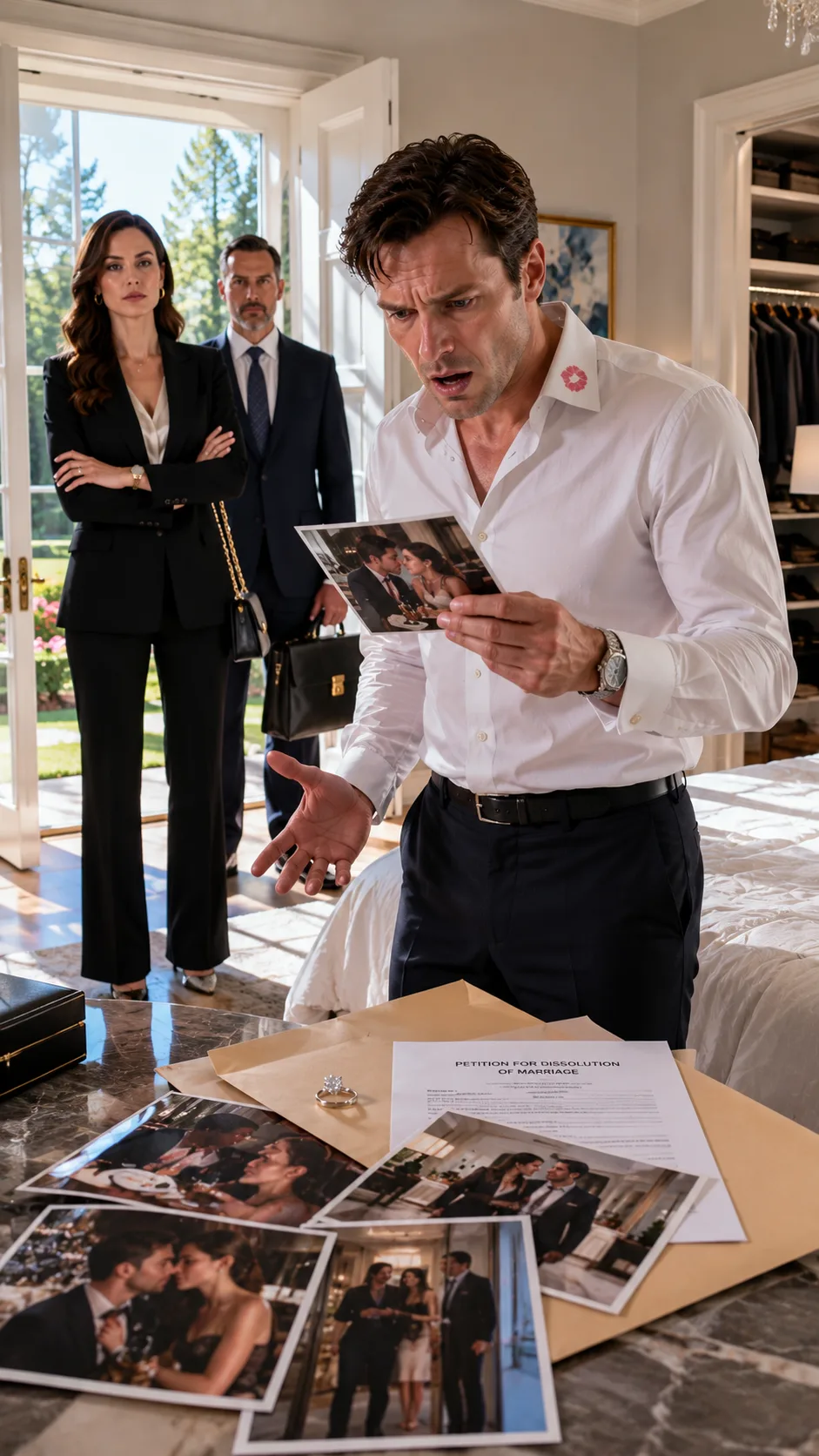
He abandoned his wife for his mistress, thinking he was in control.
Chapter 1
He abandoned his wife for his mistress, thinking he was in control.
But when he walked through his front door, he realized his wife had already liquidated his assets and erased his legacy while he was busy cheating.
Part 1:
At 6:14 in the morning, Mark Sterling came home smelling like another woman and found out his wife had destroyed him before breakfast.
He still had Jessica’s Chanel No. 5 on his collar.
That was the detail that stayed with him later. Not the frozen credit cards. Not the FBI warrant. Not the news alerts or the board vote that removed him from the company he believed he owned. The perfume. Sweet, expensive, and humiliating, clinging to his shirt like evidence he had been too arrogant to wash off.
He turned his key in the front door of the Greenwich house expecting routine.
Coffee.
Morning news.
Elena in the kitchen, wearing one of those soft cardigans he used to mock quietly in
his mind, asking if his flight from Chicago had been delayed.
He had rehearsed the lie on the drive home.
The Davis merger ran late.
Phone died.
Storm over Ohio.
I slept on the office couch.
He had built the story carefully, adding just enough irritation to make it sound real. He knew how to lie to Elena. After eleven years of marriage, he knew her weakness better than anyone.
She wanted to believe him.
That was the cruelest thing about her.
But when Mark stepped inside, the house did not smell like coffee. It did not smell like breakfast. It did not even smell lived in.
It was cold.
Not winter cold. Empty cold.
The kind of cold a house has after someone has removed herself from it completely.
“Elena?” he called.
His voice bounced against the high ceiling and came back thin.
No answer.
He walked through the
foyer, past the polished table where she always put fresh flowers on Mondays. No flowers. No vase. Just a clean rectangle in the dust where something had been taken away.
That irritated him first.
Then worried him.
Then he noticed the painting above the fireplace was gone.
The Italian coastline oil painting from her grandmother. The one Elena used to say made her feel like there was still sunlight in the world, even during Connecticut winters.
Gone.
The curio cabinet was empty too. Her porcelain figurines, the ones he privately thought were old-fashioned and useless, had vanished. The shelves looked stripped. Intentional.
Mark climbed the stairs faster now.
“Elena?”
The master bedroom door was open.
The bed was made with military precision.
His side of the closet remained untouched. Suits lined in expensive silence. Shoes polished. Watches in drawers.
Elena’s side was empty.
Not half-empty.
Empty.
No dresses. No shoes.
No handbags. No scarves. Not even the velvet hangers.
She had not packed.
She had erased herself.
On her nightstand sat two things.
Her wedding ring.
And a thick manila envelope.
Mark stared at the ring first. Three-karat solitaire. He bought it after missing her birthday three years earlier, a diamond apology large enough to silence a wound he never intended to heal. She had worn it every day since.
Now it looked small.
Cold.
Final.
He picked up the envelope. His name was written across the front in Elena’s elegant handwriting.
Mark.
He tore it open expecting tears.
A letter.
Maybe an emotional speech about heartbreak, betrayal, loneliness.
Instead, the first page was a legal filing.
Petition for Dissolution of Marriage.
Petitioner: Elena Marie Sterling.
Respondent: Mark Thomas Sterling.
His laugh came out dry and ugly.
“You have got to be kidding me.”
Then the photographs slid out.
Jessica and Mark entering the St. Regis.
Jessica and Mark kissing near his office.
Jessica and Mark at dinner.
Timestamped.
Geotagged.
Professional.
Not one blurry photo. Not one uncertain angle. A private investigator’s work.
His stomach dropped.
Then he found the letter from Reynolds, Stone and Associates.
The most feared high-asset divorce firm in New York.
He read one sentence and stopped breathing.
Pursuant to Clause 14, Section B of the prenuptial agreement, in the event of proven adultery by the primary earner, all assets acquired during the marriage, including the marital residence and spousal trust interests, revert to the injured party.
The prenup.
The prenup he had insisted she sign without reading.
The prenup he thought protected him.
Mark sat on the bed.
The perfume on his collar suddenly smelled less like desire and more like a confession.
Then his phone rang.
David Vance.
His business partner.
Mark answered with shaking hands.
“David, listen. Elena has gone crazy.”
David’s voice was ice.
“Check your email, Mark.”
“What?”
“The board held an emergency meeting at five this morning.”
“The board?”
“Elena’s lawyer dialed in.”
Mark stood. “Elena has nothing to do with the board.”
A pause.
Then David said, almost quietly, “You really never knew, did you?”
“Knew what?”
“Your wife owns fifty-one percent of Sterling Vance Architecture.”
The room tilted.
“No.”
“Yes. The anonymous angel investor who saved us ten years ago? That was Elena. She has controlling voting stock. And this morning, she used it.”
Mark could not speak.
David finished the sentence like a judge delivering death.
If you had asked Mark Sterling who Elena was the day before his life collapsed, he would have given a lazy answer.
My wife.
Quiet woman.
Bookish.
Good hostess.
A little boring, but loyal.
He would have said it with affection, maybe, but not respect. That was the hidden rot in their marriage. Mark believed affection was enough. He thought because he liked Elena’s steadiness, he valued her.
He did not.
He used her.
Elena had been twenty-six when she met him at a fundraiser for historical preservation. She wore a navy dress, simple pearl earrings, and no desire to impress him. That alone caught his attention. Most people looked at Mark like he was already important even before he became wealthy. Elena looked at him like she was deciding whether he had substance.
Back then, Mark was still hungry. He had ambition but little capital. His partnership with David Vance was barely alive, more idea than company. Sterling Vance Architecture had three clients, two lawsuits, and a conference room with a leaking ceiling.
Elena listened to him talk about buildings for almost an hour.
Not skyscrapers.
Not luxury lobbies.
Buildings as legacy.
Spaces that made people feel human.
“You talk like an architect,” she said.
“I’m a numbers guy.”
“No,” she said. “You’re a numbers guy who wants to matter.”
That unsettled him.
He liked it.
They married two years later.
Mark came from a respectable family, but not a rich one. Elena, he believed, came from something smaller. Her father had been a library archivist. Her mother had died before Mark ever met her. She lived modestly, volunteered at historical societies, and spent Sunday afternoons restoring old family papers or reading biographies on the porch.
He never looked deeper.
That was his fatal mistake.
Elena’s mother had been a Vanderhoven.
Old railroad money. Quiet money. Money that did not need a logo because banks already knew the name. Her mother had walked away from much of the public life attached to that fortune, but the family trusts remained. Elena inherited control slowly, discreetly, and with very little interest in being seen.
When Mark needed early investment, Elena provided it anonymously.
Not because he asked.
Because she believed in him.
Or the man she thought he was becoming.
She did not want him to feel owned by her family money. She did not want their marriage poisoned by pride. She wanted him to build something and know she stood behind him.
That was the kind of love she offered.
Quiet. Practical. Protective.
Mark misread it as simplicity.
Over time, his success became louder than his gratitude.
He turned into the kind of man who checked his reflection in restaurant windows. The kind who used “pressure” as an excuse for cruelty. The kind who believed every long hour at work made him entitled to something warm, young, and admiring on the side.
Jessica Miller gave him that.
She was twenty-four when she joined the firm as a marketing intern. Sharp smile. Red nails. Ambition so bright it looked almost like innocence if you did not stare too long. She laughed at everything Mark said and made him feel like a man still being discovered.
Elena, meanwhile, knew him too well.
She knew which stories he exaggerated. She knew which insecurities lived under his expensive suits. She knew success had not made him secure. It had made him afraid of being ordinary.
That frightened him.
So he chose Jessica because Jessica did not know him.
She knew the office version. The powerful CFO. The man with a black Porsche, a corner office, and a company credit card.
The affair began at a St. Regis suite after a gala.
Then another.
Then another.
Mark told himself it was harmless. Men like him always do. He said Elena was happy in her world of books and charity auctions. He said ignorance was kindness. He said he deserved passion.
What he never said was the truth:
He wanted Elena’s safety and Jessica’s excitement.
He wanted devotion at home and worship in hotel rooms.
He wanted a loyal wife to keep his life respectable while a mistress made him feel dangerous.
For two years, he lived that lie.
And Elena watched.
Not emotionally, not frantically.
Carefully.
She noticed the hotel receipts hidden under fake client names. The jewelry charges labeled “vendor gifts.” The shell company payments. The missing weekends. The perfume. The way Mark stopped looking guilty and started looking entitled.
Then she hired a private investigator.
Then forensic accountants.
Then Arthur Reynolds.
By the time Mark kissed Jessica goodbye that rainy morning, Elena had already packed her life, transferred the house, triggered the prenup clause, called the board, frozen the credit lines, and filed documentation with federal authorities.
Mark thought she was waiting in the kitchen.
She had been five moves ahead for months.
Elena’s Morning
At 5:00 a.m., while Mark was still asleep beside Jessica in Manhattan, Elena sat in the back of a black SUV outside Sterling Vance Architecture’s headquarters.
She wore a black power suit she had purchased three weeks earlier and never let Mark see. Her hair was pulled into a low, clean knot. No jewelry except her grandmother’s sapphire ring.
Arthur Reynolds sat beside her, reviewing documents on a tablet.
“You understand,” he said, “once we begin, there is no soft landing.”
Elena looked up at the dark glass tower.
“I gave him eleven years of soft landings.”
Arthur nodded.
At 5:07, the emergency board call began.
David Vance appeared on screen first. Then the other directors. Some tired. Some irritated. All confused.
Then Arthur introduced himself.
David’s eyes narrowed.
“Elena?”
She had never attended a board meeting before.
Not once.
That had been her choice. She believed Mark should be allowed to build without feeling overshadowed. She had trusted him with visibility while she remained silent.
There is a mistake many loyal people make: they confuse stepping back with love. Sometimes it is. Sometimes it teaches the wrong person that you have no power.
Elena turned on her camera.
“Good morning,” she said.
The room changed.
Arthur presented the evidence.
Adultery documented by licensed investigators. Misuse of company funds. Hidden expenditures. Unauthorized transfers. Expense fraud. Potential tax exposure tied to offshore structures that Mark, as CFO, had designed and controlled.
Then came the ownership documents.
Elena’s fifty-one percent voting control.
David stared at the screen like he had just met her for the first time.
“Elena,” he said slowly, “why didn’t you tell us before?”
She thought about that.
“Because I wanted my husband to succeed without wondering if my family money had made him small.”
“And now?”
“Now I want the company to survive him.”
That was the sentence that won the room.
The vote was swift.
Mark terminated for cause.
Internal audit authorized.
Voluntary disclosure to the IRS confirmed.
Company vehicle disabled.
Voluntary disclosure to the IRS confirmed.
Company vehicle disabled.
Corporate credit lines suspended.
Security instructed to deny him entry.
By 6:00 a.m., Elena stood in the foyer of the Blackwood Lane house while movers carried the last of her belongings into a truck. Her grandmother’s painting. Her porcelain collection. Books. Clothes. Letters. The boxes of documents Mark never bothered to ask about.
The house felt strange emptied of her.
Not sad.
Clean.
She walked one final time through the rooms she had spent eleven years maintaining. The kitchen where she made breakfast while Mark checked his phone. The dining room where she hosted investors who complimented Mark’s taste even though Elena chose every plate, every wine, every flower arrangement. The bedroom where she waited through too many false business trips.
Then she placed her wedding ring on the nightstand.
Arthur handed her the divorce petition.
She placed it beside the ring.
“No note?” he asked.
Elena looked at the bed.
“I’ve already said everything by leaving.”
At 8:55 a.m., the deed transfer went through.
At 9:00 a.m., 42 Blackwood Lane became hers alone.
By the time Mark found the papers, the house no longer belonged to him.
Later that morning, Elena returned with Arthur, two officers, and a locksmith. She did not expect Mark to be there. His car had been immobilized, but she assumed his pride would force him to disappear.
Instead, she saw him running up the driveway in the rain, overnight bag banging against his leg, face twisted with rage.
“Elena!”
The police stepped forward.
Mark stopped fifty feet away.
“You witch,” he shouted. “You planned this. You set me up.”
Elena took off her sunglasses.
“I didn’t set you up, Mark. I let you be yourself. You did the rest.”
“I made you,” he screamed. “I handled the money. I took care of you. You were nothing but a librarian’s daughter until I married you.”
For the first time that morning, Elena laughed.
Not because it was funny.
Because it was absurd.
“Mark,” she said, almost gently, “my family built the library. My family built the bank you used to work for. I didn’t need you to take care of me. I needed a partner.”
His face cracked.
Not fully. Pride fought hard. But fear was there now.
“Elena, please,” he said. “I have nowhere to go. My cards don’t work. Jessica won’t answer. I have nothing.”
For one second, she saw the man she once loved. Not the arrogance. Not the betrayal. The frightened boy under all of it.
That was why she had Arthur toss him the bag.
Dry cleaning.
Phone charger.
A prepaid card with five thousand dollars.
“I’m not heartless,” she said.
Mark stared at the bag.
“You wanted freedom,” Elena told him. “Go live it.”
Then she walked into her house and closed the door.
The lock clicked behind her.
That sound became the first quiet note of her new life.
Part 4: The Final Mistake
Mark spent the first hour after leaving Blackwood Lane believing rage could become a plan.
It could not.
Rage kept his feet moving through Greenwich rain in ruined Italian loafers. Rage made him ignore the humiliation of dragging an overnight bag through streets where men like him usually drove past people in trouble. Rage kept his jaw tight while strangers stepped aside, assuming he was drunk, unstable, or poor.
By the time he reached a bank vestibule downtown, rage had curdled into panic.
He sat on the floor beside the ATM and opened the dry-cleaning bag Elena had given him. Inside the pocket of his gray blazer, he found a note.
Mark,
I know you never read the prenup, and I know you never read the company bylaws. If you had, you would know there is a limited severance clause even for executives fired for cause. It is not much, but enough to keep you off the street. I deposited $5,000 onto the prepaid card in this pocket. Use it for a lawyer or a therapist. I suggest the latter.
E.
He found the card.
Five thousand dollars.
Yesterday, he had spent nearly that much on wine.
Today, it was his entire net worth.
Pride told him to snap it in half.
Hunger told him not to be stupid.
He kept it.
But instead of a lawyer or therapist, Mark went to an internet café.
That was his final catastrophic mistake.
He believed he still had leverage.
Mark had designed the offshore tax structures Sterling Vance used in its aggressive growth years. Apex Holdings. Blue Sky Ventures. Ironclad Trust. Shell entities in the British Virgin Islands. He knew the routing numbers, account structures, transfer patterns. He had built the system, managed the audits, and hidden risks under language only CFOs and criminals love.
If Elena wanted war, he thought, he would bring the whole company down.
He emailed the IRS whistleblower office.
Then the New York Times business desk.
He attached a detailed memo exposing the offshore structures. He named names. Dates. Accounts. Procedures. He imagined Elena in handcuffs, the Vanderhoven heiress exposed as a hypocrite. He imagined himself rewarded for cooperating. Maybe immunity. Maybe a whistleblower payout.
He slept that night in a Motel 6 near Stamford, smiling at the ceiling like a man who still believed the board had pieces left for him to move.
By morning, the reply from the New York Times arrived.
Mark opened it eagerly.
Then read it twice.
Then a third time.
Sterling Vance had already disclosed the offshore irregularities three days earlier.
Voluntary audit.
Settlement discussions with the IRS.
Public statement citing “mismanagement by former executive leadership.”
The paper declined his story.
His information was not a whistleblower tip.
It was corroboration.
Mark had not exposed Elena.
He had signed his own confession.
There was a knock at the motel door.
“Mr. Sterling?” a man called. “FBI.”
Mark looked at the laptop screen.
Then at the window.
Two black sedans waited outside.
He opened the door because there was nowhere to run.
Agent Miller, tall and expressionless, held up a badge.
“Mark Thomas Sterling, you are under arrest for wire fraud, embezzlement, and conspiracy to defraud the United States government.”
“I’m the whistleblower,” Mark said, voice breaking. “I sent the email.”
Agent Miller almost smiled.
“We know. Thanks for the road map.”
The handcuffs were cold.
As they led him outside, Mark saw Jessica across the street at a coffee shop patio, wearing oversized sunglasses, holding a latte.
For one ridiculous second, he hoped she had come to help.
Then she lifted her phone and made a call.
Not to him.
Probably to a lawyer.
Maybe to HR.
Maybe to whoever she needed to convince that she had been another victim of Mark Sterling’s abuse of power.
She watched him get pushed into the federal car without a trace of sorrow.
That was when Mark finally understood.
He had traded loyalty for appetite.
And appetite does not stay when the feast ends.
Part 5: The Woman He Could Not Name Anymore
Elena did not attend Mark’s arraignment.
She did not watch the news coverage in real time. She did not stand outside the courthouse to enjoy his humiliation.
That surprised people.
They expected revenge to look dramatic. A black dress. A cold smile. A woman watching her fallen husband dragged past cameras.
Elena had no interest in being filmed near wreckage.
She had work to do.
Sterling Vance Architecture was bleeding trust. Investors were nervous. Employees were terrified. Reporters called every hour. Some wanted scandal. Some wanted blood. A few wanted to know how a “quiet housewife” became the controlling shareholder of a major architecture firm.
Elena refused that phrase.
Housewife was not an insult.
Quiet was not an insult.
But the way they said it made both sound like evidence of incompetence.
At her first full staff meeting, she stood in the atrium, not behind a podium, because she did not want barriers between herself and the people whose livelihoods had been endangered by Mark’s lies.
“I know many of you are afraid,” she said. “You are wondering if this company will survive. It will.”
The room stayed silent.
“Not because of me alone. Because of the work you have done and will keep doing. But things will change. We are cooperating with federal authorities. We are correcting our tax exposure. We are cutting every hidden structure that depends on secrecy instead of strength. I will not ask you to protect rot for the sake of reputation.”
That line made people look up.
“I am asking you to help me rebuild something honest.”
David Vance stood near the back.
The same David who had once seen Elena only as Mark’s soft-spoken wife. The same man who now realized she had understood more than most executives in the room.
After the meeting, he approached her.
“I owe you an apology,” he said.
“For what?”
“For underestimating you.”
Elena studied him.
“Most people did. You were just less cruel about it.”
He nodded once.
Fair.
Over the next year, they worked together constantly. At first, professionally. Later, with a trust Elena did not expect to feel again.
David was different from Mark in ways that mattered. He listened without preparing a rebuttal. He asked questions because he wanted answers, not ammunition. He did not mistake Elena’s silence for emptiness.
There is something deeply healing about being seen accurately after years of being misread.
But before healing came court.
Mark took a plea deal.
Five years for embezzlement, wire fraud, and tax conspiracy.
Jessica avoided prison by cooperating. She repaid some money through a settlement and disappeared into another marketing job in another city. Elena never pursued her beyond what the law required. Some people punish themselves by remaining exactly who they are.
Mark’s first months in prison were ugly.
He wrote Elena letters.
She did not read most of them.
Arthur filtered legal communication. Anything personal went into a folder marked Not now.
Maybe that sounds cold.
It was not.
It was survival.
Forgiveness is not a performance. It does not require opening every wound because the person who cut you wants to explain their knife.
At Sterling Vance, Elena restructured everything. She sold wasteful assets. Settled with the IRS. Created employee protection funds. Reformed executive compensation. Shifted the firm toward green urban development, affordable housing partnerships, and ethical design projects.
People called it risky.
She called it necessary.
“Buildings should answer to people,” she said in an interview, “not just investors.”
Three years later, Sterling Vance won the Singapore Green City bid.
Five years later, Mark watched her on a contraband tablet in the federal cafeteria.
That scene became a strange sort of legend among inmates.
Mark Sterling, inmate 49201, staring at his ex-wife on Bloomberg while she announced a billion-dollar project beside David Vance.
The reporter asked how she turned the company around after the scandal.
Elena smiled.
“Honesty,” she said. “We cut out the rot. We stopped focusing on short-term profits and started focusing on legacy.”
She did not say Mark’s name.
That hurt him more than hatred would have.
Because hatred means you still matter.
Elena had made him irrelevant.
Part 6: What Happened After the Fall
Prison changed Mark.
Not quickly.
Not beautifully.
It made him smaller first.
That is usually how life strips arrogance. Not through wisdom, but through humiliation. Counts. Schedules. Uniforms. Men who did not care what car he used to drive or what watch he used to wear. Food on trays. Cell doors. Library duty.
The library was the cruelest irony.
He had once sneered at Elena’s father for being an archivist. Now repairing cracked book spines was the only work that quieted his mind.
In the prison library, he learned what Elena probably knew all along: books do not care who you pretended to be. They wait until you are ready to tell yourself the truth.
A younger inmate named Leo once asked him, “You still love her?”
Mark thought about that.
“No,” he said finally. “I think I loved what she gave me. Stability. Belief. Respect. I don’t know if I knew how to love her.”
That answer stayed with him.
He began writing—not letters to Elena, but notes to himself. Admissions. Not excuses.
I thought loyalty meant she would never leave.
I thought money meant I was smarter.
I thought being desired meant being valuable.
I mistook kindness for weakness because weakness was the only kindness I understood.
Those notes did not fix anything.
But they were honest.
Five years later, when Mark left prison, nobody waited outside the gates.
No Jessica.
No friends from the club.
No executive car.
A reentry volunteer handed him a bus voucher and a list of resources.
Mark took a job in a public library’s finance office.
Part-time at first.
Then full-time.
It paid badly compared to his old life. But the work was clean. Budgets. Grants. Maintenance funds. Community programming. Nobody applauded him. Nobody feared him. Nobody cared that he used to sign checks larger than the library’s annual operating budget.
At first, that felt like punishment.
Later, it felt like relief.
Elena married David Vance two years after Mark’s release.
Small ceremony. No magazine spread. No society pages. Just family, friends, and a quiet reception at the renovated company atrium. She wore ivory. David cried. Elena laughed when he did.
Mark saw a photo online.
He closed the laptop gently.
There was pain, yes.
But not the old rage.
The old rage had required believing he had been robbed.
Now he knew better.
He had thrown away something priceless and then resented the world for not returning it.
Elena became Elena Vanderhoven again professionally, though many still called her Ms. Vance after the marriage. She did not seem to care either way. That was power too, Mark realized. Not needing people to call you the right thing because you knew who you were before they spoke.
She and David built a life that looked, from the outside, almost ordinary.
Work.
Dinner with friends.
Travel.
Charity projects.
A house in the country she filled with books, art, and ridiculous amounts of flowers.
No children were mentioned in articles. Mark never knew if that was by choice, fate, or privacy. He hoped she was happy. It was the only generous thing he could offer from a distance.
Years later, Jessica sent him a message on social media.
I heard you’re out. Hope you’re okay.
He stared at it for a long time.
Then deleted it.
Some doors do not deserve reopening simply because the person behind them finally knocks politely.
Mark never became rich again.
He never regained his old status.
But he did become useful.
He helped the library secure grants. He taught free financial literacy workshops for adults rebuilding after debt, divorce, addiction, or prison. He never told them he had once been the kind of man who created the messes they were trying to escape.
One night after a workshop, a woman stayed behind and said, “My husband controlled every account. I didn’t even know where the mortgage papers were. I felt stupid.”
Mark looked at her.
“You weren’t stupid,” he said. “Someone used your trust against you. That’s different.”
The words surprised him.
They sounded like something Elena might have said.
Maybe that was what redemption looked like for people like him.
Not getting back what they lost.
Learning to protect in others what they once destroyed.
Part 7: The Life That Belonged to Her
Twenty years after Mark found the envelope, Elena sat on the porch of her country house watching the sunset stain the sky over the trees.
David sat beside her, reading glasses low on his nose, pretending to read the newspaper while actually watching her.
“You’re thinking loudly,” he said.
She smiled.
“I didn’t know thoughts had volume.”
“Yours do.”
She leaned back in the chair.
“I was thinking about Blackwood Lane.”
David lowered the paper.
“The house?”
“The morning I left.”
He said nothing.
That was one of the things she loved about him. He knew when silence was an invitation and when it was a gift.
“I used to think that leaving was the moment I became hard,” Elena said. “But it wasn’t hardness. It was clarity. I finally stopped confusing endurance with love.”
David folded the newspaper.
“You were brave.”
“I was angry.”
“Both can be true.”
She looked at him.
“Yes,” she said. “They can.”
For years, people had asked Elena about revenge.
Did it feel good?
Was she satisfied?
Did Mark deserve more?
Less?
Did she regret the way she dismantled him?
Those questions always missed the point.
Elena did not win because Mark went to prison.
She did not win because Jessica vanished.
She did not win because she kept the company or married David or became a respected business leader.
She won because she stopped building her life around being chosen by a man who had mistaken her patience for emptiness.
That was the victory.
Freedom.
Not glamorous freedom. Not movie-poster freedom with wind in her hair and champagne in her hand. Real freedom.
The kind where her house stayed quiet because it was peaceful, not because someone was lying.
The kind where her phone did not make her stomach drop.
The kind where she could make coffee for herself in the morning and not wonder what perfume would come home on someone else’s collar.
That evening, Mark’s name came up for the first time in months because a library foundation had sent Sterling Vance a grant proposal. Mark’s name was listed as finance coordinator.
David had shown it to Elena carefully.
“We can assign another reviewer,” he said.
“No,” Elena said. “Review it normally.”
Now, on the porch, David asked, “Are you sure?”
Elena watched the sun lower behind the trees.
“Yes.”
She was not interested in punishing him forever.
That was not the same as forgiveness in the sentimental sense. It was something cleaner.
Indifference with boundaries.
Peace without invitation.
A month later, the library received the grant.
Mark sent no thank-you letter to Elena personally. Only a formal acknowledgment to Sterling Vance Architecture. Professional. Brief. Appropriate.
Elena appreciated that more than an apology.
The library used the money to expand job training programs for people coming out of prison and for women rebuilding after financial abuse.
When Elena read that part of the report, she sat very still.
Then she smiled.
Not because Mark had become good.
Not because the past was repaired.
Because damage had become useful somewhere.
Years later, after David passed quietly in his sleep at seventy-nine, Elena found comfort in the company they had built and the people whose lives had crossed hers. She created the Vanderhoven Trust for Ethical Enterprise, teaching young founders what power without integrity costs.
At the first lecture, she stood before a room full of students and said:
“Never mistake someone’s silence for ignorance. Never mistake kindness for weakness. And never build a life on secrets you would be ashamed to see in daylight.”
A student asked if betrayal had made her cynical.
Elena thought about that.
“No,” she said. “It made me accurate.”
There was laughter, but soft laughter.
Then she added, “I still believe in love. I just no longer believe love should require a woman to disappear.”
That was the lesson.
The real one.
Not that cheaters get punished.
Not that rich women have hidden power.
Not that revenge makes everything right.
The lesson was simpler and harder:
A life built on lies will eventually demand payment.
And a woman who chooses herself is not cruel.
She is awake.
The night Mark chose Jessica, he believed Elena was home waiting with coffee and forgiveness.
He came back to divorce papers instead.
But the papers were not the ending.
The ending was Elena on a porch years later, drinking coffee alone at sunrise, feeling no fear, no bitterness, no need to prove anything to the man who once thought she was nothing.
She had not just survived him.
She had outgrown him.
And some victories are quiet enough that only the person who earned them can hear the applause.
THE END.
Chapter complete
You have reached the end of this chapter.
Continue reading
A few more worlds to get lost in after this chapter.




