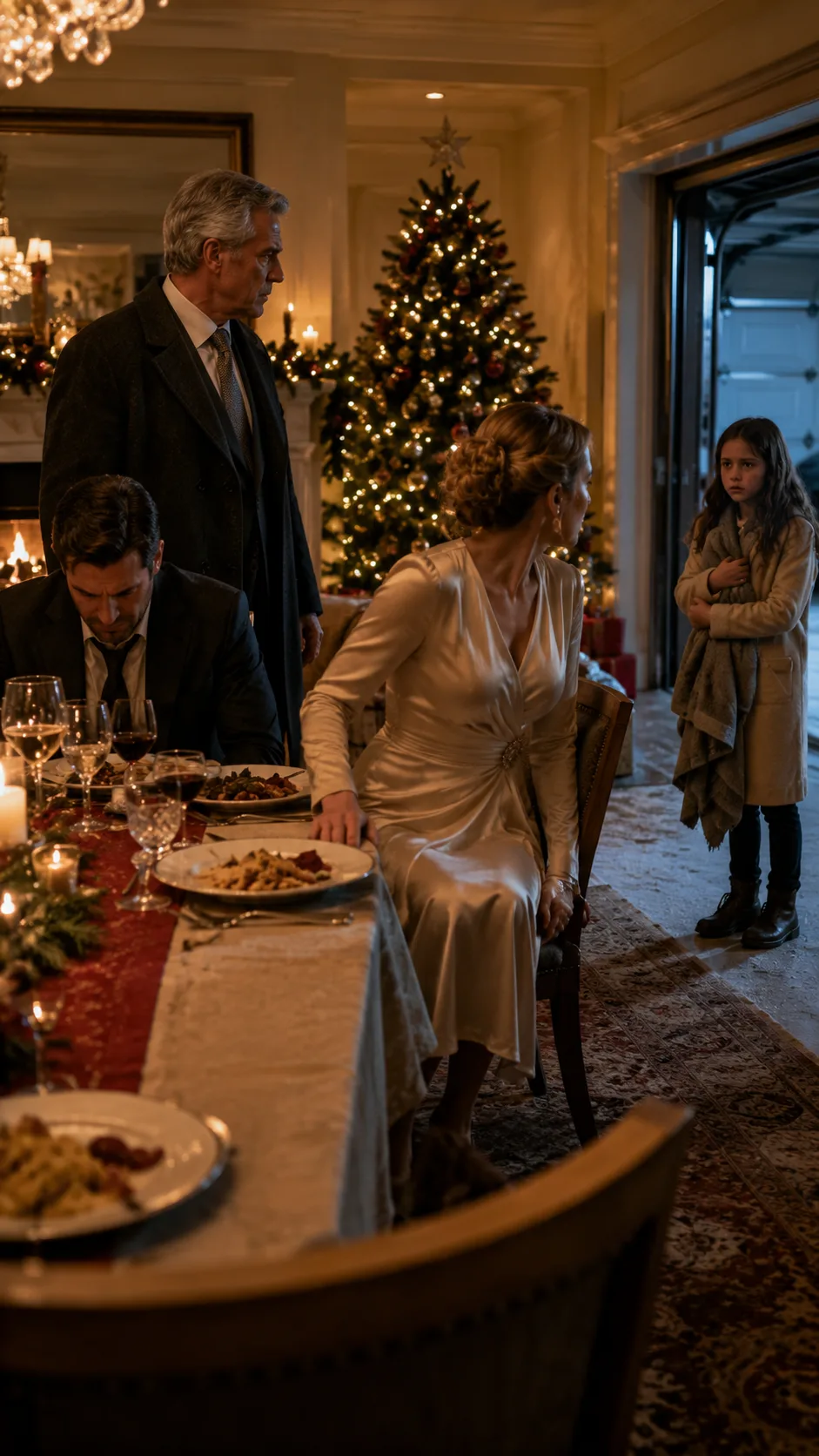
The garage smelled like gasoline, wet cardboard, and the cinnamon rolls Marissa had burned that morning before throwing them away.
Chapter 1
The garage smelled like gasoline, wet cardboard, and the cinnamon rolls Marissa had burned that morning before throwing them away.
I stood beside the old freezer with my blanket around my shoulders and counted the seconds between the bursts of laughter inside the house. If I counted long enough, I could almost pretend the sound belonged to a different family.
The concrete floor had a crack shaped like a crooked river. I kept one boot on each side of it because my toes had gone stiff, and moving them made the cold feel sharper. My coat was thin. It was the beige one Dad bought from a clearance rack two winters earlier, back when he still took me places without asking Marissa first.
Above me, the garage light buzzed.
Inside the house, someone cheered.
I turned my head toward the door that led into the kitchen. Marissa had not locked it all the way. She had left it pulled almost shut, the latch resting against the frame so a line
of warm yellow light cut across the garage floor.
Not enough to help.
Enough to remind.
My name is Clara Whitmore, and I was eleven years old that Christmas Eve. The house on Briar Glen Drive had white columns, a curved staircase, and a kitchen island big enough for four people to sit around without touching elbows. People who visited always said the same thing.
“What a beautiful home.”
They never said it to me.
They said it to Marissa.
She accepted compliments like rent.
That night, the house was full. My father’s sister Linda had come with her husband and two grown sons. Marissa’s brother Pierce had arrived in a black SUV with his new girlfriend, who kept touching the pearls at her throat as if checking they were still there. There were neighbors from three doors down, two people from Dad’s office, and a couple Marissa called “important”
because they owned a chain of medical spas.
Everyone had been told to wear cream, gold, or burgundy for photos.
I wore my school tights under my dress because the house was always cold near my room, and I had learned not to ask anyone to turn up the heat.
At 6:40, I dropped a spoon.
That was it.
One silver spoon slipped from my hand while I was carrying dessert plates from the pantry. It landed on the marble, bounced once, and left a tiny scratch near Marissa’s shoe.
She looked down.
Then she looked at me.
The dining room kept moving around us. Chairs slid. Wine poured. Someone laughed too loudly in the living room. Dad was adjusting the red ribbon on a gift box under the tree.
Marissa picked up the spoon with two fingers.
“This,” she said, “is why I don’t let you touch nice things.”
I reached for it.
She held it away.
“You can eat later.”
Dad turned at the sound of my name, but Marissa had already stepped between us with the spoon in her hand and that smooth smile she saved for witnesses.
“Clara is tired,” she said. “She needs a quiet place.”
Dad’s eyes moved to me. Then to the guests. Then to the scratched floor.
He rubbed his thumb along the side of his glass.
“Maybe just for a little while,” he said.
A little while.
That was what adults called things when they wanted them to sound smaller.
Marissa walked me through the kitchen, past trays of roast potatoes and glazed carrots, past the cranberry sauce I had stirred because she said it was the only thing I could not ruin. She opened the door to the garage with one hand and held my blanket out with the other.
“You need to learn gratitude,” she said.
The blanket was the gray one from the linen closet, rough at the edges where the stitching had come loose. It smelled faintly like dryer sheets and dust.
I took it.
She leaned closer, her perfume mixing with the cold air from the garage.
“And don’t start crying where people can hear you.”
I did not cry.
Not there.
The door closed until only the thin line of light remained.
I stood beside the freezer and listened to Christmas happen without me.
It had not always been like that.
Before Marissa, Dad used to make pancakes shaped like stars on Christmas morning. He burned the first two every year and called them practice stars. Mom would sit at the counter with her coffee and tell him the pancakes looked like flattened spiders. I was six when she got sick, seven when the house started smelling like hospital soap, and eight when she stopped coming downstairs.
Her name was Evelyn Whitmore. I remembered her hands better than her voice. Long fingers. No polish. A small scar near her thumb from cutting apples too fast.
She used to keep an old brass key in the blue bowl by the back door. I asked once why she never used it.
“For the day someone forgets what home means,” she said.
I thought she was talking like mothers talked in books.
After she died, the key disappeared.
So did the blue bowl.
Marissa came into the house fourteen months later with labeled storage bins, a wedding planner, and a rule about “starting fresh.” She moved Mom’s photos from the hallway to a box in the upstairs closet. She donated the quilts Mom had made, except one Dad hid in my room under old tax files. She repainted the kitchen white and gold. She replaced the blue curtains.
She called it healing.
Grandpa called it erasing.
Dad’s father, Arthur Whitmore, lived forty minutes away in a small brick house with a green front door and a workshop full of cedar dust. He came every Sunday for the first year after Mom died. He brought groceries, fixed hinges, sat with me during homework, and never let Marissa send me upstairs when he was there.
Then the visits got shorter.
Then fewer.
Marissa said he was “too intense.”
Dad said Grandpa needed space.
Grandpa never said anything in front of me, but once, when he thought I was asleep on the couch, I heard him in the kitchen.
“You’re letting her make that girl a guest in her own home.”
Dad said nothing.
A cabinet door closed.
Grandpa left without saying goodbye.
After that, I saw him only at school events and birthdays Marissa could not avoid inviting him to. He always brought books instead of toys. He wrote my name inside the covers in block letters.
Clara Evelyn Whitmore.
He never forgot the middle name.
That Christmas Eve, I had not expected him. Marissa had said he sent his regrets. Dad did not correct her. I had carried plates, folded napkins, and lined up gift bags under the tree with everyone else’s names facing forward.
Mine was not there.
I noticed because I had written half the tags.
For a long time, I tried to keep warm by walking from the freezer to the old lawn mower and back. The garage was crowded with things that had been pushed out of the house when Marissa changed rooms: boxes of books, two dining chairs with carved backs, a broken lamp, a rolled-up rug, and a framed painting wrapped in brown paper.
Mom’s painting.
I knew because one corner of the paper had torn, showing the edge of blue hydrangeas.
Mom painted those flowers the summer before she got sick. They used to hang above the mantel. Marissa said they clashed with the Christmas garland.
I pulled the blanket tighter and sat on one of the old chairs.
The laughter inside dipped.
Aunt Linda’s voice came through the door.
“Where’s Clara?”
A pause.
Then Marissa, bright as glass.
“She needed a quiet place.”
Someone made a soft sound. Maybe a laugh. Maybe not.
Dad’s voice came next, too low to catch the words.
The chair under me creaked.
I slid off it and stood again.
The line of light on the floor shook as someone walked past the kitchen door. For a second, I saw Dad’s shadow. It stopped there. The shadow did not open the door.
Then it moved away.
I pressed my fingers into the blanket until my knuckles hurt.
The garage door to the driveway had two little windows at the top. Frost blurred the glass, but headlights still cut through when a car turned in. I saw them sweep across the shelves, across the paint cans, across my boots.
A car stopped outside.
The engine shut off.
A door closed.
Not slammed.
Closed with weight.
The laughter inside the house faded before the knock came.
I knew those steps.
Grandpa did not shuffle like Uncle Pierce. He did not hurry like Dad. He walked as if every floorboard should decide whether it could hold him.
The front door opened.
Cold air rushed somewhere beyond the kitchen. Voices shifted.
“Arthur,” Marissa said.
Not Grandpa.
Arthur.
Her voice had that polished lift again, the one she used when people from the neighborhood watched.
“We weren’t expecting you.”
“I know,” Grandpa said.
Two words.
The house listened.
I moved closer to the kitchen door. The line of light widened a little when someone brushed past it. Through the crack, I saw the dining room reflected in the polished side of the oven: candles, shoulders, the edge of the Christmas tree, the white sleeve of Marissa’s dress.
Grandpa entered the living room still wearing his dark wool coat. Snow dotted the shoulders. His gray hair was combed, but wind had lifted one side. He held his gloves in one hand.
No gift bag.
No bottle of wine.
No smile.
“Where is Clara?” he asked.
Marissa laughed once.
It was too quick.
“She’s resting.”
“Where?”
Dad stood halfway from his chair, then stopped with one hand on the table.
“Dad,” he said. “Maybe we can talk in the study.”
Grandpa did not look at him.
“Where?”
Marissa turned toward the kitchen. For one second, her eyes met mine through the crack.
The door moved.
I stepped back.
She crossed the kitchen in three sharp steps and pulled the door open just enough to show me standing there. She kept her body in the doorway, blocking most of the garage behind her.
“See?” she said. “She’s fine.”
Grandpa’s face changed in a way that did not move much. His eyes went to the blanket. My boots. The cold concrete. The freezer behind me. The rolled rug. The painting wrapped in paper.
Then his gaze returned to me.
“Come inside.”
Marissa’s hand tightened on the door.
“She made a scene earlier.”
Grandpa looked at her hand.
The fingers opened.
I stepped over the threshold into the kitchen.
Warmth hit my face first. Then the smell of roast beef and candles and pine. Everyone at the table turned, but not all the way. Some people only moved their eyes. That was worse.
I stood by the kitchen island with the blanket still around me.
Marissa smiled at the guests.
“Children test boundaries,” she said.
Grandpa walked into the dining room.
His shoes made no sound on the rug.
Aunt Linda set her fork down.
“Arthur,” she said.
He raised one hand without looking at her.
Dad stood fully now.
“She wasn’t out there long,” he said.
Grandpa’s head turned slowly.
“How long is acceptable?”
Dad opened his mouth.
Closed it.
Marissa moved to the head of the table, the place where Mom used to sit when the table was smaller and the plates did not have gold rims.
“This is not a trial,” she said.
Grandpa looked at the chair beneath her hand.
“No,” he said. “It’s Christmas.”
That landed harder than if he had shouted.
Pierce leaned back in his chair, his girlfriend’s pearls still between her fingers.
Marissa lifted her chin.
“I will not be judged in my own home.”
Grandpa took one step toward the table.
The room tightened around him.
“Your own home.”
The words did not sound like a question.
Marissa’s smile returned, thinner now.
“Yes. Mine and Daniel’s. We have been very generous keeping family traditions alive.”
Dad stared at the tablecloth.
I saw a drop of red wine near his plate, dark against white linen. It spread slowly into the thread.
Grandpa noticed it too, or maybe he noticed everything.
He reached into his coat pocket.
Marissa’s eyes flicked to his hand.
For the first time that night, she stopped performing.
The brass key came out first.
Old. Heavy. Darkened along the edges. It lay across his palm like something pulled from the bottom of a drawer where nobody was supposed to look.
My fingers loosened on the blanket.
The key from the blue bowl.
Grandpa placed it in the center of the Christmas table.
The sound was small.
Every person in that room heard it.
Marissa stared at it.
Dad looked up.
Aunt Linda’s lips parted, but no words came.
Grandpa took a sealed envelope from the inside pocket of his coat. Cream paper. My grandmother’s handwriting across the front.
Daniel.
Dad’s name.
Not Marissa’s.
Grandpa set the envelope beside the key.
“I was asked to wait,” he said.
Dad’s chair scraped backward.
Grandpa’s eyes stayed on him.
“Evelyn believed you would do right by your daughter without paper forcing your hand.”
My name did not appear in that sentence.
It did not need to.
Marissa reached for the envelope.
Grandpa put two fingers on it.
“Not you.”
Her hand stopped above the table.
A background fork touched a plate and stayed there.
Dad looked at me then, really looked, as if the blanket had become a document too.
“Dad,” he said. “What is this?”
Grandpa slid the envelope toward him.
“Your mother’s final addendum.”
Marissa gave a short laugh.
“That cannot be valid.”
Grandpa turned to her.
“You have not opened it.”
Her face held its shape, but the skin around her mouth tightened.
Dad picked up the envelope. His fingers fumbled at the flap. He tore it unevenly.
A folded document came out.
Legal paper.
The kind Dad used to keep in his office drawer before Marissa put all his files into matching boxes.
He unfolded the page.
The room leaned without moving.
His eyes moved across the first lines. Then stopped.
His thumb pressed into the paper hard enough to bend the corner.
“Daniel,” Aunt Linda said.
He did not answer.
Grandpa placed his hand beside the key.
“Read it.”
Dad swallowed.
The sound was visible more than audible.
Marissa walked around the edge of the table toward him, but Grandpa shifted half a step, not blocking her with force, only presence.
She stopped.
Dad read the first paragraph under his breath. Then the second.
The paper shook once.
Grandpa looked toward the garage door.
“Out loud.”
Dad closed his eyes for half a second.
Then he read.
“I, Evelyn Grace Whitmore, being of sound mind, amend the residential trust concerning the property at 418 Briar Glen Drive…”
His voice failed on the address.
Grandpa did not help him.
The Christmas tree lights blinked behind him, red, gold, red again.
Dad continued.
“Upon my death, beneficial interest in the property shall pass solely to my daughter, Clara Evelyn Whitmore, held in protective trust until her eighteenth birthday.”
Someone drew a breath too sharply.
Marissa’s hand fell from the back of the chair.
Dad kept reading, but now his voice came from somewhere smaller.
“Daniel Whitmore shall retain occupancy only as guardian and caretaker, provided the property remains Clara’s primary residence and is maintained for her benefit.”
He stopped.
Grandpa took the page from his hand and laid it flat on the table for everyone to see.
“Her name is on the deed.”
No one spoke.
The key lay under the chandelier, old brass against white linen, while the paper beside it made the plates and crystal and candles look like decorations around a fact.
Marissa stared at the document.
Then at Dad.
Then at me.
The room had turned without anyone standing. I felt it in the way Aunt Linda’s body angled away from Marissa, in the way Pierce lowered his glass, in the way Dad’s office guest looked down at his napkin as if he wished he had never come.
Grandpa did not raise his voice.
“You put the owner in the garage.”
The sentence stayed there.
Marissa opened her mouth.
Nothing came out at first.
Then, “I… we didn’t know—”
Grandpa’s hand closed around the key.
“You knew enough to hide her.”
Dad sat down slowly.
Not because anyone told him to. His knees seemed to give up their argument with the floor. The paper remained in front of him, the torn envelope beside his plate, the gravy boat untouched near his elbow.
Marissa looked toward the guests. She always did that when she needed a room to rescue her.
No one moved.
Aunt Linda stood.
She came to me, not fast, not with noise. She took the blanket from my shoulders and wrapped it around me properly, crossing it in front so the cold air would not slip in. Her hands shook a little as she tucked the corner under my arm.
“Clara,” she said.
Just my name.
It sounded strange in that room.
Grandpa walked to the garage door and pushed it shut with one hand. The latch clicked.
Then he turned back.
“Daniel.”
Dad raised his head.
“Pack her coat. Her school things. Whatever she wants tonight.”
Marissa stepped forward.
“You are not taking her.”
Grandpa looked at the deed.
“I am not asking your permission.”
Dad stood again, but slower this time. He looked at me, and for a moment I saw the man who used to burn pancakes and call them practice stars. Then his eyes moved to the blanket, to the garage door, to Marissa’s hand clenched at her side.
He did not say sorry.
Not then.
He walked past the table and went upstairs.
Marissa followed two steps, then stopped when Grandpa spoke.
“You stay where witnesses can see you.”
That broke something small in her face.
Not much.
Enough.
Dad came back with my backpack, my winter boots, the quilt Mom had made, and the blue sweater I thought Marissa had given away. He carried them like evidence.
He placed them by my feet.
“I kept these,” he said.
Grandpa looked at him.
“Keeping is not protecting.”
Dad’s hand dropped.
I picked up the quilt first.
It was folded badly, one corner sticking out. Mom’s stitching ran along the edge in tiny uneven blue lines. My name was sewn into the underside, where no one would see unless they cared enough to look.
Aunt Linda helped me put on my boots.
No one ate.
The roast cooled in the middle of the table.
Marissa stood beside her chair, still in her cream satin dress, still wearing pearls, still surrounded by the house she had arranged like a showroom. But the room no longer arranged itself around her.
Grandpa held out the brass key.
Not to Dad.
To me.
It was heavier than I expected.
My palm closed around it, and the cold metal bit into my skin.
“Not tonight,” he said. “Tonight you come with me.”
I looked at Dad.
He took one step, then stopped.
“I’ll call tomorrow,” he said.
Grandpa’s face did not move.
“No. You’ll call my attorney.”
The office guests looked at each other.
Marissa sat down.
Her chair made a soft sound against the rug.
Grandpa opened the front door. Cold air moved through the foyer, clean and sharp. I stepped out with my backpack on one shoulder, Mom’s quilt under my arm, and the brass key in my coat pocket.
Snow had started again.
On the porch, Grandpa paused and looked back through the doorway.
The dining room behind us had gone very still. Candles burned low. The tree blinked. The garage door was closed.
Dad stood at the bottom of the stairs with one hand on the banister.
Marissa would not look at me.
Grandpa shut the door.
His truck smelled like cedar and peppermint. There was a paper bag on the passenger seat with two wrapped sandwiches and a thermos of cocoa. He moved it aside before I climbed in.
“You knew I’d be there?” I asked.
He started the engine.
“I knew I should have been there sooner.”
The wipers moved snow from the windshield in two slow arcs.
We did not talk for the first ten minutes. I held the quilt on my lap and kept touching the key through my pocket to make sure it had not disappeared again.
At Grandpa’s house, the porch light was on. A small wreath hung crooked on the green door. Inside, the rooms were not grand. The sofa sagged in the middle. The kitchen table had scratches. A stack of library books leaned near the window.
A plate waited on the counter.
Ham. Potatoes. A roll wrapped in foil.
Grandpa took the blanket from my shoulders and hung it over a chair.
“Eat what you can,” he said.
I sat at the table.
The roll was still warm.
The next morning, Dad called seven times before Grandpa answered. I heard only Grandpa’s side.
“No.”
A pause.
“She is eating breakfast.”
Another pause.
“You should have thought of that before dessert.”
He hung up.
By New Year’s, a lawyer named Ms. Patel had come to Grandpa’s house with copies of the trust, the deed, and photographs of the garage taken the morning after Christmas. Aunt Linda gave a statement. So did one of Dad’s office guests, the woman who had not touched her wine after Grandpa placed the key down.
Marissa tried to say it had been a misunderstanding.
The cracked garage door said otherwise.
So did the blanket.
So did the fact that my dinner plate had never been set.
Dad was allowed to stay in the house for a while, but not with Marissa. The trust required a guardian who acted for my benefit. Ms. Patel used that phrase often. For my benefit. It sounded legal at first. Then it started sounding like a door unlocking.
Marissa moved out before the end of January. She took the cream satin dress, the pearl earrings, the gold-rimmed plates, and the white-and-gold curtains. She tried to take the painting of blue hydrangeas, but Aunt Linda found it wrapped in the back of Pierce’s SUV and carried it into Grandpa’s truck without asking.
Dad began supervised visits at Ms. Patel’s office. The first time, he brought pancakes in a container.
They were shaped like stars.
Two of them were burned.
I looked at them for a long time before taking one.
He watched my hands, not my face.
“I should have opened the door,” he said.
I broke off one point of the pancake.
“Yes.”
That was all I gave him.
It was enough for that day.
The house on Briar Glen Drive sat empty for almost three months while the court and the trust and the adults sorted through things they should have sorted through before a child learned the temperature of concrete on Christmas Eve.
When I went back in the spring, Grandpa came with me.
So did Ms. Patel.
The tree was gone. The dining room smelled like dust and lemon cleaner. Sunlight crossed the marble floor and caught the tiny scratch from the spoon.
Nobody had fixed it.
I stood over that mark for a while.
Grandpa did not rush me.
We rehung Mom’s blue hydrangea painting above the mantel. Aunt Linda brought back the quilts she could find. Dad returned the blue bowl without saying where he had kept it. I placed the brass key inside it, then changed my mind and put it on a chain instead.
For years after, people still called it the Whitmore house.
I let them.
At eighteen, I signed the papers that moved the trust fully into my name. Ms. Patel used a black pen. Grandpa sat beside me in a navy suit and pretended not to watch every line.
Dad attended too.
He had been living in a small apartment across town for three years by then. He came every Thursday for dinner when I allowed it. Some nights we cooked. Some nights we burned pancakes on purpose. He never brought Marissa’s name into my kitchen.
Marissa sent one letter after I turned eighteen.
It arrived in a cream envelope with my name written in a careful hand.
I did not open it at first.
I set it on the dining table beside the brass key and made tea. The house was quiet. Not empty. Quiet.
Then I opened the envelope.
There were four pages.
I read the first line.
Folded it back.
Put it away.
Some things do not earn the whole room.
That Christmas, I hosted dinner at Briar Glen Drive.
Aunt Linda came early and burned the first batch of rolls. Grandpa carved the turkey badly and blamed the knife. Dad brought cranberries in a glass dish and set them down without making the kitchen feel smaller.
There were extra chairs.
There was always an extra chair.
Near the back door, the blue bowl sat on the small wooden table Mom used to keep by the kitchen. The brass key rested inside it until the guests arrived. Then I took it out and put it around my neck.
Snow began after dessert.
I walked to the garage door and opened it.
Just for a moment.
The concrete floor was clean. The old freezer was gone. The painting paper was gone. The crack shaped like a crooked river was still there, running across the floor like a line someone had tried and failed to hide.
Grandpa came up behind me.
“You all right?”
I looked at the warm light spilling from the kitchen onto the concrete.
Then I closed the door myself.
“Yes.”
The latch clicked.
Home stayed warm.
Chapter complete
You have reached the end of this chapter.
Continue reading
A few more worlds to get lost in after this chapter.