Claire found the cream envelope while looking for a missing hair clip under Lily’s bed.
Chapter 1
Claire found the cream envelope while looking for a missing hair clip under Lily’s bed.
It had slipped behind a stack of storybooks and a shoebox full of plastic bracelets, pressed flat against the wall where the vacuum never reached. The corner was bent. The paper smelled faintly of cedar because it had spent years inside the small wooden box Claire kept at the back of her closet.
Her mother’s box.
She sat on the carpet with one knee tucked under her, the hair clip forgotten in her hand. From the hallway, Lily hummed to herself while brushing the hair of a doll that had lost one shoe. Downstairs, Daniel’s voice came through the kitchen speaker as he told his mother they would be there by seven.
“Tell Claire not to wear anything dark,” Margaret said through the phone. “The dining room photographs badly at night.”
Claire slid the envelope back into her palm.
There were only three things inside it: an old photograph of
her mother on a porch, a small appraisal card from a jeweler in Albany, and a handwritten note so thin the fold had almost worn through. She had not opened that envelope in months. Maybe longer.
She didn’t need to.
She knew the photograph by memory.
Her mother, Ellen, in a blue dress with one hand raised against the sun. The gold necklace at her throat. Oval pendant. Twisted chain. Tiny engraved initials on the back.
E.R.
Claire had worn it once when she was seventeen. Her mother had stood behind her in the bathroom mirror and fastened the clasp herself.
“Jewelry is not for proving you are loved,” Ellen had said. “It is for remembering who loved you first.”
Claire had laughed then. Teenagers laughed at sentences like that.
Not anymore.
She put the envelope into her handbag instead of returning it to the cedar box.
Just in case.
Daniel came upstairs thirty minutes later, already in his charcoal suit, already wearing the face he wore before visits to his mother’s house. A good son face. A careful husband face. He stopped in the bedroom doorway when he saw Claire in the navy satin dress laid across the chair.
“That’s the one?” he asked.
“You hate it?”
“No.” He adjusted his cuff. “It’s just… Mom said lighter colors.”
Claire looked at him through the mirror.
Daniel looked away first.
There it was.
Small.
He crossed the room and kissed the top of Lily’s head. Lily had chosen her pale blue dress and cream cardigan because Margaret had once said children looked better in soft colors. Claire had not argued. Some fights were too boring to spend blood on.
At seven, Lily still believed dinners were about food.
Claire knew better.
Margaret Fairchild’s dining room was never just a dining
room. It was a courtroom without a judge, a stage without curtains, a place where people placed forks down at the correct angle and swallowed insults with wine. The family portraits on the walls were arranged by importance. Daniel’s father, dead eight years, still hung above the fireplace. Margaret’s portrait hung opposite him, newer, sharper, framed in gold.
No photograph of Claire had ever made it into that room.
That night, the table was set for twelve.
Crystal glasses stood in two perfect rows. White plates with thin silver rims sat on folded linen napkins. A bowl of pears rested in the center as if no one was expected to touch them. Margaret loved pears at dinner. She said they made a table look civilized.
The place cards were handwritten.
Daniel sat beside Margaret.
Claire sat two chairs away.
Lily sat beside Claire, close enough that her shoes bumped against Claire’s ankle under the table.
“Children should learn to sit without leaning on their mothers,” Margaret said as they took their seats.
Lily straightened at once.
Claire placed a hand briefly on her daughter’s back, then removed it.
Not here.
Daniel heard. His jaw moved once, then stopped.
Margaret smiled at the guests arriving behind them. “Claire, dear, you’re in navy.”
“I am.”
“It photographs almost black.”
“Then the room will survive.”
A spoon touched a plate.
Daniel’s uncle coughed into his napkin.
Margaret held the smile a second too long. “Still sharp. That must be exhausting.”
Claire unfolded her napkin and placed it across her lap.
No answer.
That was the trick with Margaret. She never shouted. She pressed with a clean fingernail and watched for a bruise. If you bled, she called it sensitivity. If you stayed quiet, she called it respect.
Dinner began with soup.
Lily ate three careful spoonfuls, then whispered that the carrots were cut too small. Claire leaned down to hear her.
Margaret noticed.
“Children don’t need commentary with every bite,” she said.
Daniel’s fork hovered above his plate.
“Mom,” he said.
Margaret turned her head a fraction. “Yes?”
Nothing followed.
Daniel put the fork down.
Claire looked at the table edge, at the tiny scratch near her plate where someone had once dragged something metal across the polished wood. She remembered the envelope in her handbag under the chair. She didn’t know why that mattered.
Yet.
The first strange thing happened during the fish course.
Margaret lifted her wineglass with her right hand, and the sleeve of her emerald blouse shifted back. A thin gold bracelet flashed on her wrist.
Claire knew that bracelet.
Not well. Not enough to accuse. But enough to make her eyes stop.
Her mother had owned one like it, a narrow chain with a flattened clasp. Ellen had worn it with the necklace at every holiday dinner. After the funeral, Claire had packed both pieces away with the appraisal card and a few photographs. She had done it herself while Daniel took calls in the hallway and Margaret arranged food no one had asked for.
The bracelet had gone missing six months later.
Daniel had said Claire must have misplaced it.
Margaret had said grief made people careless.
Claire looked at the bracelet for one beat too long.
Margaret lowered her glass and turned the bracelet inward against her wrist.
A neat movement.
Practiced.
Claire reached for her water glass, lifted it, and drank.
Her hand stayed steady.
Across the table, Daniel watched his mother’s wrist. Then he looked at Claire’s handbag under the chair.
He knew something.
The thought did not arrive as lightning. It arrived like a drawer opening in a quiet room.
Claire put the glass down.
Lily leaned closer and whispered, “Mommy, can I have bread?”
Claire passed her a roll.
Margaret’s eyes moved to the bread basket. “One is enough.”
Lily froze with both hands around it.
Claire took a second roll and placed it on Lily’s plate.
The table went quiet for half a breath.
Margaret laughed. “Well. We are feeling brave tonight.”
“It’s bread,” Claire said.
“It starts with bread.”
Daniel gave Claire a look. Not angry. Begging.
She hated that look most of all.
Not because it asked her to forgive his mother.
Because it asked her to disappear for his comfort.
The dinner moved forward. Salad. Wine. A joke from Daniel’s cousin that died halfway through. Margaret corrected the maid twice and smiled at her guests every time she did it, as if cruelty served in silk gloves was still elegance.
Then came the mini twist.
Margaret’s sister, Ruth, arrived late with a box of pastries and too much perfume. She kissed Margaret on both cheeks, then leaned down to Claire.
“You look like Ellen tonight,” Ruth said.
Claire looked up.
Ruth’s eyes went to Claire’s throat. Bare.
The older woman frowned. “You never wear her necklace?”
The room did not hear. Not yet.
Claire’s fingers tightened around the stem of her water glass.
“I keep it safe,” Claire said.
Ruth blinked once.
Then her eyes moved.
Not to Claire’s handbag.
To Margaret.
Margaret was speaking to Daniel’s uncle and pretending not to listen.
Ruth straightened too quickly. “Of course.”
Claire watched her cross the room and sit near the far end of the table. Ruth avoided Margaret’s eyes for the next ten minutes.
That was not grief.
That was knowledge.
Claire slid one foot back and touched her handbag with her heel.
Still there.
She waited for Ruth to look over again. When she did, Claire held her gaze.
Ruth looked down at her plate.
There it was again.
Small.
The main course arrived under silver covers. Margaret loved the covers. She said it made dinner feel like an occasion. Lily watched hers lift with wide eyes, then smiled when she saw potatoes arranged like little towers.
Claire almost smiled back.
Almost.
Then Margaret touched her throat.
It was not dramatic. She only adjusted the collar of her emerald blouse. But the movement exposed a flash of gold at the hollow of her neck.
Claire’s breath stopped at the back of her mouth.
Oval pendant.
Twisted chain.
The clasp was darker on one side.
For a few seconds, the room continued without her. Knives moved. Glasses lifted. Someone asked Daniel about quarterly numbers. Margaret answered for him, because she often did.
Claire looked at Daniel.
He had seen it too.
He did not look surprised.
That was the part her mind kept returning to. Not the necklace. Not yet. Daniel’s face. The way he looked at the pendant and then down at his plate, like a man who had been waiting for a door to open.
Claire’s hand lowered to her lap.
Her fingertips found the handbag clasp.
She did not open it.
Not yet.
Margaret noticed Claire looking.
Her hand drifted to the necklace and covered it. Not entirely. The edge of the pendant remained visible between two fingers.
A warning.
Or a challenge.
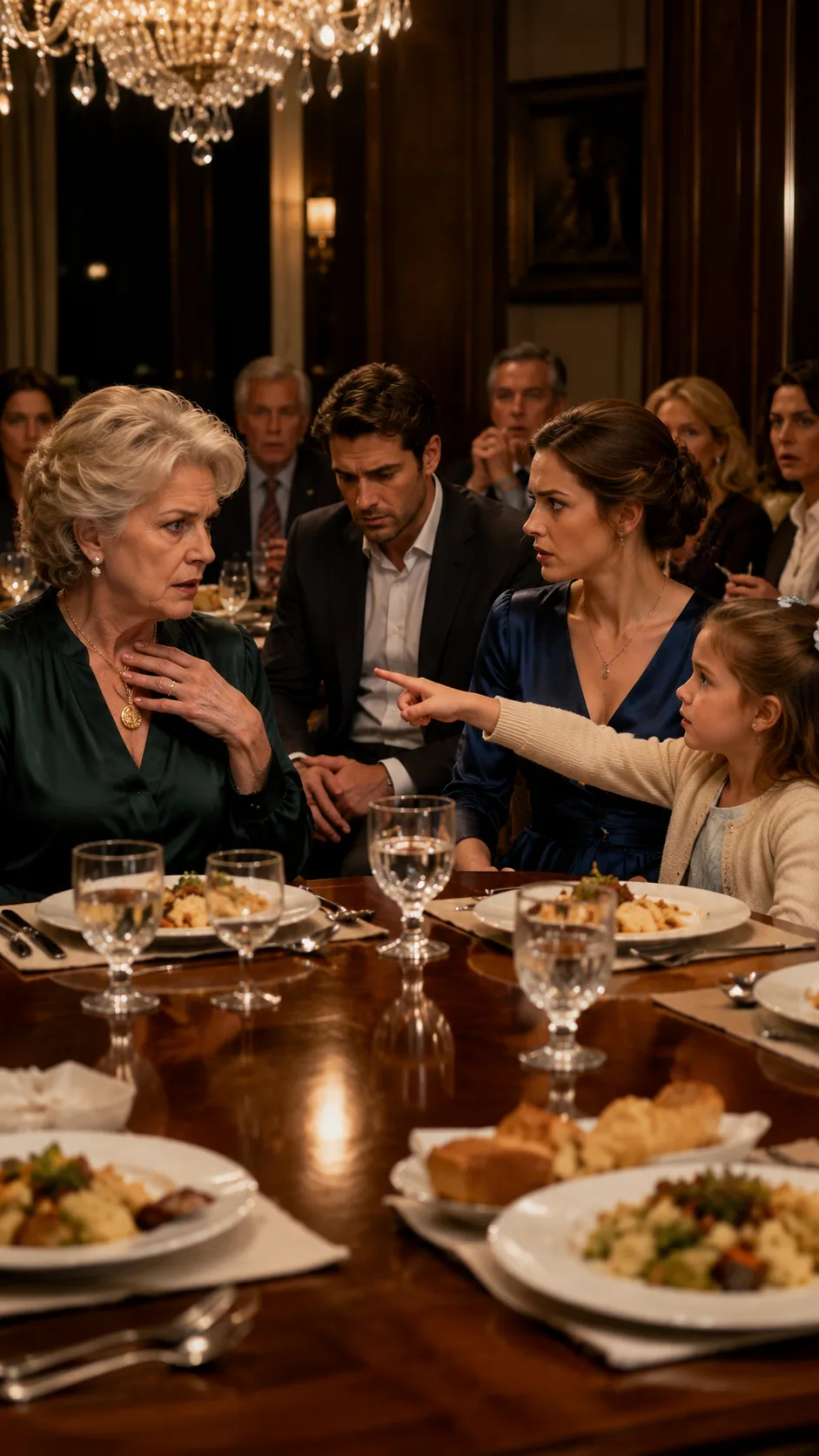
Lily was the one who broke it.
She had been quiet for almost six minutes, which was long for Lily in any room with potatoes. She looked at Margaret’s throat with her head tilted slightly to one side. Children notice what adults build whole lives trying to hide.
Her small finger rose.
“Grandma, why are you wearing Mommy’s necklace?”
The fork in Daniel’s hand stopped.
At the far end of the table, Ruth closed her eyes.
Margaret’s hand flew to her throat.
Too fast.
The pendant vanished beneath her palm, but the chain still shone against the emerald silk. The chandelier light caught it and held.
No one spoke.
Lily’s finger lowered slowly into her lap.
Claire set her fork down.
The sound was tiny against the plate.
Margaret’s gaze moved from Lily to Claire. Her face did not fall apart. Margaret Fairchild had spent too many years practicing control in mirrored hallways and charity ballrooms. But her thumb pressed hard against the pendant under her palm.
“Children touch things they don’t understand,” Margaret said.
Lily’s shoulders drew in.
Claire turned her head toward her daughter. “You didn’t do anything wrong.”
Margaret’s smile sharpened. “I didn’t say she did.”
“You didn’t have to.”
Daniel put his knife down.
Finally.
“Claire,” he said.
She did not look at him.
“Take it off,” Claire said.
Margaret leaned back in her chair, hand still covering the necklace. “Excuse me?”
“Take it off.”
A glass clicked against the table. Daniel’s uncle lowered his fork. Ruth kept her eyes on her plate, one hand pressed flat beside it.
Margaret looked around the table, collecting witnesses like coins.
“My daughter-in-law is accusing me of theft at dinner.”
“No,” Claire said. “My daughter asked you a question.”
“And you turned it into an accusation.”
“You’re wearing my mother’s necklace.”
Margaret laughed once. The sound landed poorly. “Your mother’s things were not as carefully kept as you believe.”
Daniel’s head lowered.
Claire saw it.
So did Ruth.
“Daniel,” Claire said.
He rubbed his thumb along the edge of his napkin. “I can explain after dinner.”
“After dinner?”
Margaret lifted her chin. “Your husband gave it to me.”
The room shifted toward Daniel.
His mouth opened.
Nothing came out.
Claire looked at the man she had married, the man who had held her hand beside her mother’s hospital bed, the man who had told her he had packed the jewelry box himself because she was too tired to stand. His face was clean-shaven, handsome, composed enough for strangers.
At that table, he looked twelve.
“Did you?” Claire asked.
Daniel stared at the tablecloth.
Margaret leaned forward. “You see? This is exactly why grief should not become obsession.”
Claire’s hand moved under the table and opened her handbag.
The clasp made a small metallic snap.
Margaret heard it.
Her eyes dropped.
Claire pulled out the cream envelope.
Daniel’s hand lifted an inch off the table. “Claire.”
She placed the envelope beside her plate.
Margaret’s fingers tightened around the necklace again.
Ruth whispered, “Oh, Margaret.”
No one else moved.
Claire opened the envelope flap. The paper had softened along the crease. She slid the photograph out first, holding it by the edges because she always did.
Her mother stood in sunlight, blue dress, hand raised against glare. The necklace sat at her throat, clear as breath. Same pendant. Same chain. Same clasp.
Claire placed the photo beside Margaret’s plate.
Not in front of herself.
In front of Margaret.
The room leaned toward it in pieces. Daniel’s uncle first. Then his wife. Then Ruth, who covered her mouth but did not speak.
Margaret did not touch the photograph.
Claire removed the appraisal card.
White card. Black print. The jeweler’s stamp in the corner. Her mother’s initials at the top.
E.R.
The chain description beneath it.
Oval gold pendant. Twisted chain. Engraved reverse. One clasp repair on left side.
Claire slid the card into the center of the table.
Margaret moved.
Her hand shot forward, not fast enough to seem harmless and not slow enough to seem innocent.
Daniel caught her wrist halfway across the table.
The room saw that too.
His fingers closed around his mother’s wrist. Not hard. Enough.
Margaret looked at him then.
For the first time that night, her expression moved.
“Daniel,” she said.
His voice came out low. “Mom, don’t.”
Two words.
The room changed around them. No one announced it. No one stood. But Daniel’s uncle leaned back from Margaret. Ruth turned toward Claire. The maid, half hidden near the doorway with a water pitcher, stopped pretending not to listen.
Claire pointed to the initials on the card, then to the necklace still half-covered by Margaret’s hand.
“Read the appraisal card.”
Margaret’s wrist remained trapped in Daniel’s hand.
Her other hand stayed on the pendant.
Claire waited.
A chair leg scraped near the far end of the table. Someone lowered a glass slowly. Lily sat very still beside Claire, her untouched potato tower leaning slightly to one side.
Margaret looked at the card.
She did not read aloud.
She could not.
Ruth pushed her chair back. “I knew you had it.”
Margaret’s head snapped toward her sister.
Ruth’s voice shook, but she kept going. “Ellen asked me to check after the funeral. You said Claire had packed everything.”
Margaret’s lips parted.
Ruth looked at Daniel. “And you said the box was sealed.”
Daniel released Margaret’s wrist as if it had burned him.
Claire turned to him.
The card sat between them all, flat and small and louder than any person at the table.
Daniel pressed both hands to the table edge. “I didn’t know she wore it.”
Claire watched him.
He tried again. “I knew she had it. I didn’t know she wore it.”
That was worse.
Not louder.
Worse.
Margaret found her voice first. “I kept it because Ellen owed me.”
Claire’s fingers rested on the edge of the appraisal card. “My mother owed you?”
“She lived in my brother’s house for eight months.”
“She was dying.”
“She took attention from this family.”
There it was.
Ugly, plain, unpolished.
Lily looked at her grandmother.
Claire moved the appraisal card closer to herself, then folded the envelope shut with the photograph still on the table.
“Take it off,” Claire said again.
Margaret’s chin lifted. “You will not humiliate me in my own house.”
Claire looked around the table. “You did that yourself.”
No one rescued Margaret.
Not one person.
Her hand slowly left the pendant. The chain trembled against her blouse. She reached behind her neck, missed the clasp once, then found it. The necklace came loose and slipped into her palm.
For a moment, she held it like she still owned it.
Claire extended her hand.
Margaret did not move.
Daniel took the necklace from his mother’s palm.
He placed it in Claire’s hand.
Not on the table.
In her hand.
Margaret’s mouth opened. “That is not—”
The sentence broke apart.
Claire closed her fingers around the necklace.
The gold was warm from Margaret’s skin.
No one ate after that.
The plates sat under the chandelier, beautiful and useless. The pears in the center bowl still looked untouched and staged. Lily leaned against Claire’s side, no longer trying to sit perfectly straight. Claire did not correct her.
Daniel stood once, then sat again.
Margaret remained at the head of the table with her hand bare at her throat. The emerald blouse suddenly looked too bright. Without the necklace, her pearl earrings seemed like costume jewelry.
Ruth came around the table and picked up the photograph of Ellen.
She did not ask permission.
She held it for a long time, thumb near the blue dress, then placed it back beside Claire. “Your mother wanted you to have that.”
Claire nodded once.
Daniel said her name.
She looked at him because Lily was watching.
“I should have told you,” he said.
“Yes.”
“I thought I could get it back quietly.”
“You thought silence would cost less.”
He had no answer ready for that.
Margaret pushed back her chair. It scraped loudly across the floor, and no one pretended not to hear it. She stood with the kind of posture that used to command rooms. That night it only made the silence look taller.
“This family has become vulgar,” she said.
Ruth looked up at her. “No. Just visible.”
Margaret left the dining room.
No one followed.
Claire wrapped the necklace in the napkin from her lap because she did not want to put it loose into her bag. The linen was too expensive for what it was, stiff and folded with a silver ring. She used it anyway.
Lily watched every movement.
“Was it Grandma’s?” she asked.
Claire touched the top of her daughter’s hand. “No.”
“Was it yours?”
Claire looked at the napkin, at the shape of the pendant under the cloth.
“It was my mother’s,” she said. “Now I’ll keep it safe.”
Lily nodded as if that was enough.
Maybe for her, it was.
Daniel drove them home without turning on the radio.
The road outside Margaret’s estate curved through dark trees and iron gates. Lily fell asleep before they reached the main road, her cheek pressed against the car seat, one hand still holding the ribbon from her dress.
Claire sat in the passenger seat with her handbag on her lap.
The necklace was inside now. So were the photograph and the appraisal card. The envelope had been folded again, but not the same way. One corner stuck out where it had bent under Lily’s bed that afternoon.
Daniel kept both hands on the wheel.
At the red light near the pharmacy, he said, “I was ashamed.”
Claire looked through the windshield.
The light stayed red.
“She told me she was holding it because you weren’t ready,” he said. “After the funeral. I believed that for about a week. Then I saw it in her safe.”
Claire turned toward him.
He swallowed. “I should have taken it then.”
“Yes.”
“I didn’t know how to go against her.”
Claire looked at the sleeping shape of Lily in the back seat. “You learned tonight.”
The light turned green.
Daniel did not move for one second. A car behind them tapped its horn. He drove.
Margaret called six times the next morning.
Claire did not answer.
By noon, Ruth sent a photograph from her old albums. Ellen and Claire at a summer picnic, Claire maybe eight years old, sitting on her mother’s lap with one hand reaching up toward the necklace. Ellen was laughing in the picture. Claire had forgotten that version of her mother’s face.
She saved the photo.
Daniel went to his mother’s house that afternoon alone. He returned with a small box of items Claire had not known were missing. The bracelet. A pair of earrings. A silver compact with Ellen’s initials. A folded scarf that still smelled faintly of powder and cedar.
He placed the box on the kitchen table and stepped back from it.
Claire did not thank him.
She opened the box and checked every piece against memory.
That was enough.
Margaret’s invitations stopped for three months. Then six. Her charity board removed her name from the winter gala committee after Ruth told the story to the wrong person at the right lunch. Daniel’s uncle stopped letting her host holiday dinners. People still visited her, but not in groups large enough for her to control.
Daniel started therapy on a Tuesday morning and told Claire only after he had already gone.
She respected that.
She did not forgive everything at once. Forgiveness was too clean a word for what came next. There were receipts. Questions. Nights where Daniel slept in the guest room because Claire could not stand the shape of him beside her. Mornings where Lily asked why Daddy was making pancakes like he was auditioning for something.
Life did not become simple.
It became honest.
One year later, Claire wore the necklace to Lily’s school concert.
Not to prove anything.
The clasp had been repaired again by the same jeweler whose stamp was on the old appraisal card. The pendant rested against Claire’s black dress, warm under the auditorium lights. Daniel sat beside her with a program folded in his hands. He did not comment on the necklace. He only looked at it once, then at Claire, then back at the stage.
Lily walked out with the second-grade choir, scanning the crowd until she found them.
Claire lifted one hand.
Lily smiled.
After the concert, Lily ran down the aisle and wrapped both arms around Claire’s waist. Her paper snowflake crown tilted over one eyebrow. Daniel reached to straighten it, then stopped and waited for Lily to nod first.
She did.
Small things.
Claire touched the pendant at her throat.
For years, she had thought keeping something safe meant locking it away where no one could reach it. In a cedar box. In a closet. Behind silence. Under politeness. Beneath all the manners people used when they wanted theft to look like family tradition.
Now the necklace sat in the open.
Lily noticed it while they walked to the car.
“Mommy?”
“Yes?”
“Grandma doesn’t get to wear that anymore, right?”
Claire looked down at her daughter’s serious little face, then at Daniel walking a few steps ahead with the folded program and Lily’s coat.
“No,” Claire said. “She doesn’t.”
Lily took her hand.
The pendant stayed where it belonged.
Chapter complete
You have reached the end of this chapter.
Continue reading
A few more worlds to get lost in after this chapter.