Anna had one hand under the cake box and the other pressed flat against the kitchen door when Lily came running barefoot across the marble hall.
Chapter 1
Anna had one hand under the cake box and the other pressed flat against the kitchen door when Lily came running barefoot across the marble hall.
“Miss Anna, don’t let Grandma see my socks.”
Anna looked down.
One pink sock. One white sock. Both sliding halfway off the child’s heels.
“Too late for that,” Anna said.
Lily stopped beside the kitchen island, breathing through a grin, her teddy bear tucked beneath one arm and a ribbon hanging loose from the back of her pastel dress. The house behind her was already filling with voices. Florists were arranging white roses along the staircase. A man in a black jacket was testing the speakers near the living room windows. Outside, caterers carried silver trays through the side entrance like they were handling museum glass.
It was Lily’s seventh birthday.
The Whitmore mansion had been prepared as if a diplomat were visiting instead of a child who still hated peas and slept with a stuffed bear missing one eye.
Anna set the cake box down on the counter.
“Come
here.”
Lily stepped closer. Anna knelt, fixed both socks, tied the ribbon properly, then brushed a crumb from the girl’s chin.
“There,” Anna said. “Birthday princess.”
Lily lifted the teddy bear. “He says thank you.”
Anna leaned closer to the bear. “Tell him he needs better manners at the table.”
Lily laughed.
The sound carried into the hall.
Mrs. Whitmore heard it.
She stood near the archway in a cream silk dress, one hand resting on her diamond bracelet, the other holding a champagne flute she had not tasted. Her silver-blonde hair had been pinned into a perfect low twist, and her pearls sat against her throat like small, pale warnings.
“Lily,” she said. “Guests will arrive soon. Do not run through the house.”
Lily’s smile shrank.
Anna stood and smoothed her apron.
“She was just—”
“I spoke to my granddaughter.”
The words landed cleanly.
Anna closed her mouth.
Mrs.
Whitmore looked at Lily’s mismatched socks, then at Anna’s hands, then at the cake box.
“Your mother paid for three planners, two florists, and an entire catering team,” she said. “There is no reason for staff to make themselves central today.”
Anna moved the cake box closer to the counter edge. “Of course, ma’am.”
Lily reached for Anna’s sleeve.
Mrs. Whitmore saw it.
The bracelet on her wrist caught the kitchen light.
A small flash.
A sharp one.
“Go to your mother,” she said to Lily.
Lily hesitated.
Anna gave the girl a tiny nod, and Lily shuffled out, teddy bear dragging against her skirt. Mrs. Whitmore watched until the child disappeared, then looked back at Anna.
“You are very familiar with her.”
Anna kept her eyes lowered. “I’ve cared for Lily since she was small.”
“Yes,” Mrs. Whitmore said. “That is what concerns me.”
She left before Anna could
answer.
The kitchen door swung once behind her.
Then again.
Anna stood there for a breath, listening to the hum of the refrigerator and the distant clink of glasses being arranged in the living room. On the counter beside the cake box, someone had left a single pink candle lying sideways.
Bent at the wick.
Anna picked it up and set it straight.
By two o’clock, the mansion looked nothing like a home.
Pastel balloons floated above the staircase in clusters of pink, ivory, and pale blue. The long living room had been turned into a polished stage with a birthday table near the windows, wrapped presents stacked beneath a white floral arch, and a three-tier cake sitting beneath a glass dome.
Guests arrived in soft colors and expensive shoes.
Women kissed Lily’s cheeks without bending too low. Men shook her father’s hand near the bar cart. Children in party dresses and buttoned shirts chased each other around furniture no child had ever been meant to touch.
Anna moved through it all quietly.
Water glasses. Napkins. Fallen ribbons. A dropped macaron under the piano bench.
She knew where to stand without blocking photographs. She knew when to step away before someone had to ask. She knew which guests treated her like air and which ones said thank you only when someone important was watching.
Lily kept finding her anyway.
First beside the dessert table.
Then near the staircase.
Then again in the hall, where she whispered that her shoes hurt.
Anna crouched and loosened the straps.
“Better?”
Lily nodded.
Mrs. Whitmore appeared behind them.
“Anna.”
The name was not loud.
Lily’s foot froze in Anna’s hand.
Anna stood.
“Yes, ma’am?”
“You are needed in the kitchen.”
Anna glanced toward the kitchen entrance. Two caterers were already there. So was the housekeeper.
Still, Anna nodded.
Lily reached for her teddy bear with both hands and held it under her chin.
Mrs. Whitmore smiled at her granddaughter.
“Come greet Mrs. Harlan. She brought you a gift from Paris.”
Lily looked at Anna.
Anna nodded again.
Go.
Lily went.
The first crack happened twenty minutes later.
Anna was carrying a tray of lemonade glasses past the grand staircase when she heard Mrs. Whitmore speaking near the gift table.
“The child has become attached in the wrong direction,” she said.
A woman beside her gave a small laugh. “Children attach to whoever gives them sweets.”
“It is not sweets.” Mrs. Whitmore adjusted her bracelet. “It is access.”
Anna slowed by half a step.
Only half.
Mrs. Whitmore continued, her voice smooth enough to pass as conversation.
“People forget their position when a family becomes too kind.”
The tray felt heavier.
Anna kept walking.
No glass rattled.
In the kitchen, she set the tray down and wiped a drop of lemonade from her thumb. The housekeeper, Teresa, looked up from arranging forks.
“Ignore her.”
Anna did not answer.
Teresa lowered her voice. “I mean it. Today is not the day.”
Anna reached for a clean towel. “It never is.”
Outside, the party brightened. The magician arrived. The children gathered near the rug. Lily sat in the front row with her teddy bear on her lap and her shoes already missing. Her father, Charles Whitmore, laughed when the magician pulled a silk scarf from an empty box. Her mother, Elise, stood near the windows with a hand pressed against her phone, checking messages and glancing at her mother-in-law between replies.
Elise was beautiful in the way money teaches people to be careful. Soft dress. Soft voice. Soft hands. She never said no in public. Not to her mother-in-law.
Especially not to her mother-in-law.
Mrs. Whitmore stood beside the staircase and watched Lily instead of the magician.
Anna saw the bracelet again.
Diamond links around a narrow wrist.
Mrs. Whitmore touched it often. Not nervously. Deliberately. Like she wanted everyone to know it was there.
At three fifteen, Lily ran to Anna with a frosting flower stuck to her finger.
“I saved you one.”
Anna bent down. “That’s your cake.”
“There’s a lot.”
Lily held out the frosting flower.
Anna looked around. Mrs. Whitmore was speaking to Charles near the bar cart. Elise was adjusting Lily’s birthday crown for a photograph. Nobody seemed to be watching.
Anna took the smallest bite.
“Perfect,” she said.
Lily smiled wide.
Too wide.
Mrs. Whitmore turned her head.
She saw.
The next minutes moved with polite speed. A guest asked for sparkling water. Someone spilled juice near the patio doors. One child began crying because another child opened a present that was not his. Anna crossed the room to clean the spill, then returned to gather plates.
When she passed the hall table, she noticed her coat had been moved.
It had been hanging in the staff area near the kitchen.
Now it lay folded over the armchair beside the service hallway.
Anna stopped.
Only for a second.
The black wool looked plain against the pale upholstery. One sleeve dangled toward the floor.
Teresa walked past with empty glasses. “You all right?”
Anna looked at the coat.
“Yes.”
She almost picked it up.
Then Mrs. Whitmore called from the living room.
“Anna. The cake plates.”
Anna left the coat where it was.
The cake was cut at four.
Children leaned forward. Parents lifted phones. Lily stood on a chair while Charles helped her hold the knife, his hand over hers for the photograph. Elise clapped softly. Mrs. Whitmore stood behind Lily, one hand resting on the back of the chair, diamond bracelet bright beneath the chandelier.
“Smile,” someone said.
Lily did.
Anna stood near the side table with the plates stacked against her wrist.
The photographer lowered his camera.
That was when Mrs. Whitmore touched her wrist.
Once.
Then again.
Her fingers moved over bare skin.
The bracelet was gone.
“My bracelet.”
It was quiet at first.
A few guests kept talking.
Mrs. Whitmore looked down at her wrist. She turned her hand over, as if the diamonds might have slipped beneath her sleeve.
Then she lifted her head.
“My diamond bracelet is missing.”
This time, the room heard.
Charles stepped toward her. “Mother, are you sure?”
She gave him a look that made him stop.
“It was on my wrist during the cake.”
Elise put a hand against her collarbone. “Maybe it fell near the table.”
“Then find it.”
The search began with manners.
Guests checked around their shoes. A man lifted the edge of the rug. A woman moved gift bags aside with two careful fingers. Staff opened drawers and looked beneath tablecloths. Children were asked to stay near the playroom, away from the adults.
Lily stood beside the staircase, holding her teddy bear.
Anna placed the stack of plates on the dessert table.
“I can help look,” she said.
Mrs. Whitmore looked at her.
The room had too many people for such a small smile.
“Yes,” the older woman said. “I am sure you can.”
Anna felt the first turn then.
Not fear.
Recognition.
She looked toward the service hallway. Her coat still lay on the armchair. Its sleeve hung lower now. Or maybe she only noticed it more.
A security guard approached the hallway.
“Check the staff area,” Mrs. Whitmore said.
The guard nodded.
Anna stepped forward. “My things are in the staff room.”
Mrs. Whitmore lifted her brows. “Then you won’t mind.”
“I didn’t say I minded.”
“You sounded defensive.”
Anna’s fingers pressed against her apron.
Charles glanced between them. “Mother—”
“I want my bracelet found.”
The guard came back holding Anna’s coat.
Not from the staff room.
From the armchair.
Anna stared at it.
“That shouldn’t be there,” she said.
Nobody asked what she meant.
The guard slid his hand into the right pocket.
A small metallic sound followed.
Then he pulled out the bracelet.
Diamonds spilled light across his palm.
The room changed without moving.
Anna looked at the bracelet, then at the pocket, then at Mrs. Whitmore.
“No.”
Mrs. Whitmore placed one hand against her chest. “Oh, Anna.”
The pity in her voice was polished.
Manufactured.
Anna shook her head. “No. I did not take that.”
One of the guests shifted backward. Another looked toward Elise. Someone near the windows lowered a phone but did not put it away.
Lily took one step down from the staircase.
Elise saw her and held out a hand. “Stay there, sweetheart.”
Anna looked at Charles.
He did not meet her eyes.
She looked at Elise.
Elise looked at the bracelet.
Anna swallowed once.
“I have worked here for three years.”
Mrs. Whitmore took the bracelet from the guard and held it by the clasp.
“And we trusted you for three years.”
“I didn’t steal from you.”
“You were found with it.”
“It was in my coat. I did not put it there.”
Mrs. Whitmore’s expression tightened. The public sorrow began to peel away from the edges.
“Do you know what is most insulting?” she said. “Not the theft. The lying.”
Anna stood still.
The room waited for her to shrink.
She did not.
Mrs. Whitmore stepped closer, her cream silk dress brushing the corner of the dessert table.
“You will apologize.”
Anna’s voice came out low. “For something I didn’t do?”
“For bringing shame into my son’s home.”
Teresa appeared near the kitchen door, her hands still wet from washing serving knives. She looked at Anna, then at the bracelet, then at Mrs. Whitmore.
“Ma’am,” Teresa said, “maybe we should check the cameras.”
Mrs. Whitmore did not turn around.
“There are no cameras in the living room.”
Charles cleared his throat. “Security is outside and at the entrances.”
“Yes,” Mrs. Whitmore said. “Because I never imagined I needed cameras watching the help.”
Teresa’s face went flat.
Anna lifted her chin.
“Search my bag,” she said. “Search the staff room. You won’t find anything.”
“We will,” Mrs. Whitmore said. “But first, you will kneel.”
Elise whispered, “Mother, please.”
Mrs. Whitmore held up one hand.
The room obeyed it.
That was how the Whitmore family worked.
One hand, raised.
Everyone silent.
Anna looked down at the marble floor. There was a smear of pink frosting near the leg of the cake table. She had missed it earlier. A small thing. A real thing. Her eyes stayed there for one breath too long.
Then Mrs. Whitmore spoke again.
“Poor people always mistake kindness for opportunity.”
The sentence crossed the room and stayed there.
Anna looked up.
Lily’s teddy bear slipped from under her arm and dangled by one paw.
Charles said nothing.
Elise looked away.
The guard shifted his weight.
Mrs. Whitmore turned toward him. “Search her bag. Then remove her from the property.”
The guard hesitated. “Ma’am, should we call—”
“Do it.”
Anna reached behind her waist.
Her fingers found the knot of her apron.
She held it.
Not yet.
A small sound came from the staircase.
One shoe on marble.
Then another.
Everyone turned.
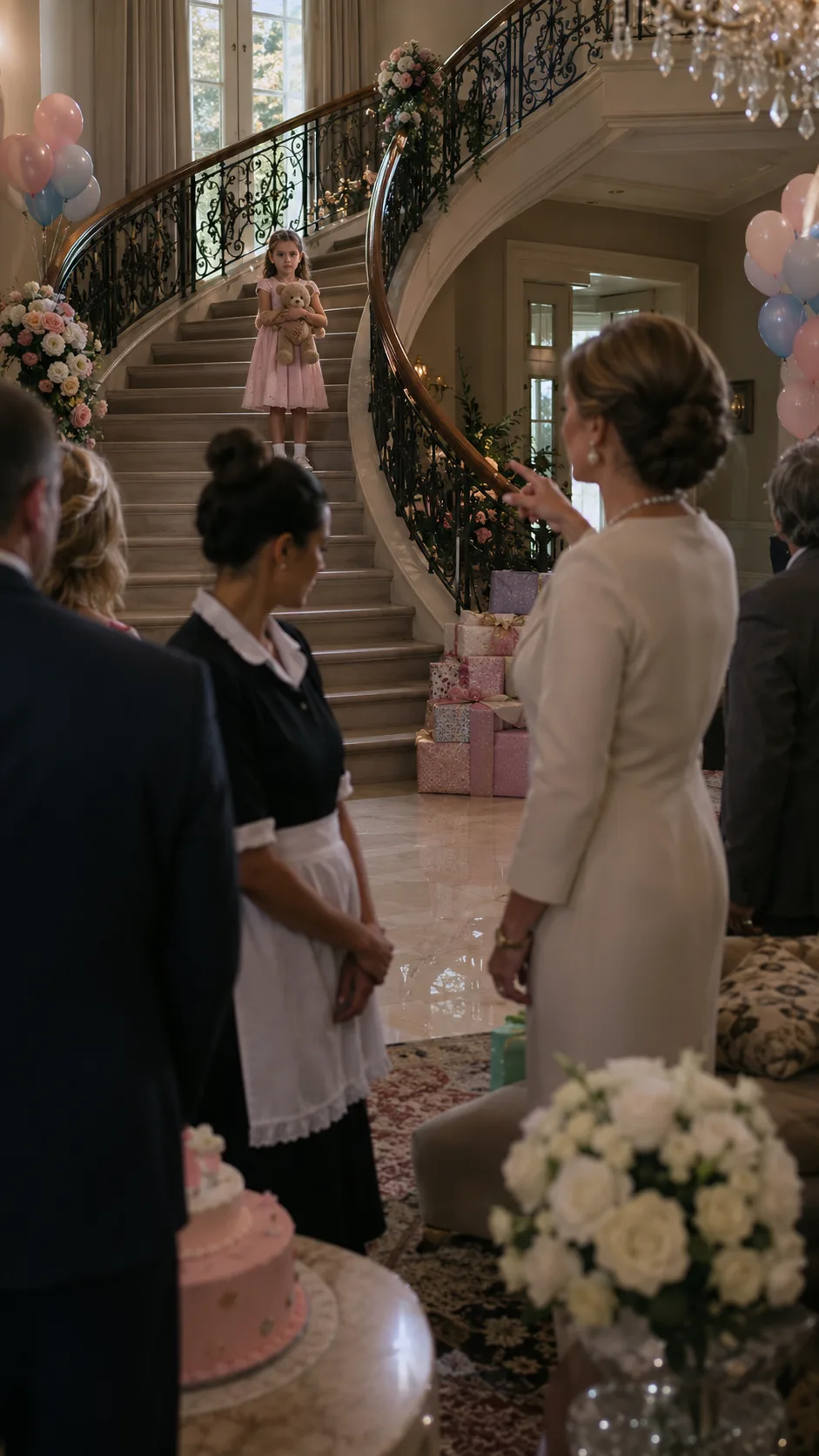
Lily stood halfway down the grand staircase, both hands wrapped around the teddy bear now. Her pastel dress had wrinkled at the waist. One sock had slipped low again. Her birthday crown was missing. A curl of hair had stuck to her cheek.
“It wasn’t Miss Anna.”
Her voice was not loud.
It carried because nobody breathed over it.
Anna turned toward the stairs.
Mrs. Whitmore changed her face first. The hard lines softened. Her mouth curved into a grandmother’s smile.
“Lily, darling, adults are handling this.”
Lily did not move.
The teddy bear pressed into her chest.
Mrs. Whitmore took one step toward the staircase. “Come down. This is not a game.”
Lily’s eyes stayed on her grandmother.
Charles said, “Lily, honey—”
“No,” Lily said.
It was one word.
Small.
Enough.
Elise took a step forward, then stopped beside the gift table.
Mrs. Whitmore’s smile thinned. “You are being rude.”
Lily’s fingers sank into the teddy bear’s worn fur.
Anna watched her.
The girl took one careful step down. Her bare toes touched the next stair. Then she stopped and held the railing with her elbow because both hands would not leave the bear.
“It wasn’t Miss Anna,” she said again.
Mrs. Whitmore’s voice lowered. “Children do not understand adult matters.”
Lily lifted one hand.
The teddy bear slid lower against her dress.
Her arm trembled, but it did not drop.
She pointed straight at Mrs. Whitmore.
“I saw Grandma put the bracelet in Miss Anna’s pocket.”
The room did not react all at once.
That made it worse.
A woman near the floral arch blinked first. The photographer lowered his camera halfway. Teresa’s wet hands curled at her sides. The security guard looked from Lily to Mrs. Whitmore, then to the coat he still held.
Mrs. Whitmore’s lips parted.
No sound came.
Then she laughed once.
Too short.
“Lily,” she said, “that is a very serious lie.”
Lily flinched at the word.
Anna stepped forward.
“Do not call her a liar.”
Mrs. Whitmore’s head snapped toward Anna.
“You do not speak to me.”
Anna took another step.
The guard did not stop her.
Lily came down two more stairs, slow and uneven, the teddy bear bumping against her knees.
“I’m not lying.”
Mrs. Whitmore’s face tightened around the smile she refused to let go.
“You were playing upstairs.”
Lily shook her head. “I was in the playroom.”
“Exactly.”
“The playroom door was open.”
Mrs. Whitmore’s hand moved to her bare wrist. The bracelet was in her other hand now. She seemed to notice that and lowered it.
Charles finally looked at his mother.
“What is she talking about?”
Mrs. Whitmore turned to him with sharp control. “Your daughter is confused.”
Lily’s mouth pressed into a line.
Then she turned and ran.
“Lily!” Elise called.
The child disappeared down the side hallway toward the playroom, her socked feet slipping once on the polished floor.
Nobody moved for two seconds.
Then Charles took a step after her.
Mrs. Whitmore touched his sleeve. “Let me handle—”
He pulled his arm away.
Not hard.
Enough.
Lily returned carrying a small plastic toy camera, pink with a cracked sticker on one side. It had been a birthday gift from Charles two weeks earlier because Lily liked pretending to film “important memories.” He had laughed when she made him wave at breakfast. He had forgotten, apparently, that the toy actually recorded short videos.
Lily held it with both hands.
Her fingers struggled with the buttons.
Anna walked to the bottom of the stairs and knelt on one knee.
“Take your time.”
Lily glanced at her.
Then she pressed play.
The tiny screen was too small for the room, so Charles crossed over and took the camera carefully from Lily’s hands. He looked at the screen.
His face changed by degrees.
First the forehead.
Then the mouth.
Then the hand holding the camera.
“What is it?” Elise asked.
Charles did not answer.
He walked to the television mounted above the low cabinet near the windows. The camera had a cable attached to the side; Lily must have brought it from the playroom with the cord wrapped around her wrist. Charles connected it with hands that did not move smoothly.
The screen flickered blue.
Then the image appeared.
The living room, earlier that afternoon.
The angle was crooked, low, filmed from the playroom doorway. Children’s voices sounded distant. A corner of Lily’s teddy bear blocked part of the frame.
Then Mrs. Whitmore entered.
Alone.
She stood near the hall table, looked toward the living room, and removed the diamond bracelet from her own wrist.
A guest made a small noise.
No one told them to be quiet.
On the screen, Mrs. Whitmore crossed to the armchair where Anna’s coat had been placed. She opened the pocket. She slid the bracelet inside. Then she arranged the sleeve so it hung over the edge.
A clean motion.
Practiced.
The video kept playing for three more seconds after she left. The empty hallway. The armchair. The coat.
Then Lily’s recorded voice from behind the camera: “Grandma?”
The screen went black.
The room stayed still.
Mrs. Whitmore looked at the television as if it had spoken a language she did not approve of.
Charles unplugged the cable.
The tiny plastic connector clicked against the cabinet.
Anna stood.
The apron knot was still between her fingers.
She pulled once.
The bow came loose.
No one stopped her.
Not Teresa. Not the guard. Not Elise, who had one hand pressed to her mouth now. Not Charles, who still held the toy camera and looked older than he had ten minutes before.
Mrs. Whitmore turned slowly.
“This is being misunderstood.”
Nobody answered.
She looked at Charles. “I was trying to protect this family.”
Charles stared at her.
The bracelet hung from her hand now. The thing she had used as a weapon looked small.
“From Anna?” he said.
Mrs. Whitmore’s eyes moved toward the guests.
Too many faces.
Too many witnesses.
She straightened. “That maid has overstepped for years.”
Anna folded the apron once.
Then again.
She placed it on the edge of the birthday table beside the plates.
Lily came down the last stairs and ran toward her, but stopped before touching her, like she had learned in the last few minutes that adults could break things by standing too close.
Anna crouched.
Lily’s face was blotchy. Her teddy bear hung in one hand.
Anna brushed a loose curl away from the child’s cheek.
“I’m sorry, sweetheart,” Anna said. “But I can’t stay in a house where a child has to protect the truth from adults.”
Lily shook her head.
Anna held her hand for one second.
Only one.
Then she stood.
The room opened for her as she crossed it.
People stepped aside without being asked. Shoes moved over marble. A man near the doorway lowered his gaze. The woman who had laughed earlier at Mrs. Whitmore’s comment pressed her lips together and looked down at her own bracelet.
Teresa followed Anna to the hallway.
“I’ll get your bag.”
Anna nodded.
Her coat was still in the guard’s hands.
He held it out to her with both palms.
“I’m sorry.”
Anna took it.
The pocket felt heavy even empty.
Behind her, Mrs. Whitmore’s voice cut through the room.
“Charles, you cannot allow this.”
Charles did not raise his voice.
“You should leave.”
Silence.
Then the older woman laughed again.
“This is my family.”
Elise looked at her mother-in-law for a long time.
Then she walked to Lily and put both hands on her daughter’s shoulders.
“Not like this,” Elise said.
Mrs. Whitmore looked from face to face, searching for the old arrangement of the room.
The one where she spoke and people folded.
It was gone.
A child had moved it.
Anna waited in the service hallway while Teresa brought her bag. The music from the living room had stopped. Somewhere near the kitchen, the golden retriever whined behind a baby gate. A caterer stood with a tray of untouched lemon tarts and no idea where to put them.
Teresa handed Anna the bag.
“I can say something,” she said.
Anna slipped the strap over her shoulder. “You already did.”
“Not enough.”
Anna looked toward the living room. Lily was visible through the doorway, small between her parents, teddy bear clutched to her ribs.
Anna’s fingers tightened around the coat.
“It was enough for her to know she wasn’t alone.”
Outside, the late afternoon sun had turned the driveway pale gold. The valet stand was still arranged beside the front steps. Cars lined the curved drive. A balloon had escaped from the front arch and knocked softly against the stone column, trapped by its own ribbon.
Anna walked down the steps.
No one followed her at first.
Then small feet slapped against the marble behind her.
“Miss Anna!”
Anna stopped.
Lily stood in the open doorway. Elise held her back gently by the shoulders, not to restrain her, only to keep her from running into the driveway.
Anna turned.
Lily held up the teddy bear.
Not giving it away.
Showing it.
Anna placed one hand over her chest and nodded once.
Lily nodded back.
The door remained open behind her, with the birthday party still arranged in perfect colors and ruined silence.
Anna left through the gate with her coat over her arm.
She did not look back again.
The story did not end that afternoon, though the party did.
Guests left early with their children and their untouched favors. By evening, the florist returned to remove half the arrangements because Elise could not stand the smell of roses. The cake sat under its glass dome until Teresa carried it into the kitchen and cut slices for staff who had lost their appetite.
Mrs. Whitmore did not apologize.
Not that day.
Not the next.
She sent messages through Charles. Then through Elise. Then through a family attorney who wrote phrases like “private misunderstanding” and “household dispute” as if legal language could soften what a child had filmed.
Charles did not answer the first letter.
Elise answered the second.
Two lines.
Do not contact Anna again.
Do not contact Lily without our permission.
The Whitmore family name did what family names often do when exposed to daylight. It tried to protect itself. Some guests stayed quiet because they preferred invitations to integrity. Others talked. The story moved through private dinners, school pickup lines, charity boards, and staff agencies that had been warning each other about Mrs. Whitmore for years but never had proof.
Now they had more than proof.
They had witnesses.
Mrs. Whitmore left for her Palm Beach house before the end of the month. The official reason was rest. The real reason sat in the silence at every family table where her chair remained empty.
Anna found work two weeks later with an elderly woman who labeled every cabinet in her kitchen and apologized when she forgot where the tea was. The house was smaller. The floors creaked. The garden had weeds near the back fence. Nobody wore diamonds at lunch.
On Anna’s first Friday there, a package arrived.
No return address.
Inside was a folded pink ribbon from Lily’s birthday dress, a small card, and a photograph printed from the party.
Not the accusation.
Not the bracelet.
Not the video.
The photo showed Lily on the staircase before everything broke open, teddy bear in her arms, looking down at the room.
On the back, in uneven child handwriting, were seven words.
Miss Anna, I told the truth.
Anna placed the photo on the windowsill above the kitchen sink.
The ribbon stayed beside it.
Months later, Lily still carried the same teddy bear, though one ear had been sewn twice and the fur had worn thin near the paws. She saw Anna sometimes at the park on Saturdays, always with Elise nearby, always with permission, always in daylight. Charles came too, not every time, but enough. He stood at a distance at first. Later, he learned to bring coffee and say fewer useless things.
One spring morning, Lily ran ahead to the bench where Anna sat with a paper cup between her hands.
“My socks match today,” Lily said.
Anna looked down.
They did.
Both yellow.
Both inside out.
Anna smiled and tapped the bench beside her.
Lily climbed up, teddy bear in her lap, shoes swinging above the ground.
Across the path, Elise watched from under a maple tree. Charles stood beside her with his hands in his pockets. Neither of them called Lily back.
Anna looked at the child beside her.
Lily was showing the teddy bear a ladybug on the bench rail.
Carefully.
Like truth was something small enough to protect with both hands.
Anna took one sip of coffee.
The cup was warm.
Chapter complete
You have reached the end of this chapter.
Continue reading
A few more worlds to get lost in after this chapter.




