The nurse placed a plastic cup of ice chips on the tray beside my bed and said my daughter had my mouth.
Chapter 1
The nurse placed a plastic cup of ice chips on the tray beside my bed and said my daughter had my mouth.
I looked down at the sleeping bundle against my chest.
She was less than three hours old. Her skin was still that fragile newborn pink, her lips parted like she had been interrupted mid-dream, one hand pressed against my collarbone. The hospital blanket swallowed her whole except for her face and the little cap sliding sideways over her forehead.
“My mouth?” I asked.
The nurse smiled as she adjusted the IV line near my wrist. “Same little curve. See?”
I did.
A small thing.
Mine.
Outside the room, someone pushed a cart down the hall. Wheels squeaked once, then disappeared under the low hum of machines and distant voices. The room smelled of antiseptic, warm milk, and the lemon soap they kept in a dispenser by the sink.
I had imagined this moment for seven years.
Not like this.
Not alone.
Not with my ex-husband’s name still able to make
my body go tight when it lit up my phone.
The screen buzzed on the tray.
Adrian Vale.
For a second, I thought pain medicine had made me read it wrong.
Then the phone buzzed again.
The nurse glanced at it, then at me. She did not ask. Nurses have a way of knowing when a name on a phone is not just a name.
“You want me to silence it?” she said.
“No.”
My voice came out flat.
I picked up the phone with fingers that still trembled from labor and blood loss and fear I had not admitted to anyone. My daughter made a tiny sound against me. I held her tighter.
“Hello.”
“Come to my wedding,” Adrian said.
No hello.
No question.
His voice was smooth, expensive, familiar. The same voice he used when he ordered wine and corrected waiters and told me not to embarrass him
in front of clients.
I looked at the whiteboard near the door.
Patient: Mia Vale.
Baby: Girl Vale.
“Did you hear me?” he asked.
“Yes.”
“I thought you should know personally.” A pause. A little theatrical. “Celeste is pregnant.”
My eyes dropped to my daughter’s face.
Her lashes were so fine they looked painted on with smoke.
Adrian kept talking.
“Unlike you.”
The room did not move.
The drip monitor blinked green. A paper cup sat sweating beside my bed. The nurse stood too still, her hand resting on the curtain.
“Still there?” Adrian said.
“Yes.”
“Don’t make that voice. Eight months is enough time to get over a divorce. Besides, you always said you wanted a family. Thought you might like watching me finally have one.”
Finally.
I did not look away from my daughter.
Seven years with Adrian had taught me many things. How to fold a dinner
napkin for his mother’s parties. How to answer questions without giving people anything useful. How to sit through a doctor explaining a miscarriage while Adrian checked email under the table.
Two miscarriages.
One empty nursery.
Then a divorce petition left beside the coffee machine.
He had not cried. He had not even looked tired.
“You’re becoming hard to love, Mia,” he said that morning.
I remembered the coffee still brewing. I remembered one mug. I remembered that I had bought blueberries the night before because Adrian liked them in oatmeal, then forgot to eat anything myself.
The nurse shifted her weight.
My daughter sighed.
I smiled.
Not because anything was funny.
Because Adrian had called too late.
“Sure,” I said. “I’ll be there.”
Silence stretched on his end.
He had expected a crack in me. A plea. A question sharp enough for him to enjoy answering.
Instead, I gave him the one thing he never knew what to do with.
Calm.
“Good,” he said at last. “Wear something modest. Don’t embarrass yourself.”
“I never do.”
He laughed through his nose. “Still pretending you have pride?”
I brushed one finger across my daughter’s cheek. Her skin was impossibly soft.
“No, Adrian,” I said. “I have proof.”
“What?”
“Nothing. Send the address.”
He hung up first.
Of course he did.
The nurse waited until my phone went dark.
“Do you need security?” she asked.
I almost said no.
Then I thought of Adrian’s mother. Lydia Vale, with her pearl earrings and her thin, elegant mouth. Lydia, who once touched my stomach at Christmas dinner and said, “Some women are not built for legacy,” while Adrian cut into his steak like he had not heard her.
I thought of Celeste.
Celeste with her perfect office dresses, her small polite smile, and the bouquet of white lilies she had sent after the divorce.
The card had read: Some women are chosen.
I had kept it in a drawer for three days.
Then I gave it to my lawyer.
“No,” I said to the nurse. “Not security.”
I looked at the leather folder on the chair beside my hospital bag.
“But I may need a pen.”
The lawyer’s name was Rebecca Shaw, and she wore shoes that made no sound.
That was the first thing I noticed when she came to my apartment two weeks after I left Adrian. Everyone else in my life had arrived loud. Lydia arrived in perfume. Adrian arrived in authority. Celeste arrived in smiles that were never meant for me.
Rebecca entered quietly, wiped rain from her coat sleeve, and asked if she could use my kitchen table.
My apartment then had almost nothing in it.
A mattress. Two plates. Three mugs, because I had accidentally packed one of Adrian’s and could not bring myself to throw it away yet. The kitchen table wobbled if anyone leaned on the left side.
Rebecca noticed and placed her files on the right.
“You said on the phone there were inheritance accounts,” she said.
I nodded.
“My grandfather’s trust. It was supposed to stay separate. Adrian said his finance team could help manage it.”
Rebecca did not react.
That was how I knew it was bad.
“How much access did he have?”
“He said it was just paperwork.”
“Did you sign anything?”
I looked down.
There it was.
The first small shame.
Not because I had trusted my husband. That should not have been a shame. But because I had trusted him after he had already begun calling me broken in small, tidy ways.
At dinner.
In the car.
At doctor’s appointments.
In bed, facing away from me.
Rebecca opened her laptop.
“We start with bank records,” she said.
That was how the folder began.
One statement.
Then another.
Transfers I had not authorized. Fees paid to an account linked to Vale & Co., Adrian’s family firm. Emails forwarded from an assistant address. Celeste’s address. A digital signature that looked almost like mine, except I had stopped dotting my i’s like that when I was nineteen.
Rebecca did not smile when she found it.
She only turned the laptop toward me and said, “Mia, this is not messy divorce behavior. This is theft.”
I stared at the screen until the numbers blurred.
My hand moved to my stomach.
I had not told anyone yet.
Not Rebecca. Not Adrian. Not my mother, who lived two states away and still sent me soup recipes by text because she did not know how else to help.
The pregnancy test was hidden under folded towels in my bathroom cabinet.
I had taken four.
All positive.
After two miscarriages, I had learned not to announce joy too early.
Joy had a way of drawing witnesses.
“Are you all right?” Rebecca asked.
I nodded.
A lie.
She closed the laptop halfway. “There’s something else.”
I looked at her.
“If you’re pregnant, and I’m asking only because timing may affect legal strategy, you need to tell me.”
My face must have answered before my mouth did.
Rebecca sat back.
“Does he know?”
“No.”
“Good.”
That word landed hard.
Good.
For once, silence protected me.
We built the case quietly after that.
Rebecca ordered records. I changed passwords. I stopped using the old joint email account. I moved twice before the baby came, once because Lydia sent flowers to my first apartment without knowing I had never given her the address.
The card that time had no signature.
Just three white roses in a glass vase and a printed message.
For peace.
I threw the flowers away.
I kept the card.
By the fifth month, my belly no longer disappeared under sweaters. I worked remotely with my laptop balanced on a pillow and kept the blinds half-closed. I learned which grocery store had self-checkout that never asked questions. I learned how to sleep sitting up. I learned not to put my hand on my stomach in public.
At night, when the apartment got too quiet, I opened the bottom drawer of my desk and looked at the folder.
Bank records.
Emails.
Notarized statements.
The lily card.
The peace card.
Then, eventually, the paternity test Rebecca arranged through the proper legal chain after my daughter was born.
Adrian had abandoned many things.
He had not erased blood.
Three weeks after the call, I stood in front of my closet wearing a cream dress that buttoned down the front and hid the soft pads tucked into my bra.
My daughter slept in her bassinet beside the bed.
Elara.
I had named her at 2:13 in the morning while a nurse held a clipboard and asked if I needed more time.
I did not.
Elara Vale would have sounded like a claim.
Elara Hayes sounded like a beginning.
Hayes was my grandfather’s name.
Mine, too, again.
I fastened the last button slowly. My body still belonged partly to pain. Standing too long made my back throb. Bending made the stitches pull. Milk leaked when Elara cried, and sometimes when she didn’t.
On the dresser, the wedding invitation leaned against a lamp.
Adrian Vale and Celeste Marrow request the honor of your presence.
Under it, in smaller script, The Bellmont Hall.
I had not been mailed an invitation. Adrian had texted a photo of one like I was being granted admission to a museum exhibit.
Rebecca arrived at noon.
She carried the leather folder in one hand and a garment bag in the other.
“What’s that?” I asked.
“A coat.”
“I have a coat.”
“You have one that looks like you slept badly and survived a hostage situation.” She hung the garment bag on my closet door. “This one says you chose to enter the room.”
It was beige wool, soft at the collar, loose enough to hide how fragile I still felt.
I touched the sleeve.
“Rebecca.”
“You can return it after.”
I looked at her.
She shrugged. “Or keep it. Consider it a professional expense for dramatic legal timing.”
For the first time in weeks, I laughed.
Elara startled in her sleep and made a face like an elderly judge.
Rebecca looked down at her.
“She looks like you.”
“That’s what the nurse said.”
“She also has his brow.”
I did not answer.
Some truths did not need warmth to be true.
Rebecca placed the folder on the dresser and opened it.
“Final review,” she said.
“I know what’s in it.”
“I know you know. I also know rooms like this. They will try to make you feel unreasonable before you open your mouth.”
She laid the pages out in order.
Birth certificate.
Paternity test.
Financial transfer summary.
Email chain.
Notarized statement from the former junior accountant at Vale & Co.
Cease-and-desist letter.
Civil complaint draft.
A copy of the police report Rebecca had filed that morning after the last signature came in.
My hand stopped over that one.
“You filed it?”
“Yes.”
“Today?”
“Yes.”
“Before the wedding?”
Rebecca looked at me across the dresser mirror. “You wanted him served in public. I wanted him unable to hide evidence before Monday.”
I looked at the police report.
The printed words sat on the page with no interest in anyone’s feelings.
Fraud.
Forgery.
Misappropriation.
Celeste Marrow.
Adrian Vale.
A sound came from my chest, small and dry.
Not a laugh.
Not quite.
Rebecca closed the folder.
“You do not have to do this,” she said.
I watched Elara sleep.
Her tiny mouth twitched.
“Yes,” I said. “I do.”
The Bellmont Hall smelled like roses, candle wax, and champagne.
A young usher opened the door before I touched the handle. He was maybe twenty-two, with hair combed too neatly and a headset wire tucked behind one ear.
“Name?”
“Mia Hayes.”
He scanned the clipboard.
Nothing.
Then I said the name Adrian expected.
“Mia Vale.”
His thumb stopped.
There it was.
Recognition.
Not of me. Of the story attached to me.
He looked at the baby carrier on my arm, then at the leather folder tucked under Rebecca’s hand. She stood beside me in a charcoal suit, expression unreadable.
“Ma’am,” he said, too late.
I stepped past him.
Inside, the ceremony had ended and the reception had begun. White flowers climbed the columns in thick, expensive spirals. Waiters moved through the crowd with champagne flutes balanced on silver trays. A pianist played something soft near the far wall, though no one listened.
Guests stood in clusters.
Men in black tuxedos.
Women in satin.
Laughter polished to the right volume.
My daughter slept against my chest in a wrap under my coat. Rebecca had suggested the wrap instead of the carrier.
“Hands free,” she said.
She was right.
I needed one hand for the folder.
And one, maybe, for balance.
We were noticed slowly.
A woman near the entrance looked at Elara first. Her smile started automatically, then froze when she saw my face.
Two men from Adrian’s company lowered their glasses.
A cousin of his whispered to her husband without moving her lips.
Then Lydia Vale turned.
She wore silver silk and a strand of pearls I had seen at every family event for seven years. Her hair was swept into a perfect knot. Her mouth tightened the second she saw the baby.
She did not come toward me.
That told me enough.
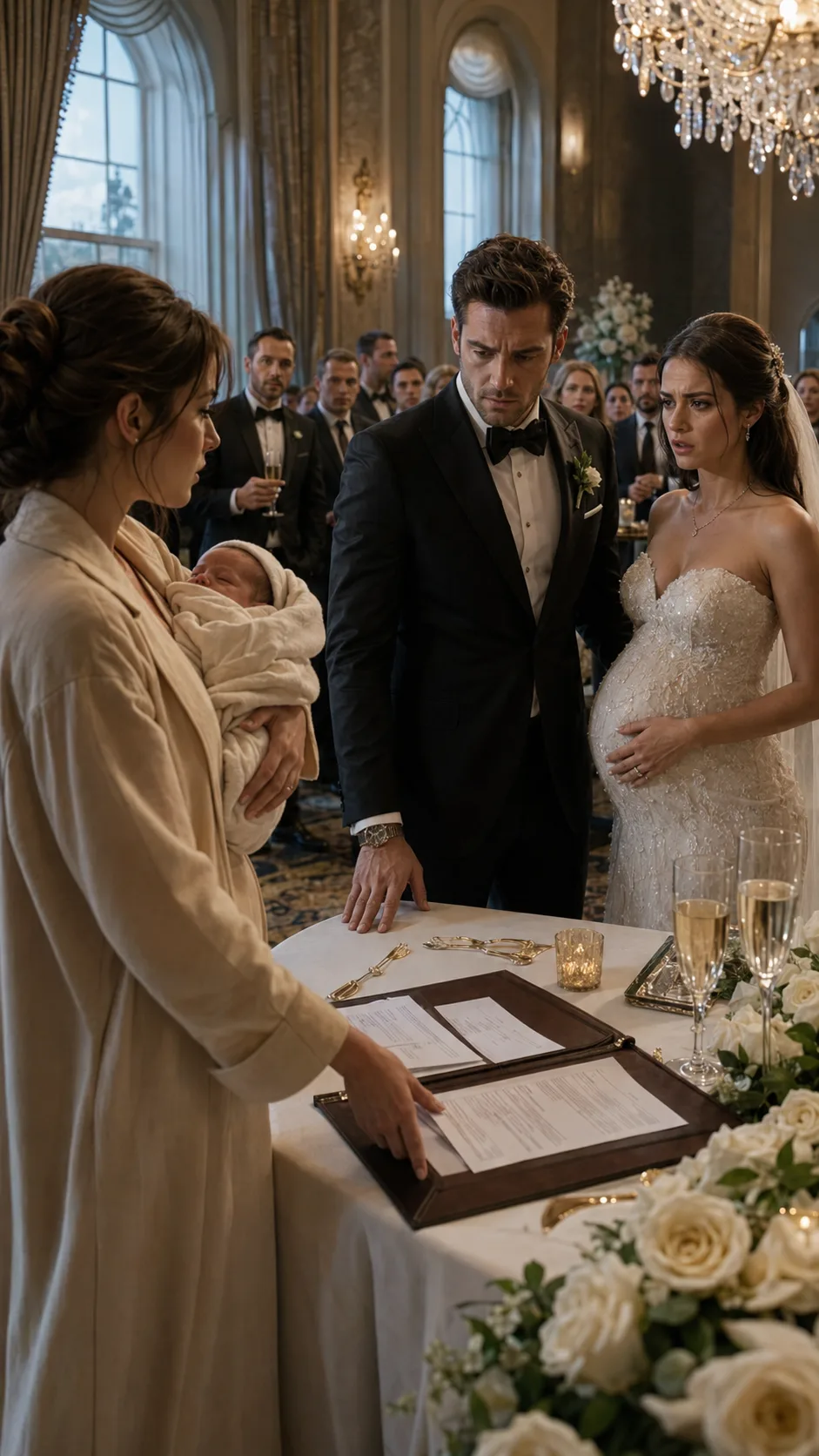
At the far end of the ballroom, Adrian stood beside the bridal table.
He looked beautiful in the way expensive men often do when no one has ever forced them to sit with damage they caused. Black tuxedo. White rose boutonniere. Gold watch. Shoulders relaxed. Smile controlled.
Celeste stood beside him in a fitted white gown that made her pregnancy impossible to miss. Her hand rested over her stomach.
The gesture had an audience.
I knew that because she checked to make sure.
Adrian saw me after Lydia did.
His smile widened.
The room seemed to give him space.
He liked that.
He stepped away from Celeste just enough to become the center of the scene.
“Mia,” he said. “You actually came.”
I shifted Elara higher.
Rebecca stayed half a step behind me.
Adrian looked at the baby.
A flicker crossed his face.
Too quick to name.
Then he found himself again.
“You brought a prop?”
A few guests made sounds and swallowed them.
Celeste’s mouth curved, then settled.
Lydia moved closer, pearls catching the chandelier light.
I did not answer.
Not yet.
Adrian spread one hand slightly, as if inviting the room to understand his burden.
“I was trying to be generous,” he said. “I thought closure might help you. But this is a wedding, Mia. Not a stage for whatever performance you’ve prepared.”
A waiter stopped near the table with a tray of champagne. No one took a glass.
Elara stirred under my coat.
Her cheek pressed against the fabric.
Adrian’s eyes dropped again.
This time, he looked longer.
Not enough.
Never enough.
Celeste stepped closer to him.
“Maybe someone should take her somewhere private,” she said.
Her voice was smooth.
Camera-ready.
I looked at her hand resting on her stomach.
“Private,” I said.
The word felt strange in my mouth.
Adrian laughed once.
“Don’t start.”
I looked at him then.
Fully.
For seven years, I had trained myself not to look too long when he mocked me. Long looks invited more words. More words invited a fight. Fights became Lydia’s version by morning.
Now I looked.
His smile weakened at the edges.
“You told me to come,” I said.
“I invited you to behave.”
“No. You invited me to watch you finally have a family.”
The room sharpened.
Celeste’s fingers tightened against her dress.
Adrian’s jaw moved.
“That was a private conversation.”
“Was it?”
Rebecca stepped beside me and placed the leather folder in my hand.
Adrian noticed her then.
Really noticed.
His eyes narrowed.
“And who are you?”
“Rebecca Shaw,” she said. “Counsel for Ms. Hayes.”
A murmur passed through the room.
Hayes.
Not Vale.
Lydia’s face changed first.
She understood names. She understood what it meant when a woman stopped wearing one.
Adrian’s mouth flattened.
“This is ridiculous.”
I walked forward.
One step.
Then another.
My body complained with every movement, but I did not let it show. The marble floor clicked under my heels. The baby slept through all of it.
At the bridal table, white roses spilled over silk. Gold flatware rested beside crystal glasses. A small card near Celeste’s place read Mrs. Celeste Vale in looping script.
I looked at it.
Then I placed the folder beside it.
The sound was small.
Everyone heard it.
Adrian stared at the folder like it had moved on its own.
“What is that?”
I opened it.
Paper does not care about weddings.
That was the thought that came to me as I lifted the first sheet. Paper does not care about flowers or champagne or how carefully a bride has curled her hair. It sits there. It waits. It says what it says.
I slid the birth certificate across the table.
Adrian did not touch it.
Rebecca moved one step to the side so the nearest guests could see enough to know the page mattered, not enough to read the child’s full details.
Lydia came closer.
“Mia,” she said. “Do not do this here.”
I turned my head.
“Where would you prefer?”
Her nostrils flared.
No answer.
Celeste looked at Adrian. For the first time, her confidence needed permission from him.
He did not give it.
His eyes were on the page.
Elara Hayes.
Date of birth.
Mother: Mia Hayes.
Father: pending legal establishment.
Adrian’s hand landed on the edge of the table.
“This proves nothing.”
“No,” I said. “That one doesn’t.”
I slid the second document forward.
The paternity test.
Adrian’s name appeared in black print.
So did Elara’s.
So did the percentage.
The room drew tighter around us.
Someone near the back said, “Oh my God,” under their breath.
Celeste leaned in before she could stop herself.
Her face went still.
Adrian read the page once.
Then again.
His fingers curled slowly against the tablecloth, pulling a faint wrinkle through the silk.
“This is fake.”
Rebecca opened her briefcase and removed a second copy.
“It was processed through a court-approved lab,” she said. “Chain of custody included. You’ll receive formal notice Monday, though we can arrange service today if you’d like to make this efficient.”
The word efficient landed beautifully.
Adrian looked at Rebecca with open hatred.
Then at me.
“You never told me.”
A laugh moved through me, but it did not come out.
“No.”
His voice rose. “You never told me?”
Elara shifted at the sound.
I placed one hand over her back.
“You divorced me while I was pregnant.”
“I didn’t know.”
“You didn’t ask.”
He opened his mouth.
Closed it.
The crowd saw.
That mattered more to him than the baby.
I could see the exact second he remembered they were watching. His spine straightened. His face tried to rearrange itself into injury.
“You hid my child from me,” he said.
Lydia seized that line like a rope.
“That is exactly what this is,” she said. “Cruel. Vindictive. After everything my son endured—”
I turned the next page.
The financial summary.
Lydia stopped speaking.
That was better than any argument I could have made.
Celeste stared at the document before Adrian did. Her hand left her stomach and gripped the back of a chair.
The page showed dates.
Transfers.
Account numbers partially redacted.
Email references.
Vale & Co.
Marrow, C.
My grandfather’s trust.
Adrian’s face lost its performance.
“What is this?”
“My inheritance,” I said.
His eyes flicked to Rebecca.
Rebecca did not blink.
“My client’s separate premarital property,” she said. “Moved through accounts connected to your family company using forged authorization and internal approvals tied to Ms. Marrow’s login credentials.”
Celeste made one sharp sound.
Not a word.
Adrian turned on her.
“What did you do?”
She looked at him like he had slapped her with the question.
“What did I do?” she said. “You told me it was already handled.”
There it was.
Not a confession written for court.
Not enough by itself.
But enough for the room.
Enough for Lydia.
Enough for Adrian’s board members standing ten feet away with champagne in their hands.
Rebecca lowered her gaze and made a note on her phone.
Celeste saw.
Her lips parted.
Adrian saw too.
His face changed again.
Now he understood there were two disasters in the room, and he could only pretend to be innocent in one at a time.
“Mia,” he said.
My name sounded different in his mouth.
Less like a possession.
More like a locked door.
I picked up the final document.
The civil complaint draft.
Rebecca had placed a yellow tab on the signature page. Not because I needed it. Because she liked order.
I set it on the table.
“Your office will receive the full filing. The police report was submitted this morning.”
Lydia’s pearls clicked softly as her hand flew to her throat.
“Police?”
A man near the champagne tower turned and walked out fast, phone already at his ear.
Adrian noticed him.
“Daniel,” he called.
The man did not turn back.
That was when the room began to choose sides.
Not out loud.
Rooms like that rarely do.
They choose with feet. With distance. With who stops touching whose arm. With whose glass remains raised and whose lowers to the table.
Celeste stepped away from Adrian.
Just half a step.
He saw it.
“You don’t get to do that,” he said to her.
She looked at the documents, then at the guests, then at Lydia.
“I’m pregnant,” she said.
No one moved toward her.
The words had worked earlier.
They did not work now.
Elara made a small sound under my coat. Her face scrunched, and one fist slipped free of the wrap.
Adrian looked at her.
For the first time, truly looked.
She had his brow.
Rebecca was right.
His gaze caught there and stayed.
My daughter opened her eyes for one second, unfocused and dark, then closed them again.
Adrian’s hand lifted from the table.
Not reaching.
Not yet.
“Is she mine?” he said.
I looked at the paternity test between us.
Then at him.
“You read the page.”
His mouth tightened.
“Mia.”
“No.”
One word.
It stopped him.
I had said yes to so many small humiliations in our marriage that no had become a language he did not recognize.
No, you don’t get to soften your voice now.
No, you don’t get to reach for her because people are watching.
No, you don’t get to call this family because the evidence cornered you.
I closed the folder, leaving copies on the table.
“These are for your attorney,” Rebecca said. “Do not destroy them. Do not contact my client directly. All communication goes through counsel.”
Adrian looked at her as if she were furniture that had started giving orders.
“You can’t ban me from my own child.”
I adjusted Elara’s blanket.
“She is not a prop,” I said. “She is not a reputation problem. She is not proof that you were wrong about me.”
The room went completely quiet.
Even the pianist had stopped.
I had not noticed until then.
I stepped back from the table.
Adrian’s face flickered with panic, then anger, then something smaller and meaner.
“You think this makes you powerful?”
I looked around the ballroom.
White roses.
Crystal.
Gold.
People who had watched him humiliate me because wealth made cruelty look like confidence if the lighting was right.
Then I looked at my daughter.
“No,” I said. “It makes me done.”
Rebecca touched my elbow once.
We turned.
Lydia blocked the path.
For a second, the old instinct returned. Step around. Apologize. Make it easy for everyone.
Then Lydia looked at the baby.
Her granddaughter.
Her legacy.
Her mouth trembled.
“You cannot keep her from us,” she said.
I met her eyes.
“You kept me from myself for seven years.”
Her face hardened.
Good.
I knew what to do with hard things.
The crowd parted as I walked out.
No one applauded. No one gasped dramatically. No one said my name.
A woman near the entrance moved her purse off a chair so I could pass more easily. A waiter opened the door without looking at me directly. The young usher from earlier stared at the floor.
Outside, the air felt too cold on my face.
I had forgotten there was weather.
Rebecca followed me down the stone steps. Her shoes made no sound. Mine clicked unevenly.
At the bottom, I stopped.
My legs had begun to shake.
Rebecca noticed but did not reach for me without asking.
“Car is two minutes away,” she said.
I nodded.
Elara woke then.
Not loudly. Just a small newborn complaint, offended by light and air and whatever adult disaster she had slept through.
I loosened the wrap and looked down at her.
Her eyes opened.
Dark.
Unsteady.
Mine.
His.
Hers.
Not a symbol.
Not revenge.
A person.
Rebecca stood beside me, folder under her arm, watching the driveway.
“You did well,” she said.
I shook my head once.
Not because she was wrong.
Because the words did not fit.
I had not done well.
I had survived long enough to arrive with paper.
That was different.
The car pulled up.
I slid into the back seat with Elara against my chest. Rebecca sat in front and gave the driver my apartment address.
As The Bellmont Hall disappeared behind us, my phone began to buzz.
Adrian.
Then Lydia.
Then an unknown number.
Then Adrian again.
Rebecca reached back without turning around.
“May I?”
I handed her the phone.
She silenced it, placed it face down beside me, and said, “We’ll deal with them Monday.”
Monday.
There would be court dates. Custody hearings. Frozen accounts. Statements. Questions. Maybe headlines in a business column if Adrian’s board decided he was too expensive to protect.
There would be nights when Elara cried and I cried too, though not for the same reasons.
There would be forms, bills, feedings, appointments, and days when I missed the version of my marriage that had never existed outside my own hope.
The car turned onto the bridge.
Elara’s fingers opened against my dress.
I placed my thumb in her palm.
She gripped it with all the strength she had.
Small.
Enough.
At home, I changed out of the cream dress and hung Rebecca’s coat carefully over the back of a chair. Milk had leaked through one side. There was a faint smear of Elara’s cheek on the collar.
I thought about cleaning it.
I didn’t.
The next morning, the lilies Celeste had once sent were still gone. The old mug from Adrian’s kitchen was still in the cabinet. The leather folder sat on my desk, thinner now because some truths had been handed over.
Elara slept in the bassinet near the window.
Sunlight touched her blanket.
My phone buzzed again.
I did not pick it up.
I had proof.
I had a daughter.
I had my name.
Chapter complete
You have reached the end of this chapter.
Continue reading
A few more worlds to get lost in after this chapter.




