Does Anyone Else Regret Becoming a Mother?
I know people are going to hate me for this.
Chapter 1
I know people are going to hate me for this.
I know some mothers will read the first few lines and decide I am a monster. Some will say I should be ashamed. Some will say I never deserved to have a child in the first place.
Maybe they are right.
But tonight, I am too tired to pretend.
So I am going to say the thing I have never said out loud.
Sometimes, I regret having my son.
There.
It is written.
My hands are shaking as I type it.
Not because I do not feed him.
Not because I do not love him.
Not because I would ever throw him away.
I am still the one who wakes up early to make sure there is food in the fridge. I am still the one who pays his school fees, washes his clothes, checks his messages from teachers, and lies awake at night wondering if he is ruining his
future before he is even old enough to understand what a future means.
I am his mother.
I have done everything a mother is supposed to do.
But deep inside, in the place no one can see, there is a sentence I carry like a stone.
If I had known motherhood would feel like this, I do not know if I would have chosen it.
My son is fifteen.
I am a single mother.
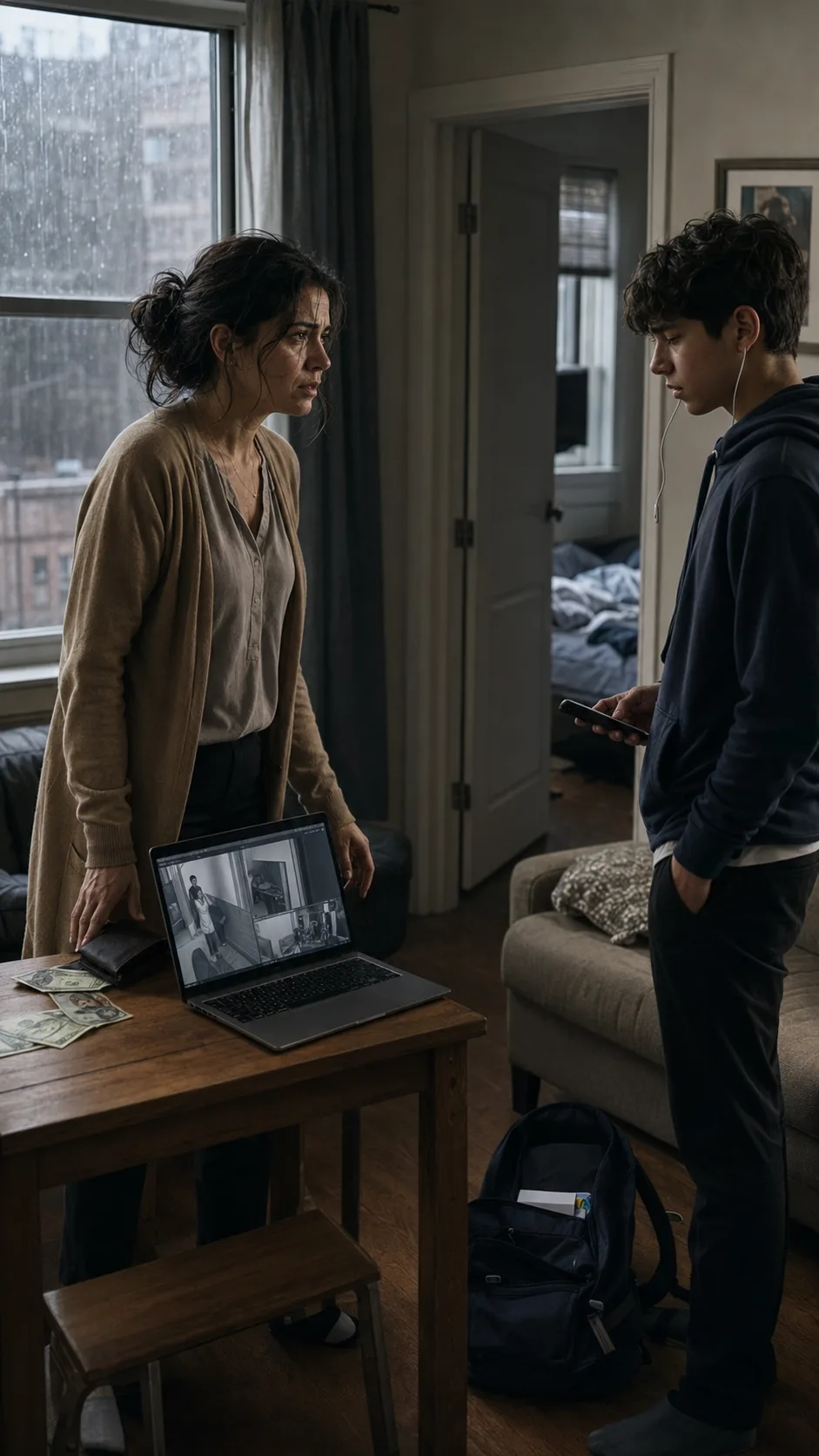
And last month, I watched security footage of him stealing money from my wallet.
That was the moment something inside me went cold.
Not because of the money.
The money hurt, of course. It was 500,000. Grocery money. Transportation money. The kind of money I had already divided in my head before I even opened my wallet.
But that was not what broke me.
What broke me was what happened after.
I called him into the
living room. He walked in slowly, still looking at his phone, one earbud in his ear.
I said, “Did you take money from my wallet?”
He did not even blink.
“No.”
Just like that.
One clean lie.
I asked again.
He sighed, annoyed, like I had interrupted something important.
“No, Mom. I said no.”
I stared at him.
For one second, I wanted to believe him.
That is the part that makes me feel stupid. After all the lies, all the arguments, all the school problems, all the nights I spent staring at his closed bedroom door wondering what happened to the little boy I raised — I still wanted to believe him.
Then I opened my laptop.
I turned the screen toward him.
The footage played in silence.
There he was.
My son.
Walking into the hallway.
Opening my bag.
Taking my wallet.
Pulling out the cash.
Looking around
once.
Then walking away.
No hesitation.
No fear.
No guilt.
The room went silent.
I watched his face. I waited for it to change. I waited for shame. I waited for tears. I waited for the child inside him to come back.
It did not happen.
He looked at the screen, then looked back at me and said, “It’s money in the house. Why are you acting like it’s such a big deal?”
I could not speak.
He said it like I was crazy.
Like I was being dramatic.
Like the money had grown on the kitchen table by itself.
Like I had not worked for it.
Like my tired body, my long hours, my skipped meals, my aching back, and my empty wallet meant nothing.
I said, “That was my money.”
He scoffed.
That sound stayed with me longer than the theft.
A small, careless sound.
Like I was nothing.
Like my pain bored him.
I used to think betrayal was something adults did to each other. Husbands. Wives. Friends. Business partners.
I never thought betrayal could come from the child whose fever I once checked every ten minutes through the night.
But it can.
It started with school.
At first, it was small.
He said he had finished his homework. He had not.
He said the teacher did not assign anything. She had.
He said he forgot his notebook at school. I found it under his bed, empty, with snack crumbs stuck between the pages.
I told myself all kids lie sometimes.
I told myself he was just going through a phase.
Then came the test.
He walked into the apartment one afternoon, dropped his backpack by the door, and said, “I got an eight.”
I remember that day too clearly.
I was cutting vegetables in the kitchen. I stopped and looked at him.
“An eight?”
“Yeah.”
I smiled.
For the first time in weeks, I felt my chest loosen.
I made his favorite meal that night.
I even bought him a drink he liked from the small store near our building, even though I had been trying to save money.
Two weeks later, I sat across from his teacher at a parent meeting.
She slid the paper toward me.
There was a big red number at the top.
Two.
Not eight.
Two.
I stared at it.
My stomach dropped.
The teacher’s voice became quiet and careful. “He told you it was an eight?”
I nodded.
She looked uncomfortable.
Then she showed me the bottom of the page.
My signature.
Except I had never signed it.
He had tried to copy my name.
Badly.
I sat there in that classroom with my face burning while other parents waited outside. I wanted to disappear.
When I got home, he was on the sofa, phone in his hand, laughing at something on the screen.
I put the test paper on the table.
He glanced at it.
Nothing.
No panic.
No regret.
I asked, “Why did you lie to me?”
He shrugged.
“I knew you would nag.”
That was it.
No apology.
No explanation.
Just that.
I knew you would nag.
As if my worry was the problem.
As if I was the enemy.
Then there were the extra classes.
He said he needed tutoring. Math. English. Science. He said everyone else was going. He said he was falling behind. He said if I did not pay, it would be my fault if he failed.
So I paid.
Every month, I gave him the money.
I am not rich. I work full-time, and sometimes I take extra work when I can. I count my spending. I compare prices. I wear old clothes longer than I should. I tell myself I do not need things because he does.
So when he asked for extra classes, I made it work.
I thought I was investing in his future.
I found out later he had not attended a single session.
Not one.
He had taken the money and gone to play games with friends.
I called the tutoring center because I wanted to ask about his progress.
The woman on the phone paused.
Then she said, “Ma’am, your son has not been here.”
I remember standing in the kitchen with the phone against my ear.
The rice cooker clicked behind me.
The sink was full of dishes.
My work bag was still on my shoulder.
I said, “What do you mean he hasn’t been there?”
She repeated it gently.
He had never gone.
When I confronted him, he did not look scared.
He looked annoyed.
“It’s not like those classes help anyway,” he said.
I asked, “Then why did you take the money?”
He rolled his eyes.
“Because you keep pushing me.”
I stood there, trying to understand how his lie had somehow become my fault.
That is what my life has become.
Every problem turns back on me.
If he lies, it is because I nag.
If he fails, it is because I pressure him.
If he stays up until three in the morning, it is because I do not understand freedom.
If I take his phone, I am controlling.
If I give it back, he disappears into it.
That phone is like a wall between us.
A glowing wall.
At dinner, it is in his hand.
In bed, it is next to his face.
In the bathroom, he takes it with him.
Walking from one room to another, he looks down at it.
Sometimes I speak to him and he does not answer because his eyes are fixed on the screen.
I say his name.
Nothing.
I say it again.
He snaps, “What?”
Like I am bothering him.
Every night, the same thing happens.
I tell him to sleep.
He says, “In a minute.”
An hour passes.
Light still under the door.
I knock.
He says, “I’m sleeping.”
But I can hear videos playing.
Sometimes I open the door and he jerks the phone under his blanket like I am stupid.
By two or three in the morning, he is still awake.
Then morning comes.
I knock on his door.
No answer.
I knock harder.
Still nothing.
I call his name.
He groans like waking up for school is torture.
I am already dressed for work. My hair is still wet. My lunch is not packed. My bus will not wait. My boss will not care that my fifteen-year-old son refuses to get out of bed.
I stand in his doorway, watching him pull the blanket over his head.
“Get up,” I say.
He mumbles, “Leave me alone.”
“You’re going to be late.”
“I said leave me alone.”
Some mornings I want to walk out and let him miss school.
Some mornings I do.
Then the school calls.
Then the teacher messages.
Then the guilt comes.
Then I am back where I started.
When I take the phone away, he explodes.
“You’re controlling me,” he says.
I say, “You are fifteen. You need sleep.”
He says, “You don’t even give me basic human freedom.”
Basic human freedom.
He says that while standing in the apartment I pay for.
Wearing clothes I washed.
Eating food I bought.
Using the internet I pay for.
I want to say all of that.
Sometimes I do.
Then he says, “Here we go again. Always talking about money.”
And I stop.
Because what is the point?
His room is another battle.
If I do not clean it, it becomes a landfill.
Empty bottles.
Snack wrappers.
Dirty socks.
Old bowls.
School papers crushed under the bed.
Clothes on the floor until there is no floor.
One Saturday, I opened his door and just stood there.
The smell hit me first.
Old food.
Sweat.
Dust.
Teenage boy and laziness.
He was lying on the bed with his phone inches from his face.
I had been cleaning since morning. Bathroom. Kitchen. Laundry. Floors. My hands were dry from detergent. My back hurt.
I said, “Clean your room.”
He did not look up.
“Later.”
“No. Now.”
He sighed so loudly that I almost laughed. Not because it was funny, but because if I did not laugh, I might have screamed.
“Every day you complain,” he said. “I’m so tired of hearing your voice.”
My voice.
The room went still.
I stood there with a trash bag in my hand.
For a second, I saw him at three years old, crying because he fell and scraped his knee. I saw myself kneeling in front of him, blowing gently on the tiny wound, saying, “It’s okay. Mom is here.”
That same voice.
The voice that comforted him.
The voice that sang to him.
The voice that called doctors, teachers, neighbors, relatives.
The voice that defended him even when other people complained.
Now he was tired of it.
I said, “Clean it before dinner.”
He laughed under his breath.
That small laugh cut deeper than shouting.
I closed the door quietly because I did not trust myself to stay.
People always say teenagers are hard.
I know.
I am not stupid.
I know fifteen is a difficult age. I know children test limits. I know boys can be messy, rude, emotional, and selfish. I know the brain is still developing. I know he may be struggling in ways he cannot explain.
I have read the articles.
I have watched the parenting videos.
I have tried calm talks.
I have tried rules.
I have tried rewards.
I have tried punishments.
I have tried being soft.
I have tried being strict.
I have tried acting like nothing hurts me.
But it does hurt me.
That is the part no one wants to hear.
Motherhood hurts.
Not in the beautiful way people write about.
Not the “I am tired but happy” kind of hurt.
I mean the ugly kind.
The kind where you sit on the bathroom floor after an argument and press your fist against your mouth so he does not hear you crying.
The kind where you stare at your child and wonder when he started looking at you like you were the problem.
The kind where you are scared of the adult he might become.
A few weeks ago, I got sick.
Not dangerously sick. Just fever, body aches, dizziness. Enough that standing up made the room tilt.
I called in sick from work, which I almost never do.
Before he went to school, I told him, “I’m not feeling well today.”
He barely looked up from his phone.
I said, “There are noodles in the cabinet. Eggs in the fridge. You can make something simple when you get home.”
He said, “Okay.”
That afternoon, I woke up to the sound of his videos playing in the living room.
He had come home.
He knew I was in bed.
He did not check on me.
Not once.
Hours passed.
My body felt heavy. My throat burned. I kept drifting in and out of sleep.
Then my bedroom door opened.
For one stupid second, I thought he was coming to ask if I was okay.
He stood in the doorway and said, “There’s nothing to eat.”
I blinked at him.
“There are noodles.”
“I don’t want noodles.”
“There are eggs.”
“You know I don’t like making food.”
I closed my eyes.
Then he said, “Why are you so lazy? Just get up and cook.”
That sentence did something to me.
I opened my eyes and looked at him.
He was not joking.
He was hungry and irritated, and my sickness was inconvenient to him.
That was all.
I wanted to ask, “Do you love me at all?”
But I did not.
Because I was afraid he would hesitate.
Or worse.
I was afraid he would answer honestly.
So I turned my face toward the wall and said, “Make noodles.”
He slammed the door.
That night, I cried silently.
No dramatic sobbing.
No screaming.
Just tears sliding down my face while the apartment stayed dark and the sound of his phone came from the other room.
I have asked him about his future.
Once, I sat across from him at the kitchen table. No shouting. No anger. Just me trying one more time.
I said, “What kind of person do you want to become?”
He leaned back in his chair.
He looked bored.
Then he said, “Whatever kind of person I become is my business.”
My business.
Those two words landed harder than they should have.
Because his life has been my business since before he was born.
His milk.
His fever.
His school.
His shoes.
His meals.
His dentist.
His teachers.
His nightmares.
His report cards.
His birthday cakes.
His broken toys.
His first uniform.
His lost textbooks.
His lies.
His mess.
His future.
All of it has been my business.
But to him, I am just the woman standing in the way.
The woman with rules.
The woman with bills.
The woman who asks too many questions.
The woman whose voice he is tired of hearing.
I know what people will say.
They will say I should have raised him better.
Maybe.
They will say I should have been stricter when he was younger.
Maybe.
They will say I should have spent more time with him.
Maybe.
They will say single mothers are too soft. Or too hard. Or too busy. Or too emotional.
Maybe.
The truth is, no matter what a mother does, someone can always tell her she did it wrong.
If I work more, I neglected him.
If I work less, I cannot provide.
If I discipline him, I am controlling.
If I give him space, I do not care.
If I cry, I am weak.
If I get angry, I am cruel.
If I admit I regret motherhood, I am a monster.
So I keep my mouth shut.
I wake up.
I work.
I buy food.
I pay fees.
I answer school messages.
I wash clothes.
I remind him to shower.
I remind him to eat.
I remind him to sleep.
I remind him to be human.
And every day, I feel myself disappearing.
There are moments when I still see the little boy.
That is what makes it worse.
Sometimes he falls asleep on the sofa with his phone on his chest. The screen goes dark. His face relaxes. His hair falls across his forehead.
In those moments, he looks young again.
Almost innocent.
I remember his small hand inside mine.
I remember him running to me after kindergarten.
I remember the way he used to say, “Mom, look,” before showing me something completely ordinary like it was a miracle.
I remember once, when he was five, he picked a tiny flower from the side of the road and gave it to me.
“For you,” he said.
I kept it in a book until it dried flat.
I do not know where that flower is now.
I do not know where that boy is either.
Maybe he is still in there.
Maybe he is buried under anger, hormones, bad friends, screens, shame, laziness, and whatever loneliness he does not know how to name.
Maybe one day he will come back.
Maybe one day he will look at me and understand.
Maybe one day he will say, “Mom, I’m sorry.”
I want to believe that.
But hope is heavy when you have carried it for fifteen years.
Some nights, after he finally sleeps, I sit alone in the kitchen.
The apartment is quiet.
There are dishes in the sink.
His backpack is on the floor.
My wallet is in my bedroom now, hidden in a drawer like I live with a stranger.
I look around and think, This is my life.
Then the thought comes.
Quiet.
Cruel.
Honest.
If I had never had a child, would both of us have been better off?
I hate that thought.
I hate myself for thinking it.
But it comes anyway.
Because maybe I was not meant to be this tired.
Maybe he was not meant to be raised by a woman who is always working, always worried, always angry, always scared.
Maybe love was never enough.
I do not want anyone to misunderstand me.
I am not saying I want to abandon him.
I am not saying I want him to suffer.
If he called me right now and said he was in trouble, I would run.
If he was sick, I would still sit beside him.
If he needed me, I would still come.
That is the curse of it.
I love him.
And I regret this life.
Both things are true.
That is the part people do not like.
They want motherhood to be simple.
They want mothers to say, “It was all worth it.”
They want pain to have a clean ending.
They want love to erase resentment.
But real life is not clean.
Sometimes love sits right next to exhaustion.
Sometimes duty keeps going long after joy has left.
Sometimes a mother can make dinner, fold laundry, pay school fees, and still feel trapped inside a life she chose before she understood what it would cost.
I do not know what happens next.
Maybe he will change.
Maybe I will find help.
Maybe we will survive this stage and one day laugh about how terrible these years were.
Maybe.
But tonight, I am not writing from the future.
I am writing from this kitchen.
This quiet apartment.
This tired body.
This mother who has not felt like herself in years.
I am writing because I need to know if anyone else has ever felt this and been too ashamed to say it.
Has anyone else looked at their child and felt love, fear, anger, guilt, and regret all at once?
Has anyone else done everything they were supposed to do and still felt like they failed?
Has anyone else thought, I love my child, but I do not love being a mother?
Please tell me the truth.
Not the polite truth.
Not the pretty truth people say in public.
The real one.
Because tonight, I do not need judgment.
I have already judged myself enough.
I just need to know I am not the only one.
THE END.
Chapter complete
You have reached the end of this chapter.
Continue reading
A few more worlds to get lost in after this chapter.