Christmas Eve should have smelled like pine, cinnamon, and warm bread.
Chapter 1
Christmas Eve should have smelled like pine, cinnamon, and warm bread.
Mine smelled like rainwater, wet asphalt, and the leather handle of a suitcase being thrown at my feet.
Daniel Collins stood at the top of the stone steps of the Collins Estate, his expensive wool coat buttoned to his throat, his face half-lit by the golden lights spilling from the mansion behind him. For twelve years, I had stood beside that man at charity dinners, business galas, funerals, weddings, and family portraits. I had carried his children. I had protected his reputation. I had smiled when his friends made cruel jokes and stayed silent when his mother reminded me I had “married above my station.”
And that night, he looked at me like I was a stain on his driveway.
“Get out,” he said.
The rain came down in silver sheets. Behind me, Grace clutched her little backpack against her chest. She was seven, old enough to understand humiliation but
too young to know what to do with it. Noah, five, held my coat with one tiny fist and his stuffed rabbit with the other.
“Daniel,” I said, keeping my voice low because the children were listening. “It’s Christmas Eve.”
He gave a short laugh.
“Then consider this my gift to myself.”
The front door opened behind him. Vanessa appeared in the glow of the foyer, wrapped in a cream silk robe, her blonde hair falling neatly over one shoulder. She was twenty-six, maybe twenty-seven. Young enough to still believe cruelty looked like power when it wore diamonds.
She didn’t say anything.
She didn’t need to.
Daniel grabbed the final suitcase and hurled it down the stairs. It burst open when it hit the wet stone. Children’s clothes spilled across the driveway. Grace flinched.
“You and those kids aren’t my problem anymore,” Daniel said.
Those kids.
Not our children.
Those
kids.
I bent down and gathered Noah’s sweater from a puddle. My hands were shaking, but I made them move slowly. Children notice panic before they understand words.
“Where are we supposed to go?” I asked.
Daniel slipped one hand into his coat pocket.
“That’s not my concern.”
“The accounts are frozen,” I said. “My card declined at the pharmacy this afternoon.”
His smile widened.
“Yes. My lawyer advised me to separate our finances immediately.”
“Our finances?”
“You never earned anything, Claire.”
The words hit harder than the cold.
I had left my job when Grace was born because Daniel said a Collins wife didn’t need to work. I had organized his charity foundations, hosted dinners for his investors, managed his social image, cared for his father through cancer, and raised our children while he built his empire from money my family had quietly lent him in the beginning.
But
men like Daniel loved calling women dependent after cutting every road beneath their feet.
Noah tugged my sleeve.
“Mommy, are we sleeping outside?”
I crouched and brushed wet hair from his forehead.
“No, baby,” I said. “We’re going to be okay.”
Daniel laughed again.
The door closed.
The lock clicked.
For a moment, I stayed there beneath the rain, surrounded by suitcases and broken promises, staring at the house I had once decorated for Christmas with my own hands.
Then Grace whispered, “Mom?”
I stood.
“Pick up what you can carry.”
We walked.
There was no car. Daniel had taken my keys before dinner, saying the mechanic needed to check something. That had been a lie too. The estate sat far from town, behind black iron gates and winding private roads lined with bare winter trees. The rain soaked through my coat within minutes. Noah’s shoes made small splashing sounds in the dark. Grace kept looking back, waiting for the mansion lights to disappear.
They did.
The road became narrower. The trees leaned over us like silent witnesses. Every few minutes, headlights appeared in the distance, then passed without slowing. I tried not to think about what we looked like: a woman dragging one suitcase, two children stumbling beside her, on Christmas Eve, in freezing rain.
After nearly an hour, we reached the edge of town. The bus station glowed faintly at the end of the street, but when I checked the posted schedule, the last bus had left twenty minutes earlier.
Grace sat on the bench and wrapped her arms around Noah.
“Mom,” she said, “I’m cold.”
“I know.”
My voice almost broke.
I turned away before she could see my face. I reached into my pocket for a tissue, but my fingers touched something smooth and plastic.
I pulled it out.
A bank card.
Dark blue. Plain. No logo except a small silver crest in the corner.
For a second, I couldn’t breathe.
My mother’s card.
Margaret Collins had given it to me three months before she died. She had been sitting in her small kitchen, wearing the blue cardigan she always wore when her hands hurt from arthritis. There had been tea between us, and rain against her window then too.
“For emergencies,” she had said.
I remembered smiling sadly.
“Mom, I’m married to Daniel Collins. What kind of emergency would I possibly have?”
She had looked at me for a long time.
“The kind you don’t see coming.”
I had never used it. I had almost forgotten it existed.
Across the street, a twenty-four-hour bank branch still had its lights on.
I looked at my children.
Then I crossed the road.
The lobby was empty except for one teller sitting behind thick glass. He looked young, maybe early thirties, with tired eyes and a loosened tie. His nameplate read JULIAN.
He glanced up when we entered, and something in his expression changed when he saw the children shivering behind me.
“Ma’am,” he said, standing. “Are you all right?”
“I just need to check a balance,” I said.
My voice sounded strange. Thin. Far away.
I slid the card under the glass.
Julian picked it up. He looked at the card, then at me.
“Do you have identification?”
I handed him my driver’s license.
He typed something into his computer. The screen reflected across his glasses. His fingers moved once, then stopped.
His back straightened.
He typed again.
Then he went completely still.
The silence stretched.
“Is something wrong?” I asked.
Julian didn’t answer. He leaned closer to the monitor. His face drained of color so quickly that I thought he might faint.
“Sir?” I said.
He looked at me.
Not like a teller looking at a customer.
Like a man looking at a bomb.
“Ma’am,” he said, voice low, “please don’t move.”
My stomach dropped.
“What?”
He pressed a button beneath the counter.
A metal shutter lowered over the glass doors behind us.
Grace gasped.
Noah grabbed my hand.
Julian lifted the phone with trembling fingers.
“Security,” he said. “Lock the building. Now.”
My mouth went dry.
“I didn’t steal that card,” I said quickly. “It was my mother’s. I can explain—”
“No,” Julian said.
He stood from his chair.
Then, very slowly, he turned the monitor toward me.
I stepped closer.
I expected a few hundred dollars. Maybe one thousand if my mother had been saving quietly. Enough for a motel. Enough for food. Enough for one night where my children weren’t cold.
Instead, I saw numbers.
Too many numbers.
Balance: $412,800,000.00
Below it, red letters flashed across the screen.
ULTIMATE BENEFICIARY FOUND. INITIATE PROTOCOL 7.
I stared at the monitor.
“That isn’t possible,” I whispered. “My mother was a schoolteacher.”
Julian swallowed.
“Mrs. Collins,” he said, “your mother was not just a schoolteacher.”
The lights in the lobby hummed overhead. Rain beat softly against the locked glass doors.
He looked at the card again with both hands, as if afraid to drop it.
“This is connected to a Private Sovereign Trust,” he said. “I’ve only seen training documents about accounts like this. They’re not normal accounts. They’re protected by legal teams, private security, and direct board-level authorization.”
I shook my head.
“No. My mother lived in a two-bedroom house. She drove an old Toyota. She clipped coupons.”
Julian looked at the screen.
“According to this, Margaret Collins was the silent partner behind the Sterling-Vane Group.”
The name meant something, even to me.
Sterling-Vane wasn’t just a company. It was hotels, shipping, medical technology, private investment, property holdings across three continents. Daniel had spent years trying to get near people connected to them. He called them “untouchable money.”
My mother had been connected to them all along.
I gripped the counter.
“That has to be a mistake.”
Julian shook his head.
“The system triggered because the final beneficiary accessed the card in distress. Protocol 7 means the trust’s protection clause has activated.”
“Protection from what?”
He looked past me at Grace and Noah.
“From whoever forced you to use it.”
Before I could answer, black SUVs pulled up outside the bank.
Not one.
Five.
Their headlights cut through the rain. Men in dark coats stepped out first, scanning the street. Then a woman emerged from the center vehicle.
She was tall, elegant, and calm in a way that made everyone else seem unprepared. Her charcoal suit was perfectly tailored. Her silver hair was pulled into a low knot. She carried a leather folder under one arm.
Julian unlocked the inner security door before she reached it.
The woman entered and looked directly at me.
“Mrs. Claire Collins?”
“Yes.”
“I’m Elena Vance,” she said. “I was your mother’s attorney.”
My knees weakened.
“My mother had an attorney?”
Elena’s expression softened by the smallest degree.
“Your mother had many things she chose not to show the world.”
Grace stood from the chair, still wrapped in my wet scarf. Elena glanced at her, then at Noah, who had fallen half-asleep against the armrest.
“First,” Elena said, “your children will be taken to the private lounge. There is food, dry clothing, and a medical team on the way to check them for exposure.”
I opened my mouth to protest, but she raised one hand.
“Stay where you can see them. No one will separate you.”
Something in my chest loosened.
Within minutes, Grace and Noah were wrapped in warm blankets in a private room behind the lobby. Someone brought hot chocolate, sandwiches, socks, and soft gray sweatshirts. Grace watched everything with wide eyes. Noah fell asleep mid-bite.
I stood in the doorway, still wet, still shaking.
Elena joined me.
“Your mother knew this night might come,” she said.
I turned to her.
“What does that mean?”
“She knew Daniel’s character before you did. She knew his first investments came from money he persuaded your family to provide. She knew he was building a life on borrowed foundations while pretending he was self-made.”
I looked down at my hands.
“Why didn’t she tell me?”
“Because she hoped you would never need the truth,” Elena said. “And because if Daniel had known what you were connected to, he would have spent every year of your marriage trying to control it.”
That sounded exactly like him.
Elena opened the folder and removed several documents.
“Your mother transferred the true family assets into a trust before her death. You are the sole adult beneficiary. Your children are protected successors. Daniel has no claim.”
A laugh escaped me. Not because it was funny. Because my body didn’t know what else to do.
“He froze my accounts.”
Elena’s eyes sharpened.
“No. He froze accounts he believed were yours. What he doesn’t know is that many of the assets funding his lifestyle were tied to your mother’s early investments and protected agreements. He violated several clauses tonight.”
“What happens now?”
Elena handed me a phone.
“Now we make calls.”
By three in the morning, Daniel Collins’ world had begun to collapse.
By five, his lawyer stopped answering.
By seven, every account Daniel controlled had been frozen pending legal review.
By eight, the Collins Estate was legally confirmed as property held under the Margaret Collins Trust.
By nine, Daniel was standing on the porch in yesterday’s clothes, shouting into a dead phone.
I know because I saw him.
Christmas morning arrived under soft snowfall. The storm had passed, leaving the estate road white and silent. I sat in the back of a black car with Grace on one side and Noah on the other. Both children wore new coats. Grace held my hand tightly. Noah still carried his rabbit.
“You don’t have to go in,” Elena said from the front seat.
“I know.”
I looked through the windshield at the mansion.
The place looked smaller now.
Not physically. The columns were still huge. The windows still glittered. The gates still curved like something from another century.
But power looks different once you know who owns it.
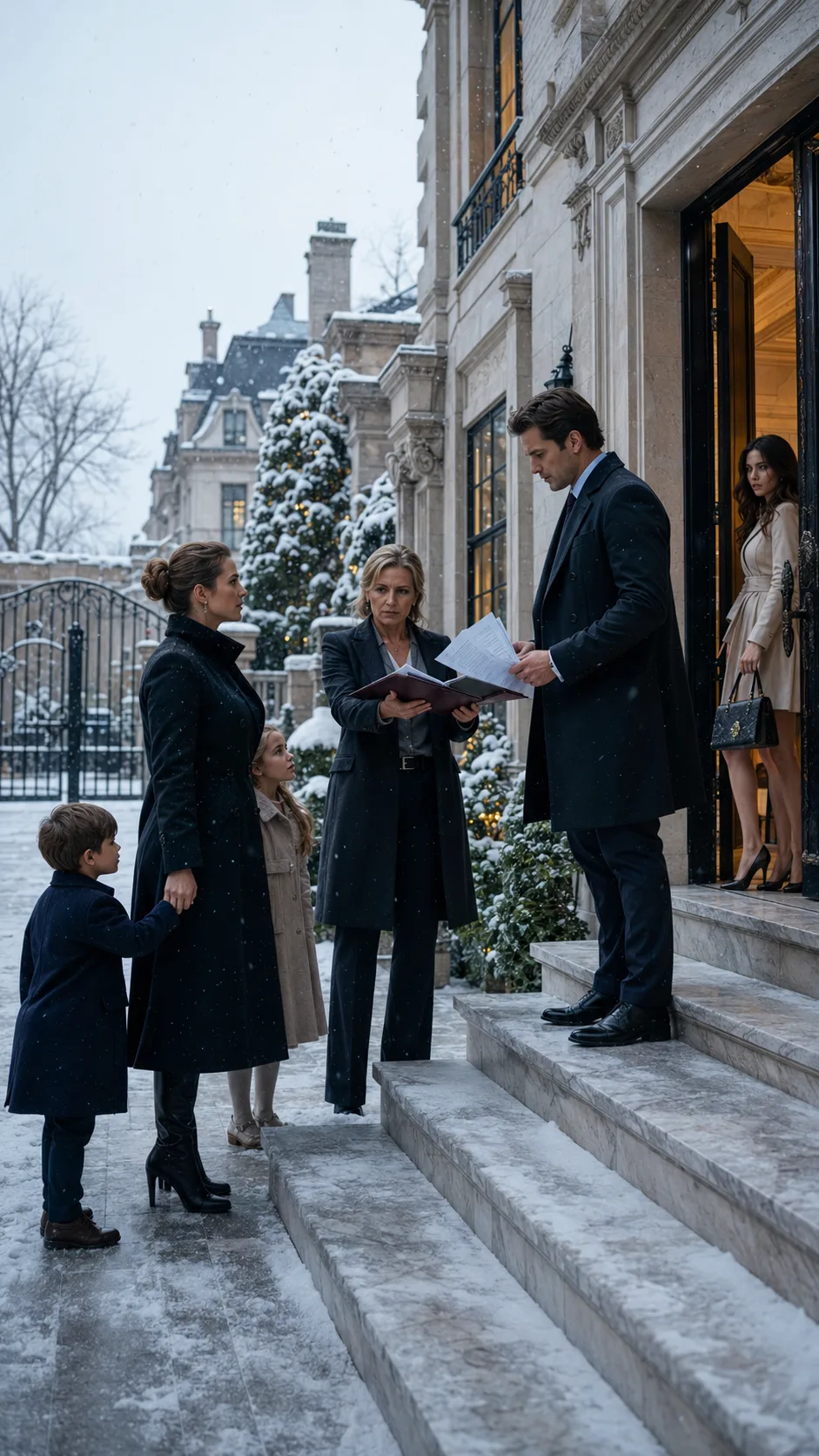
Daniel appeared before the car stopped. He rushed down the front steps, hair messy, coat open, face tight with panic. Vanessa stood in the doorway behind him, clutching a designer purse against her chest.
When Daniel saw me step out, confusion crossed his face.
Then habit returned.
He sneered.
“Back already?”
I closed the car door.
Elena stepped out behind me. Two security men followed.
Daniel looked at them, then back at me.
“What is this?”
I didn’t answer immediately. I took Grace and Noah’s hands and walked up the first few steps.
Daniel blocked the path.
“I told you,” he said, voice rising. “You get nothing.”
I looked at the man I had once loved.
The man who had thrown his children into the rain.
The man who believed money made him untouchable.
“Actually, Daniel,” I said, “you’re the one who has nothing.”
His expression flickered.
Elena moved beside me and opened her folder.
“This residence is property of the Margaret Collins Trust,” she said. “Mr. Collins, you are trespassing.”
Daniel laughed once.
It came out wrong.
“You’re insane.”
Elena handed him the papers.
“You have ten minutes to collect one bag of personal items. Security will escort you to the edge of the driveway.”
Vanessa’s face changed first.
She understood before he did.
Daniel looked down at the documents. His eyes moved quickly, then slower, then stopped. His hand tightened around the paper until it bent.
“No,” he said.
Elena remained still.
“Yes.”
“This is my house.”
“It was never yours.”
The words landed quietly.
That made them worse.
Daniel looked at me then. Really looked. Not at the wife he had dismissed. Not at the woman he believed he had emptied and discarded. He looked at the person standing in front of him with his children, his house, his accounts, and the truth.
“You did this,” he said.
I shook my head.
“No. You did.”
Behind him, Vanessa took one step backward.
Daniel turned.
“Where are you going?”
She didn’t answer.
She slipped through the doorway and disappeared into the house.
For the first time in twelve years, Daniel Collins had no one eager to stand beside him.
He looked back at me.
“Claire,” he said.
My name sounded strange in his mouth now.
I waited.
He swallowed.
“Think about the children.”
Grace’s hand tightened around mine.
I looked down at her. Then at Noah.
“I am.”
Daniel’s face twisted.
“You can’t just throw me out.”
I almost smiled.
Almost.
“You mean into the cold? With no money? On Christmas?”
His mouth opened.
No words came.
Security moved forward.
Daniel backed up one step, then another.
And just like that, the man who had thrown our suitcases into the rain was given ten minutes to pack one bag.
He took eight.
I did not go inside to watch.
I stayed on the steps with my children while snow fell quietly around us.
When Daniel came out, he carried a leather duffel bag and wore the expression of a man waiting for someone to tell him this was all a mistake. No one did. At the bottom of the driveway, the gates opened.
Security walked him out.
He looked back once.
I didn’t wave.
A month later, I sold the Collins Estate.
People expected me to keep it. They thought I would want to sit in its dining room, sleep in its master bedroom, and prove that I had won.
But that house had never felt like mine. It had walls full of silence and floors polished by women who were told to be grateful.
So I sold it.
Then I donated the proceeds to a shelter for displaced families, with one condition: every mother who arrived there on a cold night would be given a private room, clean clothes, hot food, and legal help before anyone asked her to explain why she had nowhere else to go.
Elena helped me create the fund.
We named it after my mother.
Margaret’s House.
Grace chose the logo: a small silver key inside a heart.
Noah asked if we could make sure they had hot chocolate.
We did.
Our new home was smaller than the estate, but it had sunlight in the kitchen and a garden behind the fence. Grace planted lavender near the back steps. Noah built crooked little stone paths for toy cars. Some mornings, I sat by the window with coffee and watched them run barefoot through grass that belonged to no one but us.
The bank card sat on the mantel in a small glass frame.
Not because of the money.
Because of what it meant.
My mother had spent her life looking ordinary. She wore simple shoes, saved gift bags, bought fruit on sale, and listened more than she spoke. People mistook that for weakness. Daniel mistook it for poverty.
But my mother had understood something he never did.
Real power doesn’t always announce itself.
Sometimes it waits quietly in a coat pocket.
Sometimes it looks like a forgotten card.
Sometimes it is a mother protecting her daughter long after her hands are gone.
On the first Christmas after everything ended, Grace hung a silver ornament on the tree and asked, “Do you think Grandma knew we’d be okay?”
I looked at the card on the mantel.
Then I looked at my children.
“Yes,” I said. “I think she made sure of it.”
And for the first time in years, Christmas Eve felt warm.
THE END.
Chapter complete
You have reached the end of this chapter.
Continue reading
A few more worlds to get lost in after this chapter.




