By the time my last year of high school arrived, the life my father and I had built together felt almost unbreakable.
Chapter 1
By the time my last year of high school arrived, the life my father and I had built together felt almost unbreakable.
It wasn’t fancy. It wasn’t the kind of life people at Eastbrook liked to brag about. Our house was small, the paint on the porch had started to peel, and the kitchen table had one uneven leg that my dad kept promising he would fix “after one more paycheck.” But to me, that house was safe. It was warm. It was ours.
My father, Samuel Carter, had a way of making small things feel important. Sunday pancakes were never just pancakes. They were a ceremony. Braiding my hair badly after watching tutorials online was never just an attempt to help me get ready for school. It was his way of saying, “I may not know how to do this yet, but I’m going to learn for you.”
He worked as the school janitor, and everyone knew him. Some students knew him as the man pushing the mop cart through the
hallway after lunch. Some knew him as the person who cleaned up glitter after spirit week, mud after football games, and soda spills after dances. But I knew the truth.
He wasn’t just keeping the school clean.
He was holding pieces of it together.
When senior year started, we had one plan that mattered more than all the others: prom.
Dad had already picked the spot for photos. Not some expensive studio or downtown garden, but the tiny patch of flowers behind our house that he had cared for every spring. He said the light hit the marigolds best right before sunset. I laughed at him for pretending to be a professional photographer, but secretly, I loved that he had thought about it.
“We’ll find you a dress,” he told me one evening while washing dishes after dinner. “A real one. Something that makes you feel like you walked straight
out of a movie.”
I told him not to spend too much.
He gave me that look, the one that meant the conversation was over.
“Sarah,” he said, drying his hands on a towel, “you only get one senior prom.”
At the time, I believed we had months.
I thought there would be more breakfasts, more terrible braids, more evenings where he came home tired but still asked me about school as if every detail mattered.
Then winter came.
At first, it was just a cough.
That was what he said. “Just a cough.” Then he started sitting down more often. Then he stopped making pancakes on Sundays because standing too long made him tired. The man everyone called unshakable began to move like the weight of the entire world had settled into his bones.
Within weeks, our little house changed.
The hallway seemed longer. The rooms felt colder. The
silence between us grew heavy, not because we had nothing to say, but because we were both too afraid to say what we already knew.
Three months later, my father was gone.
At school, Principal Miller announced a moment of silence over the loudspeaker. For everyone else, it lasted a minute.
For me, it never ended.
After the funeral, people said the things people always say. They told me he was in a better place. They told me he had loved me more than anything. They told me I was strong.
But they went home after saying it.
I stayed in the house where his jacket still hung by the door.
As prom got closer, girls at school talked about dresses, makeup appointments, limousines, and after-parties. I tried to pretend I didn’t hear them. I told myself I didn’t care anymore. What was prom without him standing in the garden, pretending not to cry while taking photos?
One evening, I went into his room.
It still smelled faintly like cedar, laundry soap, and the peppermint gum he always kept in his pocket. His closet was almost empty except for the things he had worn most: his button-down shirts.
They were not expensive. Some had fading at the collar. Some had soft spots near the elbows from years of washing. But when I touched them, I felt him.
I sat on the floor for a long time, surrounded by fabric, memory, and grief.
Then I made a decision.
I didn’t want a dress from a store.
I didn’t want satin chosen by someone who had never known my father. I didn’t want something beautiful that had nothing to do with him.
I wanted to bring him with me.
So I pulled out the old sewing machine he had once bought from a yard sale because he believed “every house should have one practical thing nobody knows how to use yet.”
I chose three shirts.
The pale blue one he wore when I graduated middle school. He had stood in the crowd that day, clapping louder than anyone else, his eyes shining like I had just accepted a Nobel Prize.
The crisp white shirt he saved for church, folded carefully every week like it deserved respect.
And the navy flannel that I used to steal whenever I was cold because wearing it felt like being wrapped in his arms.
For weeks, I cut, pinned, stitched, ripped seams, and started over. My fingers hurt. The machine jammed. Twice, I cried so hard I had to stop because I couldn’t see the needle.
But slowly, the pieces became something new.
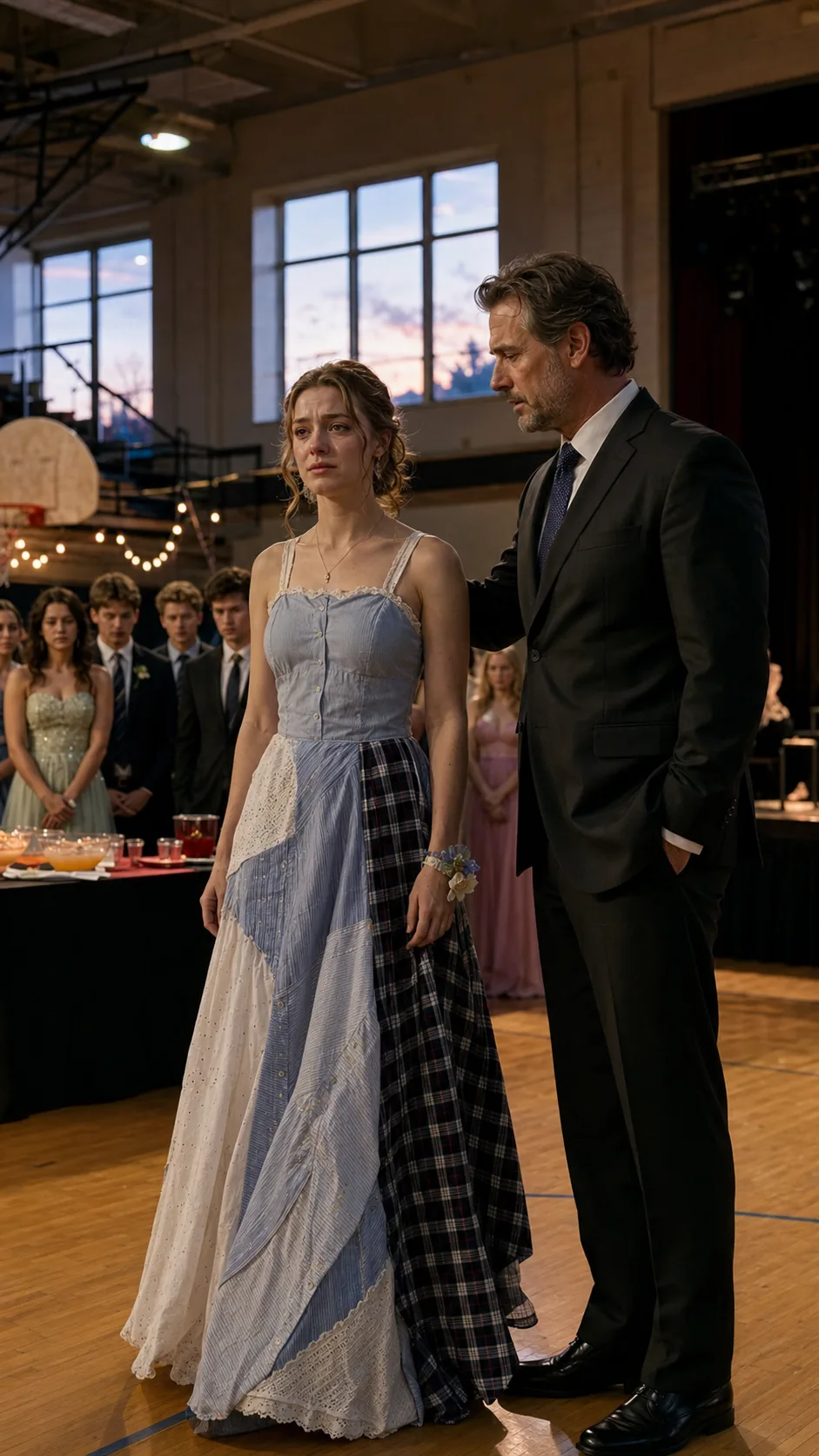
The sleeves became part of the bodice. The tails of the shirts became a full patchwork skirt. The colors didn’t match perfectly, but somehow, that made it better. The dress looked like memory stitched into shape.
It wasn’t the kind of gown Eastbrook girls wore.
It wasn’t silk. It wasn’t glittering. It didn’t come from a boutique with soft lighting and champagne for mothers.
But when I put it on, I felt taller.
I felt protected.
I felt like my father’s love had become armor.
On the night of prom, I stood in front of the mirror for almost ten minutes before leaving. The dress moved softly when I turned. The pale blue fabric curved across the bodice. The navy flannel brushed against my legs.
For one second, I imagined Dad standing in the doorway.
Then I wiped my eyes, lifted my chin, and went to the school gym alone.
The moment I stepped inside, I knew they had noticed.
The music was loud. The lights were low. Girls in expensive gowns turned their heads, their smiles freezing before twisting into something sharper.
I heard the first whisper before I even reached the punch table.
“Is she wearing a quilt?”
Then another voice, louder.
“No way. Did she make that out of old shirts?”
Someone laughed.
Then someone else.
The sound spread faster than I could escape it.
I stood near the punch bowl, gripping the side of my skirt with trembling fingers. Every laugh seemed to tug at a stitch. Every stare made the room feel bigger and colder. I wanted to disappear. I wanted to run home, lock the door, and bury my face in the navy flannel until the world stopped looking at me.
A boy nearby smirked and said, “Guess that’s what happens when your dad was the janitor.”
The words hit harder than the laughter.
For a moment, I wasn’t at prom anymore. I was that little girl in the hallway, hearing kids make jokes about the man who came home with aching feet and still made sure I had dinner.
My throat tightened.
Tears burned behind my eyes.
Then the music stopped.
Not faded. Stopped.
A sharp scream of microphone feedback cut through the gym, and every head turned toward the stage.
Principal Miller stood beneath the dim stage lights, holding the microphone in one hand. His face was pale, but his eyes were fixed on me.
The room grew uneasy.
“I have been principal of Eastbrook High for twenty years,” he said.
His voice carried through the gym, deeper than usual, rough around the edges.
“In that time, I have watched thousands of students walk through these doors. I have seen athletes, valedictorians, performers, troublemakers, and young people who went on to do extraordinary things.”
He paused.
“But in all those years, I knew only one man who truly held this building together.”
The silence changed.
Students glanced at each other, no longer laughing.
Principal Miller stepped away from the podium.
“Most of you knew Samuel Carter as the man with the mop,” he continued. “Some of you passed him in the hallway without saying hello. Some of you left your trash on the floor because you knew he would pick it up. Some of you forgot he was a person at all.”
My hands froze against the fabric.
“But I knew him,” he said, his voice tightening. “I knew a father who worked double shifts so his daughter could have choices. I knew a man who fixed broken lockers before anyone asked, stayed late after games, shoveled snow before sunrise, and treated every student in this room with a dignity many of you have not shown tonight.”
No one moved.
He walked down the steps from the stage, slowly, deliberately, until the students between us began to part.
The gym split open before him.
When he reached me, my breath caught.
He looked at the dress, then at me.
“This,” he said, raising his voice so even the students at the back could hear, “is the most beautiful dress that has ever entered this gymnasium.”
My eyes filled.
“Not because it is expensive,” he said. “Not because it is made of silk or covered in jewels. It is beautiful because it is made from love. From sacrifice. From memory. From the shirts of a man who gave everything he had so his daughter could stand here tonight.”
He placed one hand gently on my shoulder.
“Sarah,” he said, softer now, though the whole room still heard him, “your father would be proud beyond words.”
For a moment, the silence was complete.
But it wasn’t the cruel silence from before.
It was heavy. Ashamed. Respectful.
The girl who had whispered about the quilt stared down at the floor. The boy who had laughed turned away, his face red. Around the room, the glittering gowns and polished shoes suddenly seemed much less important.
I looked down at the pale blue fabric across my chest.
I saw my father clapping at my middle school graduation.
I felt Sunday mornings in the kitchen.
I remembered his clumsy hands trying to braid my hair.
I heard him telling me that kindness was not weakness, that being looked down on did not make you lower, and that sometimes the strongest thing a person could do was keep their heart soft in a hard world.
The music began again.
This time, it was slower. Gentler. It filled the room carefully, as if even the speakers understood something sacred had happened.
Principal Miller’s hand remained on my shoulder for one more second before he stepped back.
And for the first time since my father died, I did not feel alone inside my grief.
A few students looked at me differently now. Not with pity. Not with mockery. With something closer to understanding.
Then someone approached.
It was Mark, a quiet boy from my chemistry class who usually sat two rows behind me and rarely spoke unless called on. His face was flushed, and he looked nervous, but he didn’t look away.
He held out his hand.
“Sarah,” he asked softly, “would you like to dance?”
The question was simple, but something inside me opened.
I smiled for the first time that night without forcing it.
“Yes,” I said. “I would.”
I placed my hand in his.
As we stepped onto the dance floor, I felt the patchwork skirt move around me. The white church shirt, the pale blue graduation shirt, the navy flannel that felt like a hug—they moved with me as if my father had found a way to keep his promise after all.
He wasn’t standing in the garden taking pictures.
He wasn’t waiting by the porch, pretending he had dust in his eyes.
But he was there.
He was in every stitch.
Every seam.
Every piece of fabric that had once rested against his shoulders and now carried mine.
Around us, the store-bought dresses shimmered under the gym lights. The tuxedos, the flowers, the decorations, the polished shoes—everything Eastbrook had taught me to measure myself against—faded into the background.
I was not the janitor’s kid in a homemade dress.
I was Samuel Carter’s daughter.
I was wearing proof that love does not vanish just because someone leaves the world.
And as the navy flannel brushed against my leg, warm and familiar, I knew something with a certainty deeper than applause, deeper than shame, deeper than grief.
I would never need their version of beautiful.
The most beautiful dress I would ever wear had already been made from the life of the best man I had ever known.
Chapter complete
You have reached the end of this chapter.
Continue reading
A few more worlds to get lost in after this chapter.




