mother, Sylvia Bennett, was even better at it.
Over the years, she had perfected the art of making me feel unwelcome while remaining technically polite.
According to Sylvia, I was always slightly inadequate.
Not educated enough.
Not connected enough.
Not refined enough.
Not Bennett enough.
The irony was that before marrying Conrad, I had never cared about becoming any of those things.
My father had owned a successful logistics company in Vermont.
My mother taught literature at a small college.
I grew up surrounded by honest people who worked hard and treated others decently.
The Bennetts viewed kindness as weakness.
Everything was status.
Everything was hierarchy.
Everything was appearance.
I spent years trying to earn approval that had never been available.
By the time that dinner arrived, I was exhausted.
The evening began strangely.
Conrad barely looked at me.
His younger brother, Grant, kept making comments that sounded harmless until
mother smiled.
“You’re not part of this family anymore.”
I remember standing.
Picking up my purse.
Walking away.
No speech.
No scene.
The rain outside felt warmer than the room I had left behind.
For nearly an hour I wandered through downtown Boston while traffic lights reflected across wet sidewalks.
My marriage was over.
Strangely, I felt relief.
Pain too.
But mostly relief.
Then my phone started ringing.
Conrad.
Ignored.
Sylvia.
Ignored.
Grant.
Ignored.
Conrad again.
Again.
Again.
By the fifth call, curiosity won.
I answered.
The panic in Conrad’s voice shocked me.
“Andrea, where are you?”
His breathing sounded uneven.
For the first time in eight years, he sounded afraid.
“You told me to leave.”
“Please come back.”
I stopped beneath a storefront awning.
“Why?”
Silence.
Then voices in the background.
Arguments.
Movement.
Chaos.
His mother suddenly grabbed the phone.
“Come back immediately.”
Her command carried none of its usual confidence.
“What happened?”
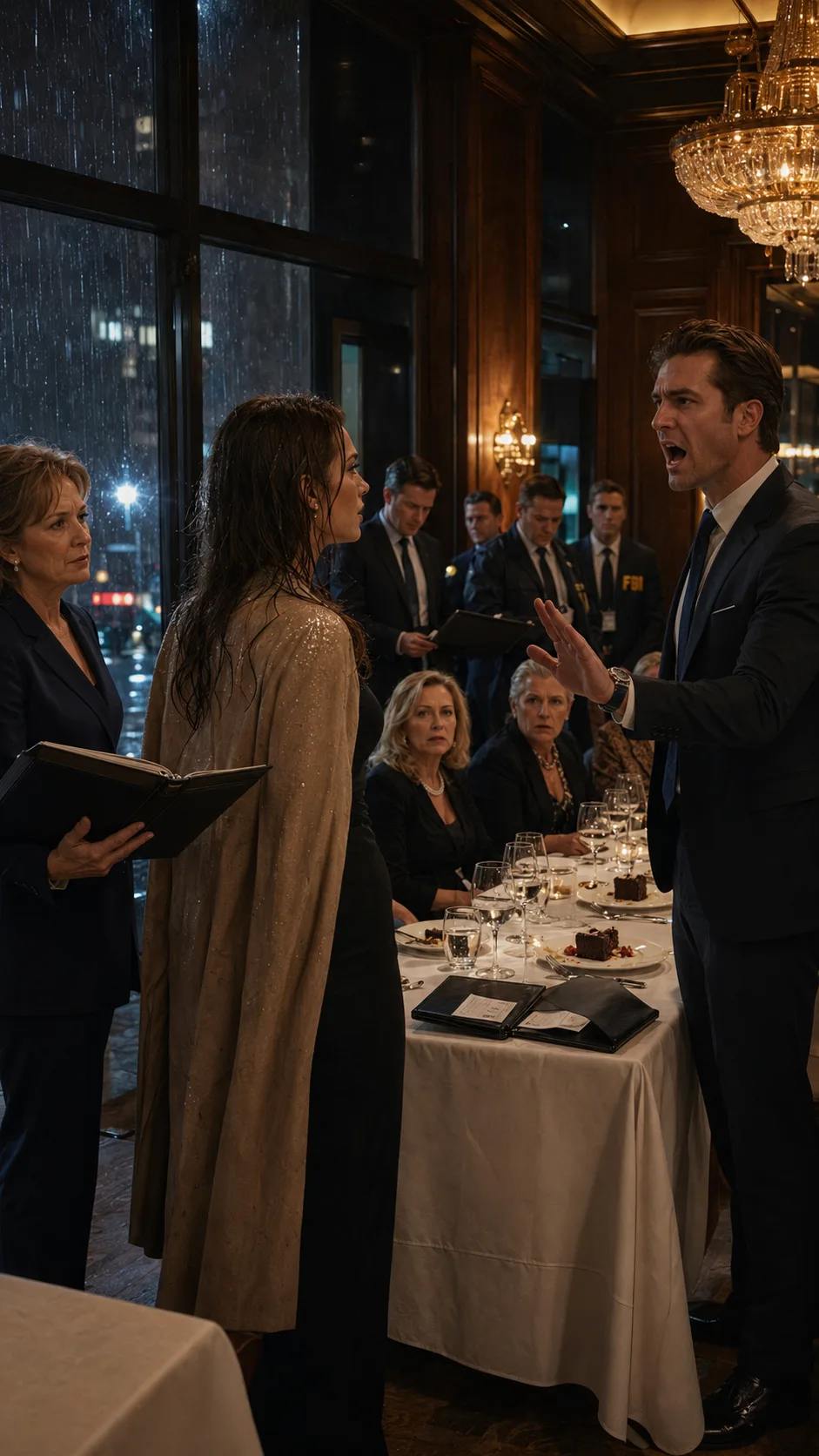
“Federal investigators arrived.”
I blinked.
“What?”
“They want financial records. Company records. Reservation records. Everything.”
I said nothing.
Sylvia continued.
“They mentioned your name.”
That caught my attention.
“My name?”
“Just get back here.”
Then the call disconnected.
I stood in the rain staring at my phone.
The night had become far more interesting.
Twenty minutes later I returned to the restaurant.
The atmosphere had completely transformed.
Luxury had been replaced by anxiety.
Several men in dark suits were speaking with management.
Attorneys had arrived.
Guests whispered nervously.
Conrad spotted me immediately and hurried over.
His face looked pale.
His confidence had vanished.
“What happened?” I asked.
Before he could answer, a woman approached.
She wore a navy suit and carried a leather portfolio.
“Andrea Bennett?”
“Yes.”
She extended a hand.
“Special Investigator Rebecca Sutton.”
I shook it cautiously.
“Have we met?”
“No.”
Her eyes moved briefly toward Conrad.
Then back to me.
“We’ve been reviewing financial activities involving Bennett Capital Holdings.”
My stomach tightened.
Conrad looked ready to collapse.
The investigator continued.
“We understand several transactions were approved using your authorization.”
I frowned.
“What transactions?”
That answer changed everything.
Because I genuinely had no idea what she was talking about.
The investigator studied my expression carefully.
“You weren’t aware?”
“No.”
The silence that followed seemed to stretch forever.
Then Rebecca nodded slowly.
“I see.”
Conrad closed his eyes.
For the first time all night, I realized the investigation wasn’t about me.
I was collateral damage.
Over the following weeks, the truth emerged piece by piece.
It was worse than anyone imagined.
For nearly three years, Bennett Capital had been hiding losses through a network of fraudulent accounting practices.
Money had been shifted between subsidiaries.
Documents had been altered.
Approvals had been fabricated.
And somehow, my name appeared on dozens of authorizations.
At first I thought there must be a mistake.
Then my attorney discovered something disturbing.
Several signatures attributed to me were not mine.
Someone had forged them.
Repeatedly.
The evidence led directly back to senior executives.
Including Conrad.
When my lawyer explained the situation, I sat silently for almost a minute.
Then I laughed.
Not because it was funny.
Because it was absurd.
The man who had spent years treating me as insignificant had used my identity as a shield.
He considered me important enough to absorb blame.
Just not important enough to deserve respect.
The investigation accelerated.
Board members resigned.
Shareholders demanded answers.
Financial publications began reporting the story.
Suddenly the Bennett family wasn’t attending galas.
They were attending depositions.
Conrad called constantly.
At first he wanted forgiveness.
Then cooperation.
Then help.
One evening he appeared outside the townhouse where I was temporarily living.
He looked exhausted.
Older.
Smaller.
I almost didn’t recognize him.
“Andrea.”
I folded my arms.
“What do you want?”
His eyes lowered.
“I need you to tell them you knew.”
I stared at him.
The request was so unbelievable that I wondered if I had misheard.
“You want me to lie?”
“They think I acted alone.”
The statement hung in the air.
I laughed.
Actually laughed.
After everything.
After the humiliation.
After the forged signatures.
After the public divorce.
He still thought I existed to solve his problems.
“Listen carefully,” I said.
His face tightened.
“For eight years, I kept protecting you from the consequences of your own choices.”
He opened his mouth.
I continued.
“That ends tonight.”
Then I closed the door.
The following year became one of the hardest and most rewarding years of my life.
The divorce proceeded.
The investigations continued.
Eventually, Conrad lost his executive position.
Several lawsuits followed.
Financial penalties followed those.
The empire that once looked invincible turned out to be built on fragile foundations.
His mother blamed everyone except herself.
His brother disappeared from public view.
The family spent years rebuilding what remained of their reputation.
As for me, something unexpected happened.
I rediscovered who I had been before marriage.
I returned to consulting work.
I reconnected with old friends.
I visited my parents more often.
I slept peacefully.
That last one surprised me.
I hadn’t realized how exhausted I had become until the constant tension disappeared.
One spring afternoon, almost two years after the divorce, I attended a nonprofit fundraising event focused on educational opportunities for rural communities.
I wasn’t looking for romance.
I was there because I believed in the cause.
During the event, I accidentally spilled coffee on a stack of brochures.
A man standing nearby immediately helped gather them.
“That’s one way to make an entrance,” he joked.
I laughed.
His name was Nathaniel Brooks.
He was a civil engineer who spent weekends volunteering on community projects.
We talked for twenty minutes.
Then an hour.
Then several hours.
Unlike Conrad, Nathaniel asked questions because he cared about the answers.
Unlike Conrad, he listened.
Unlike Conrad, he never treated kindness like a weakness.
Three years later, we were married beside a lake in Vermont surrounded by family and friends.
No luxury ballroom.
No social performance.
No hierarchy.
Just people who loved us.
Sometimes life gives you exactly what you thought you wanted.
Other times it takes everything away and replaces it with something far better.
A few months after our wedding, I received one final call from an unknown number.
It was Conrad.
His voice sounded distant.
Defeated.
“I wanted to apologize.”
I looked out across the lake from our porch.
The sun was setting.
Nathaniel was inside making dinner.
For a moment, I considered all the years behind me.
Then I smiled.
“I accepted your apology a long time ago.”
His breathing caught.
“Really?”
“Yes.”
A pause.
Then he asked quietly, “How?”
I watched sunlight dance across the water.
“Because forgiveness was never for you.”
The line remained silent.
I wished him well.
Then I ended the call.
And for the first time since that rainy night in Boston, I realized I wasn’t carrying any of it anymore.
The humiliation.
The betrayal.
The anger.
The grief.
All gone.
The people who had once tried to make me feel small had spent years creating their own downfall.
Meanwhile, the woman they dismissed at dinner had built a life filled with peace, purpose, and love.
In the end, the twelve-thousand-dollar bill turned out to be the best investment I ever made.
It bought my freedom.
And that was worth far more than the price printed on the receipt.
THE END.