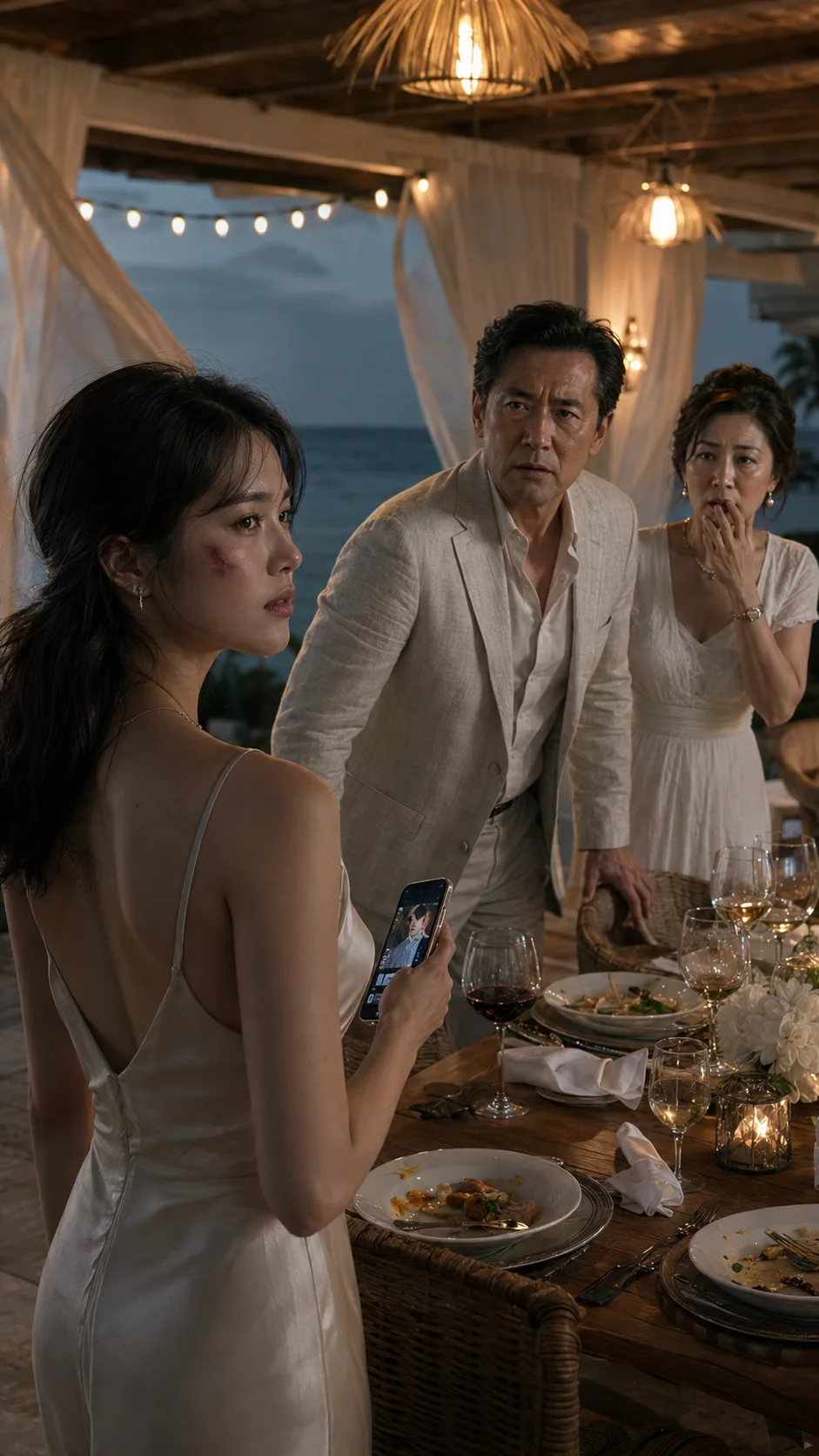
mother, Felicia Hart, stood at the end of the table with her chest heaving, one hand still half-curled as if it had not yet accepted what it had done. She wore a white sundress printed with tiny blue hibiscus flowers. It brushed against her knees in the breeze. A streak of sangria ran across the table runner and dripped slowly onto the tile.
My father, Kurt Hart, had gone silent in the way he always did when something ugly threatened the family image. His face had not changed much, but his eyes had. They had narrowed, not with concern for me, but with calculation. That look did not ask whether his daughter was hurt. It asked who had seen too much. It asked what his guests might repeat. It asked how quickly the evening could be repaired.
And across from me, my sister Tawny did not flinch.
Not when the bowl hit me.
Not when blood reached the collar of my blouse.
Not when one of my mother’s friends put a hand over her mouth and whispered my name.
Tawny leaned back in her chair, one tanned arm draped over the cushion, and lifted her half-empty glass with two lazy fingers.
“Servants should know their duties,” she said.
There are moments in life that arrive with such force they do not feel real until long after they are over. You do not cry in them. You do not scream. Your body takes over because your mind cannot catch up fast enough. That was one of those moments.
I put my hand to my face. When I pulled it away, my fingertips were red. I looked at them, not because I had never seen blood before, but because seeing my own blood on my own hand finally made something inside me click into place.
I had spent most of my life doing what was asked before anyone finished asking. I anticipated. I arranged. I soothed. I fetched. I apologized for things that were not my fault and filled gaps other people left behind. I had done it so long that I thought it was personality. I thought it was love. I thought being useful was how a person earned her place in a family.
That night, with blood and vinaigrette slipping down my neck while my sister smirked, my father sat frozen, and my mother looked at me like I had committed the crime, I saw it for what it really was.
It was not love.
It was training.
I stood up so quickly my chair scraped hard against the patio tile. The sound snapped one of my mother’s guests back to life. She gasped and said, “Jodie,” but I did not look at her. I did not look at any of them. My face throbbed in time with my heartbeat, and my left eye had already begun to swell.
My mother said my name too.
“Jodie—”
She said it in that dangerous tone that was half warning, half plea. The tone she used when she expected me to smooth something over for her. The tone that meant she had done something terrible and I was supposed to help make it disappear.
I didn’t answer.
I turned and walked through the sliding door, across the kitchen with bits of lettuce still clinging to my shoulder, and up the stairs to the bedroom I had moved back into after college. It was the same room that still held my old high school trophies, a narrow bed with a quilt my grandmother had made, and framed seashell prints my mother had chosen when I was twelve because “coastal girls need coastal rooms.”
My steps sounded too loud. Halfway up the stairs, the pain hit harder and my vision wavered, but I gripped the banister and kept going.
When I reached my room, I shut the door and locked it.
The slam rattled the framed shell print on the wall.
Only then did I let myself breathe.
I sank onto the edge of the bed and pressed my palm against the cut again, wincing when the fabric of my sleeve dragged across my cheek. My heart was thundering. Downstairs I could hear muffled voices resuming. Someone laughed awkwardly, too high and too brief. Silverware clinked. My mother must have said something brisk and reassuring, because the sounds of dinner slowly began to knit themselves back together, brittle and false.
That was my family’s real talent.
Not hospitality.
Not loyalty.
Recovery.
We could step over almost anything if it meant preserving the performance.
A few minutes later, footsteps came up the stairs. My mother tried the handle once, hard enough to prove she expected access.
“Open the door,” she said.
I stared straight ahead.
“Jodie, don’t be dramatic. Open this door.”
I still said nothing.
Her breathing sharpened. “You embarrassed us in front of your father’s guests.”
I laughed once. Not because anything was funny, but because the sentence was so perfectly her. My face was bleeding because she had thrown a bowl at me, and somehow I had embarrassed her.
She stayed outside another few seconds. Then her tone changed. Softer. More dangerous that way.
“Honey. Open the door. Let me see.”
I stood, crossed to my desk, opened the top drawer, and took out the little round hand mirror I kept there. Under the yellow lamplight, the damage looked worse than it felt. Blood had made a diagonal track from just beneath my outer eye to the curve of my cheek. The cut wasn’t deep enough for stitches, I thought, but it was ugly, already swelling purple underneath. Vinaigrette glistened on my skin. A piece of romaine lettuce was stuck in my hair.
I cleaned myself up in the bathroom with shaking hands.
Cold water.
Washcloth.
A small first-aid kit I had bought myself months earlier and kept hidden because in our house anything useful you purchased risked becoming community property. The antiseptic burned so sharply my knees almost buckled.
The knocking resumed, lighter this time.
“Jodie, please,” my mother said. “Just talk to me.”
I sat on the floor with my back against the bed and listened.
At some point, I heard the tiny metallic click of the old hallway lock turning from the outside. It was a strange feature in that house, a relic from some earlier renovation, a privacy lock that could be worked with a key from the hall. I stared at the door when I heard it.
She wasn’t letting me out.
She was making sure I stayed in.
That click did more to me than the bowl.
The bowl had hurt my face.
The lock told me exactly what I was in.
My phone was on the nightstand. I reached for it, opened the camera, and took a picture of my face. Then another from the side. Then one with the bloodied washcloth in the sink. I do not know exactly why I did it except that some part of me, the part that had finally woken up, understood something important.
If I wanted to survive that house, I needed proof.
Evidence.
Something more solid than my word against theirs.
After that, I opened my laptop. There was no internet connection because my father had changed the Wi-Fi password the week before after announcing that if I was “living under his roof again,” I should spend less time “staring at screens” and more time “being useful.” But you can still write offline. You can still compose an email and save it until morning.
I typed three words before my hands started shaking so badly I had to stop.
Then I began again.
Trisha, it’s Jodie.
Trisha Vale had been my grandmother’s closest friend, a wiry woman with silver hair, a smoker’s laugh, and the kind of direct stare that made people tell the truth faster than they intended. When I was a teenager, she used to come by once or twice a year in bright earrings and black sandals, kiss my mother on the cheek, call my father “Mr. Hotel” just to irritate him, and slip me old essays or folded feminist zines when no one was looking. She had a way of seeing right through our family’s choreography.
Things got bad tonight, I wrote. I need help. Can we meet?
I saved the draft and closed the laptop. Then I sat in the dark and listened to the house settle around me. Somewhere in those long hours between dinner and dawn, I began to understand that the silence I was holding on the other side of that locked door was not surrender.
It was the first thing in my life that belonged completely to me.
The next morning, my mother came back.
At first she knocked softly, as if approaching a wounded animal.
“Jodie, honey,” she whispered. “Please.”
I did not move.
A few minutes later, the knocks turned urgent. Then angry. Then soft again. A cycle. Always a cycle with her.
I pressed my ear to the wood and heard her crying quietly, or trying to sound like she was. Downstairs, Tawny laughed at something on her phone. A cabinet shut. My father’s car started in the driveway. A normal morning in a house where nothing normal had ever truly existed.
I stayed quiet because quiet was the only language in that house anyone respected.
While my mother begged outside my door, my mind dragged me backward through the years as if the bowl had knocked loose every memory I had ever packed away to keep functioning.
I remembered our coral-pink bungalow in Coral Gables, one street from the Atlantic, with salt always caught in the curtains and fine white sand forever appearing in the corners no matter how much I swept. I remembered how early in life I had learned that usefulness was my currency.
My father liked to say we were a close family.
What he meant was a disciplined one.
Kurt Hart owned a chain of beachside hotels strung along the Florida coast from Key West to Palm Beach, places with white umbrellas, teak loungers, citrus-scented lobbies, and staff trained to make wealthy tourists feel as if the ocean itself had been arranged for their comfort. He was broad-shouldered and handsome in a hard-edged way, with silver beginning at his temples and the stillness of a man used to being obeyed. Employees straightened when he entered a room. His voice rarely rose because it did not need to. He could stop an argument, a tantrum, or a line of thought with one look.
My mother, Felicia, had once wanted something different. I know that now, though I did not understand it as a child. She married my father young, twenty-one and pretty and praised for her taste, and somewhere between pregnancies, charity luncheons, holiday centerpieces, and hotel investor dinners, her own plans shrank until all that remained was the art of presentation. She had wanted, before she became Mrs. Hart, to curate small coastal weddings. By the time I was old enough to remember her clearly, she was curating our lives instead.
And then there was Tawny.
Tawny arrived three years after me and from the beginning seemed to understand attention in a way I never did. She could cry and people would laugh because she was dramatic and adorable. She could snatch a toy from my hand and everyone would call her spirited. She could refuse to eat dinner and my mother would chase her through the house with a forkful of food while I sat politely at the table and learned that calm children make bad stories.
I was the older daughter.
The reliable one.
The capable one.
In our family, those words did not mean what they sound like they mean. They were not praise. They were assignments.
At six, for Tawny’s birthday, my father surprised her with a kiteboard almost as tall as she was. He carried it in from the garage while she squealed and bounced on the balls of her feet, and my mother clapped her hands and said, “Look at our fearless girl.”
I stood in the doorway in my socks, smiling because that was what you did when someone else was loved loudly.
My own birthday came a month later.
I got a mocktail shaker set with little plastic stirrers and paper umbrellas.
“You’re such a natural hostess,” my mother said.
I was six years old.
By nine, I knew how to fold napkins three different ways. I could blend mango slushies without splashing the counters. I could scrub sunscreen streaks off patio chairs and rinse sand from Tawny’s flip-flops after beach parties she was too young to attend without supervision, which somehow became my supervision even when I barely wanted to be there myself.
Tawny’s assigned chore was flipping the porch cushions twice a month.
My mother celebrated it like she had rebuilt the house with her bare hands.
“You hold us together, Jodie,” my mother would say while chopping cilantro at the kitchen island, and I would feel a complicated warm ache in my chest because I wanted so badly for that to be love.
At school, the difference between us sharpened.
I brought home straight A’s folded carefully inside my backpack. My father would glance at them over the top of a newspaper, say, “Good,” and ask if I had remembered to call the florist about the fundraiser centerpieces. Tawny brought home C’s with brightly colored teacher comments about potential and creativity, and my mother took her out for ice cream because “school is hard for different kinds of minds.”
I do not say this because I wanted Tawny punished.
I say it because children notice where delight goes.
Children notice who gets effort and who gets expectation.
After a while, you stop hoping fairness will appear and start bargaining for crumbs.
When I was thirteen, my father put me to work summers at one of his hotels. Officially I was “learning the business.” In practice, I stood behind the front desk in a crisp name tag while guests complained about room temperatures, extra towels, noisy children, and views that did not look exactly like the website photos. I smiled. I fixed things. I apologized for problems I had not caused.
I was good at it.
Good at anticipating needs.
Good at smoothing tension.
Good at making difficult people feel catered to.
My father admired that in the way businessmen admire efficiency. He never said he was proud of me. He said I was useful.
Tawny spent those same summers poolside in oversized sunglasses with a string of girls orbiting around her. By fifteen, she had mastered the art of looking occupied while doing nothing. She called it “vibes.” My mother called it charm. My father called it personality.
The only adult in my life who seemed disturbed by any of this was my grandmother.
She had never quite fit into our family. She swore more than my mother liked, laughed too loudly, and had spent the sixties and seventies working in bars along the coast from Tampa to New Orleans, which my father spoke about as if it were a contagious disease. She wore red lipstick well into her seventies and believed women should always keep emergency money where men would never think to look.
When I was little, she let me sit on the kitchen counter while she peeled oranges and told me stories about drunks, hurricanes, gamblers, bartenders, and the many different ways a person could rescue herself.
“Listen to me,” she said once when I was maybe eleven and helping her shell shrimp in our backyard. “Being useful is not the same as being cherished.”
I remember staring at my hands, slick with shrimp juice, not understanding why the sentence made my throat burn.
She saw it all, of course. Not every detail, but enough. Enough to start leaving me notes. Sometimes tucked into birthday cards. Sometimes mailed directly to me in uneven slanted handwriting my mother called messy. They were the kind of notes that do not make sense at first because you have not yet lived enough to hear them properly.
Never confuse being needed with being loved.
A girl who learns only how to serve will be invited everywhere and welcomed nowhere.
Keep copies of your papers.
Own a bank account nobody else can touch.
And once, scrawled on the back of a postcard with a faded martini glass on the front: Don’t just pour, sweetheart. Own the bottle.
At sixteen, I thought it was a funny line from her bartender days.
At twenty-six, it would save my life.
I got through high school the way some people get through long swims: by fixing my eyes on a shore no one else could yet see. I read late at night under a blanket with a flashlight after everyone else slept. I filled notebooks with scholarship deadlines, tourism programs, and business ideas. I learned how to write essays that made strangers believe in me even when the people in my own house found belief inconvenient.
When the acceptance letter from Orlando State University came with a full scholarship attached, I opened it alone in my room and cried into my hands so no one would hear.
That evening, we had overgrilled mahi-mahi on the patio. My father cut into his portion with the focus of a surgeon. My mother was distracted because Tawny had gotten too much sun and was sulking about missing a beach bonfire. I waited until everyone had plates in front of them.
“I got in,” I said. “Full ride. Orlando State.”
My father’s fork stopped halfway to his mouth.
“What’s in Orlando?” he asked after a beat, as if I had announced plans to move to the moon. “Stay here. Work concierge full-time for a year. Then we’ll talk. Plenty of opportunities in Miami.”
My mother’s glass made a tiny sound against the table. “Tawny has surf camp this summer,” she said, not even pretending this was a response to my future. “She needs the SUV.”
I remember looking at both of them and seeing, with a clarity that startled me, that they had never truly imagined I might leave. They had mistaken my applications for a hobby. Something decorative. Something I was doing because organized girls liked paperwork. They had mistaken my quiet for compliance.
“It doesn’t cost you anything,” I said. I had rehearsed every number. “Tuition is covered. Housing is mostly covered. I can work on campus. I can get a small loan for the rest if I need to.”
Tawny sprawled in her chair with sunburned shoulders and damp hair, barely glancing up from her phone.
“Who even wants to go to Orlando?” she muttered. “There’s no ocean.”
My father put down his fork. “Family is the real world,” he said. “School is not.”
My grandmother would have laughed at that. But she had already died by then, two years earlier, taking her red lipstick and all her useful truths with her. The house had become quieter since she was gone.
Less honest.
I did not argue. I laid out the facts again, calm and precise, because that was the language my father respected. Cost. Program. Career path. Placement rates. Eventually he looked at my mother, then at me, and gave a short nod that made it sound as if he were granting a reckless indulgence rather than acknowledging my hard work.
“Fine,” he said. “Try it.”
Try it.
I carried that sentence with me all the way to Orlando, both wound and fuel.
College changed me in ways that felt almost embarrassing at first. Not dramatic movie changes. Smaller. More disorienting.
My first roommate, Carrie Dunn, asked me the second week whether I wanted to split dish duty or alternate days. I blinked at her because no one had ever asked me how I wanted a chore arranged before. In our apartment, there was a dry-erase board on the fridge where we wrote groceries we needed, and everyone contributed. If one of us cooked, another cleaned. If someone was broke, we covered them without turning it into a debt ledger. When I thanked people too much, they laughed gently and told me to relax.
I did not know how to relax.
But I learned.
In class, I discovered that the things my family had treated as convenient features in me—organization, emotional intelligence, my ability to read a room—were not servant traits. They were skills. Strategy. Leadership. I loved my hospitality marketing courses. I loved watching how place, design, timing, and story shaped human behavior. I loved making campaigns that made a hotel feel not just luxurious but intentional. I loved group projects where my ideas were not swallowed by louder people because professors actually noticed when I was the one holding the thing together.
One professor, Dr. Aimee Nguyen, pulled me aside after a presentation my sophomore year and said, “You have instincts people cannot be taught. Don’t spend them in a room that only wants your labor.”
I went back to my dorm and cried the stunned kind of tears that come from being seen in a way you did not know you needed.
I made friends.
Real friends.
Carrie from Seattle, who wore combat boots with sundresses and never met a silence she felt obligated to fill. Mateo Ruiz from Tampa, who could turn any leftovers into a meal and believed everybody should know how to patch drywall. Elise Parker from Atlanta, who collected vintage postcards and could identify a cheap hotel lobby redesign from twenty feet away. We spent too much money on tacos, built mock campaigns for boutique inns as if we were already running agencies, and sat in the library until closing arguing over fonts and target demographics.
For the first time in my life, I became somebody outside my family’s mythology.
I still went home on breaks. Money was tight, and every trip reminded me why leaving had mattered. The bungalow felt smaller each time I returned. The expectations snapped back over me like elastic. Tawny had somehow become even more entitled in my absence, not because she had changed much, but because my absence had shown everyone how much I had been doing. Coming home meant stepping back into a role the second my suitcase crossed the threshold.
“Can you run to the store?”
“Can you steam Tawny’s dress?”
“Can you help with the welcome bags for your dad’s event?”
“Can you make those little mojitos your grandmother used to make?”
I always meant to refuse more often. I always ended up doing most of it anyway because refusing in that house took more energy than compliance, and school had taught me to reserve my strength for places where it might matter.
When graduation came, I crossed the stage with honors and looked out at a sea of faces and did not see my family anywhere.
I knew why before I checked my phone.
Tawny had a beach talent showcase that same weekend, a ridiculous event involving sponsored paddleboards, a local lifestyle blogger, and a panel of judges who described themselves as “coastal tastemakers.” My mother texted me a selfie of Tawny in a sequined cover-up with the message so proud of both my girls! as if parallel events carried equal weight.
I stood outside the stadium in my cap and gown, holding a bouquet Carrie had shoved into my hands, and felt something old and painful finally begin to harden into knowledge.
I had to stop expecting them to become people they had never tried to be.
I wanted to leave Florida for good after that. I wanted Seattle, Chicago, Denver, New York, anywhere that would let me build a life far enough from the bungalow that the salt in the air no longer smelled like obligation. But the market tightened the year I graduated. Hiring slowed. Interviews evaporated. The tourism industry shifted, froze, and scrambled all at once. I stretched savings. Picked up freelance work. Waited. Applied. Waited more.
Then my mother called.
“Come home for a little while,” she said, her voice rich with warmth. “Get back on your feet. No shame in family helping family.”
I should have heard the triumph beneath the kindness.
Maybe I did.
Maybe I was just too tired to resist it.
I drove south under a sky the color of dishwater, palms blurring past, and by the time I crossed back into Coral Gables, my chest had tightened the way it used to before exam results or family gatherings. Tawny was on the porch swing when I arrived, bronzed from the sun, one foot pushing the swing lazily while she scrolled her phone. She was twenty-three by then and had sampled just enough college to decide she was above it. She called it “finding herself.” Mostly she found beaches, parties, and whichever part-time gig let her keep her mornings free.
She glanced at my loaded car, then at me.
“You took forever,” she said. “Can you bring me iced tea?”
That was before I had even carried my boxes inside.
By dinner, I was back in orbit. My father mentioned a staffing issue at one of the hotels and suggested I sit in on a few calls “just until I figure some things out.” My mother asked if I could help reorganize the linen closet because “no one folds fitted sheets right except you.” Tawny left a wet towel in the hallway and yelled from her room for me to grab her charger on my way downstairs.
Every return to that house worked the same way.
It did not matter who I had been outside it.
I crossed the threshold and became function.
Days slipped into an old rhythm that felt like drowning in slow motion. I job-hunted online when I could, but my father controlled the internet and monitored how much time I spent “on applications.” He said networking mattered more than sending résumés into the void, and by networking he meant using his hotel contacts and staying geographically convenient. My mother kept inventing domestic emergencies that required my hands. Tawny moved through the house like minor royalty, dropping requests behind her as casually as hairpins.
“Jodie, my sandals.”
“Jodie, can you iron this?”
“Jodie, make the blender drinks. Yours taste better.”
There is a particular humiliation in being treated like staff by people who insist they are family. Outsiders at least call it work. In a family like mine, they call it love and act wounded when you notice the exchange rate is exploitative.
I might have stayed in that suspended state longer than I did if not for the attic closet.
I was up there one humid afternoon looking for an old folder of résumé samples from college. The attic space over the garage was cramped and full of plastic bins smelling of dust, cedar, and trapped heat. I moved aside a box of Christmas ribbon and found, shoved behind an old lamp, a weathered hatbox tied with blue ribbon.
Inside were letters.
Dozens of them.
Some addressed to my mother before she was married. Some addressed to me in my grandmother’s familiar slanted script, letters I had never received, likely intercepted and stored away. There were postcards from bars in Biloxi and Galveston, receipts with notes written on the back, folded cocktail napkins with lines scribbled in pen.
I sat cross-legged on the attic floor and read until sweat ran down my spine.
My grandmother’s younger voice crackled off those pages—irreverent, sharp, practical. She wrote to my mother once, long before I was born, that a woman who shrinks herself for a man who likes being big will eventually disappear in his shadow and be blamed for the darkness. In another note, clearly meant for me because it used the nickname only she used, she wrote: You’re going to grow up in a world that claps for girls who carry trays and stay smiling. Learn how to set the tray down.
And then, on a postcard with a lipstick print in one corner, the line I already knew, but this time longer.
Men in bars always think the girl holding the bottle belongs to the room. She doesn’t. Don’t just pour, sweetheart. Own the bottle. Own the table if you can.
I read that line three times.
Something in me went very still.
It is hard to explain how a sentence can arrive exactly when a life is ready to hear it. I had read versions of independence before. I had spent years trying to carve one out. But sitting there in the dim hot attic, dust glittering in a shaft of sunlight, my family moving below me in their old accustomed ways, I felt something shift from idea into decision.
I put the letters back in the hatbox, carried them down to my room, and hid them beneath my mattress.
Three days later, my sister snapped her fingers at the dinner table and told me to pour her wine.
It was a Sunday, the sort of South Florida evening that made the air feel as if someone had ironed it flat and laid it over your skin. My father had invited two business associates and their wives over for dinner on the patio. My mother, who could still become incandescent with purpose when entertaining, had spent the whole day moving between kitchen and patio in a sundress and bare feet, marinating shrimp, cutting limes, setting out bowls of guava salsa and cilantro slaw as if she were dressing a stage set. Tawny had done what she called “helping,” which mostly meant getting in the way attractively.
I had spent the afternoon on my laptop at the kitchen counter applying for jobs until my mother shooed me aside to make room for platters. Then I was pressed into service carrying dishes, arranging glasses, restocking napkins, blending another batch of frozen drinks because “your father’s friends love them.”
By the time we sat down, I was exhausted in the way that makes the skin around your eyes feel thin. My father was in a good mood, telling a long story about spring break occupancy rates. The guests laughed on cue. Tawny sat across from me in a white sundress, tan legs crossed, one hand on her phone beneath the table. Her wineglass ran low.
She tapped the side of it with one fingernail and then, because she preferred spectacle, snapped her fingers.
“Jodie,” she said. “Top me off. Red, not white.”
The bottle was beside my plate.
I looked at it. Dark glass, neck beaded with condensation from the air. Then I heard my grandmother’s voice in my head so clearly it was almost physical.
Set the tray down.
I placed my fork carefully on the plate.
“Pour it yourself, Tawny.”
She blinked. One of the guests looked up, interested. My mother, midway through lowering a pitcher of sangria onto the table, paused.
“What?” Tawny said.
“You’ve got two hands,” I said. “Use them.”
My mother’s voice came quick and sharp. “Jodie, don’t start.”
A familiar terror moved through me then, the old childhood terror of public defiance, of violating the unspoken rules in front of outsiders. But running alongside it, stronger this time, was something else. Not courage exactly. Clarity.
“No,” I said, still looking at my sister. “I’m done.”
“Done with what?” Tawny asked, and she smiled then, slow and cruel, because she thought we were playing a little game whose outcome she already knew. “Being useful?”
The guest wives exchanged a glance. My father had stopped laughing. He sat very still, fingers steepled over his plate.
“Done playing bartender,” I said.
Tawny leaned forward. “Servants should know their duties.”
My mother slammed the sangria pitcher down so hard some of it sloshed over the rim.
“Enough.”
That word cracked through the patio. She was flushed now, color high on both cheeks, eyes bright with the kind of rage that was always one insult away from panic. I had embarrassed her in front of her audience. Worse, I had exposed the script.
“Your sister has had a long day,” she said.
I actually laughed.
Tawny had spent that day sunbathing and posting pictures of mango smoothies to social media.
“She can pour her own wine,” I said.
There are people who escalate by degrees. My mother was not one of them. She lived most of her life inside restraint, which meant when she snapped she did not know how to do it halfway. Her hand moved to the center of the table. The ceramic bowl of salad was there, heavy and slick with dressing. She grabbed it, and before any sane thought could intervene, she threw it.
Afterward, people would ask whether my mother meant to hit me. I do not know. I suspect she meant to frighten me and hit me anyway, which is somehow not better.
I remember the hiss of leaves, the crack, the heat, the silence, and my sister’s line.
Then upstairs.
Lock.
Proof.
The morning after, when my mother’s apologies turned frantic behind the door, I was already changing.
By Monday, I moved through the house like an actress who had finally understood the part but no longer believed in the play. I kept my head down, covered the swelling bruise with concealer, and resumed small tasks just enough to lower suspicion. My mother watched me closely, too gently. My father watched from a distance, saying little. Tawny had the sense not to mention the dinner directly, which made her occasional demands even uglier. She behaved as if we had all agreed not to dwell on the accident.
“Make the iced coffee strong,” she said from the lanai while I loaded the dishwasher. “I’m tired.”
I poured it without comment and handed it over. Her eyes flicked once to my cheekbone, where concealer could not fully hide the yellowing edges of the bruise, then away.
That was the week I began my exit in earnest.
Every morning, I volunteered for errands. Grocery run. Pharmacy pickup. Dry cleaning. Anything that got me out of the house and into my car. Instead of going straight to the store, I drove to the public library on Dixie Highway and used their computers. The air-conditioning in that building always felt too cold after Miami heat. I loved it. I sat in the back row and sent application after application north and west, tailoring cover letters, refining bullet points, reaching out to old professors, classmates, and anyone who might remember my work from Orlando.
When you have been underestimated long enough, competence becomes a private fury.
Mine sharpened on those library keyboards.
I applied to agencies in Seattle, Portland, Denver, Austin, anywhere the tourism sector was bending toward strategy and storytelling instead of family patronage. One posting kept pulling me back: a junior coordinator role at a small Seattle marketing firm focused on eco-tourism and boutique hospitality. The pay was modest, but the job description felt alive. Campaign design. Brand identity. Community partnerships. Room to grow.
I rewrote my résumé twice for them.
Attached campaign samples from school and freelance work.
Hit send with my pulse hammering in my throat.
In the afternoons, I played my role. I folded laundry. Wiped patio tables. Answered one of my father’s hotel calls when he barked my name from the den because he needed a quick summary before a meeting. Every act of obedience bought me cover. Every chore completed without expression was one more brick quietly removed from the wall before it collapsed.
At night, I stole back what I needed.
My father kept important documents in a locking file cabinet in his office, and I knew exactly where he hid the key: beneath a conch shell paperweight on the credenza, same place for years because men like my father mistake familiarity for security. The first night I slipped in there after everyone slept, my hands shook so badly I had to stand still in the dark for a full minute before I trusted myself to move.
The office smelled like leather, printer toner, and the expensive cologne he wore when he wanted to feel commanding. I used the flashlight on my phone, shielding it with my palm.
Birth certificate.
Social Security card.
Passport.
Old school records.
I took what belonged to me, photographed everything else, and over the next three library visits made copies so good he would not notice the substitutions unless he looked closely.
I also opened a bank account across town with money I had been hiding for years in ridiculous places my family never bothered to inspect: an old sunscreen bottle, a zipped beach bag pocket, the lining of a jewelry case. My grandmother would have been proud. It was not much, just a few hundred dollars, but depositing it under my own name felt holy.
The next reply came from Trisha.
Meet me at Surfside Café. Noon tomorrow, it said. I’ve got you.
Surfside Café sat a block from the beach, all peeling turquoise paint and ceiling fans that only moved hot air from one table to another. Trisha was already there when I arrived, seated in a corner booth with black sunglasses on and a mug of coffee in front of her like she owned the place. She took one look at my face and her mouth went flat.
“Oh, honey,” she said, and it was the first softness I had heard directed at me without strings in months. Maybe years.
I slid into the booth. For a second I thought I might cry, but the tears did not come. I was beyond crying. So I told her everything instead.
Not just the bowl.
The whole structure.
The chores, the deference, the way my father used silence like a weapon, the way my mother translated abuse into family order, the way Tawny had been raised to think I existed in service to her comfort. Trisha listened without interrupting except to ask for details when they mattered.
When I finished, she took off her sunglasses and rubbed the bridge of her nose.
“Your grandmother knew this would happen,” she said quietly.
I swallowed. “She did?”
“She knew enough.”
Trisha reached into her canvas tote and pulled out an envelope, then a key on a brass ring. She slid both across the table.
“My condo in North Beach,” she said. “Spare key. If you need somewhere before you go, use it. Envelope’s five hundred. Don’t argue.”
“I can pay you back.”
“I know you can. That’s why I’m not worried.”
I stared at the key. At the envelope. At her thin nicotine-stained fingers resting near mine on the tabletop.
“I feel like I’m running,” I said, and hated how young I sounded.
Trisha’s eyes sharpened.
“No. You’re choosing. There’s a difference. Running is panic. Choosing is a plan.”
She leaned back and took a sip of coffee.
“Your mother spent her life shrinking herself to survive your father and then passed the pattern down because power feels safer when it has somewhere lower to land. Your sister grew up in the mess and learned entitlement instead of skill. None of that is your assignment. Do you understand me?”
I nodded, though the understanding reached me in pieces.
“Women in your family have been apologizing for taking up space for three generations,” she said. “Don’t be the fourth.”
I tucked the key and envelope into my purse and walked out of that café feeling not lighter exactly, but steadier. Like the ground under me had finally agreed to hold.
Two days later, the Seattle firm emailed me back.
They wanted a phone interview Thursday at ten.
I took the call from my car in the library parking lot, the AC rattling, my notes spread across the passenger seat. The recruiter’s voice was cheerful and efficient. She asked about my experience with hospitality branding, crisis communication, community-driven campaigns. I spoke clearly, maybe more clearly than I ever had, because the truth was I had been preparing for that conversation much longer than my résumé showed.
Years of watching image, service, behavior, expectation.
Years of understanding what people buy when they buy an experience.
Years of making difficult environments function.
At the end of the call, there was a pause.
“I think you’d fit here,” she said. “We’ll be sending an offer by tomorrow if all goes well. Start date would be in about ten days. Could you make that work?”
Could I make that work.
I nearly laughed.
“Yes,” I said. “I can make that work.”
Back at the bungalow that evening, my mother was making ceviche and pretending to hum. Tawny had left wet towels over two patio chairs. My father was on a conference call in the den. Everything looked the same. That was the eerie thing about liberation at first: on the outside, nothing changes until it changes all at once.
During dinner, my mother announced we were having a family conversation after dessert.
The words landed heavily. My father’s expression stayed neutral. Tawny glanced up, wary. I knew immediately what this was. They had noticed something in me. A withdrawal. A stillness. They did not know the details, but they could feel control slipping.
I washed plates slowly after dinner, letting the lemon soap dry my hands while my pulse kept time against my ribs. My phone sat in my pocket, heavy with the photographs from the night of the bowl. My duffel bag was packed under my bed. The envelope from Trisha was tucked into the inner pocket. My documents were in the trunk of my car.
The offer email came through while I was rinsing forks.
I read it standing barefoot at the sink.
I had the job.
The family talk happened on the patio, of course. That was the room where all performances in our house eventually ended. My father took his usual wicker chair at the head of the table, posture impeccable. My mother remained standing for a moment, fingers smoothing her skirt, before taking her place. Tawny slouched sideways with one knee up, trying for casual and failing.
The ocean was loud that night. A storm had moved somewhere offshore. I could smell rain even though the sky above us was clear.
My mother began.
“Your attitude has been an issue.”
There it was.
Not the assault.
Not the silence after.
My attitude.
“You’ve been withdrawn,” she continued. “Cold. You disappear for hours. You barely speak to your sister. We need to clear the air.”
My father folded his hands. “A household runs smoothly when everyone plays their role.”
I looked at him, really looked. This man had watched his wife throw a bowl at his daughter and done nothing because intervention would have meant acknowledging disorder. He did not think in terms of right and wrong. He thought in terms of function. If a machine kept working, the damage to individual parts was acceptable.
“My role,” I said slowly. “You mean serving.”
Tawny rolled her eyes. “God, not this again.”
I pulled out my phone.
My mother’s face tightened immediately, as if she sensed the threat in the gesture before she saw the screen. I opened the photo album and turned the first image toward them: my cheek split open, blood bright and undeniable against my skin.
“This,” I said, “is what happened because I refused to pour Tawny wine.”
No one spoke.
I swiped to the next photo. The washcloth in the sink, stained red. Then the side view of the bruise blooming.
My mother’s hand flew to her mouth. My father’s chair creaked under him. Tawny sat up.
“Jodie,” my mother whispered.
“No,” I said. “You don’t get to do that. You don’t get to say my name like I’m the problem here.”
I heard my own voice and hardly recognized it. It was not louder than usual. That was the startling part. It was simply stripped of accommodation.
“You threw a bowl at me,” I said to my mother. “You locked me in my room. And the first thing you said afterward was that I embarrassed you. Do you hear yourself?”
Tears flooded her eyes almost instantly. My mother had always been a fast crier when cornered.
“You pushed me,” she said. “You were provoking everyone—”
I laughed then, a sharp unbelieving sound.
“Because I didn’t pour a glass of wine?”
My father spoke for the first time.
“Think carefully before you dramatize this. Families have bad nights.”
“Bad nights?” I repeated. “You let it happen.”
His jaw tightened. He hated emotion that could not be filed neatly away.
“Lower your voice.”
I stood up.
“No.”
The word shocked all of us, maybe most of all me. But once it was spoken, I could not go back.
“I am done being the person who makes this family comfortable,” I said. “I’m done cleaning up after Tawny. Done being useful on command. Done pretending your silence is neutrality, Dad. Done pretending Mom’s breakdowns excuse violence. Done letting either of you tell me this is what love looks like.”
Tawny scoffed, but it came out thin. “You’re blowing this way out of proportion.”
I turned to her. “You told me servants should know their duties while I was bleeding.”
For the first time in years, maybe ever, she had no comeback ready. Her mouth opened, then closed. Her face changed not into remorse exactly, but confusion, as if being quoted back to herself forced her to hear her own ugliness in a new accent.
My father rose halfway from his chair. “Where is this coming from?”
“It’s been coming for a long time,” I said. “You just never had to listen.”
I took a breath.
“I got a job in Seattle. I leave at dawn.”
The sentence entered the patio like weather.
My mother made a broken noise in the back of her throat. My father stared. Tawny actually laughed once because disbelief was her first defense against all reality.
“No, you don’t,” she said.
“Yes,” I said. “I do.”
My mother stood so abruptly her chair tipped. “You cannot just run away because you’re upset.”
I slid my phone back into my pocket. “I’m not upset. I’m finished.”
Her tears spilled then, fully and dramatically. “We are your family.”
I thought of the locked door. The snapped fingers. The bowl. My father’s silence. Tawny’s contempt. Years of labor disguised as devotion.
“No,” I said. “You’re the people I was born near. Family is supposed to be something else.”
I do not know whether that sentence hurt them. Maybe it did. Maybe it merely offended them. The distinction mattered less and less.
My father’s voice turned low. Dangerous.
“As long as you’re under this roof—”
“I won’t be.”
The interruption startled him into silence.
My mother reached for me then, both hands out as if she could physically gather me back into the arrangement. I stepped away before she could touch me.
“Don’t call me,” I said. “Don’t text me. Don’t ask me for favors, advice, money, or absolution. I’m done.”
Tawny’s face went hard. “You’ll come back.”
“No,” I said, and looked straight at her. “You’ll have to pour your own drinks.”
Then I went upstairs.
I did not sleep that night. I checked my bag three times. Documents. Laptop. Charger. Clothes. Toiletries. My grandmother’s letters. Cash. Offer letter printed from the library because I wanted to hold something tangible that was mine.
Around midnight, I heard my mother crying in her room. Around one, I heard my father’s voice, low and clipped, then a door shutting. Around two, there was silence. At three, Tawny padded past my room to the bathroom and back, her footsteps uneven. I wondered if she had been crying too.
I did not get up to see.
At four in the morning, I carried my duffel downstairs.
The house was dark except for the stove clock and a little pool of light from the range hood someone had forgotten to switch off. In the kitchen, my mother had left a bowl of limes soaking in water, as if tomorrow were going to be an ordinary entertaining day. That nearly undid me. Not because it made me sad, but because it captured so perfectly how denial works.
Violence on Sunday.
Citrus for guests on Monday.
I left my room key on the counter. No note.
When I opened the front door, humid air met me like breath. My car was already packed. I eased it out of the driveway with the headlights off until I reached the end of the street. Then I turned them on and did not look back at the bungalow.
I had ten days before I needed to start in Seattle. Enough time to drive if I wanted. Enough time to let the miles do some of the unmaking for me.
So I drove.
The first day, I made it out of Florida on adrenaline and gas station coffee. I crossed causeways still dark from dawn, watched Miami flatten behind me in the rearview mirror, then disappear. I stopped only when my hands started cramping around the wheel. At a motel outside Mobile, I stood under a shower so hot it turned my skin pink and cried for the first time since the bowl hit my face.
Not because I wanted to go back.
Because leaving a family, even a cruel one, feels less like one clean break than like tearing fabric with your bare hands.
The next morning, I woke with swollen eyes and drove west.
There is something medicinal about crossing states alone. The landscape keeps changing whether or not you are ready. Marshes gave way to long highway stretches lined with billboards and pine. Then low cities, truck stops, bad coffee, weather systems. I drove through Louisiana under a sky bruised purple with rain. Texas felt endless, all heat shimmer and distance. In New Mexico, I rolled the windows down at dusk and smelled dust instead of salt for the first time in my life. In Colorado, I stopped at a scenic overlook just to stand somewhere cold and high enough that my old life felt statistically small.
At night, I called Carrie, who had answered my message about Seattle with exactly the right mixture of profanity and practical support.
“You’re staying with me when you get here,” she said the first night. “Don’t argue.”
“I can pay some rent.”
“You can buy noodles and stop apologizing. Same rate.”
She texted me directions, parking instructions, and a list of items she already had in the guest room. The generosity made my chest ache in ways I was still learning to identify.
By the time I hit Washington, rain had begun, a fine gray veil that turned the edges of everything soft. Seattle emerged slowly out of it: overpasses, wet glass, green hills, ferries moving in the distance like patient ghosts. The city did not dazzle me. It steadied me. After Miami’s glaring performance, the muted palette felt like mercy.
Carrie met me outside her Capitol Hill walk-up in a sweater two sizes too big and socks that did not match. She hugged me hard enough to force a noise out of me.
“You look like hell,” she said, pulling back.
“I know.”
“Good. Honesty. You’re healing already.”
Her apartment was tiny, cluttered, and perfect. A futon in the guest room. Plant cuttings in jars on the windowsill. Books stacked sideways when the shelves ran out. The view from the kitchen sink caught a sliver of the Space Needle if you leaned left. That first night, we ate takeout noodles cross-legged on the floor because her table was buried under laundry she had not yet folded. Halfway through the meal, I automatically reached for our cartons and said I’d wash up.
Carrie blinked at me. “I cooked nothing. You drove across America. Sit down.”
The words hit me oddly.
I sat.
We finished eating. She cleaned half. I dried half. Nobody kept score. Nobody praised me for it. Nobody acted as if the arrangement revealed my moral worth.
I had not realized until that moment how much of my identity had been tethered to visible service.
Monday, I started at the firm.
The company occupied the second floor of a renovated brick building near Pioneer Square, all large windows, mismatched desks, and whiteboards dense with arrows and sticky notes. My boss, Lena Morales, shook my hand once, looked me straight in the eye, and said, “We hired you because your portfolio showed instincts, not polish. We can teach polish.”
I loved her instantly.
The work was not glamorous at first. Junior roles rarely are. I researched target demographics, pulled competitor data, sat in on client calls, and took notes fast enough to predict the next question before it was asked. But what mattered was that my mind was in the room. My ideas were heard. When I spoke, people wrote things down.
The first time Lena circled back to a suggestion I had made in a brainstorm and said, “That’s the spine of the campaign,” I had to look down at my notebook to keep emotion off my face.
There were still moments when old wiring surfaced. If someone mentioned coffee, I half-rose. If a meeting ran long, I started stacking used mugs without noticing. Once Lena looked up from her laptop and said, not unkindly, “You know you don’t have to be the office daughter, right?”
I froze.
She did not ask for the story behind my expression. Good bosses do not pry just to prove empathy. They leave doors open. I sat back down. Two weeks later, I stayed late helping refine a pitch deck for an eco-lodge partnership, and Lena tossed me the final version marker.
“Run point,” she said.
That was the beginning of everything.
Outside work, Seattle began teaching me other things. Rain as mood instead of inconvenience. The comfort of bookstores open late. The way friendship deepens when no one in it is performing for the neighborhood. Carrie’s circle adopted me without fanfare. We did trivia at dim pubs, hiked muddy trails on weekends, traded jackets and secrets and cheap takeout recommendations. Nobody expected me to mother them. Nobody called me selfish if I wanted a night alone.
I met Garrett Foster at a client brainstorm six months in. He was a designer on contract with our firm, broad-shouldered and quietly funny, the kind of man who listened with his whole face. The first thing I noticed about him was that when the meeting ended and someone asked if we wanted another round of coffee, he stood and asked, “Who wants what?” not because he assumed women would handle it, but because he was already headed that way and saw the task as communal.
The second thing I noticed was that when we started dating and cooked together for the first time in his apartment, he rinsed his chopping board without being asked.
It sounds ridiculous, maybe, to mark intimacy by dishes. But people who grew up the way I did understand. Equality is often most visible in domestic details.
The first time I apologized for sitting still while he cleared plates, he frowned.
“Why are you sorry?” he asked.
The question was so gentle it almost undid me.
Because somewhere deep in my body I still thought rest had to be earned, I nearly said. Because I was raised to believe the person who notices the empty glass is responsible for filling it. Because doing nothing in front of other people feels dangerous.
Instead I said, “Habit.”
He kissed my forehead and handed me a dish towel. “Then let’s build new ones.”
Meanwhile, Miami did what Miami always does. It gossiped. It shimmered. It punished weakness and hid its own. I blocked my parents’ numbers within a month of arriving in Seattle because the voicemails had started coming in waves.
At first, my mother’s messages were thick with apology.
Honey, please. I know I made a mistake. Just talk to me. We can fix this.
Then came the guilt.
Your father is furious. Tawny is heartbroken. You know how sensitive she is.
Then came the revisionist history.
It wasn’t as bad as you’re making it. Families fight. You left us in the cruelest possible way.
My father called only twice. The first voicemail was restrained outrage: You are acting impulsively. Contact us immediately. The second, two months later, was colder. I assume you plan to handle your own insurance then.
It would almost have been funny if it had not been so predictable.
Tawny texted from numbers I did not know.
The first one said: dramatic much.
The next, a week later: Mom’s a mess. Thanks.
I blocked each new number as it appeared.
Trisha became the only bridge I allowed, and even that bridge stayed narrow. Every few months, she emailed asking if I wanted updates. Sometimes I said yes. Sometimes I did not. Healing is not linear. There were weeks when hearing anything about home would have dragged me backward.
When I did ask, the reports came clipped and unsentimental, just like her.
Felicia’s having a rough time socially. Word got around about the dinner. Hard to host block parties when neighbors keep watching your hands.
Kurt got pushed sideways at work. Apparently family scandal looks bad next to luxury branding.
Tawny picked up barista shifts. Turns out lattes don’t pour themselves.
I would read these messages in my Pike Place studio later, after I had moved out of Carrie’s apartment and into a place that was mine in every legal, practical, emotional sense. It was small—one room, tall windows, pipes that clanged in winter—but I signed that lease with my own hand and cried afterward in the hallway because ownership, even temporary ownership, still felt miraculous.
I filled the studio slowly. Thrifted shelves. A fern Carrie brought over with a ribbon tied around the pot. Garrett’s sketches framed by the desk. My grandmother’s postcard in a cheap brass stand where I could see it every morning.
Don’t just pour, sweetheart. Own the bottle.
Work accelerated. The Seattle firm trusted me with larger campaigns. I became the person Lena called when a hospitality client wanted depth instead of fluff. We built a regional eco-tourism campaign around local stewardship that ended up getting picked up by national blogs. Six months later, I was leading a team of three. A year after that, five.
Titles mattered less to me than evidence.
Evidence that the instincts my family exploited could, in a different context, build something beautiful and profitable and mine.
I also began, almost by accident, talking to younger women about leaving.
It started through Trisha, who volunteered with a local network that helped women transition out of controlling family systems and bad relationships. She asked if I would join one virtual panel. Just one. I said yes because I owed her so much and because by then I had enough distance from my own story to speak without shaking.
The first call wrecked me.
A twenty-year-old student from Arizona described parents pressuring her to drop out and marry a family friend. A nurse in Georgia talked about supporting two brothers while being told she was lucky to be needed. A girl barely out of high school said she felt selfish every time she imagined living alone. I heard myself in all of them, fractured and redistributed.
So I kept doing it.
I never framed myself as a guru. I hate people who turn survival into branding. I just told the truth.
That leaving might feel cruel even when staying is killing you.
That usefulness is a trap when it becomes identity.
That practical steps matter as much as courage.
Documents.
Bank account.
A couch.
A plan.
Proof if you need it.
Silence strategically used.
Not all departures are dramatic. Some are spreadsheets and spare keys.
Once, after a session, a participant emailed to say she had stayed in school because of something I said about not confusing obligation with destiny. I printed the message and pinned it near my desk.
Years passed in layers.
Rainy mornings.
Campaign deadlines.
Grocery lists shared with Garrett when we eventually rented a loft together.
Trivia nights with Carrie.
Hikes where my legs burned and my mind emptied.
The first Thanksgiving I hosted in Seattle, I stood in my own kitchen basting a chicken while Garrett chopped herbs and Carrie opened wine, and nobody ordered anyone around. We moved around each other as if cooperation were the most natural thing in the world. I had to step into the bathroom for a minute and breathe because happiness, when you have not trusted it, can feel almost as destabilizing as pain.
Miami kept whispering.
My mother shifted from apology to desperation. According to Trisha, the social world she had curated around herself shrank after the bowl story circulated. Not because Miami was suddenly moral. It is not. But because people who host and perform domestic elegance are judged harshly when the violence slips into view. She started therapy, then stopped, then started again. She sent messages through Trisha asking for my number, saying she needed closure, needed forgiveness, needed understanding.
Later, she needed help with therapy bills.
Tell Jodie I’m drowning, one email said.
I read that line and felt almost nothing.
My father’s decline was less emotional and more practical. His board moved him out of flagship oversight and into a lesser regional role after whispers about “instability” and “reputational concerns.” One of his major clients jumped to a competitor. Pride is expensive when your business depends on polished trust. He asked Trisha once if I might “review his résumé” or “open doors” in Seattle since I was “apparently doing well in the industry.”
Apparently.
I stared at that message a long time, not because I considered helping, but because the audacity fascinated me. He had watched me be harmed, dismissed my life, and then wanted my expertise once it had market value. In some strange way, the request healed me further. It proved there had never been a misunderstanding between us.
Only extraction.
Tawny’s messages changed the most.
For a while, they stayed acidic. Snide comments passed through Trisha or from emails I never answered. You always thought you were better than us. Hope Seattle’s rain is worth your little tantrum.
But entitlement has a hard time surviving when nobody subsidizes it.
She picked up more shifts. She enrolled in a hospitality certificate program, maybe because she finally saw there were actual skills under the glossy life she had grown used to. Trisha reported that Tawny now lived in a cramped studio over a garage and had joined a women’s discussion group that sounded part therapy, part survival club.
Then one day, almost two years after I left, an email came from a new address. The subject line was just my name.
Jodie,
I don’t know if you’ll read this. I get it if you don’t. I’m not writing to ask you to come back. Mom keeps doing that and it makes everything worse. I just wanted to say I think about what I said that night. The servant thing. I used to think it was funny because that’s how everyone treated you and nobody acted like it was bad, so I thought it was normal. I don’t think it’s funny anymore.
I’m making my own coffee now, if that matters. That sounds stupid. I know. I guess I mean I’m doing things for myself and I keep realizing how much you used to do and how little I noticed. I’m sorry for that part at least.
Tawny
I read it twice.
There are apologies that ask for relief, and there are apologies that simply place truth down between two people and leave it there. Hers was somewhere in between.
Not enough.
Not nothing.
I did not answer.
Growth on her side, if it was real, had to stand without being rewarded by me. But for the first time, I allowed myself to imagine that Tawny had not been born cruel so much as shaped in a house where hierarchy was language and I had been made the floor.
That realization did not soften my boundary.
It just made the story sadder.
My scar faded over time but never vanished completely. In certain lights, especially winter lights, you can still see the thin pale line along my left cheek if you know where to look. People assume old accident. I let them. I do not owe every room my origin story.
But I owe myself the truth of it.
The truth is that I built my life twice.
Once according to my family’s design.
And once after the bowl shattered it.
The second life is better.
In the second life, I wake in a loft in Seattle with rain on the skylights and a man who believes chores belong to whoever notices them first, not whoever has been trained to serve. In the second life, I lead strategy meetings and ask for more money without apologizing. In the second life, I send encouraging emails to young women hiding documents under mattresses and tell them practical things my grandmother knew before I was born. In the second life, I buy my own furniture, plan my own trips, and host dinners where guests stand up and clear plates because they live in the same century I do.
And in the second life, when messages come from Miami asking me to absorb consequences that belong to the people who caused them, I let them go unanswered.
The final email from my mother arrived on a gray Tuesday afternoon. I was at my desk working on a campaign for a Pacific Northwest lodge collective when the notification popped up. No subject line. Just her name.
I should have deleted it without opening it.
Instead, I clicked.
Jodie,
We’re falling apart. Bills, jobs, me. I know you don’t owe us anything after what happened, but you’re doing so well and I don’t know where else to turn. Please. Help us. Or at least talk to me. I miss you. I miss who we were before everything got broken.
Mom
I sat very still after reading that.
Outside the office window, rain moved down the glass in crooked lines. Somewhere behind me a printer started up. Lena laughed in the conference room. Normal sounds of a normal day in the life I had fought for.
I read my mother’s line again.
I miss who we were before everything got broken.
Before everything got broken.
There is always a before in families like mine, and the dangerous thing is that it can sound almost tender if you do not inspect it closely. But what did she miss, really? The daughter who anticipated her moods? The domestic assistant with blood ties? The buffer between Tawny’s needs and everyone else’s exhaustion? The version of me who bled quietly and then opened the door when asked?
What she missed was the arrangement.
The arrangement had broken.
Not me.
I closed the email, emptied the trash, and went back to work.
That evening, Garrett met me outside the office with two umbrellas because I always forgot mine. We walked home through streets shining black under the rain. He told me about a mural project. I told him a client had finally approved the language we fought for. At home, Carrie dropped by with mushrooms from the market and a story about her coworker accidentally emailing a meme to the entire department. We cooked together, three people moving around the kitchen with easy collision and apology and laughter.
Garlic hit hot oil.
Wine was poured.
Garrett handed me a glass without being asked, and not once did anyone expect me to stand up because my value in that room was not measured by how quickly I served.
Later, after Carrie left and the dishes were done and the city had gone soft with drizzle and light, I stood at the window with my wine and touched the faint line on my cheek.
My grandmother had been right in more ways than one. Men in bars, mothers at patio tables, sisters raised on borrowed labor—so many people think the person holding the bottle belongs to the room. They think the one who knows how to soothe, pour, clear, arrange, and endure must always do so. They mistake capacity for consent. They build their comfort on that mistake.
What saved me was not some sudden burst of bravery I had been missing all along. It was something smaller and more stubborn.
The decision, finally, to let my no mean no.
The willingness to disappoint people who had built identities around my obedience.
The acceptance that they might call it cruelty when I stopped offering myself up for use.
A bowl broke against my face on a humid Miami night, and with it broke the last lie I had been taught to live inside.
I did not rescue my mother from the loneliness that followed. I did not restore my father’s reputation. I did not teach Tawny adulthood from a safe emotional distance. Maybe that sounds harsh. Maybe some people hearing this would say blood should count for more. But blood counted for everything in that house and none of it protected me.
Boundaries were the first honest inheritance I ever gave myself.
Sometimes I think of the little girl with the mocktail shaker and paper umbrellas, smiling because the adults told her she was a natural hostess. I wish I could sit beside her on the kitchen counter and tell her what it took me two decades to learn.
That being easy for other people is not the same as being loved by them.
That competence is a gift, but only if you choose where to spend it.
That no house, no matter how close it sits to the ocean, is worth drowning in.
Mostly, though, I just live.
I live in the life they said I was too dramatic to build. I live in rooms where my labor is valued and my rest is not treated like theft. I live in a city that smells like rain and cedar instead of salt and fear. I live with people who ask, not order. I live with the memory of a locked door and the knowledge that I walked away anyway.
And every now and then, when I open a bottle of wine in my own kitchen, I think of my grandmother. I think of the hatbox, the attic heat, the old postcard in her slanted hand. I pour myself a glass. I sit down before anyone can ask for anything. I lift it to the window, to the night, to the woman I became the moment I finally set the tray down.
No one snaps their fingers.
No one throws a thing.
And the silence that follows belongs entirely to me.
THE END.