After My Wife’s Funeral, My Son Threw Me Away—Until Her Final Will Destroyed His Perfect Life Forever In Court
The rain began before the first shovel of earth touched Eleanor’s coffin.
Chapter 1
The rain began before the first shovel of earth touched Eleanor’s coffin.
It came down hard over the cemetery in Albany, striking the black umbrellas, the polished headstones, the wet grass, and the shoulders of every person pretending grief could be measured by how still they stood. Water ran down the brim of my borrowed hat and into the collar of my old black coat. I did not move to wipe it away.
At seventy-two years old, I had learned that pain had many shapes.
Some pain sat in the bones, like the ache in my hips after two surgeries. Some pain lived behind the ribs, like the warning throb that had come after my heart attack six years earlier. And some pain stood quietly beside an open grave while the woman who had shared your coffee, your bills, your arguments, your ordinary mornings, and your entire life was lowered into the ground.
That was the kind of pain that made the
world feel too large.
Eleanor Whitaker had been my wife for forty-six years.
She had been the first person who looked at me as if I was not merely a man who brought home a paycheck. She saw me when I was a young mechanic with grease under my nails and nothing in my bank account but hope. She saw me when our son was born and I held him like he might break. She saw me when my hands started shaking too much to fix engines and I had to retire before I was ready. Even in her final months, when illness took weight from her face and strength from her voice, she still looked at me as if I mattered.
Now she was gone.
Our son, Daniel, stood across the grave, ten feet away from me, dry beneath a wide black umbrella held by his wife, Claire. He
wore an expensive charcoal suit and shoes that had never known mud. His hair was combed back, his jaw freshly shaved, his expression arranged into something that looked almost like sorrow if you did not know him well.
But I knew my son.
I watched him check his phone three times during the service.
When the minister finished, people came to me in small, careful waves.
“I’m so sorry, Arthur.”
“She was a wonderful woman.”
“You two had something rare.”
I nodded because words had become heavy. I shook hands with people whose names I could not remember. I let widows press my hand between both of theirs. I let old neighbors hug me. I let the rain hide the tears I did not want Daniel to see.
Daniel did not come close until the crowd began to thin.
“We should go,” he said.
Not, Are you all right, Dad?
Not, Take your time.
Just, We should go.
Claire stood beside him in a black wool coat that probably cost more than my monthly pension. Her eyes moved over me quickly, the way someone checks furniture for scratches before deciding whether it is worth keeping.
I looked back at Eleanor’s grave.
“I’d like another minute,” I said.
Daniel sighed, quietly but not quietly enough. “Dad, it’s pouring.”
“She was your mother.”
His mouth tightened. For one second, irritation slipped through the mask. “I know who she was.”
I should have heard the warning in that sentence.
Maybe some part of me did.
But grief makes fools out of lonely men. It tells you that family, no matter how cold, will still be family when the grave closes. It tells you your son may be distant, but surely not cruel. It tells you a child cannot truly abandon the father who taught him to walk.
So I let Daniel guide me toward his car.
The drive back to the house was silent except for the sweep of the windshield wipers.
I sat in the passenger seat with both hands resting on my cane, watching familiar streets blur behind rainwater. Albany looked washed out and gray, every tree bare, every sidewalk shining. Eleanor used to love rain. She said it made our blue Cape Cod house look like something from a watercolor painting.
We bought that house in 1983.
Back then, it had peeling paint, a sagging porch, and a kitchen so narrow we had to dance around each other to make breakfast. We fixed it room by room. I replaced the banister myself. Eleanor planted hydrangeas along the front walk. Daniel took his first steps in the living room and later crashed his bicycle into the mailbox. Every floorboard knew us. Every window had watched us age.
I thought Daniel was driving me home to sit in the kitchen, maybe drink coffee, maybe discuss the arrangements that still needed attention.
Instead, when he pulled up beside the curb, I saw boxes on the porch.
Six of them.
Cardboard boxes softened by rain.
At first, I did not understand what I was seeing. My mind refused to put the pieces together. I recognized the navy sweater folded on top of one box. My pill organizer was visible through the torn handle of another. A stack of my books leaned sideways inside a third.
Then I saw Eleanor’s framed photograph wrapped carelessly in one of our old bath towels.
I opened the car door slowly.
The cold hit my face.
“Daniel,” I said, staring at the porch. “Why are my things outside?”
He did not turn off the engine right away. He sat with his hands on the wheel as if he had rehearsed this moment and wanted to get through it quickly.
“I packed what you need.”
“For what?”
“For where you’re going.”
I looked at him then.
He finally shut the car off and stepped out, walking around the hood with a tight, businesslike expression. Claire stayed in the back seat, scrolling on her phone.
“What does that mean?” I asked.
Daniel glanced at the house, then back at me. “Dad, be reasonable. You can’t live here by yourself.”
“This is my home.”
“It’s too much house for you.”
“It is two bedrooms and a porch.”
“You can barely manage stairs.”
“There are three steps.”
His eyes sharpened. “Mom is gone. Things have changed.”
The sentence landed harder than the rain.
I took a step toward the porch, my cane sinking slightly into the wet lawn. “I’m going inside.”
Daniel moved in front of me.
Not violently. Not dramatically. Just enough to block the path.
“Don’t make this difficult,” he said.
I stared at my son, at the man whose fever I had cooled with wet cloths when he was eight, whose college tuition had cost me ten years of overtime, whose first apartment deposit I paid because he said he just needed one chance.
“You’re standing between me and my own front door,” I said.
His face hardened.
“It wasn’t yours alone,” he said. “It was Mom’s too.”
“Your mother and I bought it together.”
“She put things in trust before she died. I’m handling the estate now.”
That confused me because Eleanor had never told me Daniel would control anything. She had been sick, yes, but clear in her mind until the last days. She had always been careful with paperwork. She had always told me, “Arthur, don’t worry. I’ve made sure you’ll be protected.”
Protected.
I looked at the wet boxes.
“Where do you expect me to go?”
Daniel breathed out through his nose. “I found a place.”
“What place?”
“An assisted-living facility. It’s clean. They have staff.”
“I don’t need staff. I need my home.”
“Dad, stop.”
His voice was low now, impatient and embarrassed, like I was a scene happening in public.
“You can’t take care of yourself,” he said. “Mom did everything. You know that. Bills, medication, appointments. Without her, you’ll fall apart.”
I felt something inside me crack, not loudly, but with the quiet finality of ice giving way.
“Your mother is not even in the ground an hour,” I said.
Daniel looked past me at the house.
“I’m trying to help.”
“No,” I said. “You’re trying to take.”
His eyes snapped back to mine.
For a moment, I saw the boy he used to be. Not the sweet version, not the photograph version. The other one. The one who broke things and lied before anyone accused him. The one who learned early that apology was a tool, not a feeling.
Claire rolled down the window.
“Daniel,” she called, annoyed. “We’re going to be late.”
Late for what, I wondered.
A showing?
A meeting with a realtor?
A celebratory lunch?
Daniel picked up two boxes and carried them toward me. “Get in the car.”
I did not move.
He set the boxes down at my feet and leaned close enough that I could smell his expensive aftershave.
“You don’t have options,” he said.
I wish I could tell you I fought harder.
I wish I could tell you I called the police, shouted at him, demanded proof, refused to leave. But I was seventy-two, soaked through, shaking from grief, and so tired I could barely stand. My wife had been buried that morning. My son was looking at me like an inconvenience.
So I got back into his car.
I held Eleanor’s photograph in my lap all the way to the facility.
The place Daniel chose was called Maple Ridge Senior Residence, though there were no maples and nothing about it felt like a residence. It smelled of disinfectant, steamed vegetables, and old carpeting. The lobby had cheerful paintings on the walls and a receptionist who spoke to me in a voice too bright to be real.
Daniel signed papers at the front desk.
I stood beside him, numb.
When the woman asked for emergency contact information, Daniel gave his number without looking at me. When she asked who would manage payments, Daniel said, “He has a pension.”
I turned toward him.
“I don’t know what this costs.”
He kept writing. “We’ll figure it out.”
We.
That word would disappear quickly.
My room was small. Beige walls. One narrow bed. One chair by the window. A television mounted too high. The bathroom had metal bars beside the toilet and a shower seat bolted into the wall.
Daniel carried in three of the boxes. An aide brought the rest later.
Claire did not come upstairs.
Daniel stood by the door while I placed Eleanor’s photograph on the nightstand.
“Do you want me to stay a while?” he asked, but his hand was already on the handle.
I looked at him.
For one wild second, I almost begged.
Not because I needed him. Because I needed to believe I had not raised someone who could leave his father alone on the day of his mother’s funeral.
But pride, or maybe the last piece of Eleanor inside me, kept my mouth shut.
“No,” I said.
Relief passed over his face so fast another man might have missed it.
Daniel nodded. “I’ll call.”
He did not call.
Not that night. Not the next day. Not the day after that.
The first week, I told myself he was busy with the estate. The second week, I told myself grief made people selfish. By the third week, I stopped lying to myself and began waiting for the phone only because habit is harder to kill than hope.
Life at Maple Ridge became a pattern of small humiliations.
I ate food that tasted of salt and nothing else. I sat through bingo because the staff said participation was good for my mood. I listened to the woman in the next room cry for her daughter every night at nine. I learned which aides were gentle and which ones moved too fast. I rationed my pension like a man counting matches in winter.
Eleanor’s photograph watched me from the nightstand.
Some mornings, I spoke to it.
“You were right about the curtains,” I told her once. “The blue ones did make the living room brighter.”
Another morning, after a nurse brought me pills in a paper cup, I whispered, “I don’t know what I did wrong with him.”
That was the question that ate at me.
Where had I failed Daniel?
Was I too strict? Too tired? Too often at work? Did he grow up believing love meant sacrifice from everyone but him? Had I mistaken ambition for character? Had Eleanor seen something I refused to see?
Three weeks after the funeral, pain struck my spine like lightning.
I had been trying to stand from the chair when my legs buckled. The room tilted. Eleanor’s photograph slipped from my hand and hit the floor. I remember shouting, then bright hospital lights, then voices above me.
Daniel appeared at the hospital the next morning.
He looked irritated.
The surgeon said there was compression in my lower spine, damage that could worsen if left untreated. I was frightened, medicated, and half-confused by pain. Forms appeared on clipboards. Daniel spoke with doctors in the hallway. He told them he was my son. He told them he had been managing my care. He told them I was not always clear.
I heard pieces.
Necessary procedure.
Consent.
Rehabilitation afterward.
Financial responsibility.
I tried to ask questions, but every answer came wrapped in medical language and Daniel’s calm, controlling voice.
“It’s fine, Dad,” he said beside my bed. “Just sign where they tell you.”
I remember the pen in my hand.
I remember my signature looking like it belonged to someone else.
The surgery left me weaker before it made me stronger. Afterward, I returned to Maple Ridge with a brace, a walker, and a folder of discharge instructions I could barely understand.
The bill arrived two weeks later.
Eighty-six thousand dollars.
I read the number once.
Then again.
Then a third time, because surely I had misunderstood.
I called the hospital billing office from the phone beside my bed. A woman with a tired voice explained that my insurance had covered only part of the procedure and related care. The remaining balance was assigned to me.
“But my son handled the forms,” I said.
“Yes, sir. According to the documents, he confirmed that you would be responsible for any uncovered charges.”
My throat tightened.
“He said that?”
“There is a note in the file,” she replied carefully. “It states that your son clarified you were financially independent.”
Financially independent.
That was one way to describe a widower spending his pension on a room he never wanted.
I called Daniel.
He answered on the fifth ring.
“What is it, Dad?”
No greeting. No warmth. Just inconvenience.
“I received a bill from the hospital.”
A pause. “Okay.”
“It says I owe eighty-six thousand dollars.”
“You had surgery.”
“You signed the forms.”
“You signed too.”
“I was medicated.”
“You needed the procedure.”
“Daniel, I don’t have eighty-six thousand dollars.”
On the other end, I heard muffled voices. Claire, perhaps. A restaurant? Their house? The life he had returned to after disposing of me.
“Dad,” he said, with a patience that was not patience at all, “I can’t keep solving every problem for you.”
I closed my eyes.
“I am not asking you to solve every problem. I am asking why you told them I would pay for something you arranged.”
“You’re an adult.”
“I’m your father.”
That silenced him for only a second.
Then his voice changed.
It flattened. Hardened. Became something I had never heard from him before, though perhaps it had always been there beneath the surface.
“You’re not my responsibility anymore.”
The words entered me slowly.
Not my responsibility.
I sat on the bed in that little beige room, the bill shaking in my hand, and understood that Daniel had not abandoned me by accident. He had made a decision. He had removed me from his life like a line item from a budget.
“Daniel,” I whispered.
But he had already hung up.
After that, something inside me went quiet.
Not peaceful. Not healed.
Just quiet.
I stopped expecting him. I stopped checking the hall when footsteps passed. I stopped asking the receptionist if anyone had called. I folded the hospital bill and placed it beneath Eleanor’s photograph, as if she might somehow know what to do with it.
For two months, I lived like a man waiting for the last door to close.
Then Attorney Margaret Hale called.
I knew Margaret only vaguely. She and Eleanor had gone to college together, though I had met her only a handful of times over the years. She had always struck me as elegant, sharp, and difficult to fool. Her voice on the phone was calm but careful.
“Arthur,” she said, “I’m sorry it has taken this long. Eleanor left instructions that certain documents be reviewed after a specific waiting period.”
“What documents?”
“Her will. The trust. And a recorded message.”
My hand tightened around the phone.
“She made a video?”
“Yes.”
I stared at Eleanor’s photograph.
Margaret continued, “I need you at my office tomorrow afternoon. Daniel has also been notified.”
I almost said I did not want to see him.
But then I heard Eleanor’s voice in my memory.
Arthur, don’t worry. I’ve made sure you’ll be protected.
So I went.
Margaret sent a car for me.
That detail alone would have made Daniel suspicious if he had known. No one had sent a car for me since my retirement dinner. The driver helped me into the back seat with more kindness than my own son had shown on the day of Eleanor’s funeral.
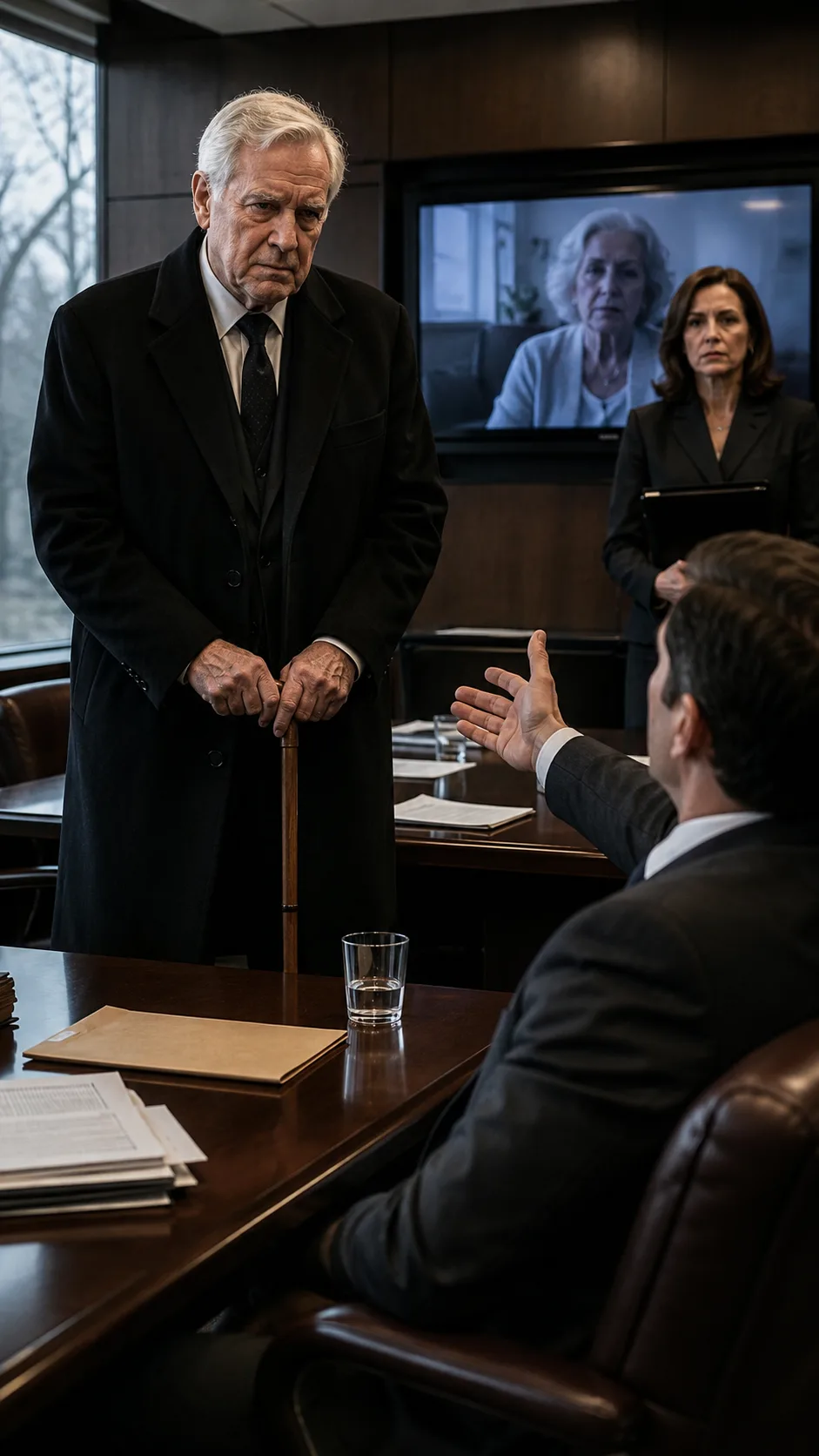
Margaret’s office occupied the top floor of an old brick building downtown. The conference room overlooked the city, its tall windows catching the pale afternoon light. The table was polished dark wood. A screen hung on one wall. On the table sat a leather folder, several sealed envelopes, a glass pitcher of water, and a small black remote.
Daniel arrived ten minutes after me.
Claire came with him.
They both looked dressed for victory.
Daniel wore another expensive suit, navy this time, with a silver watch at his wrist. Claire wore cream wool and carried a designer handbag large enough to hold the future she believed she had already purchased. They paused when they saw me seated at the table.
Daniel’s eyes flicked over my cane, my old coat, my thin hands.
He smiled.
Not with affection.
With relief.
The weak old man had come.
Good.
“Dad,” he said, as if nothing had happened between us. “You look better.”
I did not answer.
Claire leaned close to him and whispered something. I caught only a few words.
Market value.
Before spring.
Daniel touched her elbow, warning her to wait.
Margaret Hale entered exactly on time.
She was in her late fifties, dressed in a charcoal suit, her silver-streaked hair pinned neatly back. She greeted me first.
“Arthur.”
Then Daniel.
“Mr. Whitaker.”
That was the first time I saw Daniel’s confidence falter. Margaret had known him since he was a child. She had never called him Mr. Whitaker.
He recovered quickly. “Let’s begin. Claire and I have another appointment.”
Margaret sat at the head of the table and opened the leather folder.
“The matter before us concerns the estate of Eleanor Grace Whitaker,” she said. “Some portions are standard. Others are not.”
Daniel leaned back, fingers folded.
Claire placed her handbag on the floor and crossed her legs.
Margaret began with the ordinary things. Personal belongings. Jewelry. Eleanor’s small savings account. A few charitable donations. Her book collection. Her grandmother’s china. Items that sounded like Eleanor, tender and precise.
Daniel grew restless.
Finally, he interrupted.
“And the house?”
Margaret looked up.
“The house will be addressed shortly.”
“It’s in trust,” Daniel said quickly. “I’ve already begun the process of managing it.”
“No,” Margaret replied.
The word was quiet.
Daniel blinked. “Excuse me?”
“No,” she repeated. “You have not.”
Claire’s posture changed.
Daniel sat forward. “I have documents.”
“I’m aware.”
Margaret turned one page in the folder.
“Before we continue, Eleanor requested that a recorded message be played in the presence of all principal parties.”
Daniel laughed once, sharply. “A video? Is that necessary?”
Margaret looked at him without expression. “It is required.”
She picked up the remote.
The screen came alive.
And there was Eleanor.
For one second, I could not breathe.
She sat in our living room, in the blue chair by the window, the one with the worn armrest where her hand always rested. She looked thinner than I remembered, her cheekbones sharper, a scarf wrapped around her head. But her eyes were clear. Strong. Entirely herself.
“My dear Arthur,” she began.
My hand went to my mouth.
Daniel looked away.
Claire stared at the screen with the tight discomfort of someone watching the dead speak at an inconvenient time.
“If you are seeing this,” Eleanor continued, “then I am gone. And if Margaret has followed my instructions, then enough time has passed for people to reveal who they truly are.”
Daniel went still.
Eleanor turned her gaze slightly, as if she were looking directly at him through the camera.
“Daniel,” she said. “I know what you planned.”
The room changed.
Not physically. Nothing moved except the faint reflection of light on the table. But the air tightened. Claire’s eyes darted to Daniel. Daniel’s jaw clenched.
Eleanor’s voice remained steady.
“You believed illness made me unaware. You believed grief would make your father easy to control. You believed paperwork could turn theft into duty.”
Daniel pushed back his chair.
“This is ridiculous.”
Margaret did not pause the video.
On screen, Eleanor lifted a folder into view.
“You told your wife that once I died, you would remove Arthur from the house, claim authority over the estate, and sell everything before anyone could stop you.”
Claire’s hand flew to her throat.
Daniel turned to Margaret. “Turn it off.”
Margaret’s finger rested calmly on the remote. “Sit down.”
“I said turn it off.”
“And I said sit down.”
Her voice cut through the room like a blade.
Daniel remained standing for a moment, breathing hard. Then the screen filled with a new image: a bank statement.
His bank statement.
Not from a local bank.
Offshore.
Daniel’s face lost color.
Eleanor’s recorded voice continued.
“I also learned that your business troubles were not the result of bad luck. They came from money moved through accounts you thought no one would find.”
Claire looked at Daniel as if she had never seen him before.
“What is that?” she whispered.
“Nothing,” he snapped.
But the screen changed again.
Documents. Transfers. Names. Dates.
Margaret slid a copy across the table.
Daniel did not touch it.
Then came the recording.
At first, I did not understand what I was hearing. The audio crackled slightly. A machine hummed in the background. Eleanor’s hospice room, perhaps. Then Daniel’s voice filled the conference room.
“She won’t last much longer.”
Claire’s voice answered, faint but clear. “And your father?”
Daniel laughed.
Not loudly.
Carelessly.
“He’s weak. He’ll do whatever I tell him. After the funeral, I’ll put him somewhere and take control of the house. He won’t even know how to fight it.”
My body went cold.
The room seemed to tilt.
I gripped my cane until my knuckles hurt.
The recording kept playing.
Daniel again: “Once the property sells, we clear the business debt, pay off what we need to pay off, and move on. The old man has a pension. He’ll survive.”
Claire whispered, “And if he complains?”
Daniel’s voice came back.
“Who’s going to believe him?”
The recording ended.
No one spoke.
For the first time since I arrived, Daniel looked at me not as a burden, not as a problem, not as an old man to be managed.
He looked at me as a witness.
Eleanor returned on screen.
“I heard more than you thought,” she said. “And I kept more than you knew.”
Margaret reached into the leather folder and removed a thick manila envelope. She slid it toward me.
“The house,” Eleanor continued, “was placed into an irrevocable trust five years ago. Margaret Hale is the trustee. Arthur has lifetime rights to live there. No one may remove him. No one may sell it while he is alive. And Daniel has no authority over it.”
Daniel swallowed.
“That’s not possible.”
Margaret looked at him. “It is.”
“I have papers.”
“You have forged papers.”
Claire made a small sound.
Daniel’s head snapped toward her. “Claire.”
Margaret opened another folder.
“The documents you submitted claiming estate control were reviewed by a handwriting expert and by Eleanor herself before her death. They are fraudulent. Copies have already been sent to the district attorney.”
Daniel sat down.
Not gracefully. He dropped into the chair as if his legs had gone hollow.
The tailored suit, the silver watch, the confident posture—everything that had made him appear powerful minutes earlier now looked theatrical. Costume pieces on a frightened man.
Eleanor’s voice softened only slightly.
“You always wanted the fastest path to what others built slowly. But greed makes people careless, Daniel. You did not simply betray your father. You underestimated your mother.”
Daniel’s breathing grew uneven.
Claire reached for her handbag, then seemed to think better of it. Her eyes moved to the door.
She was already calculating distance.
Then Eleanor said the words that changed everything for me.
“Arthur, my love, there is one more thing.”
I looked up.
On the screen, my wife’s eyes filled with tears.
“Years ago, when Daniel was still young and you were working double shifts, I took out a life insurance policy. You told me it was unnecessary. You said we would be fine with what we had. But I knew you, Arthur. You would give away your last dollar to someone you loved and call it duty. So I did what you would never do for yourself.”
Margaret placed another document in front of me.
“The payout is three million dollars,” Eleanor said. “Every dollar goes to you.”
Daniel made a choking sound.
Claire stared at him, then at the papers, then at me.
Eleanor continued.
“If there are medical bills, pay them. If you need a nurse, hire one. If the porch needs repair, fix it. Buy the old books you always pretended were too expensive. Drink coffee in our kitchen. Sit in the chair by the window. Live in the home we made together.”
My vision blurred.
I tried not to cry in front of Daniel.
I failed.
Eleanor leaned closer to the camera, as if she had saved the last of her strength for me.
“You are not helpless, Arthur. You are not a burden. You are the man who loved me faithfully for nearly half a century. You are my husband. And you are going home.”
Her lips trembled.
“I love you.”
The screen went dark.
Silence filled the room.
It was not empty silence. It was full of everything Daniel had lost and everything Eleanor had saved.
Then Daniel collapsed.
His body folded sideways out of the chair, one hand clutching at the table before he slid to the carpet. Claire screamed his name and dropped beside him, her handbag tipping over, spilling lipstick, keys, and a folded real estate brochure onto the floor.
A real estate brochure.
For my house.
Margaret did not rush.
She pressed pause even though the video had already ended, stood, poured water into a glass, and handed it to Claire.
“He is conscious,” Margaret said calmly. “He is breathing. Give him a moment.”
Daniel opened his eyes after a few seconds, pale and sweating. Claire helped him back into the chair, though she looked less like a concerned wife and more like a woman deciding whether the ship was sinking fast enough to jump.
Daniel’s gaze found mine.
“Dad,” he rasped.
I said nothing.
He leaned forward, both hands trembling on the edge of the table. “Dad, please. You have to understand. I was under pressure.”
The word pressure almost made me laugh.
Pressure was working fourteen-hour days with a bad back because your son needed braces. Pressure was choosing between fixing the furnace and paying for college books. Pressure was holding your dying wife’s hand and pretending you were not terrified so she could sleep.
Daniel had not been under pressure.
He had been under greed.
“The business was failing,” he said. “People were coming after me. I made mistakes.”
Margaret’s eyes narrowed slightly. “Several, according to the evidence.”
Daniel ignored her. His focus stayed on me.
“I never wanted it to go this far.”
“You put my clothes in boxes,” I said.
My voice sounded strange to me. Calm. Distant.
Daniel flinched.
“You left Eleanor’s photograph in the rain.”
His mouth opened, then closed.
“You signed hospital papers and sent the bill to me.”
“I panicked.”
“You told your wife I was weak.”
His eyes filled with tears then. Real ones, perhaps. Or useful ones.
“Dad, I’m your son.”
For a long moment, I looked at him.
And I saw all of him.
Not just the man in the suit begging because his plans had failed. I saw the baby Eleanor had placed in my arms in a hospital room bright with morning light. I saw the little boy who refused to sleep without the blue blanket. I saw the teenager who rolled his eyes when I tried to teach him to change a tire. I saw the young man who hugged his mother at graduation and barely looked at me because fathers, to boys like Daniel, were furniture that paid bills.
I had loved him through every version.
That was the tragedy.
Love does not always make people worthy of it.
Daniel reached across the table.
“Please,” he whispered. “We can handle this privately. You don’t want your own son going to prison. Mom wouldn’t want that.”
At that, something in me finally stood up before my body did.
“Do not use your mother as a shield,” I said.
His hand froze.
I placed both palms on the handle of my cane. My legs shook as I pushed myself upright, but I did not sit back down. Margaret stepped slightly forward, ready to help. I gave the smallest shake of my head.
I wanted to stand on my own.
Daniel watched me rise.
He had never looked smaller.
I adjusted the front of the borrowed black coat I had worn since Eleanor’s funeral. Soon, I thought, I would buy a coat that actually belonged to me. One Eleanor would have liked. Dark wool, maybe. Good buttons.
Daniel’s voice broke.
“Dad.”
I looked down at him.
Not with hatred.
Hatred would have meant he still owned some burning room inside me.
What I felt was quieter. Cleaner. A door closing without being slammed.
“You told me something on the phone,” I said. “When I called about the hospital bill.”
His face changed.
He remembered.
“You said I was not your responsibility anymore.”
“Dad, I—”
“No.”
One word.
He stopped.
I held his gaze.
“You are not my problem anymore, Daniel.”
The sentence left my mouth gently.
That made it worse.
Claire looked away. Margaret lowered her eyes, not in sadness, but in respect.
Daniel stared at me as if I had struck him.
I turned toward the door.
My cane tapped once against the floor.
Then again.
Behind me, Daniel began speaking quickly, desperately, throwing words after me like coins into a well.
“Dad, wait. Please. We can talk. I’ll fix the bill. I’ll talk to the attorney. Dad, don’t walk out. Dad!”
I did not stop.
Margaret walked beside me to the elevator.
Neither of us spoke until the doors opened.
Then she said quietly, “Eleanor wanted you to know she was not afraid at the end. She was worried for you, but she was not afraid.”
I nodded because my throat had closed.
When we reached the lobby, sunlight was breaking through the clouds.
For the first time in months, the world did not look gray.
The car was waiting at the curb. The driver opened the door, but I paused before getting in. Across the street, rainwater shone along the pavement like glass. People hurried past with bags and coats and lives that had nothing to do with mine.
I was still old.
My back still hurt.
My wife was still gone.
My son had still betrayed me.
Money did not erase any of that.
But Eleanor had given me more than money. She had given me proof. She had given me back my name, my home, my dignity. She had reached from the edge of death and placed herself between me and the son who thought love made me defenseless.
That afternoon, I did not return to Maple Ridge.
Margaret had already arranged everything.
A nurse would meet me at the house. My boxes had been retrieved. The locks had been changed. The trust was secure. The district attorney would handle Daniel.
The blue Cape Cod looked smaller than I remembered when the car pulled up, but more beautiful than any mansion could have been.
The hydrangeas were bare for winter. The porch needed paint. One shutter hung slightly crooked. Rain still clung to the steps.
Home.
The driver offered his arm. I took it, then shifted my weight to the cane and climbed the three porch steps slowly.
Inside, the house smelled faintly of dust, lemon cleaner, and Eleanor.
I stood in the entryway for a long time.
The silence was different here. At Maple Ridge, silence had been abandonment. Here, it was memory.
In the living room, Eleanor’s blue chair waited by the window.
Her photograph had been placed on the mantel.
I walked to it, touched the frame, and smiled through tears.
“You did it,” I whispered.
Outside, sunlight warmed the wet porch boards.
I made coffee in our kitchen, though my hands trembled and I spilled some grounds on the counter. I carried the cup carefully to the living room and lowered myself into my chair across from Eleanor’s.
For the first time since the funeral, I allowed myself to breathe without fear of where I would sleep, who would pay the next bill, or whether my own son would decide I had become too inconvenient to exist.
The house creaked softly around me.
Old pipes. Settling wood. Familiar ghosts.
I looked toward the window where Eleanor used to sit with her tea.
“I’m home,” I said.
And in the quiet, with the afternoon sun stretching across the floor we had chosen together forty-three years earlier, I almost heard her answer.
I know.
THE END.
Chapter complete
You have reached the end of this chapter.
Continue reading
A few more worlds to get lost in after this chapter.