After My Mom Destroyed the Wrong House, She Learned My Father’s Final Secret
After my father passed away, my mother and I were each left a house.
Chapter 1
After My Mom Destroyed the Wrong House, She Learned My Father’s Final Secret
After my father passed away, my mother and I were each left a house.
At least, that was how simple it sounded when the attorney read the will.
My father, Daniel Hayes, had owned two properties on the edge of Columbus, Ohio. One was the house my parents had lived in for nearly thirty years, a wide brick home with a deep front porch, old maple trees, and enough memories inside its walls to make every hallway feel haunted after his funeral. That house went to my mother, Marilyn.
The second property was a smaller two-bedroom rental on West Oak Street. Dad had bought it years earlier, back when he still believed real estate was the quietest way to build security for the people he loved. According to the will, that rental belonged to me.
I did not smile when the attorney said it. I did not celebrate. I barely reacted at all.
My father was dead. My chest still hurt every morning when
I remembered I could no longer call him. I wanted peace more than property. I wanted to survive the paperwork, the condolences, the empty chair at Sunday dinner.
But my mother heard the will, and grief changed shape inside her.
By the time we returned to her kitchen that afternoon, the softness had left her face.
“You don’t deserve this,” she said.
I was standing near the sink, still wearing the black dress from the attorney’s office. I looked at her, exhausted. “Mom, please.”
“Don’t you ‘please’ me, Sarah.” Her voice was calm in a way that made it worse. “Your father gave you that house to punish me.”
“That’s not true.”
“You always knew how to make him feel sorry for you.” She stepped closer, her red eyes sharp and dry now. “He should have left everything to me.”
“He left you the family home.”
“That is not the
point.” Her mouth tightened. “Give me the keys.”
I stared at her. “What?”
“The keys to the rental.”
“I don’t even have them yet,” I said slowly. “The property manager still has to transfer everything after the title is finalized.”
“Then when you get them, you will bring them to me.”
Something cold moved through me. “No.”
Her face changed immediately, as if the word had struck her.
“No?” she repeated.
“That house is mine now. Dad wanted me to have it. I’m not giving you access just because you’re angry.”
Her hand shot out and closed around my wrist. Her nails pressed into my skin.
“You think owning one little house makes you important?” she hissed. “You think you earned any of this?”
I pulled my arm free, my pulse hammering. “I’m not fighting with you. Dad just died. I don’t want a war.”
But my mother had already
chosen one.
That night, my phone would not stop lighting up.
She sent message after message. I was selfish. I was greedy. I had manipulated my father. I had abandoned her. She reminded me that she had raised me, fed me, clothed me, as if motherhood had been a loan and I had missed the payment.
I read the first few. Then I stopped.
The next morning, at exactly 7:12, my phone rang.
Her name filled the screen.
I already knew answering was a mistake. Still, some old part of me—the daughter who kept hoping her mother would become reasonable if I stayed calm enough—pressed accept.
She was laughing.
Not nervously. Not sadly.
She laughed like she had won something.
“I hope you enjoyed your last comfortable night,” she said.
My stomach clenched. “What are you talking about?”
“I had your house demolished.”
For a second, the room tilted.
“What?”
“The little rental your father gave you like a prize,” she said, her voice bright with cruelty. “I sent a crew in early. They took it down. Walls, windows, roof—gone. Enjoy sleeping on the street, Sarah.”
My throat went dry. “Mom, that’s illegal.”
“Prove it,” she said. “You don’t even have the keys.”
Then the call ended.
I stood frozen in my apartment, phone still pressed to my ear, listening to silence.
Then I grabbed my car keys and ran.
The drive across town was a blur of red lights, shaking hands, and thoughts too fast to hold. I imagined the house reduced to splinters. I imagined the years my father had spent saving money, repairing pipes, repainting walls, all destroyed because my mother could not bear to let me keep anything he had chosen for me.
By the time I turned onto West Oak Street, my breathing was ragged.
And there it was.
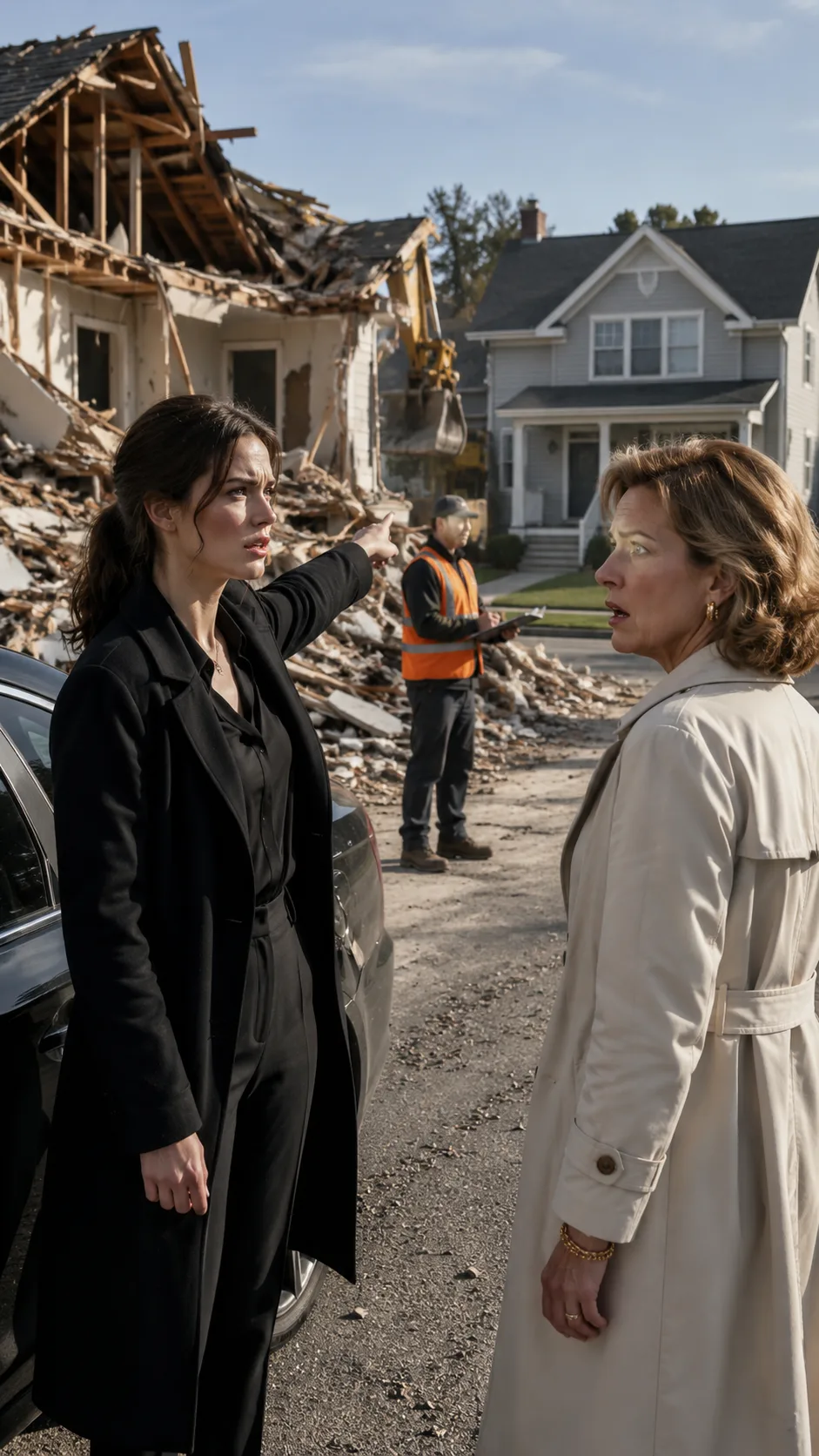
A demolition crew in orange vests. A dumpster overflowing with broken wood and torn insulation. Dust hanging in the air like smoke.
My hands tightened around the steering wheel.
Then I saw the permit sign in the yard.
I blinked.
Once.
Twice.
And then, despite everything, I started laughing.
Because the house my mother had destroyed was not mine.
I pulled up to the curb and stepped out slowly.
Marilyn stood in front of the rubble in a cream designer trench coat, one hand on her hip, looking like a queen admiring the ruins of an enemy city. Her hair was perfectly styled. Her lipstick was perfect. Her smile was poisonous.
She turned when she saw me.
“Well?” she said, pointing at the heap of crushed drywall and shattered beams. “There it is. Your inheritance. Dust.”
I did not look at the wreckage.
I looked across the street.
A neat gray cottage sat untouched in the morning light. Two bedrooms. White trim. Fresh paint. Small porch. Quiet windows.
Then I looked back at my mother.
“Mom,” I said carefully, “do you remember the address of Dad’s rental?”
Her smile faltered. “Don’t play games.”
“I’m not.”
“It was the little house on Oak Street,” she snapped.
“The rental was 1422 West Oak.” I pointed across the road. “That one.”
She followed my finger.
For the first time since she had called me, she stopped looking pleased.
I turned and pointed at the wrecked property behind her. “This was 1421 West Oak.”
The color drained from her face so quickly it was almost frightening.
“No,” she whispered.
“Yes.”
“No, the lawyer said—”
“The lawyer said the rental,” I cut in. “You heard what you wanted to hear.”
She stared across the street at the gray cottage, then back at the demolished house. Her lips parted, but no words came.
I took a breath.
“Dad bought this place six months ago through a separate LLC,” I said. “It wasn’t the old rental. It was a fixer-upper. He planned to renovate it and leave it to you as extra income for your retirement.”
Her eyes widened.
“He was going to surprise you after the estate settled,” I continued. “You would have known that if you had waited for the final deed descriptions instead of trying to destroy what belonged to me.”
A foreman approached us then, clipboard in hand, sweat darkening the collar of his shirt.
“Ma’am?” he said, looking at my mother. “We’ve got a problem.”
Marilyn barely turned toward him.
He cleared his throat. “The city inspector is here. He says the permit you gave us is for 1422 West Oak, not 1421. Also, we hit a gas line that wasn’t marked on our paperwork.”
My mother’s face went slack.
The foreman glanced at the rubble. “This demolition wasn’t authorized for this address.”
For a long moment, no one spoke.
The dust moved slowly around us. Somewhere, a machine beeped in reverse. Across the street, my actual house stood untouched, quiet and whole.
My mother had rushed everything. She had gone around proper channels, used a cheap company recommended by some friend of a friend, and pushed them to start before anyone could stop her.
She had not ruined my inheritance.
She had destroyed her own.
I looked at her then—not with anger, not even with satisfaction, but with a kind of tired clarity I had never felt before.
“You wanted me homeless,” I said quietly. “But now you’re the one with a mortgage on a pile of dirt, an illegal demolition, and city fines coming.”
Her mouth trembled. “Sarah—”
“No.”
The word came out calm. Final.
I crossed the street, walked up the driveway of the gray cottage, and stood on the porch of the house my father had actually left me.
For the first time since his funeral, I breathed deeply.
Two weeks later, a letter arrived from my mother’s attorney.
It contained an apology, written in careful legal language, and a request for financial help with environmental fines, emergency repairs, and penalties from the city.
I did not answer.
Some people burn bridges because they are angry.
My mother used a wrecking ball.
She kept the rubble.
I kept the house.
And for the first time since my father died, justice finally had an address.
THE END.
Chapter complete
You have reached the end of this chapter.
Continue reading
A few more worlds to get lost in after this chapter.




