Rat counted spoons by the sound they made.
Chapter 1
Rat counted spoons by the sound they made.
Silver rang clean.
Pewter landed dull.
Copper had a tired little clink that made the kitchen boys laugh when they were not supposed to.
He sat on a low stool beside the washing trough, sleeves rolled past his elbows, fingers red from hot water and lye. Steam crawled along the stone ceiling. Fish bones lay in a bucket near his bare feet. Somewhere behind him, Cook Mara was shouting at a scullion for burning the barley cakes meant for the west guardhouse.
Rat did not turn.
He kept counting.
One silver spoon.
Two silver spoons.
Three.
Then a hand knocked the whole pile into the dirty water.
“Start again.”
The voice belonged to Pell, a stable boy with a wide jaw and a habit of taking things from people smaller than him. He leaned over Rat’s shoulder, grinning like he had done something clever.
Rat looked at the ripples in
the trough.
The spoons had disappeared under grease and brown foam.
Pell tapped the back of Rat’s head with two fingers. “Did you hear me?”
Rat reached into the water and found the first spoon by touch.
Silver.
He placed it on the cloth.
One.
Pell waited for a reaction. He did not get one, so he spat near Rat’s foot and walked away.
That was how most days worked in the palace kitchens. Someone pushed. Someone laughed. Rat bent down and picked up whatever had fallen.
He had been doing it long enough to know the rules.
Do not look nobles in the eye.
Do not answer guards unless they ask twice.
Do not ask where the extra bread goes.
Do not touch anything with a royal crest.
Do not let anyone see the whistle.
The last rule was his own.
The whistle hung beneath his tunic on a
cord so old it had gone soft. It was small, carved from dark wood, with a crack along one side and a faded mark near the mouthpiece. Rat did not know what the mark meant. He had traced it with his thumb so many times that he could feel it in his sleep.
A crescent.
A claw.
A line through both.
Cook Mara once asked where he got it. Rat had been nine then, maybe ten. Nobody knew his age. She had reached toward it, not rough, not kind either.
Rat had stepped back so fast he hit the flour bin.
After that, she stopped asking.
People said many things about him.
They said he had been left at the outer wall during a winter rain.
They said a laundry woman found him in a basket of spoiled linen.
They said he had no mother because no mother would leave
a baby with nothing but a wooden toy and a name nobody used.
The name Rat had come later.
A guard had called him that after finding him asleep behind the grain sacks.
The kitchen kept it.
Names stuck easier when they hurt.
On the morning the royal seal vanished, Rat was polishing wine cups for the high table. The Emperor was receiving three northern lords, a delegation from the salt coast, and one priest with a white beard long enough to dip into his soup. The palace had been awake before dawn. Armor had been brushed. Red banners had been hung from the eastern gallery. Every servant had been given work twice over and bread half as thick as usual.
Rat carried a tray of cups through the servants’ corridor with both hands.
At the corner near the falcon court, he saw Lord Cassius.
That was the first bad thing.
Cassius never stood in servant passages unless he wanted something hidden from people who mattered. He was tall, narrow, and dressed in deep burgundy wool even in the heat. Gold rings covered three fingers on his right hand. One held a ruby dark enough to look black indoors.
He was speaking to Captain Varric, head of the palace guard.
Rat slowed without meaning to.
Cassius turned.
His eyes found the tray first. Then Rat’s face. Then the torn collar of Rat’s tunic where the whistle cord sometimes showed if he moved too quickly.
Rat lowered his head.
“Boy,” Cassius said.
Rat stopped.
“Come here.”
The tray trembled once. Rat tightened his fingers around the handles and stepped closer.
Cassius took one cup from the tray. He turned it in his hand as if judging whether Rat had left a smear on the rim. There was none.
“You work in the lower kitchen?”
Rat nodded.
“Words.”
“Yes, my lord.”
Cassius smiled. One side only.
“Have you ever entered the imperial archive?”
Rat shook his head. “No, my lord.”
“The inner council chamber?”
“No, my lord.”
“The west treasury?”
“No, my lord.”
Cassius leaned in just enough for Rat to smell cloves on his breath.
“Good. Remember that.”
He placed the cup back on the tray.
Rat carried the wine cups to the hall and did not spill a drop.
By noon, the palace doors were sealed.
The news reached the kitchen in pieces. First, two guards came down and searched the pantry. Then one of the assistant stewards was dragged through the corridor with his hands tied. Then Cook Mara ordered everyone to stand along the wall, palms open, sleeves raised.
“The Emperor’s seal is missing,” Pell said under his breath.
Rat looked at him.
Pell enjoyed knowing things early.
“Gold,” Pell said. “Big as a plum. They say whoever holds it can sign an order in the Emperor’s name.”
Cook Mara heard him and struck the back of his head with a ladle.
“Quiet.”
No one was quiet after that.
The guards tore through the kitchen. They opened flour sacks with knives. They shook out aprons. They overturned baskets of onions and cracked open jars of pickled eggs. One guard even lifted the lid of the ash bin and coughed until his eyes watered.
Rat stood near the furnace, hands at his sides.
He kept his chin down.
He did not think about the whistle.
That made him think about it.
A guard came to him last. He was young and broad, with a scar under his left eye.
“Name.”
Rat looked up.
The guard’s mouth twitched.
“That is what I thought.”
He grabbed Rat’s arms, turned them over, checked his palms, then patted down his tunic. His fingers brushed the cord.
Rat’s hand moved before he could stop it.
The guard noticed.
“What is that?”
Rat closed his fist around the whistle beneath the cloth. “Nothing.”
The guard slapped his hand away and yanked the cord up.
The whistle came out.
It looked smaller in the guard’s grip. Dark wood. Cracked edge. Old string.
“A toy?”
Rat reached for it.
The guard lifted it higher.
“Please.”
That one word made the kitchen still.
Rat almost never said please. Please gave people something to step on.
The guard looked at the whistle again.
Then Lord Cassius entered.
Everyone bowed, except Rat, who was still staring at the whistle.
Cassius walked slowly between the overturned baskets and split flour sacks. White dust marked the stones like snow. He stopped in front of Rat and held out one hand.
The guard gave him the whistle.
Cassius studied it.
For a moment, the lines near his mouth disappeared.
Rat saw it.
Only for a breath.
Then Cassius smiled again.
“What a curious little thing.”
He held the whistle between two fingers and lowered it until it hung in front of Rat’s face.
“Where did you get this?”
Rat swallowed.
“I have always had it.”
Cassius’ eyes narrowed.
“That is not an answer.”
“It is the only one I know.”
Pell made a small sound from the wall. Someone elbowed him quiet.
Cassius turned the whistle. His thumb passed over the faded mark.
Crescent.
Claw.
Line.
He stopped touching it.
Then he let the whistle fall against Rat’s chest, still tied to the cord.
“Search his bedding.”
“I sleep by the furnace,” Rat said.
Cassius looked at him.
The room shrank.
Rat lowered his eyes.
The guard found nothing in the grain sack. Nothing under the old brick Rat used as a pillow. Nothing behind the stove except a bent spoon, three crumbs hard as pebbles, and a mouse skull Pell claimed was Rat’s cousin.
The kitchen boys laughed.
Cassius did not.
He looked at the empty sack. Then at Rat.
“Bring him.”
Cook Mara stepped forward before anyone else could move.
“My lord, he has been in this kitchen since dawn.”
Cassius turned to her.
Cook Mara stopped with one hand still raised.
“He carried trays through the east passage,” Cassius said.
“All servants did.”
“He was near the falcon court.”
“With cups, my lord.”
“And no family to speak for him.”
Cook Mara’s fingers curled into her apron.
Rat stared at the floor.
A black drop of grease sat between two stones near his toe. He fixed his eyes on it because it was easier than looking at Mara’s face.
The guards took him by both arms.
The whistle bounced once against his chest.
That night, Rat sat in a holding cell beneath the arena.
The palace had old places under it. Most servants knew about the wine cellars and drainage tunnels, but fewer knew of the punishment rooms. Those were below the western quarter, where the air smelled of iron and damp straw. The walls sweated even in dry weather.
Rat’s hands were tied in front of him.
Not tight enough to cut.
Tight enough to remind him.
Across the corridor, a man slept with his head against the bars. Farther down, someone muttered a prayer over and over until a guard told him to shut his mouth.
Rat did not pray.
He did not know which god took prayers from kitchen rats.
Near midnight, Cook Mara came.
She carried no lantern. A guard brought one and stood behind her with his thumb hooked in his belt.
Mara looked smaller outside the kitchen.
Her gray hair had come loose near one ear. Flour still marked the side of her dress. She held a heel of bread wrapped in cloth.
The guard opened the door just wide enough for her to pass it through.
She pushed it into Rat’s hands.
“Eat.”
Rat looked at the bread.
It was good bread.
High-table bread. White inside. Still soft.
He tore a piece and put it in his mouth.
Mara watched him chew.
“You did not take the seal.”
Rat shook his head.
“I know.”
He swallowed.
“Does that matter?”
Mara’s face changed around the mouth. Nothing more.
“The Emperor will not hear kitchen testimony against Lord Cassius.”
Rat leaned back against the wall.
The stone was wet through his tunic.
“What happens tomorrow?”
Mara looked at the guard.
The guard looked away.
Rat understood.
The arena.
He had scrubbed blood from the beast hooks after arena days. He had carried buckets past men who came back without all of themselves. He had heard crowds cheer from the kitchens below until flour drifted from the ceiling.
His fingers closed around the whistle.
Mara saw.
“Why do you keep that thing?”
Rat looked down.
The old cord had cut a red line across the back of his neck over the years. He could have taken it off. He never had.
“I don’t know.”
Mara reached through the bars. Her hand stopped before touching his head.
She pulled it back.
“There was a woman,” she said.
Rat looked up.
Mara’s jaw tightened. She was not a woman who liked old stories. “Years ago. Before you were brought in. There was a woman who came through the lower gate with a bundle. I was younger then. Stupider. I heard shouting near the wall. By morning, the bundle was in the laundry room.”
Rat did not breathe right.
Mara looked toward the corridor.
“I only saw her once. She wore a dark cloak. Her hair had silver pins shaped like leaves. Noble pins. Not servant work.”
Rat’s hand went flat against the whistle.
“What was her name?”
“I never heard it.”
“Did she leave this?”
Mara looked at the whistle.
“I think so.”
The guard coughed.
Time.
Mara stepped back.
“Eat the rest before morning.”
Rat held the bread in both hands.
“Mara.”
She stopped.
He had never used her name without Cook in front of it.
“If they open the beast gate…”
Her eyes held his for half a second.
“Do not run in a straight line.”
Then she left.
That was the kindness the palace could afford.
At dawn, bells rang.
The arena was built from pale stone and pride. It rose above the western quarter in stacked circles, wide enough to hold half the capital if the gates were thrown open. On festival days, children bought honey nuts outside and men wagered on spear fighters. On punishment days, the same vendors sold twice as much.
Rat heard the crowd before the guards opened his cell.
A thousand feet.
A thousand mouths.
A living thing made of noise.
The guards untied his ankles but left his hands bound. One gave him water from a clay cup. Rat drank too fast and coughed. The other laughed.
“He’ll last less than a minute.”
“Depends what they send.”
“They say Cassius asked for the black one.”
The first guard stopped laughing.
Rat looked between them.
The black one.
Every kitchen had stories about the imperial beasts. Most were bred for war, chained in vaults under the old barracks, fed by men who never turned their backs. There were striped cats with tusks, armored bulls from the eastern marshes, gray hounds the size of ponies.
But the black one was not like the others.
It had a name nobody used in daylight.
Mourn.
The Emperor’s beast.
Older than three wars.
Too dangerous for battle now, too valuable to kill.
It had once guarded the royal nursery, according to one story. In another, it had eaten seven traitors in a single morning. Pell said it had human eyes. Cook Mara told him to stop speaking filth near the bread.
The guards led Rat up the ramp.
Light waited at the top.
His feet touched sand.
The crowd laughed.
It rolled over him first, hot and sharp. Rat blinked against the sun. For a moment, he could not see faces, only color: red banners, gold trim, white veils, dark armor, raised hands.
Someone threw a peach pit.
It struck the sand near his left foot.
“Thief!”
“Rat!”
“Seal-stealer!”
He kept walking because the guard behind him pushed the butt of a spear between his shoulder blades.
At the center of the arena, the rope was cut from his wrists.
His skin stayed marked.
The guards retreated.
Gate chains rattled behind him.
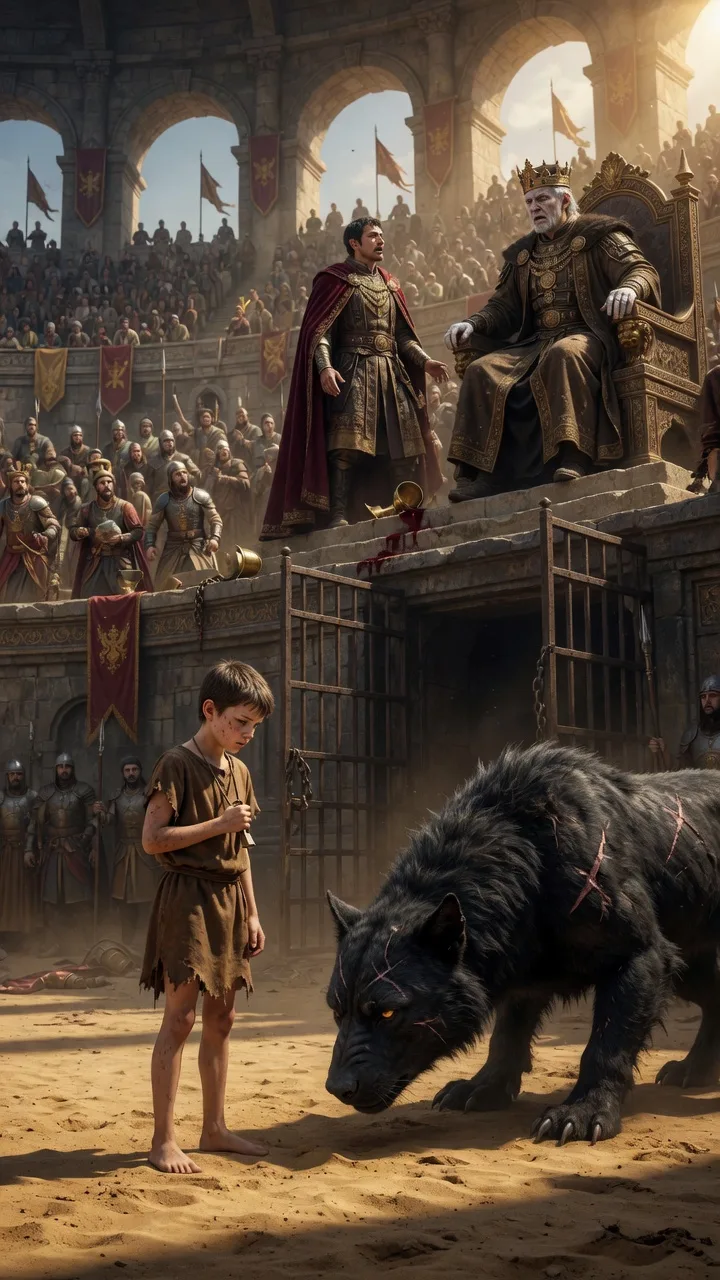
Rat turned.
Across the sand, Lord Cassius sat among the noble houses under a canopy trimmed in gold tassels. His burgundy cloak lay perfectly over one shoulder. A cup rested in his hand.
Above him, higher than all, sat the Emperor.
Emperor Aurelian had ruled since before Rat was born. People called him the Stone Lion because he had taken two cities before he turned thirty and buried three brothers before he took the throne. In portraits, his eyes were bright and merciless. From the arena floor, they looked tired.
He glanced at Rat once.
No more.
A herald stepped forward and raised a bronze horn.
“By decree of the imperial court, the accused stands condemned for theft of the royal seal, violation of sacred trust, and treason against the bloodline.”
Rat’s mouth dried.
Treason.
The word was too big for his body.
The crowd cheered anyway.
The herald looked toward Cassius, then continued.
“Let the judgment of the arena be carried out.”
Trumpets sounded.
The iron gate opposite Rat began to rise.
The sound scraped through the arena like a blade across bone.
Rat remembered Mara’s words.
Do not run in a straight line.
His feet shifted in the sand.
Something moved in the dark behind the gate.
The first thing he saw was gold.
Two eyes.
Then a muzzle scarred white across black fur.
Then the beast stepped into daylight.
The arena changed.
The crowd had come for blood, but now even their hunger took a step back.
Mourn was enormous.
Its shoulders rose higher than Rat’s head. Its black fur was thick and rough, gray around the jaw, torn in places where old scars crossed the hide. One ear was split. Its front claws sank deep into the sand with every step. Chains dragged behind it for two paces before handlers cut them loose and fled through side doors.
Mourn did not look at the crowd.
It looked at Rat.
The boy’s legs wanted to move.
He made them stay.
Mourn came forward slowly.
That was worse than a charge.
A fast beast gave a body no time to think. This one gave Rat every second. Every breath. Every grain of sand under his feet.
Cassius leaned forward.
His voice carried because the arena had gone quiet.
“Let the rat learn his place.”
A few nobles laughed.
Rat heard Pell somewhere in the servant stands. Not laughing now.
Mourn crossed half the arena.
Rat took one step back.
Then another.
His heel caught in the sand.
The whistle tapped against his chest.
Tap.
Tap.
Tap.
He looked down.
Old wood under torn cloth.
The cord moved with his breath.
Mourn was close enough now that Rat could smell it: dust, iron, animal heat, and something older, like rain on stone.
The beast’s lips pulled back.
Not fully.
Enough to show teeth.
Rat’s hand went under his tunic.
The crowd stirred.
Cassius lifted his cup.
The Emperor turned his head.
Rat pulled out the whistle.
It looked foolish in his fingers. A child’s object. A kitchen scrap. A thing no one should notice on the day of an execution.
Mourn stopped walking.
Only for half a beat.
Rat saw it.
No one else seemed to.
His fingers tightened.
He raised the whistle to his mouth.
A guard shouted from the wall.
Rat did not hear the words.
He blew.
The sound was thin.
Not music.
Not command.
Just one strange note that slipped through the arena and returned from the stone in a softer echo.
Mourn froze.
Its claws dug into the sand.
The crowd went still in pieces. First the front rows. Then the noble seats. Then the high tiers, where children stopped whispering because their parents had stopped breathing.
Rat lowered the whistle from his mouth.
Mourn’s golden eyes held him.
The beast took one final step.
It was close enough to kill him without effort.
Rat saw the scars across its muzzle. One old wound ran from the left eye down to the jaw. Another crossed the bridge of its nose. Its breath moved the dust on Rat’s tunic.
He did not move.
Mourn lowered its head.
Slowly.
Down.
Down.
Until its massive scarred muzzle touched the sand before Rat’s bare feet.
Then its front legs bent.
The beast bowed.
For a moment, the whole kingdom forgot how to make sound.
Lord Cassius’ golden cup slipped from his hand.
It struck stone and rolled under the bench.
The Emperor stood.
Not with ceremony.
Not like a ruler rising to address a crowd.
He stood like a man who had seen a grave open.
His hand gripped the throne armrest so hard the knuckles paled.
“That whistle,” he said.
The words did not carry to every seat, but those close enough heard. Those who heard turned to those who had not. The silence broke into murmurs, then gasps, then a low spreading noise that moved around the arena faster than flame.
Cassius was on his feet too.
His face had lost its color beneath the powder.
“Your Majesty,” he said. “It is a trick.”
The Emperor did not look at him.
His eyes stayed on Rat.
“Bring the boy.”
No one moved.
Mourn lifted its head.
The guards near the wall stepped back.
The Emperor’s voice changed.
“Bring him.”
Three soldiers entered the arena through the side gate. They carried spears, but none pointed them at the beast. Mourn turned its head toward them, and all three stopped at once.
Rat put one hand on Mourn’s lowered muzzle.
He did not know why.
The beast went still beneath his palm.
The arena saw it.
The Emperor saw it.
Cassius saw it too.
Rat’s hand was small against the black fur. Dust clung to his fingers. The whistle rested against his chest, catching the sun.
Mourn took one step aside.
The path opened.
Rat walked.
Not because he was brave.
Because the beast had moved for him.
The soldiers did not touch him. They walked near him, not beside him. Every step toward the imperial stairs made the arena lean closer.
Rat passed the noble seats.
Cassius stood so close to the rail that his rings pressed into the wood.
His mouth moved.
No sound came out.
Rat looked at him once.
The flour mark was gone from his boot now. Polished clean. Perfect again.
At the base of the imperial platform, Rat stopped.
The Emperor descended three steps before any attendant could stop him.
That alone made the court shift.
Emperors did not come down.
People came up.
Aurelian stood before Rat, and for the first time, the boy saw age in him. Not weakness. Not softness. Just the cost of sitting too long above everyone else.
“Where did you get it?” the Emperor asked.
Rat touched the whistle.
“I have always had it.”
The Emperor’s jaw tightened.
“Who gave it to you?”
“I don’t know.”
Aurelian reached out.
Rat stepped back before he could stop himself.
Several guards reached for swords.
Mourn growled.
It was not loud.
It did not need to be.
Every sword stayed half-drawn.
The Emperor lowered his hand.
“May I see it?”
Rat looked at the beast.
Mourn’s golden eyes stayed on the Emperor.
Then Rat untied the cord.
His fingers fumbled once at the knot. Nobody laughed. Nobody breathed loudly. He placed the whistle in the Emperor’s open palm.
Aurelian turned it.
His thumb found the faded mark.
Crescent.
Claw.
Line.
His face changed so slightly that only those nearest could see. The muscles beside his mouth locked. His eyes went to the crack along the side.
“This was carved from the cradle rail,” he said.
The captain beside him stared.
“Your Majesty?”
The Emperor looked past Rat, beyond the arena, beyond the stone and banners.
“My son’s cradle.”
The words landed without trumpet or drum.
Rat did not understand them at first.
The crowd did.
A sound rose from the lower seats, then vanished under a sharper silence.
Cassius moved.
Not far.
Just one step back.
The Emperor turned to him.
“Lord Cassius.”
Cassius bowed too quickly.
“My Emperor, allow me to explain—”
“You told the court the child died.”
Cassius’ lips parted.
The Emperor stepped down one more stair.
“You brought me ashes.”
Cassius’ hand went to his rings, twisting one around his finger.
“The rebellion had reached the nursery. The body was burned beyond—”
“No.”
The Emperor’s voice did not rise.
That made it worse.
Rat stood between them with the whistle cord still in his hand, not knowing where to look. The beast remained on the arena sand below, but its head was lifted now, ears forward, eyes fixed on Cassius.
The Emperor held up the whistle.
“Only three existed. One stayed with the beast master. One was buried with my wife. One was tied to my infant son’s wrist by the Empress herself because Mourn would not sleep unless the child was near.”
The arena did not move.
Rat heard a banner rope tapping against a pole in the wind.
Tap.
Tap.
Tap.
The Emperor looked at the boy.
His voice changed again. Not warm. Not gentle. Stripped bare.
“What name was given to you?”
Rat almost said Rat.
The word rose automatically, trained into him by years of use.
Then his mouth closed.
He looked at Cook Mara in the servant section. She had both hands over her apron. Pell stood beside her, pale and useless.
“I don’t know,” Rat said.
The Emperor’s face held.
Aurelian turned to the captain.
“Seal the arena. No noble leaves.”
Cassius straightened.
“Your Majesty, this is madness. A kitchen boy appears with a stolen relic and a trained beast bows because of some old sound, and you would accuse a lord of the inner council?”
The Emperor looked at him for the first time fully.
“Where is the seal?”
Cassius blinked.
“The thief took it.”
“Where is it?”
Cassius’ throat moved.
The Emperor turned to Captain Varric.
“Search him.”
Cassius laughed once.
It was too sharp.
“Search me?”
No one laughed with him.
Two guards approached. Cassius held out his arms with insult in every line of his body. They checked his cloak, belt, sleeves, inner pockets. One guard hesitated before touching the lord’s boots.
The Emperor said nothing.
The guard knelt.
Cassius looked down.
“No.”
The guard removed the left boot.
Something gold fell into the sand.
Small.
Heavy.
Marked with the imperial crest.
The royal seal rolled once and stopped at Rat’s bare foot.
Nobody spoke.
Rat bent down and picked it up.
It was heavier than he expected.
The gold was warm from Cassius’ boot.
He looked at the Emperor, then held it out.
Aurelian took the seal with one hand.
Cassius’ face had gone empty.
The Emperor stepped close to him.
“For twelve years,” he said.
Cassius’ mouth opened.
No answer came.
“For twelve years, I kept your house beside my throne.”
Cassius’ eyes flicked toward the crowd, toward the exits, toward anywhere but the beast.
“Your Majesty—”
“Do not use my title as a shield.”
The Emperor lifted one hand.
The guards seized Cassius.
This time, he fought.
Not like a warrior. Like a man unused to hands closing around him. His cloak twisted. One ring tore free and struck the stone. His bootless foot slipped on the stair.
Mourn growled again from below.
Cassius stopped struggling.
Rat watched all of it with the whistle cord still looped around his fingers.
The Emperor turned back to him.
The arena waited.
Aurelian looked at the boy’s torn tunic, his bare feet, the rope marks on his wrists, the dust in his hair. Then his gaze dropped to the place where the whistle had rested for years.
“What did they call you?”
Rat did not answer at once.
The name sat there, ugly and familiar.
“Rat,” he said.
The Emperor closed his eyes.
Only for a second.
When he opened them, he faced the crowd.
“No longer.”
The words carried.
The arena seemed to pull them upward.
The Emperor placed the whistle back into Rat’s hand, then removed the narrow gold clasp from his own cloak. It bore the imperial mark. He fastened it clumsily at the torn collar of Rat’s tunic. The fine metal looked wrong against the dirty fabric.
Or maybe the fabric looked wrong beneath the mark.
Aurelian lowered himself to one knee.
The imperial court made a sound no one could name.
The Emperor kneeling in the arena.
Before a kitchen boy.
Before the child they had come to watch die.
Mourn stepped closer and bowed its head again.
This time to both of them.
Aurelian’s voice was low enough that only Rat heard clearly.
“I failed you before I knew your face.”
Rat looked at the gold clasp.
His fingers closed around the whistle.
He did not know what a son was supposed to say to an emperor.
So he said nothing.
That was the only honest thing left.
The days after the arena did not become simple.
Stories changed faster than palace banners.
By evening, some claimed they had always known the boy had noble eyes. By morning, three servants swore they had defended him from the start. By the second day, Lord Cassius’ relatives began leaving the capital with sealed wagons and drawn curtains.
They did not get far.
The royal seal was found where everyone had seen it fall. The hidden records came after. A midwife paid in rubies. A nursery guard promoted after a funeral that had no body. A burned cradle replaced before sunrise. A servant woman in a dark cloak murdered outside the northern road two weeks after delivering a bundle to the lower gate.
Cook Mara told her part once.
Only once.
She stood before the Emperor without bowing properly, apron twisted in her hands, and said she had seen the woman with silver leaf pins. She said she had heard a baby cry near the laundry room. She said nobody asked kitchen women questions when lords were busy burying lies.
The Emperor listened.
Afterward, Mara was moved to the upper kitchens.
She hated them.
“Their knives are too clean,” she told Rat three days later.
Rat was not called Rat in official rooms anymore.
The Emperor gave him a name.
Prince Caelan Aurelian.
It felt too large.
It followed him down corridors like a cloak that dragged in the dirt. Tutors bowed. Guards saluted. Servants lowered their eyes, and that was the worst part. Yesterday they had shoved bowls into his hands. Now they backed away as if his shadow carried law.
He kept sleeping badly.
Not near the furnace. They gave him a chamber with carved shutters, a bed wide enough for six kitchen boys, and a silver bell he refused to touch. The first night, he slept on the floor beside the hearth because the mattress was too soft and the ceiling too high.
On the fourth morning, he went to the beast vaults.
No one stopped him.
Mourn lay in a courtyard below the old barracks, chained only by habit now. The beast master, an elderly man with one milky eye, stood aside when Caelan entered.
Mourn lifted its head.
Caelan approached with both hands visible.
The beast huffed once.
Then it lowered its massive muzzle to the stones.
Caelan sat beside it.
For a long while, neither moved.
From above, the palace bells rang for council.
From below, water dripped somewhere in the beast tunnels.
Caelan took the whistle from beneath his clean tunic. The cord had been replaced, but he had kept the old one folded in a wooden box he did not open often.
He looked at the faded mark.
Crescent.
Claw.
Line.
The Emperor came to the courtyard near noon.
No crown today. No heavy robe. Just a dark coat and the face of a man who had slept less than the boy.
The beast master bowed and left.
Aurelian stood at the edge of the stones.
Caelan did not rise.
For a moment, that seemed dangerous.
Then the Emperor sat beside him, not too close.
Mourn watched them both.
“I do not know how to be what they want,” Caelan said.
The Emperor looked at the beast.
“Good.”
Caelan turned.
Aurelian’s hands rested on his knees. They looked older without rings.
“The court wants a symbol. The nobles want a weapon. The people want a miracle they can cheer for and forget by winter.” He looked at Caelan then. “Be none of those too quickly.”
Caelan ran his thumb over the whistle crack.
“What should I be?”
The Emperor had no fast answer.
That was the first thing about him Caelan trusted.
At last, Aurelian said, “Alive. For now, that is enough.”
Mourn placed its head on the stones between them.
The beast’s breath moved dust across Caelan’s boot.
Boot.
He had boots now.
Soft leather. Buckles. Too fine. He still missed the feeling of warm kitchen stones under his feet, though he would never say it aloud.
Aurelian looked at the whistle.
“Your mother tied that to you because Mourn would not leave your cradle.”
Caelan held it tighter.
“What was she like?”
The Emperor looked toward the high walls.
A small leaf had fallen into the courtyard from some tree growing where no tree should have been. It spun once near the drain and stopped.
“She laughed at councils,” he said. “Not loudly. Just enough to make cruel men lose their place.”
Caelan pictured silver leaf pins in dark hair.
Not a memory.
Something close enough to hurt without bleeding.
He lifted the whistle and rested it against his palm.
“Did she know?”
Aurelian did not ask what he meant.
“No.”
The answer sat between them.
Mourn closed its golden eyes.
After a while, Caelan stood.
The Emperor stood too.
Not first.
That mattered.
Above them, the palace waited with its polished floors, hidden knives, smiling nobles, and rooms full of people who would now try to love what they had laughed at.
Caelan tied the whistle cord behind his neck.
The knot was clumsy.
He left it that way.
At the courtyard gate, he stopped and looked back at Mourn.
The beast opened one eye.
Caelan almost smiled.
Almost.
Then he walked toward the palace.
No one called him Rat.
Not anymore.
Chapter complete
You have reached the end of this chapter.
Continue reading
A few more worlds to get lost in after this chapter.




