PART 3 — THE MILLION-DOLLAR GIFT I TOOK BACK
He winced.
Chapter 3
PART 3 — THE MILLION-DOLLAR GIFT I TOOK BACK
He winced.
“That’s unfair, Mom. She was upset.”
“So was I.”
I lightly touched his arm.
“But let’s not dwell on unpleasantness before your wedding.”
“Thanks, Mom.”
After a moment, he added awkwardly, “You really do look good tonight.”
When I returned home, I walked through every room of the house, my fingers brushing familiar surfaces. The next day, Sandra and I would meet to complete the initial documents transferring the property to Caroline’s foundation. The process would take months to finalize, but the first papers would be signed before Michael and Vanessa returned from their honeymoon.
In Richard’s study, I opened his favorite poetry book and found a line he used to read aloud.
You will meet yourself with joy when you finally arrive at your own door.
“You were right, Richard,” I whispered to the empty room. “The time has come.”
The wedding unfolded with careful perfection.
Michael looked handsome
in his tuxedo. Vanessa was stunning in her couture gown. I performed my role as the happy mother flawlessly, wearing a silver dress that drew compliments all day.
At the reception, Judith leaned toward me and whispered, “You’ve stolen the show. Half the room is watching you.”
I smiled while Michael and Vanessa moved through their first dance.
“Let them enjoy their moment,” I said. “Mine is coming soon enough.”
When Caroline sat at our table later that evening, several people recognized her as the director of the Women’s Dignity Foundation. We spoke warmly, loud enough for those nearby to hear about a new grant her organization had received.
“Eleanor,” Caroline said, “your generosity still amazes me. This will change so many lives.”
Richard’s cousin Beth leaned closer.
“What generosity?”
“Just a small donation,” I said.
Across the room, Vanessa’s attention snapped toward me.
Within minutes, she was beside our
table with a champagne flute in her hand and a fixed smile on her face.
“Eleanor, may I borrow you for a minute? Private family matter.”
She led me to a quiet corner of the ballroom. The moment we were out of earshot, the mask slipped.
“What are you planning?” she hissed.
“I’m not sure what you mean.”
“Don’t play innocent. That woman. Caroline. What donation was she talking about?”
“We serve on the same board now,” I said. “I made a small contribution to her foundation.”
“What kind of contribution?”
Her fingers tightened around the stem of her glass.
“It has nothing to do with today’s celebration,” I said. “Everything will be clear at our lunch next week.”
She studied my face, searching for clues, and found none. Then she changed tactics.
“I truly want us to be close, Eleanor. I know we’ve had disagreements, but Michael adores you.”
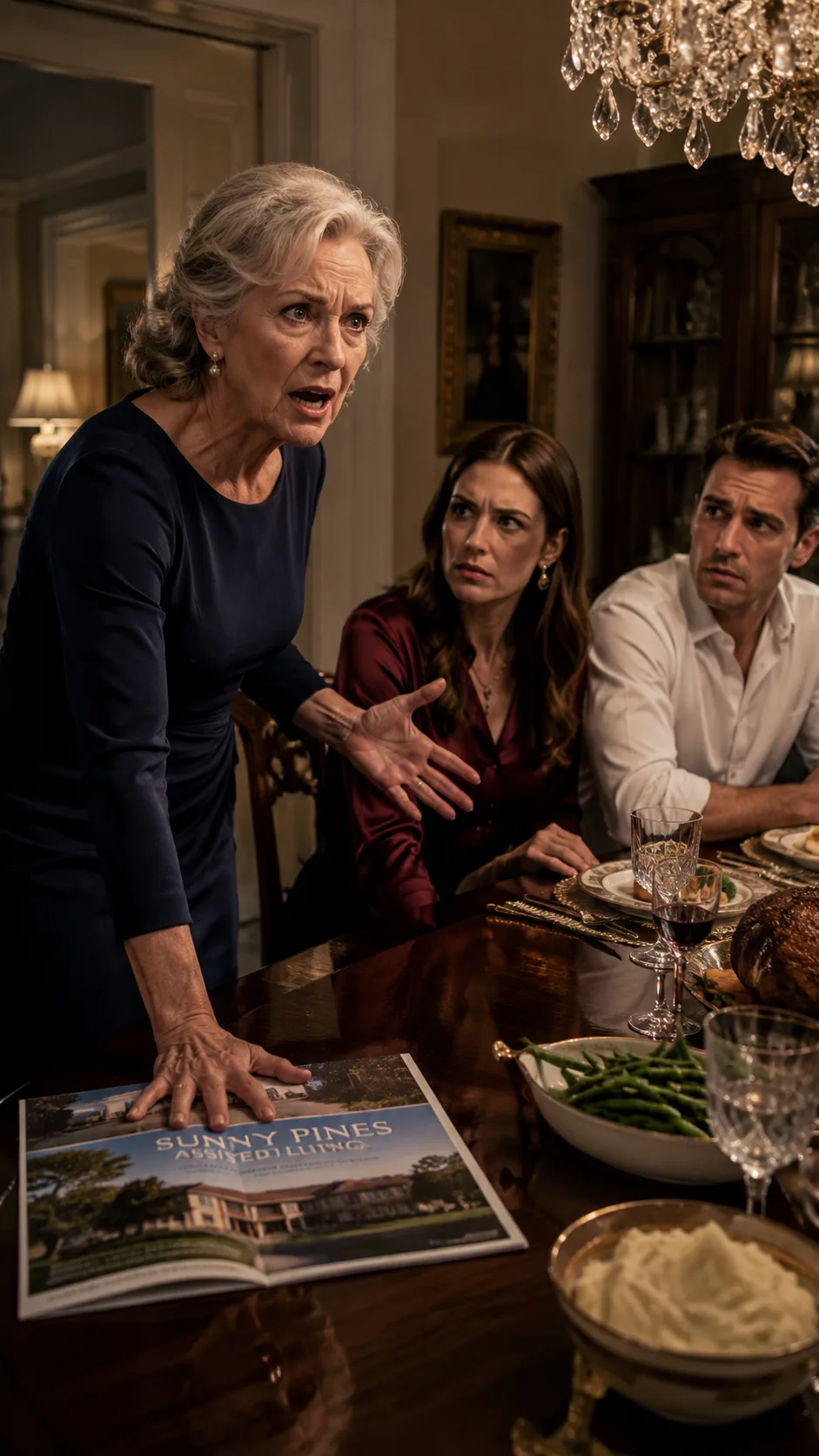
“How kind,” I said, “especially after you discussed sending me to Sunny Pines.”
Color rose in her cheeks.
“That was a misunderstanding.”
“Was it also a misunderstanding when you shoved me and Michael walked away without checking whether I was hurt?”
“You’re twisting everything,” she snapped. “That is exactly why—”
“Why what?” I asked. “Why I’m no longer the obedient, convenient woman you expected me to be?”
Vanessa stepped closer, lowering her voice to a whisper.
“You should think very carefully about whatever you’re planning. Michael is your only family. Without us, you’re alone.”
“That is where you are mistaken.”
I looked toward the ballroom, toward Judith, Caroline, Catherine, and the people who had remembered me when I had forgotten myself.
“There are people who value me for who I am, not for what I own.”
Her façade broke completely.
“We were promised that house. You can’t—”
“I signed nothing,” I said. “Legally, it is still mine.”
Michael was walking toward us, concern etched across his face.
“Is everything okay?” he asked, looking between us.
“Excellent,” Vanessa said at once, recovering. “Your mother was only sharing some marriage advice.”
Later, near the coat check, Michael caught me as I was preparing to leave.
“What’s going on, Mom? Vanessa said you brought up the house.”
“How about the gift?” I patted his cheek gently. “Everything will be clear at our lunch. Enjoy your honeymoon, Michael.”
Driving home that night, I felt an odd sense of calm. My conversation with Vanessa had confirmed what I already knew. There would be no easy resolution. I might lose my relationship with my only child because of the path I had chosen.
But for the first time in years, I was acting according to my own principles instead of surrendering to other people’s pressure.
The Sunday afternoon light shone across the white tablecloth in my dining room three weeks later. Richard’s grandmother’s china, crystal glasses, and sterling silver flatware were arranged with care. It looked like a tableau of family history waiting for its most dramatic moment.
At exactly one o’clock, the doorbell rang.
I smoothed my linen dress and went to greet them.
“Welcome home, Michael. Vanessa.”
I hugged them both, noting the tension behind Michael’s smile and the poorly hidden excitement in Vanessa’s eyes as she looked around the house.
She believed she would soon own it.
“Mom, the place looks great,” Michael said, following me into the dining room. “Did you redecorate?”
“Just refreshed a few things.” I gestured for them to sit. “How was Bermuda?”
We made polite conversation through the appetizer. Michael had always loved my homemade crab cakes. Vanessa’s gaze kept drifting to my handbag on the sideboard, clearly expecting the deed to be inside.
When Michael finished his crab cake, he set down his fork.
“This is delicious, Mom. You said you had something to discuss?”
“Yes.”
I took a deliberate sip of water.
“I’ve made some important decisions about my future.”
“About this house?” Vanessa asked, forgetting her fork and leaning forward.
“As you know, this property means a great deal to me. Every room holds memories of your father and the life we built together.”
“Of course,” Michael said quickly. “We’ll preserve—”
“Let me finish, please.”
I raised one hand gently.
“After careful thought, I decided this house should continue to serve a meaningful purpose.”
I reached for the folder beside my plate, removed several documents, and placed them on the table.
“Two weeks ago, I signed the initial papers to donate this property to the Women’s Dignity Foundation.”
Silence.
Complete silence, heavy as thunder.
Vanessa recovered first.
“What?” The word came out as a strangled whisper.
“The foundation will transform the house into transitional living for women over sixty experiencing family separation. It will be called the Richard Thompson Memorial Home.”
The color left Michael’s face.
“This is a joke, right, Mom?”
“No, Michael. The agreement is legally binding.” I slid the papers toward them. “The final transfer will take about six months.”
Vanessa shot out of her chair.
“You are a cunning old woman. You promised us this house.”
“I changed my mind after I learned you planned to ship me to Sunny Pines.”
“That’s not—” Michael began shakily.
“Do not lie to me.”
I looked at him, steady and still.
“I saw the brochures. I saw your emails.”
Anger twisted Vanessa’s face.
“You’re doing this out of spite.”
“No, Vanessa. I’m doing this because it is right. This house should shelter people who genuinely need it.”
“What about us?” Michael’s voice cracked. “We were counting on it.”
“That was premature,” I said. “Nothing was ever finalized.”
“We’ll fight this,” Vanessa spat. “It’s obvious you lack the mental capacity to make this decision.”
I slid another document across the table.
“I had a full psychological evaluation last month. I am in excellent mental health.”
Michael looked at me as if he had never seen me before.
“Where are you going to live?”
“I bought a condo near the university. I move next week.”
“How much money do you have?” Vanessa demanded.
I turned to Michael.
“Your father left me very well provided for. If you had ever asked about my well-being instead of my property, you might have known that.”
Vanessa’s face flushed with rage as she reached for her handbag.
“I refuse to sit here and be insulted.”
“Vanessa, wait,” Michael called as she hurried toward the front door.
She turned back from the hallway.
“Are you coming?”
He hesitated, looking between us, visibly torn.
“Go,” I said quietly. “She is your wife now. She should be your priority.”
That night, my phone kept ringing with calls from Michael. I let them go to voicemail. His messages shifted from angry accusations to desperate appeals.
The last one arrived near midnight.
Please, Mom. We’re in serious financial trouble. We need to talk.
I set the phone aside and looked out at the moonlit garden.
His betrayal still hurt.
But it no longer defined me.
The next three months unfolded like a difficult chess match.
Michael and Vanessa made the expected attempt to challenge my decision, beginning with vague threats of legal action. During our weekly meeting, Sandra reassured me.
“They have no grounds. The psychological evaluation and documented evidence have blocked most of those avenues.”
When legal intimidation failed, Vanessa turned to subtler tactics. Rumors began to circulate that I was becoming unstable. She even approached Richard’s brother and tried to convince him to intervene.
What surprised Vanessa was the network I had built.
Friends, former colleagues, and former students rallied around me, contradicting her story with their own accounts of Michael and Vanessa’s behavior over the years.
Meanwhile, I continued painting with Catherine and joined Caroline’s foundation advisory board. My academic background proved useful for grant writing. My new condo, though smaller than my old house, became a sanctuary filled only with objects that mattered to me. Through its floor-to-ceiling windows, I could watch the seasons change over the small park below.
Six months after the lunch confrontation, on a cool autumn afternoon, my doorbell rang.
Michael stood alone in the hallway. He looked thinner than I remembered, with dark shadows beneath his eyes. His voice held none of its old confidence.
“May I come in?”
I stepped aside and led him into my living room, where my newest paintings were displayed along the walls.
“You did these?” he asked, sounding genuinely surprised.
“Yes,” I said. “I did.”
He sat heavily on the sofa, hands clasped between his knees.
“Vanessa went back to Chicago. We’re separating.”
I absorbed the news in silence.
“The financial pressure was too much,” he continued. “We had stretched everything because we thought we were getting your house. When that didn’t happen…”
His voice trailed off. He shook his head.
“Everything fell apart.”
“I’m sorry you’re hurting,” I said, and I meant it.
“Are you?” His eyes were red-rimmed when he looked up. “After what we planned to do to you?”
“You hurt me deeply, Michael. But I never wanted to see you suffer.”
He nodded slowly.
“I started therapy. I’m trying to understand why I was willing to betray my own mother.” He gave a bitter laugh. “Apparently, I have some serious work to do.”
“We all do,” I said softly.
“The house,” he said carefully. “Is it really becoming a shelter?”
“Yes. The Richard Thompson Memorial Home. Renovations begin next month.”
His eyes filled with tears.
“Dad would have been proud.”
“He would have been.”
We sat in silence for several minutes, the weight of everything that had happened resting between us.
At last, he said, “I don’t expect forgiveness. But Mom, I am sorry. I am so sorry.”
I studied his face. My son. A stranger. Maybe both.
“I believe you,” I said. “But forgiveness will take time. Trust will take longer.”
He nodded, accepting that.
“Do you think we could have coffee sometime?”
“Start small?”
“Start small.”
Something eased inside me. Not forgiveness. Not yet. But perhaps the first step toward it.
“That would be nice,” I said.
That weekend, Caroline organized a fundraising art show featuring work by women over sixty. Two of my paintings were displayed, including a landscape of the garden I was about to leave. To my astonishment, both sold before the night ended.
As fall turned into winter, I visited the house regularly to supervise renovation plans. Each time I walked away more certain of my decision. The rooms that had witnessed me shrinking would soon shelter women learning to reclaim their own lives.
Every few weeks, Michael and I met for coffee. At first, it was awkward. Gradually, it became easier. He had taken a job with a nonprofit housing organization, very different from his previous position.
“It pays less,” he admitted one afternoon, stirring his coffee. “But I sleep better.”
I was learning that change could take many forms. Sometimes it came through dramatic confrontation. Sometimes it came through quiet, everyday choices.
One year after I first revealed my plans for the property at that fateful lunch, I stood on the front porch of my former home and watched Caroline cut the ceremonial ribbon stretched across the entrance.
The crowd applauded. Community members, foundation supporters, and the first residents who would move in the following week filled the front lawn. Folding chairs had been set up along the courtyard, and the restored porch gleamed in the afternoon sun.
Caroline’s voice carried across the crowd.
“I declare the Richard Thompson Memorial Home officially open.”
Judith squeezed my hand as cameras flashed.
The renovations had preserved the house’s charm while giving it a new purpose. The formal dining room had become a community kitchen. The master bedroom was now a counseling space. The library remained almost unchanged, except that its shelves now held resources on legal rights, financial literacy, and rebuilding after family estrangement.
The sunroom meant the most to me. It was now an art studio, where I would teach weekly painting classes to residents.
My life had circled back in the most unexpected way.
As people toured the center, I noticed a familiar figure lingering near the edge of the crowd. Michael stood there holding a small wrapped box, his expression nervous but determined.
When I approached him, he said, “I wasn’t sure if I should come.”
“I’m a little surprised you did,” I admitted. “But I’m glad.”
Over the past year, our relationship had slowly improved. It was not what it had been before, but perhaps that was not a bad thing. Therapy had helped him uncover old patterns. My own counseling had helped me see the ways I had contributed to his entitlement by giving too much and asking too little.
“I brought something for the house,” he said, holding out the box.
Inside was a framed photograph of Richard tending his favorite roses in the garden, smiling beneath the summer sun.
“For the entrance,” Michael said. “So everyone who comes in knows whose spirit guides this place.”
Tears stung my eyes.
“It’s perfect.”
Later, while the celebration continued, I stood in what had once been my bedroom. It was now a comfortable sitting room for residents. Through the window, I could see the garden, now maintained by a local horticultural therapy program. Richard’s roses were still blooming.
“What a transformation,” someone said behind me.
I turned and found Judith standing there with two champagne flutes.
“Me or the house?” I asked, accepting one.
“Both.” She clinked her glass against mine. “I always knew you had this in you.”
“Did you?” I asked. “Because I certainly didn’t.”
“That’s what happens when you spend decades shrinking yourself for other people’s comfort,” she said. “You forget how big you really are.”
Michael joined us hesitantly. His way of apologizing, not only to me but to women like the ones now living there, was to volunteer once a week at the center, helping residents with financial literacy.
Caroline called everyone together for one final toast as evening settled over the property.
She lifted her glass.
“To Eleanor Thompson, who taught us that it is never too late to take back your voice, your purpose, and your power.”
People turned toward me: old friends, new friends, women who would soon call this house home, and Michael, standing quietly at the back of the room.
I lifted my own glass.
“And to Richard,” I said, “who always saw me clearly, even when I could not see myself.”
Later that evening, in the quiet of my condo, I stood before my newest painting: a self-portrait unlike any I had ever made.
In it, I was not looking at the viewer. I was looking into the distance, my expression calm and expectant.
At seventy, I had finally learned that life’s greatest transformations do not always come when we are young. Sometimes they come when we least expect them, when we find the courage to look honestly at ourselves and stand by what we know is right.
The betrayal that nearly broke me had become the spark of my rebirth.
THE END.
Chapter complete
You have reached the end of this chapter.
Continue reading
A few more worlds to get lost in after this chapter.




