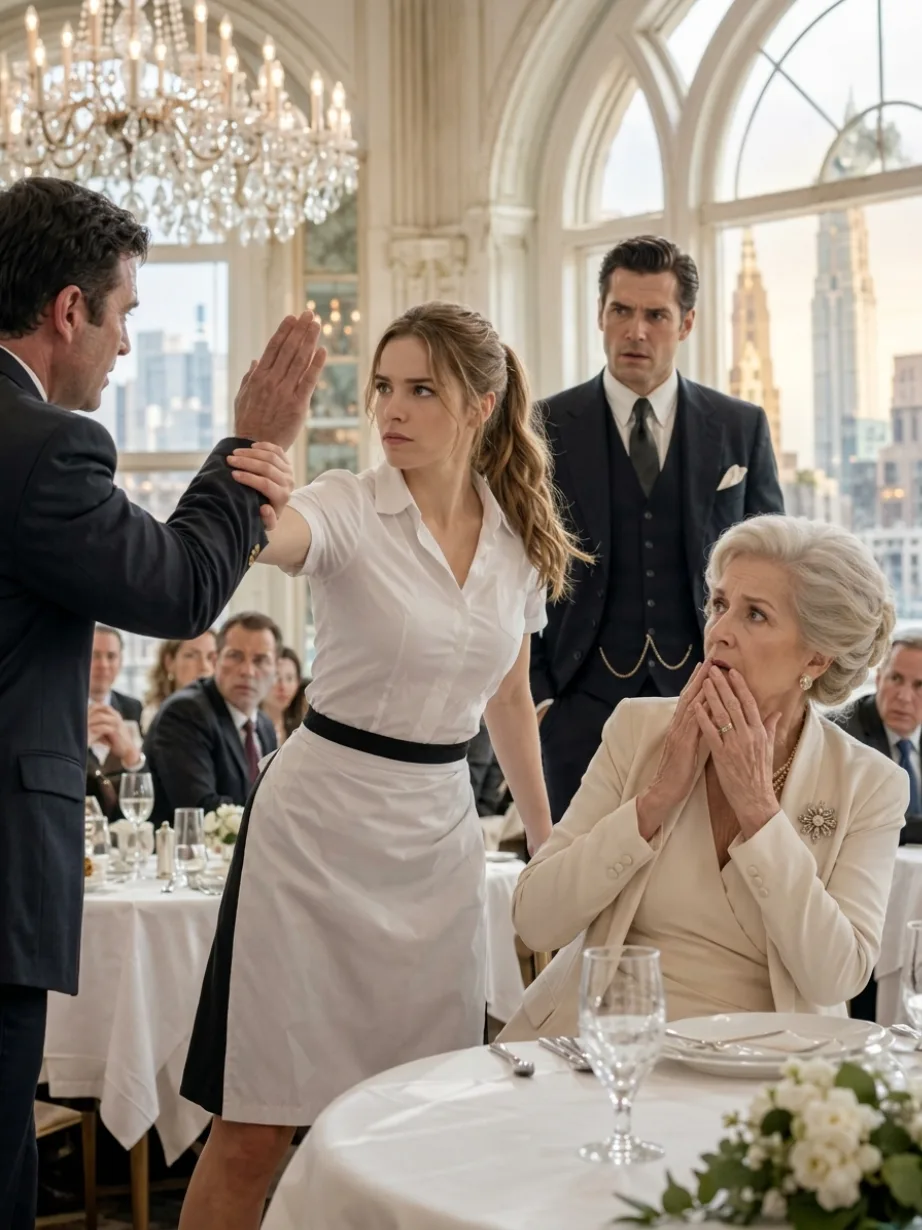
The Waitress Stopped a Mob Boss’s Mother From Being Slapped and Had No Idea the Most Feared Man in Chicago Was Watching
ByHoangAnh1 MrJune 18, 2026
Grace let go slowly.
Chapter 1
ByHoangAnh1 MrJune 18, 2026
Grace let go slowly.
Then she turned, crouched beside Margaret, and asked softly, “Are you okay, ma’am?”
Margaret looked at her.
Really looked at her.
For all of Grace’s life, wealthy people had looked through her. Margaret did not. Her eyes were full of pain, yes, but also astonishment.
“I think so,” Margaret said. “Thank you.”
Grace stood.
Vivian’s face had changed from shock to rage.
“You stupid little waitress,” she said. “You just made the biggest mistake of your life.”
Grace felt every eye in the ballroom land on her. She thought about rent. Her mother’s medicine. Noah’s school. The job she could not afford to lose.
Still, she lifted her chin.
“Maybe,” Grace said. “But at least I’m the one person in this room who did something.”
The silence that followed was enormous.
Then the room changed.
It was subtle at first. A ripple. A shift. People straightened. Conversations died. A path
opened without anyone being asked to move.
Dominic DeLuca stepped out from the shadow.
Grace knew it was him before anyone said his name.
Some men needed to announce power.
Dominic carried it like a weapon already loaded.
He was tall, broad-shouldered, dressed in a black suit that looked severe rather than fashionable. His dark hair was combed back. His face was calm, almost unreadable, but his eyes were fixed on Vivian Whitmore with a stillness that made the air feel dangerous.
Vivian went pale.
“Dominic,” she whispered.
He stopped in front of her.
For several seconds, he said nothing.
That was worse than shouting.
Then he looked past Vivian at Margaret.
His voice was low.
“My mother.”
Two words.
That was all.
Grace felt the room tilt.
Vivian turned slowly toward the woman in the wheelchair, and comprehension destroyed her expression piece by piece.
The stranger she had mocked,
shoved, and nearly slapped was Margaret DeLuca.
Dominic DeLuca’s mother.
“Dominic, I didn’t know,” Vivian said quickly. “I would never have—”
“That is the problem,” Dominic said.
His voice remained quiet, but everyone heard it.
Vivian blinked. “What?”
“You would never have done it if you knew she was mine.” He stepped closer. “Which means you would have done it to anyone else.”
No one breathed.
Dominic took out his phone and made one call.
Then another.
Then a third.
He never raised his voice. He never threatened Vivian. He did not need to. Grace could not hear every word, but she saw the terror spread across Vivian’s face as if she could already feel doors closing all over Chicago.
By sunrise, the Whitmore Foundation would lose two major donors.
By noon, three hidden lawsuits tied to Vivian’s late husband’s properties would reach the right reporters.
By the end of
the week, people who had once begged to sit at Vivian’s table would stop returning her calls.
Dominic DeLuca did not destroy people loudly.
He let silence do the work.
But in that moment, Vivian no longer mattered to him.
Dominic walked to his mother and knelt in front of her chair.
Grace saw the change immediately.
The coldness left his face. What remained was raw and human.
“Mama,” he said.
Margaret placed one hand against his cheek. “I’m all right.”
His jaw tightened.
“I should not have brought you here.”
“No,” Margaret said firmly. “You should not have left me home for four years.”
Pain crossed his face.
Grace looked away, feeling suddenly as if she had witnessed something private.
She bent down and began picking up pieces of broken glass from the floor.
It was absurd, maybe. She had just challenged one of the most powerful women in Chicago and accidentally exposed a room full of cowards, yet some part of her still believed her job was to clean the mess.
“Stand up.”
The voice was Dominic’s.
Grace froze.
She looked up.
He was standing over her now.
Not angry. Not exactly gentle either. He was the kind of man whose calm felt like a locked door.
Grace stood, wiping her hands on her apron.
“What’s your name?” he asked.
“Grace,” she said. “Grace Miller.”
He nodded once, as if confirming something he had already decided.
“I want to offer you a job.”
Grace stared. “A job?”
“Caring for my mother full-time.”
She glanced at Margaret, then back at him. “I’m not a nurse.”
“No,” Dominic said. “You are something rarer.”
Grace did not know what to say.
He continued. “You would live at my residence. Your salary would be enough to solve your current financial problems. Your mother’s medical care would be covered. Your brother’s education would be handled.”
Grace’s stomach dropped.
“How do you know about my family?”
Dominic looked at her steadily. “I know everyone working an event where my mother is present.”
That should have scared her.
It did.
But not as much as the hospital bills waiting on her kitchen table.
“Why?” Grace asked.
Dominic seemed almost surprised.
Most people probably asked how much. Not why.
He looked toward Margaret.
“Because in a room full of powerful people, you were the only one who moved.”
Grace thought of Noah pretending not to be hungry. Her mother’s hand in hers. The rent notice folded under the sugar jar.
She also thought of Margaret’s eyes when Vivian raised her hand.
Grace had not helped because Margaret was important. She had helped because Margaret was helpless in that moment, and no one deserved to be treated like that.
“What happens if I say no?” Grace asked.
“Then you keep your job here,” Dominic said. “No one in this hotel will punish you. I have already made sure of that.”
Grace believed him.
That scared her too.
Margaret reached for her hand.
“My son makes everything sound like a business arrangement,” she said. “What he means is that I would like very much to know the young woman who threw away her tray for me.”
Grace looked at the older woman.
For the first time in months, she felt the tiniest possibility that maybe she did not have to carry everything alone.
She took a breath.
“All right,” she said. “I accept.”
Part 2
The next morning, a black SUV with tinted windows pulled up outside Grace’s apartment building in Rogers Park.
Noah stood by the window in his hoodie, staring down at it with wide eyes.
“That car looks like it belongs to either a president or a murderer,” he said.
Grace zipped her bag. “Don’t say things like that.”
“Am I wrong?”
She looked out the window.
The driver stood beside the vehicle, hands folded, expression blank.
Grace sighed. “No.”
Noah turned to her, his teenage sarcasm fading. “Are you sure about this?”
No.
She was not.
But their mother’s hospital bill was on the table between them, and the number at the bottom looked like a threat.
“I’m sure enough,” she said.
By noon, Grace entered the DeLuca estate in Lake Forest.
It did not look like the mob mansion she might have imagined. There were no gold lions, no fountains shaped like angels, no vulgar displays of wealth. The house was large, old, stone-faced, and elegant, surrounded by bare winter trees and iron gates. It looked less like a home than a place built to withstand a siege.
Inside, everything was polished and quiet.
Too quiet.
Men stood near doors without appearing to stand guard. Cameras hid in corners. Hallways had strange angles. Windows were thicker than normal. Every room seemed to have more than one exit.
Grace noticed because invisible people learned to notice.
Margaret’s suite was on the ground floor, overlooking a garden that had been carefully designed for wheelchair access. When Grace entered, Margaret was sitting by the window reading a worn paperback novel.
She looked up over her glasses.
“You’re younger than I expected.”
Grace smiled faintly. “You’re tougher than you looked last night.”
For a beat, silence.
Then Margaret laughed.
It was small, but real.
“Sit down, Grace Miller,” she said. “I don’t care about your résumé. I want to know who you are.”
So Grace sat.
At first, she spoke carefully. She was used to rich people asking questions as decoration, not because they cared about the answer. But Margaret listened differently. She did not interrupt. She did not pity. She did not make Grace feel like a charity case.
Grace told her about Noah, who was fifteen and smarter than he let people see. She told her about Ellen, who used to sing while cleaning and now saved her breath for phone calls. She told her about growing up in a small apartment where love had always been louder than money.
Margaret told Grace about Dominic as a boy.
“He hated peas,” she said. “Would hide them in his napkin and think I didn’t know.”
Grace glanced toward the hallway, where a guard stood out of sight but not out of hearing. “Hard to imagine Mr. DeLuca afraid of vegetables.”
“Oh, he was afraid of plenty,” Margaret said softly. “He just learned early not to show it.”
Over the next weeks, the estate changed.
Or maybe Margaret did.
Grace reorganized her therapy schedule. She questioned doctors who seemed too comfortable with the word plateau. She asked about new treatments. She learned exercises and pushed Margaret gently but firmly.
“No,” Margaret groaned one afternoon, gripping the parallel bars in the therapy room. “I’m done.”
“You’re not done,” Grace said.
“I am sixty-two years old. I know when I’m done.”
“You’re sixty-two, not dead.”
Margaret glared.
Grace folded her arms.
After a moment, Margaret muttered, “You are extremely irritating.”
“So I’ve been told.”
Margaret took one more step.
Then another.
That night, Dominic watched the security footage from his office.
He told himself he was checking the perimeter.
That was a lie.
He watched his mother laugh in the garden with Grace.
He watched Grace tuck a blanket around Margaret’s knees without making it feel like pity. He watched her lean close when Margaret spoke. He watched his mother’s hands move more when she talked, animated in a way he had not seen since before the attack.
Dominic had built his life on control.
Control kept people alive.
Control kept enemies afraid.
Control kept weakness buried.
Grace Miller disturbed control simply by existing.
She did not treat him like other people did. His employees obeyed him. His associates measured every word. His enemies pretended confidence and smelled of fear. Even people who loved him never fully forgot the danger attached to his name.
Grace knew the danger.
He saw it in her eyes.
But she still looked directly at him.
One evening, Dominic stood outside Margaret’s suite, speaking quietly into his phone.
“No,” he said. “Tell Cavanaugh if he moves the shipment without my approval, he loses more than the shipment.”
Inside the room, Margaret was trying to sleep.
Grace opened the door.
Dominic stopped speaking.
The man on the other end of the call fell silent too.
Grace pointed down the hall. “Take that somewhere else.”
One of Dominic’s guards looked as if he might choke.
Dominic slowly lowered the phone.
Grace did not blink. “Your mother is resting.”
For several seconds, no one moved.
Then Dominic nodded and walked down the hall.
He did not know why he obeyed.
That bothered him.
After that, he came home earlier.
He canceled meetings that suddenly seemed unnecessary. He found reasons to pass through the garden, the library, the breakfast room. Sometimes Margaret invited him to sit. Sometimes Grace did not look surprised when he did.
One rainy afternoon, Grace found him in the kitchen at midnight, standing in front of the sink with a glass of water untouched in his hand.
“You don’t sleep much, do you?” she asked.
Dominic turned. “Neither do you.”
“I have an excuse.”
“So do I.”
“What’s yours?”
He looked out the dark window.
“Habit.”
Grace leaned against the counter. “That’s a sad answer.”
“It’s an honest one.”
She studied him. Most men like him would have snapped at her for saying that. Dominic did not.
“My mom used to say sleep is where guilt gets loud,” Grace said.
Dominic’s gaze shifted to her.
“Smart woman.”
“She is.”
“Is?” he asked.
Grace swallowed.
“Yes. Is.”
Something softened in his face.
“Her care has been transferred,” he said. “A private respiratory specialist will see her Monday.”
Grace looked down. “You didn’t have to do that.”
“I said I would.”
“That’s not the same thing.”
“It is to me.”
She hated the way gratitude made her feel exposed.
“She’ll like you,” Grace said, then smiled a little. “Actually, no, she won’t. Not at first. She doesn’t trust men in expensive suits.”
“Reasonable woman.”
Grace laughed before she could stop herself.
Dominic stared at her.
Not because the laugh was remarkable, but because of what it did to the room. It made the house feel less guarded.
That was when Grace began to understand something dangerous.
Dominic DeLuca was not only the stories people told about him.
And Dominic began to understand something more dangerous.
Grace Miller was becoming necessary.
The truth came by accident.
Grace was not snooping. Margaret’s new specialist had requested early medical records, and Margaret told Grace there was a file in Dominic’s private study.
“He won’t mind,” Margaret said.
Grace was not sure about that, but she went.
Dominic’s study was dark wood, leather chairs, locked cabinets, and the faint smell of smoke though she had never seen him smoke. She found the medical folder in the drawer Margaret described.
But beneath it was another folder marked only with a date.
October 14.
The date of Margaret’s accident.
Grace should have closed the drawer.
Instead, she opened the folder.
The first page was a police report.
The second was a private investigation summary.
The third showed photographs of the wrecked car.
By the fifth page, Grace’s hands were cold.
Margaret had not been in an accident. She had been attacked. The driver who hit her had ties to the Moretti family. The attack had been ordered to punish Dominic.
Grace sat down slowly.
She thought of Margaret practicing steps in the therapy room, her jaw tight with pain. Margaret laughing over coffee. Margaret calling Grace sweetheart one morning, then pretending not to notice when Grace’s eyes filled.
She thought of Dominic kneeling before his mother in the ballroom.
Now she understood the fear beneath his control.
She closed the folder carefully.
She told no one.
But she began watching.
She noticed the dark sedan parked near the estate gates three days in a row. Different plates. Same dent near the rear bumper.
She noticed a man in a navy coat at the coffee shop asking one of the younger groundskeepers how long “the new girl” had worked for the DeLucas.
She noticed the same florist van pass the property twice in one afternoon without stopping anywhere.
Then the warning reached Noah.
Grace had been in Margaret’s room helping her with hand exercises when her phone rang.
Noah.
She answered immediately. “Hey. Everything okay?”
Silence.
“Noah?”
“A guy talked to me after school,” he said.
Grace’s blood chilled. “What guy?”
“I don’t know. He knew my name.”
Margaret looked at Grace’s face and went still.
“What did he say?”
“He asked how you liked your new job.” Noah tried to sound casual and failed. “Grace, who are these people?”
That night, Grace walked into Dominic’s office without knocking.
He looked up from his desk.
Normally, that would have been enough to make most people apologize.
Grace did not.
“Someone is watching us,” she said.
Dominic’s expression did not change.
His eyes did.
“Tell me.”
She did.
The car.
The coffee shop.
The van.
Noah.
Dominic listened without interruption. When she finished, he made two calls.
Within twenty minutes, additional guards arrived.
Within an hour, Noah was in a secure car headed to the estate.
Grace stood by the window, arms wrapped tightly around herself.
“He’ll be safe here,” Dominic said.
“That’s not all I’m worried about.”
“What worries you?”
She turned.
“Your mother.”
A pause.
Then she added, “And you.”
For the first time since she had known him, Dominic had no immediate answer.
“You don’t need to worry about me,” he said finally.
“I know,” Grace said. “But I do.”
His face changed then.
Only slightly.
But Grace saw it.
The attack came on a Thursday evening at 7:14.
The sun had slipped behind the trees, leaving the estate wrapped in blue-gray light. Grace was in Margaret’s sitting room, reading aloud from a ridiculous celebrity magazine Margaret claimed to hate but never stopped requesting.
The first explosion hit the east gate.
The windows shook.
Margaret’s hand flew to the arm of her chair.
Grace was already moving.
“Stay calm,” she said.
Her voice surprised her.
It did not shake.
The lights flickered, went out, then returned dimly as the emergency system activated. Somewhere in the distance, alarms began. Then came voices. Running footsteps. A sharp burst of gunfire, controlled and terrifying.
Margaret’s face paled.
“Dominic,” she whispered.
“He has people,” Grace said. “We need to move.”
Because she had prepared for this.
Not with weapons. Not with training. But with observation.
For weeks, while others slept, Grace had mapped the house in her mind. She knew which hallway led to the reinforced safe room. She knew which service passage avoided the main entrance. She knew which doors locked automatically and which ones stuck in damp weather.
When you spend your life invisible, you learn the shape of rooms.
She pushed Margaret’s wheelchair through the private bedroom exit and into a staff corridor. They moved fast, the rubber wheels whispering over the polished floor.
“We’re almost there,” Grace said.
Then the door at the end of the corridor opened.
Gabriel stepped into their path.
Grace stopped.
Gabriel had worked for Dominic for six years. Quiet, professional, trusted. He had carried Margaret into the garden when the lift malfunctioned. He had driven Noah to school twice. He had once brought Grace coffee without being asked.
Now he stood blocking the safe-room corridor.
Behind him were three men Grace had never seen.
“I’m sorry,” Gabriel said.
His voice sounded sincere.
That made it worse.
“I didn’t have a choice.”
Margaret lifted her chin.
“There is always a choice.”
Part 3
They took Grace and Margaret to the east wing.
It was the oldest part of the estate, partially sealed during renovations, and now, Grace realized, deliberately cut off from the main security system. Someone had planned this from inside.
Gabriel would not meet her eyes.
The three strangers moved with cold efficiency. One took Grace’s phone. Another checked Margaret’s chair. The third watched the hallway with a gun held low.
Grace kept one hand on Margaret’s shoulder.
Margaret kept her head high.
Neither woman would give them the satisfaction of seeing fear.
The room they were brought into had once been a formal sitting room. Dust sheets covered furniture. A cracked fireplace sat cold beneath a portrait of some long-dead DeLuca ancestor.
Then Rafael Moretti entered.
Grace knew him from the folder before anyone said his name.
He was older than Dominic, maybe late forties, with silver at his temples and a pleasant face that made his eyes seem even crueler. He walked in as if he had already won.
First, he looked at Margaret.
“Mrs. DeLuca,” he said. “Still elegant.”
Margaret’s voice was ice. “Still a coward.”
Rafael smiled.
Then his gaze moved to Grace.
“And the waitress.”
He approached slowly.
Grace refused to step back.
“How fascinating,” he said. “At first, I thought you were insignificant.”
Grace said nothing.
“Then I learned Dominic moved your brother, paid your mother’s hospital bills, brought you into his home.” Rafael tilted his head. “Somehow, a girl with no money, no name, and no power became important.”
He pulled out his phone and dialed.
Dominic answered on the first ring.
Rafael put the call on speaker.
“I have your mother,” he said.
His eyes slid to Grace.
“And I have the girl.”
The silence on the other end was terrifying.
Not empty.
Controlled.
“Rafael,” Dominic said.
Grace heard something beneath his calm. A darkness so deep it made her skin prickle.
Rafael smiled wider. “You know what I want.”
“Say it.”
“I want the northern routes. The port contacts. The aldermen. The judges. The unions. Everything you took from my family.” He walked around the room like a man admiring his own stage. “You will sign over the companies we name. You will step down publicly from every major board. You will confess to certain financial crimes your lawyers will find believable enough. By midnight, Dominic DeLuca becomes a memory.”
Margaret closed her eyes.
Grace understood then.
This was not only about money.
Rafael wanted Dominic to dismantle himself.
Dominic’s voice came through the phone. “And if I refuse?”
Rafael’s smile vanished.
“Then you lose the two women who made you weak.”
Grace’s stomach twisted.
Rafael continued, “Your mother first. Slowly enough for you to hear it. Then the waitress. And for the rest of your life, you will know you could have stopped it.”
The room went silent.
Grace looked at Margaret.
Margaret looked at Grace.
Neither spoke, but something passed between them.
Dominic finally said, “I need twenty minutes.”
Rafael laughed softly. “You have fifteen.”
He ended the call.
“He’ll do it,” Rafael said, almost to himself. “For her, he might hesitate. For both of you? He’ll do it.”
Grace’s mind raced.
Fifteen minutes.
Dominic would never simply surrender. She knew that with a certainty that should have frightened her. Rafael believed he was giving Dominic a deadline, but Grace suspected Dominic had asked for time because time could be used.
They had to help him.
Rafael made his first mistake by turning away from Margaret.
Most people made that mistake.
They saw the wheelchair before they saw the woman.
For eight weeks, Margaret had endured physical therapy with Grace beside her. Painful, humiliating, exhausting therapy. Doctors spoke of limits. Grace spoke of one more try. Margaret had cursed, cried, laughed, and tried again.
Her right arm had grown stronger.
Her balance had improved.
Her pride had sharpened into something dangerous.
The nearest guard looked toward the window when a distant crash echoed from another part of the house.
Margaret moved.
Her right hand shot out and slammed the metal footrest of her wheelchair into the guard’s knee with every ounce of strength she had rebuilt.
The man cried out and dropped hard.
Grace moved at the same instant.
She drove her shoulder into the second man’s ribs. He stumbled backward into a covered table. Grace grabbed the radio from his belt and smashed it against the fireplace once, twice, three times until the casing split.
Rafael spun around.
“You stupid girl.”
He reached inside his jacket.
Then the door blew inward.
Not exploded.
Kicked with such force it cracked against the wall.
Dominic entered first.
Behind him came his men, precise and silent, weapons trained, exits covered. The chaos Rafael expected never came. This was not a wild rescue.
It was an ending.
Dominic had never intended to wait fifteen minutes. While Rafael spoke, Dominic’s team had traced the call through the estate’s internal dead zone, identified Gabriel’s access codes, and moved through service tunnels Grace herself had once mentioned over breakfast without realizing Dominic remembered every word.
The room froze.
Rafael grabbed Grace.
His arm locked around her throat, pulling her against him as a shield.
Dominic stopped.
For the first time, Grace saw fear on his face.
Not for himself.
For her.
Rafael saw it too.
“There it is,” Rafael whispered. “The great Dominic DeLuca, afraid.”
Grace could barely breathe.
Dominic’s voice was deadly soft. “Let her go.”
Rafael pressed something cold against her side. “Take one more step and she dies.”
Grace looked at Dominic.
His eyes held hers.
Do not move, they seemed to say.
But Grace had spent her whole life surviving men who thought fear made women obedient.
She let her knees buckle.
All her weight dropped suddenly.
Rafael, unprepared, lurched forward. The weapon shifted. Grace twisted hard, just enough to free her throat.
Dominic crossed the room in three strides.
It ended before Grace fully understood it had happened.
Rafael hit the floor. The gun skidded away. Dominic’s men closed in. Gabriel was dragged in from the hallway moments later, face gray, hands bound.
He looked at Margaret.
“I’m sorry,” he whispered.
Margaret stared at him for a long time.
“No,” she said. “You are sorry you failed.”
By midnight, Rafael Moretti’s empire was gone.
Not damaged.
Gone.
Accounts froze. Warehouses were seized. Associates vanished into deals with federal agents. Politicians who had smiled over his envelopes suddenly discovered ethics. Men who had sworn loyalty chose survival instead.
Rafael had spent three years planning the perfect strike.
He had made only one mistake.
He believed Dominic DeLuca was dangerous because of power.
He never understood Dominic was most dangerous when protecting love.
The weeks after the attack passed strangely.
The estate was repaired. The east wing was rebuilt. Security doubled, then tripled. Noah moved back and forth between school and the estate with a driver he pretended to find annoying but secretly liked. Ellen Miller’s condition improved under better care, and one afternoon Margaret insisted on visiting her.
Grace watched the two mothers meet in Ellen’s hospital room.
Margaret brought flowers.
Ellen looked her up and down from the bed and said, “You’re the lady my daughter almost got fired for?”
Margaret smiled. “Yes.”
“Good,” Ellen said. “Then you must be worth something.”
They became friends immediately.
Margaret slept fourteen hours after the attack. When she woke, she asked for coffee and Grace, in that order.
Grace entered carrying a mug.
“I see your priorities remain strong.”
“Always,” Margaret said.
They sat by the window in morning light.
After a while, Margaret lifted her right hand.
It trembled, but it moved.
“I was fast that night,” she said.
Grace smiled. “You moved first.”
Margaret looked at her hand as if seeing something returned from the dead.
“More therapy,” she said.
Grace nodded. “More therapy.”
That afternoon, Dominic found Grace alone in the garden.
The trees were bare, but the first stubborn signs of spring pushed through the soil near the stone path. Grace sat on a bench, coat wrapped tight around her, watching the wind move across the lawn.
Dominic sat beside her without asking.
Grace noticed that he only did that with two people.
His mother.
And her.
For a while, neither spoke.
Then Dominic said, “You knew the route to the safe room.”
“I paid attention.”
“You prepared.”
“I had a bad feeling.”
“You told me.”
“I did.”
Silence settled between them.
It was not uncomfortable.
It was full.
Finally, Dominic said, “Thank you.”
Grace had heard those words from him before. To employees. To associates. To doctors. Usually they sounded like payment.
This time, they sounded like surrender.
“She’s your whole world,” Grace said.
Dominic looked toward the garden.
“For a long time,” he said, “she was all I had left.”
Grace heard what he did not say.
And now?
He turned to her.
“Now it is more complicated.”
Her heart moved in a way that frightened her.
Three days later, Dominic came to Grace’s room and knocked.
He always knocked.
That mattered to her.
A man who could command half the city still waited for permission before entering her space.
When she opened the door, he held a folded document.
Grace recognized it.
Her employment contract.
“What are you doing with that?” she asked.
Dominic looked at it, then tore it in half.
Grace stared. “Dominic.”
“I am not offering you a job anymore.”
She went still.
“I am not offering money, protection, medical care, or anything written on this paper.” His voice was steady, but his eyes were not. “I am asking if you want to stay.”
Grace could not speak.
“Not because of what you can do for my family,” he continued. “Not because you owe me. Not because I owe you. Because you choose to.”
She looked at the torn paper in his hands.
“And if I say no?”
“Then you leave with everything I promised. Your mother’s care continues. Noah’s education is secured. You will never have to ask me for anything.”
She believed him.
That made her eyes burn.
“And if I say yes?”
“Then you stay as yourself. Not as someone I hired. Not as someone I own. Not as someone swallowed by my world.” His voice lowered. “As someone who chooses to be here.”
Grace studied him.
Dominic DeLuca, the man Chicago whispered about, stood in front of her with no armor she could see. No threats. No commands. No bargain.
Just a question.
“I don’t have much experience with this,” he admitted.
Grace almost smiled. “With asking?”
“With needing someone to say yes when they are free to say no.”
That broke something open in her.
She thought about the girl she had been months earlier, invisible in hotel ballrooms, carrying trays past people who never saw her. She thought about rent notices, hospital bills, Noah’s worried eyes. She thought about Margaret laughing in the garden, Ellen breathing easier, Noah doing homework at the kitchen island while pretending not to enjoy the chef’s cookies.
She thought about Dominic standing in a doorway, asking instead of taking.
“I won’t disappear inside your world,” Grace said.
“I know.”
“I won’t become quiet because powerful men prefer women quiet.”
“I would never ask that.”
“I’m still going to argue with your doctors.”
“They are terrified of you.”
“And I’m still going to tell you when you’re being impossible.”
A faint smile touched his mouth.
“I rely on it.”
Grace took the torn contract from his hands.
Then she smiled.
“Yes,” she said. “I’ll stay.”
One year later, the Bennett Children’s Charity Gala returned to The Bellamy.
Same ballroom.
Same chandeliers.
Same white roses in gold vases.
But nothing was truly the same.
Everyone remembered what had happened there. The night Vivian Whitmore raised her hand. The night a waitress dropped a tray. The night Chicago learned that silence could be cowardice and courage could wear a server’s uniform.
The main doors opened at eight o’clock.
The room turned.
Margaret DeLuca entered walking.
Not easily.
Not quickly.
But on her own feet.
She used a cane in her right hand, and every step demanded effort. Dominic walked on her left. Grace walked on her right.
Margaret wore the same burgundy gown.
She had chosen it deliberately.
It no longer belonged to the night someone tried to humiliate her. It belonged to the night she began taking her life back.
People greeted her with respect.
Some out of fear, perhaps.
But not all.
Many had heard about the foundation Grace had started that spring, the Miller House Fund, built to help families crushed between illness, debt, and survival. It began with two rooms, three volunteers, and a phone that never stopped ringing. It helped mothers who needed oxygen tanks, brothers who needed school lunches, daughters who worked double shifts and still could not catch up.
People like Grace had been.
Margaret sat on the board.
Ellen wrote thank-you notes to donors in handwriting Grace claimed no one could read.
Noah, now sixteen and talking seriously about law school though he still had two years of high school left, attended every meeting with a notebook and the intense expression of someone preparing to sue the entire world into behaving better.
Dominic funded most of it quietly.
When Grace found out how much he had contributed, she confronted him in the kitchen.
“Why didn’t you tell me?”
“Because it is your dream,” he said. “I did not want anyone thinking it was mine.”
She looked at him for a long moment.
“You know,” she said, “you’re not as hard to understand as you think.”
Almost a smile.
“Do not tell anyone.”
At the gala, Grace wore dark green.
She stood beside Dominic beneath the chandeliers, watching the room that had once made her feel small.
She was not invisible anymore.
More importantly, she was no longer trying to be.
Later that night, she and Dominic found themselves near the same corner where everything had begun. The orchestra played softly. Rain tapped the windows, just as it had a year before. Across the ballroom, Margaret laughed with Ellen, both women holding coffee cups instead of champagne.
Dominic watched them.
Then he looked at Grace.
“What?” she asked.
He took her hand.
Not for the room.
Dominic never performed tenderness for an audience.
He did it because he wanted her to feel it.
“I was thinking about that night,” he said.
Grace waited.
“I was surrounded by the most powerful people in Chicago. Judges. Politicians. Executives. People who would have done almost anything I asked, some out of loyalty, most out of fear.” His thumb moved gently over her hand. “But the only person who had no reason to help me, the only person who could lose everything and gain nothing, was the only one who moved.”
Grace’s throat tightened.
“You did not just save my mother,” Dominic said. “You saved the part of me I thought this life had buried.”
Around them, the gala continued. Glasses clinked. Music played. The city glowed beyond the windows.
But for a few seconds, the world narrowed to his hand holding hers.
Grace looked up at him.
“Do you know something about invisible people?”
Dominic’s eyes softened. “Tell me.”
She smiled.
“They’re usually the ones who see everything.”
And for the first time in a room full of people who feared him, Dominic DeLuca smiled like a man who had finally found something more powerful than fear.
A family.
A home.
A woman who chose him not because of what he owned, not because of what he could destroy, not because of the name that made Chicago lower its voice, but because beneath all of it, she had seen the man still worth saving.
In the end, true strength does not always belong to the people with money, weapons, influence, or power.
Sometimes it belongs to the woman carrying a tray through a crowded ballroom, the woman everyone thinks is invisible, the woman who sees cruelty rising like a hand in the air and decides, even if it costs her everything, to step forward.
THE END
Chapter complete
You have reached the end of this chapter.
Continue reading
A few more worlds to get lost in after this chapter.




