PART 3 — THE HOUSE THEY PLANNED TO STEAL BECAME A SAFE HAVEN
Trevor stood again.
Chapter 3
PART 3 — THE HOUSE THEY PLANNED TO STEAL BECAME A SAFE HAVEN
Trevor stood again.
“What?”
Brenda looked around the room, searching for a face that might still belong to her.
“Mom gave me access.”
“I gave you access to pay my rent while I was in the hospital.”
“You said you wanted to help us.”
“I said you could borrow five thousand.”
“It was family money.”
“No,” Lorraine whispered. “It was the money your father left me.”
Brenda’s composure shattered.
She turned on Trevor.
“You knew we were in trouble. You knew what would happen if the bank foreclosed.”
“I didn’t know you took her money.”
“I was going to put it back.”
“With what?”
“With the equity from this house!”
Her words struck the walls and came back at us.
There it was.
The whole ugly design, spoken aloud.
Move in.
Establish dependence.
Convince the old widow the house was too much.
Pressure her to sign.
Sell the property.
Call it family.
Trevor
looked at his wife as though a stranger had appeared in her clothes.
“You told me your mother wanted to invest.”
“She would have agreed eventually.”
Lorraine recoiled.
Brenda’s voice rose.
“Do you think I wanted any of this? Do you think I enjoyed lying awake while collectors called? Trevor kept saying he would fix it. He kept saying another contract was coming. Somebody had to make a plan.”
“A plan?” Trevor said. “You robbed your mother.”
“I saved our family.”
“You used her.”
“I did what you were too weak to do.”
The words hit him with surgical precision.
Trevor flinched.
Then something in his face settled.
The crease between his eyebrows disappeared.
When he spoke, his voice was almost gentle.
“My father used to say broken things are not always ruined.”
Brenda shook her head. “What are you talking about?”
“But he also said you cannot repair something
while someone keeps swinging the hammer.”
She stared at him.
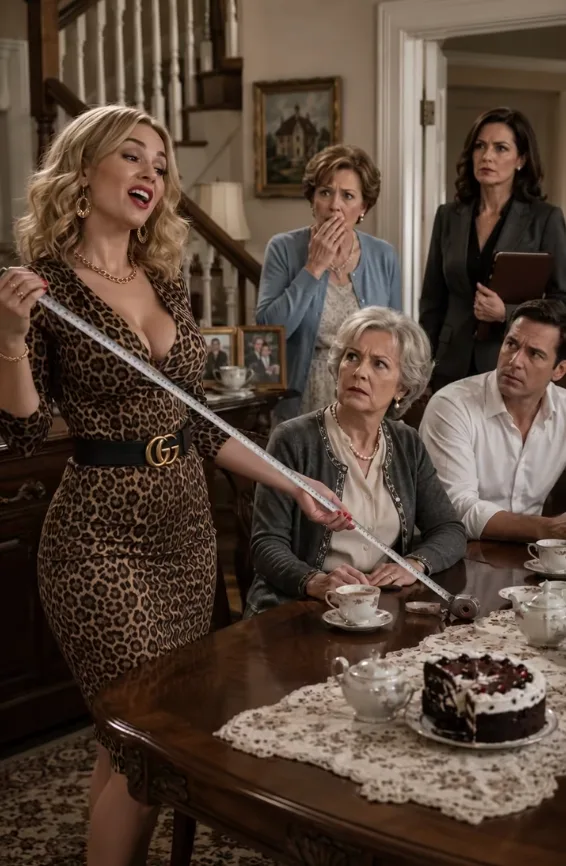
Trevor reached into his pocket, removed his wedding ring, and set it beside the ruined slice of cake.
The small gold band rolled once across the plate before coming to rest in the cream.
“I’m done, Brenda.”
Her face collapsed.
“No.”
“I’m taking the children to a hotel tonight.”
“You can’t take my children.”
“Our children. And tomorrow I’m calling the bank, a bankruptcy attorney, and the police.”
Lorraine closed her eyes.
Brenda turned to me.
The hatred in her expression was almost childlike.
“This is what you wanted.”
“No,” I said. “I wanted my son to tell me the truth before he brought a thief into my house.”
She grabbed her purse.
The measuring tape fell out and struck the floor.
No one moved to pick it up.
Brenda marched toward the hallway, then stopped at the doorway.
“You
will regret humiliating me.”
I met her eyes.
“You humiliated yourself. We merely stopped pretending not to see it.”
She left.
The front door slammed so hard the hallway clock rattled.
For several seconds, we sat in the aftermath.
Lorraine cried silently.
Trevor stared at his wedding ring.
Rain had begun tapping against the windows, soft at first, then harder, washing the garden in silver.
Evelyn gathered the legal papers but left the bank statements untouched.
“I’ll make some calls,” she said. “Lorraine, do not contact your daughter tonight. Trevor, keep copies of everything.”
Then she touched my shoulder and left us alone.
The three of us remained around Edward’s table.
The cake sagged in the warm room.
Coffee cooled in our cups.
Finally, Trevor looked at me.
“Why didn’t you tell me about the trust?”
“Would you have supported it?”
He opened his mouth.
Then closed it.
“I don’t know,” he admitted.
“That is why.”
His eyes filled.
“I thought the house would always be there.”
“It will.”
“You know what I mean.”
“Yes.”
He looked toward the empty chair where Edward had once sat.
“I failed you.”
I reached across the table.
“No. You frightened me. You disappointed me. You lied by omission, and you let your wife treat me as though I were furniture waiting to be moved.”
He lowered his gaze.
“But failure is what happens when a story ends,” I said. “Yours has not.”
His hand closed around mine.
For the first time that afternoon, he allowed himself to cry.
Not like a child. Not like a man performing remorse.
He cried quietly, shoulders shaking, one hand covering his face while I held the other.
Lorraine rose and came around the table.
She placed her palm between his shoulder blades.
For a while, we stayed that way.
Three people who had trusted the wrong silences.
Three people sitting at a table built to hold bad news, arguments, and whatever forgiveness we could still manage.
A month later, Trevor filed for divorce.
The police investigation revealed that Brenda had forged Lorraine’s electronic authorization and transferred the money through an account connected to her failing design company. She was charged, though Lorraine begged the prosecutor for leniency.
Trevor sold his house before the foreclosure was completed. There was no profit, but there was no longer a lie attached to it.
He and the children rented a small apartment twelve minutes from me.
The first resident moved into my house in September.
Her name was Marjorie. She was seventy-two and had slept in her car for eleven nights after her stepson emptied their joint account.
Then came Helen, whose landlord had raised her rent beyond her pension.
Then Ruth, who arrived carrying two suitcases and a framed photograph of the woman she had loved for forty-one years but had never been permitted to marry.
Lorraine took the upstairs room with the morning light.
Her sewing machine sat beside the window, exactly where Brenda had imagined it.
But the room was Lorraine’s because she had been invited.
Because she had asked.
Because she was safe.
On the first Sunday after all six rooms were occupied, Trevor brought the children for dinner.
The house no longer sounded like a museum.
It hummed.
Pots clattered in the kitchen. Someone laughed in the hallway. Ruth argued with Marjorie about whether cinnamon belonged in apple pie. Lorraine helped my granddaughter thread a needle. Trevor stood at the sink with his sleeves rolled up, washing dishes the way Edward used to.
Before dessert, Evelyn arrived with a narrow wooden box.
“I found this in the old trust records,” she said.
My name was written across the lid in Edward’s handwriting.
My breath stopped.
The box had been stored with documents from an account Edward opened years before his illness. I carried it to the dining table and opened it beneath the chandelier.
Inside lay a folded letter.
The paper was yellowed at the edges.
My hands trembled as I unfolded it.
Renata,
If you are reading this, then I am gone, and you have finally done something with the house that I was too afraid to suggest while I was alive.
I looked up.
Everyone had fallen silent.
I kept reading.
You always thought I built the table for us. The truth is, I built it after my mother called me from a motel and told me my brother had taken her home.
My eyes blurred.
Edward had rarely spoken about his mother’s final years. I knew only that she had died in a rented room several states away.
The letter continued.
She said she did not need much. Only one room where nobody could tell her she was in the way.
I promised myself that one day our house would become that room for someone.
But then life became busy. Trevor was born. We worked. We worried. I got sick.
You were always braver than I was, Renata.
So if you ever feel the house is too quiet, fill it with women who have been told they take up too much space.
And keep the table.
It was never meant for only one family.
My tears fell onto the page.
For months, I had believed the idea was mine.
I had believed grief had driven me toward the shelter, that loneliness had pushed me to open the house.
But perhaps love had been guiding me from farther back.
Through Edward’s hands.
Through oak and sawdust.
Through a promise he never managed to speak aloud.
Trevor came to stand beside me.
“What does the last line say?” he asked.
I looked down.
Beneath Edward’s signature was one final sentence, written smaller than the rest.
The room blurred around me as I read it aloud.
“A good house does not belong to the person whose name is on the deed; it belongs to whoever finally feels safe enough to sleep inside it.”
THE END.
Chapter complete
You have reached the end of this chapter.
Continue reading
A few more worlds to get lost in after this chapter.




