PART 3 — THE RECKONING SHE NEVER SAW COMING
Geraldine leaned back in her chair.
Chapter 3
PART 3 — THE RECKONING SHE NEVER SAW COMING
Geraldine leaned back in her chair.
For a moment, she did not look like my attorney. She looked like the woman who had sat beside me at Walter’s funeral and handed me tissues without saying anything foolish.
“Then make sure you tell him as his mother first,” she said. “Not as Lakeshore Glen.”
I nodded.
That was good advice.
It usually was.
I signed the documents Monday afternoon.
Theo came over at 6:30.
He looked terrible.
His eyes were rimmed red. His shirt was wrinkled. He had shaved badly, missing a spot near his jaw the way he used to when he was first learning.
When I opened the door, he hugged me for a long time.
Not the quick adult-son hug.
The kind of hug children give when they are afraid the world has shifted.
“I’m sorry,” he said into my shoulder.
“I know.”
“She’s been crying since Saturday night.”
I said nothing.
“She didn’t
mean it the way it sounded.”
I still said nothing.
He pulled back and looked at my face.
That was when he understood that I was not going to help him soften it.
“She said it,” I said.
He closed his eyes.
“I don’t know what to do.”
“That’s why you’re here.”
I brought him into the kitchen and poured coffee for both of us, though it was evening and neither of us needed caffeine. Some conversations require something to hold.
We sat at the same table where he had done homework, eaten cereal, filled out college applications, and once told me he was thinking of becoming a lawyer because “words make things happen.”
I looked at him across that table and felt the weight of all the years I had chosen silence.
“Theo,” I said, “I love you. I have loved you since the day you were born, and
there is nothing on this earth that will ever change that.”
He swallowed.
“But I need to tell you some things tonight that I should have told you a long time ago. You are not going to like all of them.”
He sat very still.
I told him about the company.
Not the polite version.
The whole thing.
I told him about the strip mall in Tulsa, and Walter’s real estate trust, and the buildings that had multiplied over decades while I packed school lunches and clipped coupons in front of him.
I told him about Lakeshore Glen.
I told him about the 41 buildings that had become 53.
I told him about my actual income, which last year had been just under $900,000.
He stared at me.
Not greedily.
Not angrily.
Just as if the woman in front of him had suddenly become two people, and he was trying
to make them fit back into one body.
I told him that the $80,000 I had given him for the house had technically been structured as a loan, and that I had done it that way to protect him if things ever went sideways.
“Not because I distrusted you,” I said.
He looked down at his coffee.
“Because you distrusted Camille?”
I took a breath.
“Because I had concerns.”
He gave a small, humorless laugh.
“That’s a very lawyer answer, Mom.”
“I raised a lawyer.”
That almost made him smile.
Almost.
I told him I had been planning for years to leave him everything.
I told him about the trust for Poppy.
I told him about the amendment to my will, though not every detail. Enough.
He did not interrupt once.
That was one of Theo’s best qualities. When the truth finally arrived, he let it speak.
When I was done, he put his face in his hands.
For a long time, the only sound was the hum of the refrigerator.
Then he said, “Mom, why didn’t you tell me?”
I had prepared answers to that question for years.
Responsible answers.
Protective answers.
Answers about character and work ethic and wanting him to stand on his own feet.
But when my son asked me that question with his face in his hands, most of those answers felt too clean.
So I said, “Honey, why do you think?”
He sat with it.
He has always been smart.
After a while, he looked up.
“Because you wanted me to be a person.”
The sentence landed softly, but it broke something open in me.
“Yes,” I said. “And because I was afraid money would do to you what I had seen it do to other people. And because somewhere along the way, I confused protecting you with not trusting you.”
His eyes filled.
“I would have been okay,” he said.
“I know that now.”
“I wish you’d known it then.”
“So do I.”
He cried a little.
I let him.
Then I told him about Camille’s firm.
About my 46 percent stake.
About the approval I had signed.
About the partnership review I had called for the following week.
He went very still.
“Mom,” he said carefully. “Are you going to—”
“No.”
He looked at me.
“I am not going to block her partnership. I am not going to call the house loan. I am not going to do anything that harms her career or your home or your daughter’s stability.”
He let out a breath, but not fully.
“That is not who I am,” I said. “But I called the review because I wanted, just once, to sit in a room with your wife and let her see who I actually am.”
His jaw tightened.
“And then?” he asked.
“And then I am going to walk away. I am going to let the two of you decide what to do with that information.”
He cried harder then.
Not loudly.
Theo has never been a loud crier.
His shoulders just folded inward, as if something he had been carrying had finally become visible to him.
“I’m so sorry,” he said.
“I know.”
“I should have stopped it before.”
“Yes,” I said.
He looked up, startled.
I reached across the table and put my hand over his.
“I love you too much to lie to you now. You should have stopped it before. But I should have spoken before. We both let peace become more important than truth.”
He nodded, tears slipping down his face.
I said, “Honey, listen to me. This is not about Camille apologizing to me. I do not need an apology as much as you think I do. I am too old to build my life around who says sorry and who doesn’t. This is about you. The marriage you are in. The daughter you are raising. The man you want to be. I am giving you the information. What you do with it is yours.”
He stayed until midnight.
We talked about Walter, who he barely remembered and whom I had perhaps turned into a saint by never speaking enough about his flaws.
We talked about Poppy.
We talked about marriage.
He told me Camille had been struggling. That the job was crushing her. That she had been drinking more than she should. That partnership had not made her feel secure the way she thought it would. It had only made her more afraid of being exposed as someone who did not belong.
I listened.
Then I said, “That is not an excuse.”
“No,” he said. “It isn’t. But it’s context.”
I considered that.
Context matters.
It does not erase harm, but it tells you where harm learned its route.
“Okay,” I said. “Context is fair.”
He went home.
He told Camille that night.
I do not know exactly what he said, because he never told me and I did not ask.
But I know what happened the next morning.
At 7:15, my doorbell rang.
I was in my bathrobe, rinsing my teacup at the sink. I looked through the small window beside the door and saw Camille standing on my porch.
No black dress.
No champagne.
No perfect party smile.
She wore jeans, a sweater, and no makeup. Her hair was pulled back badly, the way women do it when their hands are shaking or they have stopped caring how they look. She looked like she had been awake for thirty hours.
Poppy was on her hip, wearing yellow socks and holding a stuffed rabbit by one ear.
I opened the door.
For a moment, none of us spoke.
Then Poppy smiled.
“Gamma.”
That nearly undid me.
Camille’s eyes filled immediately.
“Hazel,” she said, “can I come in, please?”
I stepped aside.
“Yes.”
She came in.
She set Poppy down on my living room rug with the basket of toys I always kept there for her. Poppy went straight for the wooden blocks, because children are mercifully uninterested in adult ruin when blocks are available.
Camille sat on my couch.
I sat in my chair.
Between us, on the coffee table, was a bowl of butterscotch candies Walter used to pretend he hated while eating three at a time.
We looked at each other.
Camille clasped her hands in her lap so tightly her knuckles turned pale.
“Theo told me last night,” she said. “He told me everything.”
I said, “Okay.”
Her mouth trembled.
“I don’t have words.”
I waited.
“I don’t have any words for what I did. There aren’t any.”
I looked at her.
Then I said, “Try anyway.”
So she did.
She talked for almost an hour.
Not elegantly. Not like a lawyer. Not like a woman performing remorse.
At first, she stumbled. She started sentences and abandoned them. She wiped under her eyes with the heel of her hand. She looked toward Poppy whenever she needed courage.
She talked about her parents in Indiana.
About the hardware store.
About growing up in a town where people knew exactly how much money you did not have because they knew what car your father drove, what coat your mother wore to church, and whether your family went on vacation or just visited cousins two counties over.
She talked about how desperately she had wanted to become someone no one could pity.
Someone no one could dismiss.
Someone no one could look at and immediately understand the limits of.
Somewhere along the way, she said, she had decided that being somebody meant being better than other people.
Especially the kind of people her parents were.
Especially women like her mother.
Women who packed lunches, balanced checkbooks, wore the same good coat for ten winters, and called it practical.
She looked at me then.
“I saw her in you,” Camille said.
I did not respond.
“I walked into your house the first Thanksgiving, and I saw my mother. Not really. I know that now. But I thought I did. The little house. The old appliances. The way you saved foil. The way you asked if people wanted seconds like that was the most important thing in the world.”
Her face twisted.
“And I hated it. I hated it because I was afraid it was where I came from. I hated it because I was afraid it was still in me.”
I watched Poppy stack one block on top of another with careful concentration.
Camille kept talking.
She talked about the night of the party. About the Hendersons. About how much she wanted them to respect her. About how she had felt all evening as if she were standing on a chair, trying not to fall off. About the champagne. Three glasses, maybe four. About hearing Marjorie say my name like I mattered, and feeling panic before she even understood why.
“My mouth was faster than my brain,” she said. “But that doesn’t make it not mine.”
That was the first sentence that made me respect her that morning.
She did not make excuses.
She made explanations.
There is a difference.
And I respected the difference.
Then she said, “I don’t expect you to forgive me. I don’t expect anything.”
Her voice broke.
“Theo told me about the firm and the buildings and the trust. And I want you to know, Hazel, that none of it changes what I’m asking for. I don’t care about the money.”
I believed that she wanted me to believe it.
That is not exactly the same as belief.
But I listened.
“I want my daughter to know her grandmother,” she said. “I want my husband to be okay. And I want, if you’ll let me, to spend the rest of my life trying to become the kind of person you should have had as a daughter-in-law.”
She looked down at her hands.
“That’s all.”
I sat with that.
One of the privileges of age is that you do not have to rush to fill silence.
Young people think silence is a problem to solve.
It is not.
Sometimes silence is the only place truth can sit down.
Poppy knocked over her tower and laughed.
The sound filled the room like sunlight.
I looked at Camille and said, “Do you know what I am mostly?”
She shook her head.
“I’m tired.”
Her face crumpled.
“I know.”
“I’m tired of being talked over. I’m tired of being talked down to. I’m tired of being treated like a sweet little old woman in everybody else’s story.”
Camille covered her mouth.
“I have built things,” I said. “I have built things you cannot imagine. Not just buildings. A life. A company. A family. A marriage that survived more than people know. A home my son could grow up in without being ruined by what he would one day inherit.”
I leaned forward.
“What hurt me Saturday was not only that you were rude. Rudeness I can survive. I have survived far worse than rudeness.”
Her eyes stayed on mine.
“What hurt me was that you had decided, years ago, there was nothing in me worth being curious about. You decided you knew the size of my life because you had seen the size of my kitchen. That hurt, Camille. That has been hurting for a long time.”
She started crying then.
Quietly.
Not the kind of crying that asks to be comforted.
That mattered, too.
I said, “I am going to forgive you.”
Her head lifted.
“I am going to forgive you because I want my granddaughter to grow up with a mother. Because Theo loves you. Because I believe, at least this morning, that you understand the thing you broke.”
She nodded, unable to speak.
“But forgiveness is not a reset button. We are not pretending Saturday did not happen. We are not going back to the old arrangement where I swallow disrespect and call it peace. We are going to start over, you and I. But we are starting over with the truth on the table this time. All of it.”
She whispered, “Okay.”
“I am going to attend the partnership review next week. I am going to introduce myself to the managing committee as the principal of Lakeshore Glen. I am going to confirm your partnership without objection.”
Her shoulders shook.
“After that,” I said, “I am going to recuse myself from all future decisions involving you. Your career is yours. I will never interfere with it. I want you to know that.”
She nodded.
“I am also going to forgive the house loan. The whole $80,000. It was a gift. I am going to make it a gift on paper, too.”
She opened her mouth.
I raised a hand.
“That is for Poppy’s sake. Not yours. I want her to grow up secure.”
Camille closed her mouth.
A wise choice.
“And in exchange,” I said, “I want one thing.”
She looked frightened then.
Good.
Fear has its uses when it teaches people to listen.
“What?” she asked.
“I want a standing dinner on the first Sunday of every month. You, Theo, Poppy, and me. At my house, or yours, or a restaurant. I don’t care. Three hours. Phones off. Just family. For the rest of my life or yours, whichever comes first.”
Camille stared at me.
Then she laughed.
Not because it was funny.
Because relief sometimes has no better doorway.
“That’s it?”
“That’s it.”
Her tears started again.
“That’s everything?”
“That is everything.”
She stood, crossed the room, and hugged me.
I did not hug her back right away.
I want to be honest about that.
Forgiveness is not always immediate warmth. Sometimes it is a decision made before the body is ready to follow.
But then Poppy, sitting on the rug, held up a block and said, “Gamma.”
Camille made a sound into my shoulder.
And I raised my arms and held my daughter-in-law.
Not tightly.
But enough.
I looked at my granddaughter on the rug, at the morning light crossing my old carpet, at the toys scattered near the coffee table, and I thought, this is what I built.
Not the buildings.
Not the accounts.
This.
That was 14 months ago.
Camille made partner.
I attended the review.
Geraldine came with me, wearing her red glasses and the expression of a woman who had waited two decades for a room to underestimate me properly.
The managing committee gathered in a conference room on the twenty-third floor of a building I had owned for twelve years. I had walked through that lobby many times in a cleaning uniform, mostly because I liked to see how properties functioned when nobody thought the owner was watching.
That morning, I wore a charcoal suit and Walter’s pearls.
Camille sat across the table in a navy suit, her hands folded in front of her. She did not look at me when I entered. Not at first.
The managing partner began with polite corporate language.
Geraldine let him finish.
Then she said, “Before we proceed, I’d like to formally introduce Hazel Voorhees, principal representative of Lakeshore Glen LLC.”
The room changed.
It was subtle, but I have spent my life reading rooms.
One man dropped his pen.
Another straightened so quickly his chair squeaked.
The managing partner blinked three times, then stood halfway up as if he had forgotten what manners were supposed to look like.
“Mrs. Voorhees,” he said.
“Hazel is fine,” I said.
It was not, but I enjoyed saying it.
Camille finally looked at me.
I offered my hand across the table.
She stood and shook it.
Like a stranger.
Like a professional.
Like someone who understood, finally, that respect is not the same as affection, and both must be earned in different ways.
We played our little play.
The compensation package was reviewed.
Questions were asked.
Camille answered them clearly and well.
I confirmed my approval without objection.
Then I stated for the record that I would recuse myself from any future matter directly involving Camille Voorhees Marsh to avoid conflicts of interest.
Geraldine almost smiled.
Almost.
Afterward, in the parking garage, Camille waited near my Buick.
For a moment, we stood between concrete pillars while cars echoed above us.
Then she said, “Thank you.”
I nodded.
She hugged me.
Briefly.
Carefully.
Then she got into her car and left.
The Sunday dinners have happened 13 times.
We missed one when Poppy had the flu, though she FaceTimed me from the couch with flushed cheeks and told me her stuffed rabbit was also sick but being brave.
Camille brings dessert.
She is, I will say, a terrible baker.
Truly bad.
Her first apple pie had a crust that could have patched a roof. The second time, she made brownies so dry Theo called them “historic” and then pretended he meant “memorable.” Once, she brought a lemon cake that leaned visibly to the left.
She brings dessert anyway.
We eat it anyway.
There is grace in that.
Theo and I have a different relationship now.
He knows what I do. He knows, mostly, what I am worth. He has joined the board of the family company in a junior role, because he asked for it and earned it. I made him sit through six months of financial statements before I let him vote on anything, and he complained exactly as much as he used to complain about saving for that Honda.
He is learning.
He is good at it.
Walter would be proud.
That thought still catches me sometimes.
I will be signing a document or watching Theo study a property report with his brow furrowed, and suddenly I see Walter beside him, leaning over his shoulder, pretending not to be impressed.
Poppy is three now.
She calls me Gamma Hazel, and she has my mother’s eyes.
Last week, she came to my house, and we made cookies. She stood on a wooden stool at the counter wearing a little apron with strawberries on it. She got flour in her hair, on her nose, on the floor, and somehow inside one of my slippers.
Camille stood in the doorway watching us.
She did not take over.
She did not correct.
She just watched.
Then she took a photo.
Later that night, she sent it to me.
Two Voorhees women at work.
I stared at those words longer than I should have.
Then I printed the photo and put it on my refrigerator with a magnet shaped like a strawberry.
I am going to tell you what I learned, because I think that is why you are still listening.
I learned that money is a test.
Walter and I always knew that in theory. We said it to each other when tenants became successful and changed, when relatives got strange around inheritances, when men in suits treated us differently after seeing numbers on paper.
But I understand it better now.
Money tells you who people are, but it does not always do it loudly.
Sometimes it does it slowly.
A tone at dinner.
A glance around a room.
A hand placed too tightly on an older woman’s arm.
A sentence said in a marble kitchen after three glasses of champagne.
I also learned that hiding money is not the same as being humble.
That was harder.
I had told myself for years that I was protecting Theo. And I was, in some ways. But protection can curdle into control if you never question it.
I should have told him sooner.
Maybe not when he was eighteen.
Maybe not when he was twenty-five.
But sooner.
I should have trusted the man I had raised to survive the truth about his own family.
I did not.
That is on me.
Not on him.
I learned that respect is not something you can demand.
People say that often, usually when they are trying to sound wise.
But here is the part they leave out: when people refuse to give you basic respect, you still have a choice.
You can beg for it.
You can shrink around its absence.
You can keep making yourself easier to dismiss and call that kindness.
Or you can stop pretending it does not matter.
You can walk into the room, place the truth on the table, and let it do its quiet work.
And I learned, finally, that forgiveness is not weakness.
Forgiveness is what strong people do when they have the capacity to choose something larger than punishment.
It cost me something to forgive Camille.
I will not pretend it did not.
It cost pride.
It cost the sharp satisfaction of watching her squirm longer than one morning.
It cost the little pleasure of keeping moral superiority polished and close.
But it would have cost me far more not to forgive her.
I have a son.
I have a granddaughter.
I have, God willing, ten or twenty more years on this earth.
I am not going to spend them feeding an anger that already had its say.
But I will tell you this, because honesty matters.
I still keep the envelope.
The one Geraldine prepared.
The one with the loan call paperwork and the partnership objection draft.
It sits in the bottom drawer of my desk, under old tax files and a box of Walter’s cufflinks.
I have not opened it.
I will probably never open it.
But I keep it.
Not because I plan to use it.
Not because I am waiting for Camille to fail.
I keep it because forgiveness is a gift, and I gave it freely, and I meant it.
But memory is not cruelty.
A woman is allowed to remember where the floor gave way.
A woman is allowed to keep a map of the hole.
I am 67 years old, and I have learned a few things.
One of them is this: a woman who has been called a sweet little old lady one too many times is allowed to keep one drawer that nobody else has the key to.
I have thought about that night many times since.
Mostly in the quiet hours, when the house has settled and my tea has gone cold beside me.
I keep coming back to one truth.
Camille did not decide to be cruel to me on the night of that promotion party.
Not all at once.
She decided it years earlier in small, invisible moments.
Every time she walked into my little ranch house and let her eyes do the math.
Every time she heard me speak and decided not to listen.
Every time she called me sweet little mother and watched me accept it.
Every time she confused a modest kitchen with a modest life.
The cruelty on Saturday night was not a sudden storm.
It was a harvest.
She had been planting that seed for eight years, watering it with every small dismissal, and on the night the Hendersons were watching and the champagne had loosened her mouth, the seed grew into the sentence that came out of her.
That is how character works.
We do not fall as often as we drift.
And what we drift toward, eventually, the world hands back to us.
I think about my own part, too.
Because I drifted.
I let her talk over me.
I let her order my food.
I let her turn me into a harmless little figure in the corner of her life because I was afraid that objecting would make things harder for Theo.
I told myself I was being patient.
Really, I was being silent.
There is a difference.
The difference matters.
If I had spoken up the first time she called me sweet little mother, maybe the eighth time would not have happened.
I taught her, by accepting it, that I would always accept it.
That is on me.
I have made peace with that, but making peace is not the same as pretending it was wise.
What I want Poppy to know, when she is old enough to understand any of this, is that being good and being strong are not two different jobs.
They are the same job.
You forgive, but you do not erase.
You give second chances, but not blank checks.
You walk into the room with your truth in your pocket. You do not have to wave it around. You do not have to make a speech. You do not have to punish everyone who failed to see you.
But you do not pretend your truth is not there, either.
That envelope in my bottom drawer is not anger.
It is memory.
It is the part of me that learned, after 67 years, that a woman who refuses to know her own worth is teaching everyone around her to refuse it, too.
I built a life with Walter that was bigger than anyone knew.
I raised a son who turned out, in the end, to be a man I am proud of.
I made mistakes.
I hid too much for too long.
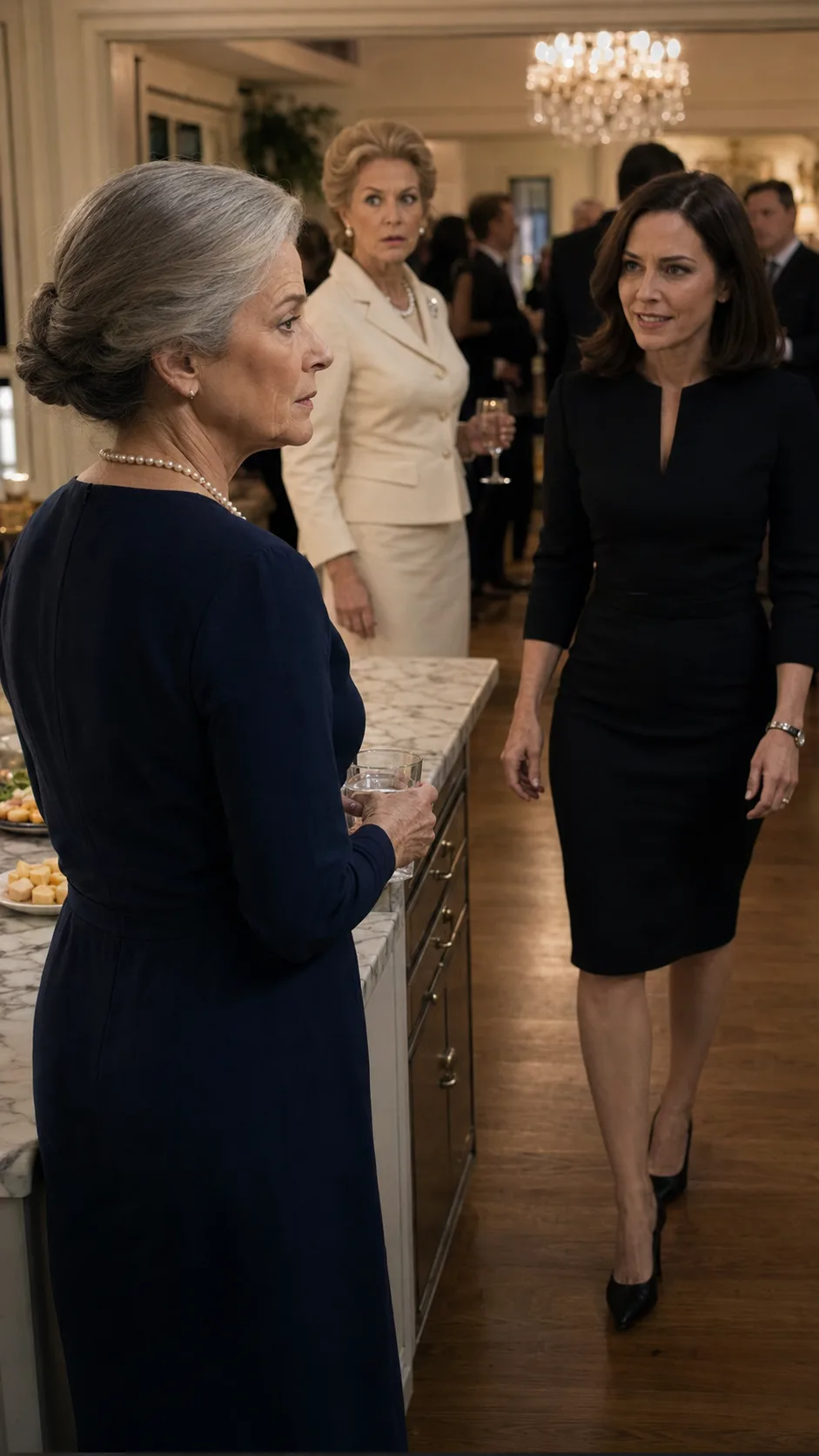
I paid for it on a Saturday night in March, standing in a marble kitchen with a glass of water in my hand while my daughter-in-law called me an embarrassment.
Then I learned from it.
And I changed.
That is what a life is, I think.
Not the buildings.
Not the bank accounts.
Not the signatures on documents or the rooms that go quiet when people finally realize who you are.
A life is the willingness to keep learning when you are old enough that nobody expects you to anymore.
That is the only inheritance worth leaving.
I hope Poppy gets it.
I hope Theo does, too.
And perhaps, in her own way, I think Camille already has.wned Her Law Firm
THE END.
Chapter complete
You have reached the end of this chapter.
Continue reading
A few more worlds to get lost in after this chapter.




