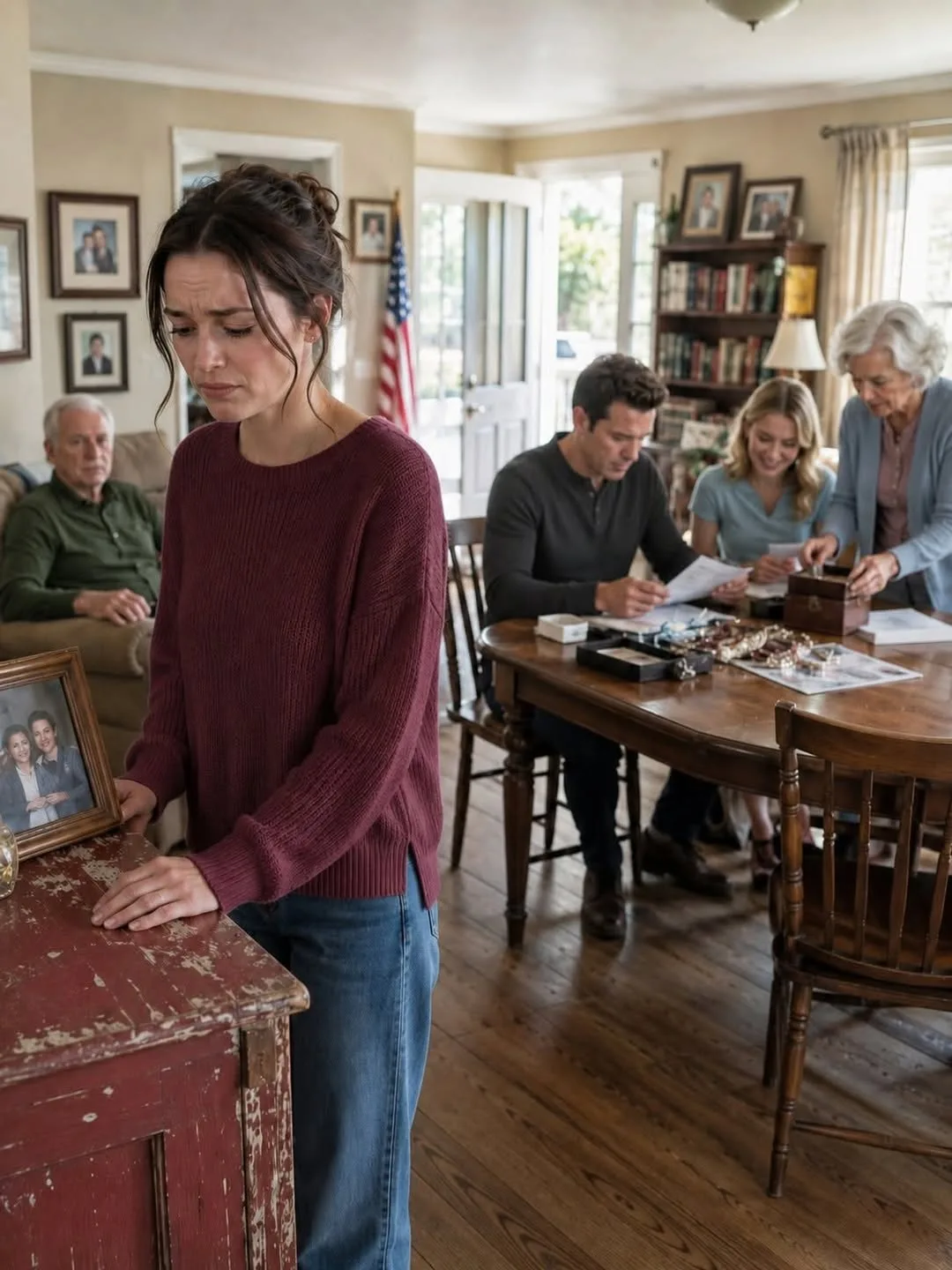
I did not answer my mother’s question.
Chapter 3
I did not answer my mother’s question.
Instead, I looked at my uncle.
He had known my father for fifty-two years. I had never seen him look afraid.
“What does Brandon have to do with this?”
My uncle lowered himself onto an overturned storage crate.
“Your father discovered something six months before he got sick,” he said. “Brandon had been taking money from the family business account years ago. Small amounts at first. Then larger ones. Your mother found out and covered for him.”
I stared at the ledger.
The entries were painfully precise.
Nine thousand dollars.
Twelve thousand.
Seventeen thousand.
Transfers marked as equipment purchases that never happened.
Checks bearing my father’s name in handwriting that was almost right, but not quite.
Then I saw the final withdrawal.
Forty-eight thousand dollars.
Three days after Dad died.
My stomach turned cold.
“From what account?”
“The emergency reserve your father kept tied to the land.”
I looked again
at Dad’s four words.
Ask your mother about Brandon.
My phone rang a second time.
Then a third.
Finally, I answered.
Mom did not say hello.
“Bring the wardrobe back.”
Her voice had lost the softness she used whenever she wanted to appear reasonable.
“Why?”
“You don’t need that old thing.”
“You gave it to me.”
“I changed my mind.”
Behind her words, I could hear movement. Then Brandon’s voice, muffled but unmistakable.
“Ask her what she found.”
That was all I needed.
I put the call on speaker.
My uncle’s expression hardened.
“Mom,” I said, “who withdrew forty-eight thousand dollars three days after Dad died?”
Silence.
Not confusion.
Not disbelief.
Silence.
Then she said, “Your father owed Brandon money.”
My uncle stood up.
“No, he didn’t.”
Mom froze.
She had not realized he was there.
A few seconds later, Brandon grabbed the phone.
“This is none of Uncle Ray’s
business.”
“It became my business when Dad wrote everything down.”
Another silence.
Then Brandon laughed.
It was the same laugh he used whenever he wanted to make someone else feel foolish.
“You really think some notebook changes anything? The house is mine. Mom already signed it over. The money is gone. Whatever Dad left in that cabinet doesn’t change that.”
I looked at the deed to the forty acres.
Then at the beneficiary certificate.
Then at the ledger.
For the first time in my life, Brandon sounded less like my older brother and more like a man trying to convince himself he was safe.
“You’re right,” I said. “The wardrobe doesn’t change anything.”
He exhaled.
“But the evidence inside it does.”
I ended the call.
The next morning, I met with an estate attorney named Rebecca Sloan. I expected caution. Instead, after reading Dad’s letter and reviewing the records, she
became very still.
“This is not a family disagreement,” she said. “This may be financial fraud.”
She confirmed the certificate was valid. The account passed directly to me outside probate. The land deed was real too, and Dad had transferred it into a trust eighteen months earlier. I was the sole successor trustee.
Then she reached the forged withdrawals.
“This,” she said, tapping the page, “is where your family has a serious problem.”
The emergency reserve had belonged to the trust.
Which meant Brandon had not taken money from Dad.
He had taken money from an entity he did not control, using signatures that did not belong to him.
Rebecca asked whether I wanted to confront them privately or proceed formally.
For seventy-three hospital nights, I had stayed quiet.
For thirty years, I had been told not to keep score.
I thought of my mother telling me not to be greedy while she handed everything to the children who had abandoned Dad.
“Formally,” I said.
Within forty-eight hours, Rebecca sent preservation notices to the bank, the title company, and every institution connected to the trust.
That was when the panic began.
Ashley called first.
She was crying.
“Why are lawyers contacting Mom?”
“Ask Brandon.”
“I don’t know anything about Brandon.”
“Then this will be a short conversation.”
She lowered her voice.
“Mom says you’re trying to steal the house.”
I almost laughed.
The house they had given Brandon while I sat ten feet away apparently became sacred only after someone asked how they had moved money around.
“I never claimed the house.”
“Then stop this.”
“No.”
She went silent.
It was the first time I had ever said that word to her without explaining myself afterward.
No.
No apology.
No justification.
No attempt to make her comfortable.
Later that afternoon, Brandon appeared at my front door.
He looked exhausted.
“Open the garage.”
I remained behind the locked screen door.
“Why?”
“You know why.”
“I want to hear you say it.”
His jaw tightened.
“That ledger belongs to the family.”
“No. It belonged to Dad.”
“He was confused at the end.”
“The first entry is nine years old.”
Brandon stared at me.
Then he changed tactics.
His voice softened.
“We’re family.”
There it was.
The sentence my mother had used whenever I was expected to give something up.
“In a family, we don’t keep score.”
I looked directly at him.
“Dad did.”
His face changed.
For one second, all the arrogance disappeared.
Then he whispered, “You have no idea what happens if that ledger becomes public.”
I felt a strange calm settle over me.
“Then you should have thought about that before you signed his name.”
Brandon stepped closer to the door.
“You’ll destroy Mom.”
“No,” I said. “I’m going to find out what she helped you destroy.”
That evening, Rebecca called.
The bank had recovered security footage tied to the forty-eight-thousand-dollar withdrawal.
Brandon was not alone.
My mother was standing beside him.
And she had been carrying Dad’s driver’s license.
Click the blue “PART 4” below to read the final part: 👉 PART 4 👈
Chapter complete
You have reached the end of this chapter.
Continue reading
A few more worlds to get lost in after this chapter.




