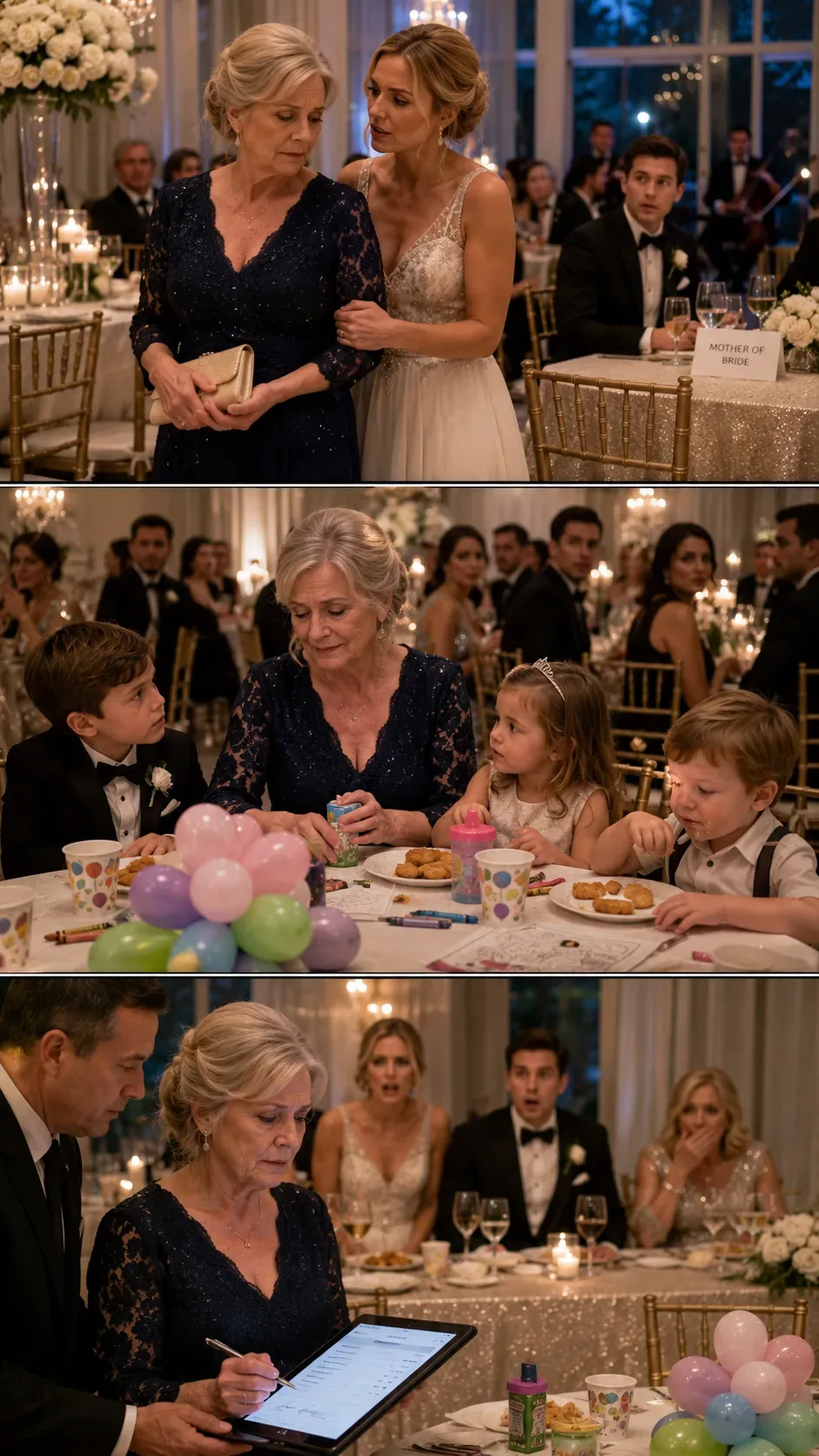
The children’s table went quiet first.
Chapter 2
The children’s table went quiet first.
That was strange, because children usually do not understand adult humiliation. They only feel it in the air, the way animals feel a storm before rain touches the ground.
The little ring bearer stopped chewing.
The flower girl looked from my face to the manager’s tablet.
A toddler with one shoe missing held a chicken tender in midair like someone had frozen him in place.
Then the head table went silent.
The music still played. The candles still flickered. The waiters still moved between tables with practiced smiles.
But the whole room had shifted.
Marissa rose from her chair first.
She did it slowly, like standing too fast would make her look guilty. Her white dress whispered across the polished floor as she walked toward me. Behind her, Ryan stayed seated.
Of course he did.
That had always been my son’s talent.
Remaining seated while other people did the damage.
“I’m sorry,” Marissa said, smiling at the venue manager. “There must be some confusion.”
The manager glanced down at his tablet.
“No confusion, Mrs. Whitaker is listed as the primary account holder and responsible party for the remaining balance.”
Marissa’s smile did not disappear.
It hardened.
“Eleanor,” she said softly, “we can handle this later.”
I looked at her hand.
She had placed it gently on the back of my tiny chair, the same way she had touched my elbow earlier. A graceful touch. A public touch. A touch designed to look loving from a distance.
But I had learned by then that Marissa’s kindness always had claws underneath.
“No,” I said. “We can handle it now.”
Ryan finally stood.
“Mom,” he said.
Just that.
Not an apology.
Not an explanation.
Just Mom, said in the tone he used when he wanted me to stop embarrassing him.
I looked at
him, and for one painful second, I saw the little boy he used to be. The boy who ran into my classroom after school with untied shoes. The boy who cried when Walter left for business trips. The boy who once told me he would always take care of me when I got old.
Then I saw the man in front of me.
A groom in a black tuxedo.
A son who had let his mother sit with children after she paid for the ballroom around him.
“What is it, Ryan?” I asked.
His mouth opened, then closed.
Marissa stepped between us.
“Eleanor,” she said, still quiet enough to seem controlled, “this is not the time to make a scene.”
I looked around.
At the white roses.
At the gold-rimmed plates.
At the champagne glasses raised by people who had suddenly become very interested in our family.
“At my age,”
I said, “I have learned that people only call it a scene when the person being humiliated stops cooperating.”
Her mother gasped.
Her father lowered his eyes.
Ryan looked as if I had slapped him.
I had not.
I had only spoken clearly.
The venue manager shifted awkwardly beside me. “Mrs. Whitaker, I apologize. We do need approval before processing the balance.”
“May I see the charges?” I asked.
He handed me the tablet.
My hand was steady when I took it.
That surprised me.
Inside, my heart was pounding so hard I could feel it in my teeth. But outside, I was calm. Years of teaching second graders had trained me well. You can survive almost anything if you do not let the loudest person in the room decide the rules.
I looked at the screen.
The original venue balance was there.
That part I recognized.
I had agreed to it months earlier, after Ryan called me late one night and said, “Mom, we’re already in too deep.”
I remembered sitting at my kitchen table with Walter’s old coffee mug beside me. I remembered staring at my savings account. I remembered thinking how proud Walter would have been to see our son married.
So I paid.
Then I kept reading.
Imported champagne upgrade.
Late-night seafood station.
Private bridal suite extension.
Premium floral arch relocation.
After-party lounge.
Extra photography hour.
Designer dessert display.
Custom monogrammed guest favors.
My thumb stopped on the final number.
It was not a bill.
It was a betrayal with commas.
I looked up at Marissa.
She was no longer smiling.
“You added these after I approved the contract,” I said.
Her jaw tightened.
“They were necessary.”
“For whom?”
“For the wedding,” she snapped.
“Not my wedding.”
The room got even quieter.
Ryan took one step closer. “Mom, please. We’ll talk about this tomorrow.”
I almost laughed then.
Tomorrow.
That magical place where weak people store every apology they never intend to make.
“No,” I said. “We will talk about it tonight.”
His eyes darted toward the guests. “People are watching.”
“Yes,” I said. “They are.”
Marissa’s voice dropped. “You promised to help us.”
“I did help.”
“You said you wanted this day to be beautiful.”
“I did.”
“Then why are you doing this?”
That question landed harder than I expected.
Because for months, I had asked myself the same thing in reverse.
Why had she done this?
Why had she taken my money and treated me like an obstacle?
Why had my son watched it happen and called it stress, planning, emotions, anything except cruelty?
I handed the tablet back to the manager and stood.
The small chair scraped lightly against the floor.
Every eye followed me.
For a moment, I saw myself the way they probably saw me. A sixty-four-year-old widow in a navy dress, standing beside paper cups and crayons, surrounded by children while the bride glowed under chandeliers.
Small.
Out of place.
Disposable.
Then I remembered Walter’s hands on mine the day Ryan was born.
I remembered him saying, “This boy will never doubt he is loved.”
And I realized I had mistaken love for permission.
I had loved Ryan so deeply that I had allowed him to become comfortable with my silence.
I turned to the manager.
“I will pay the original balance I approved,” I said. “Nothing more.”
Marissa inhaled sharply.
“Please remove every unauthorized upgrade,” I continued. “Bill those separately to the bride and groom.”
The manager nodded once. “Of course.”
Ryan whispered, “Mom.”
There it was again.
That one word.
But now it was too late for that word to save him.
Marissa’s cheeks flushed red. “You are humiliating us.”
I looked at her.
“No,” I said. “I am simply refusing to finance my own erasure.”
Behind me, the ring bearer whispered, “What does erasure mean?”
I smiled without turning around.
“It means,” I said, “someone tried to make me disappear, and I decided not to.”
A murmur moved through the ballroom.
Marissa looked at Ryan, waiting for him to defend her.
Ryan looked at me, waiting for me to soften.
And that was when the venue manager cleared his throat again.
“There is one more issue,” he said carefully.
I turned back to him.
“What issue?”
He looked at the tablet, then at Marissa.
“The after-party lounge was charged to the same account,” he said. “But the card used for the deposit does not belong to Mrs. Whitaker.”
Marissa went still.
Ryan blinked.
I felt my chest tighten.
“What card?” I asked.
The manager hesitated.
Then he said a name I had not heard since my husband’s funeral.
Walter Whitaker.
TO BE CONTINUED, PART 3 NOW
Chapter complete
You have reached the end of this chapter.
Continue reading
A few more worlds to get lost in after this chapter.




