PART 4 — The Vacation They Could No Longer Afford
Amber did not move slowly.
Chapter 4
Amber did not move slowly.
Amber erupted.
“Are you kidding me?” she said. “You actually ruined our vacation? What is wrong with you?”
“I didn’t ruin it,” I said. “I stopped paying for it.”
Her mouth opened.
“You said I didn’t pay for the trip,” I continued. “You said you and Bradley saved for it. You said you earned it. So I decided to let you handle it yourselves.”
“This is insane,” Amber snapped. “Bradley, do something.”
The representative cleared her throat.
“Ma’am, I need to ask you to lower your voice.”
Amber turned on her. “This is family business.”
“And this is still an airport desk,” the representative said. “Please lower your voice.”
Amber grabbed Bradley’s arm. “Pay for it. Use your card.”
Bradley pulled out his phone. His hands were shaking. He opened his banking app, then went pale.
“Amber,” he said quietly, “we don’t have twelve thousand dollars.”
“Then put it on
a credit card.”
“Our cards are maxed out.”
“Use another one.”
“We don’t have another one.”
“And your mother is just going to stand there?”
I watched the argument pass between them like a storm trapped in glass. I had known their financial situation was bad. Bradley had told me months ago. Wedding debt. Car payments. Credit cards. That was why I had offered to pay in the first place.
Amber turned toward me.
Her face was no longer polished. No camera-ready smile. No social grace. Only anger.
“You bitter old woman,” she said. “You did this because you’re jealous.”
“Amber,” Bradley said weakly.
“No,” she snapped. “She needs to hear it. You’re jealous because I have Bradley and you don’t. You’re lonely, and you want everyone else to be miserable too.”
People had begun to stare. A small crowd gathered at a distance, pretending to check phones or adjust
bags while watching every second.
“You’ve always been a burden,” Amber continued. “Bradley only spends time with you because he feels guilty. We didn’t want you on this trip. I didn’t want you here. Nobody did.”
That should have broken me.
A year earlier, maybe it would have.
But something had changed in Denver. Her words did not enter the way they once might have. They struck the surface and fell away.
What hurt was not Amber.
What hurt was Bradley still standing there, still not truly defending me.
“Are you finished?” I asked.
Amber blinked. She had expected tears. Maybe apologies. Maybe panic.
She had not expected calm.
“I’m going to speak now,” I said, “and you’re going to listen.”
Bradley looked at me then. Really looked.
“Six months ago, you came to me for help with a vacation,” I said. “I said yes because I love my son.
I said yes because my late husband left me money and told me to live life, to be happy, and to help the people I care about when I could.”
I turned to Bradley.
“I paid almost twelve thousand dollars for this trip. First-class tickets for all three of us. A beautiful resort. Airport transfers. Lounge access. Everything.”
His face tightened.
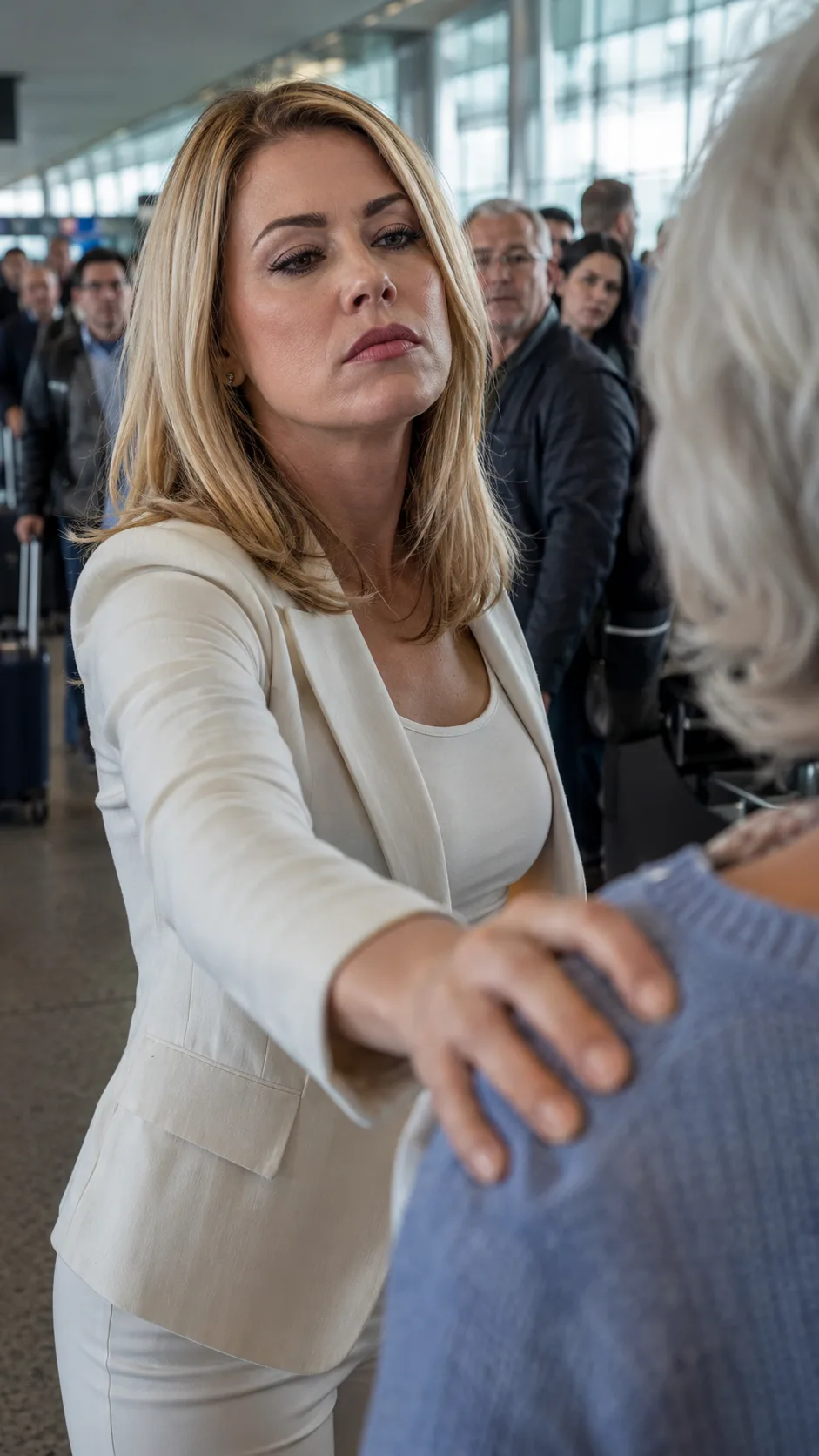
“And in return, I spent six weeks being excluded and mocked. This morning, you sat away from me in a lounge I paid for. You let your wife treat me like an inconvenience. Then at the gate, she put her hand on me, tried to push past me, and announced to an entire airport that I didn’t pay for this trip.”
Amber crossed her arms. “I didn’t mean—”
“You did,” I said.
She closed her mouth.
“So I decided to make your statement true,” I continued. “I stopped paying.”
Bradley’s voice cracked.
“Mom, please. I’m sorry. We’re sorry.”
He looked at Amber.
“Right?”
Amber said nothing.
She only glared at me with a hatred so plain it almost looked childish.
“Here’s what’s going to happen,” I said. “I’m taking a taxi to a different resort. I already made a reservation at Esperanza. It’s where your father and I always said we would stay if we came to Cabo. It costs about three thousand dollars for the week, and I’m going to enjoy it alone.”
I opened my wallet and took out two hundred dollars in cash. I held it toward Bradley.
“This should cover a taxi back to the airport and something to eat. Your flight home is scheduled for a week from now, but I’m sure the airline can help you change it if you explain the situation. Or maybe Amber’s parents can help.”
Bradley did not take the money.
Tears filled his eyes.
“Mom,” he said. “I didn’t know she was treating you that badly. I didn’t see.”
“You saw,” I said.
My voice sounded harder than I had ever heard it.
“You saw and did nothing. You’re thirty-two years old, Bradley. You are not a child. You made choices, and choices have consequences.”
I set the cash on the counter.
Then I turned to the representative, who looked as if she had just witnessed the most uncomfortable family drama of her career.
“Could you please call me a taxi to Esperanza Resort?”
She nodded quickly.
“Of course, señora. Right away.”
I spent seven days in paradise.
The resort was everything Tom and I had imagined when we used to sit at our kitchen table in Denver during February snowstorms and talk about someday. Elegant rooms, ocean views, staff who remembered my name by the second afternoon. The sound of waves outside my balcony. White linens. Fresh flowers. Coffee brought to my room at sunrise.
The first day, I sat by the pool and did absolutely nothing. I let the sun warm my shoulders. I listened to the water. I ordered fish tacos and ate them slowly, without anyone making a joke about what was “my speed.”
The second day, I went snorkeling. A young guide helped me into the water and told me I was doing great. I saw bright fish move like scraps of silk through the reef, and for the first time in months, I laughed without checking who might be annoyed by it.
The third day, I got a massage. The therapist asked if I wanted light or firm pressure, and I almost cried at the simple kindness of being asked what I wanted.
I read three books. I bought a straw hat. I watched the sunset every night with a glass of wine and imagined Tom beside me, his hand warm around mine.
Amber texted constantly for the first two days.
At first, the messages were furious. Then blaming. Then suddenly apologetic. Then furious again.
I did not read most of them.
I blocked her number.
Bradley called once the day after the airport. I let it go to voicemail.
His message was three minutes long.
“Mom, I’m so sorry,” he said, crying. “We’re at a cheap hotel near the airport. Amber won’t stop crying. I didn’t realize how bad I let things get. Please call me back. Please.”
I did not call back then.
Not because I wanted him to suffer. Because for once, I needed to let him sit inside the consequences without rushing in to soften the walls.
On my last evening in Cabo, I sat on my balcony and watched the sun sink into the Pacific. The sky turned gold, then pink, then deep blue. I had spent years fearing that if I stopped accepting disrespect, I would lose my son.
But the truth was sharper.
I had already lost the version of him I was trying to protect.
The boy who once defended me from rude strangers, who called just to talk, who said “I love you, Mom” without needing a reason, was no longer in front of me. The man who had replaced him needed to decide who he wanted to become.
When I returned home to Denver, there were flowers on my doorstep.
Two dozen roses.
The card said, Mom, I’m so sorry. Please let me explain. Love, Bradley.
I brought them inside. I trimmed the stems and placed them in water.
But I did not call him.
Three days later, he came to my house.
He looked terrible. Dark circles under his eyes. Rumpled clothes. His hair uncombed. He stood on my porch like a man waiting for a verdict.
“Can we talk?” he asked.
I opened the door.
We sat outside because the weather was mild and because the porch had always been where Bradley and I told each other the truth. The maple trees had new leaves. A neighbor’s flag moved softly in the wind. Somewhere down the street, a lawn mower started and stopped.
Bradley held a mug of coffee in both hands.
Then he told me everything.
He told me Amber had convinced him I was trying to control their lives. That every time he came to see me, she accused him of choosing his mother over his wife. That every phone call became a fight. That every dinner with me turned into days of cold silence at home.
He told me he had been afraid of conflict.
“So I took the easier road,” he said. “I kept telling myself it wasn’t that bad. I told myself you were strong and could handle it. I told myself Amber was just stressed.”
His voice broke.
“But really, I was letting her hurt you because it was easier than dealing with her anger.”
I looked at my son, and I saw shame in him. Real shame. Not embarrassment at being caught. Not frustration that things had become inconvenient. Shame.
“Where is Amber now?” I asked.
“We’re taking a break,” he said. “She’s staying with her parents. I told her what she did was unacceptable. I told her I need time to think about whether I want to stay married.”
I did not feel triumphant.
I thought I might, but I did not.
I felt sad. Sad that my son had needed a public collapse in another country to understand what private silence had cost us. Sad that Amber’s cruelty had been allowed to grow so large. Sad that I had ignored my own hurt for so long because I was afraid of becoming lonely.
“I don’t know if I can forgive what happened,” I told him honestly.
He nodded and looked down.
“But I’m willing to see if we can rebuild something,” I continued. “It won’t be what we had before. That is gone. But maybe it can become something more honest.”
He cried then. Quietly. Not like a child trying to be rescued, but like a man finally facing himself.
Since then, he has come by once a week. We drink coffee. We talk. Sometimes it is awkward. Sometimes there are long silences. But the silences are different now. They are not avoidance. They are space where truth is trying to grow.
Bradley started therapy. He says he is working on boundaries, conflict, and the habit of confusing peace with surrender. I hope he means it. I hope he becomes the man his father tried to raise.
As for me, I am planning another trip.
Maybe Italy. Maybe Greece. Maybe somewhere I never considered because I was too busy saving my best years for people who treated my presence like a burden.
Tom was right.
Life is for living.
And I am done shrinking myself to make room for people who do not appreciate me.
For years, I thought keeping the peace meant staying quiet.
Now I know better.
Sometimes peace begins the moment you stop paying for your own disrespect.
THE END.
Chapter complete
You have reached the end of this chapter.
Continue reading
A few more worlds to get lost in after this chapter.




