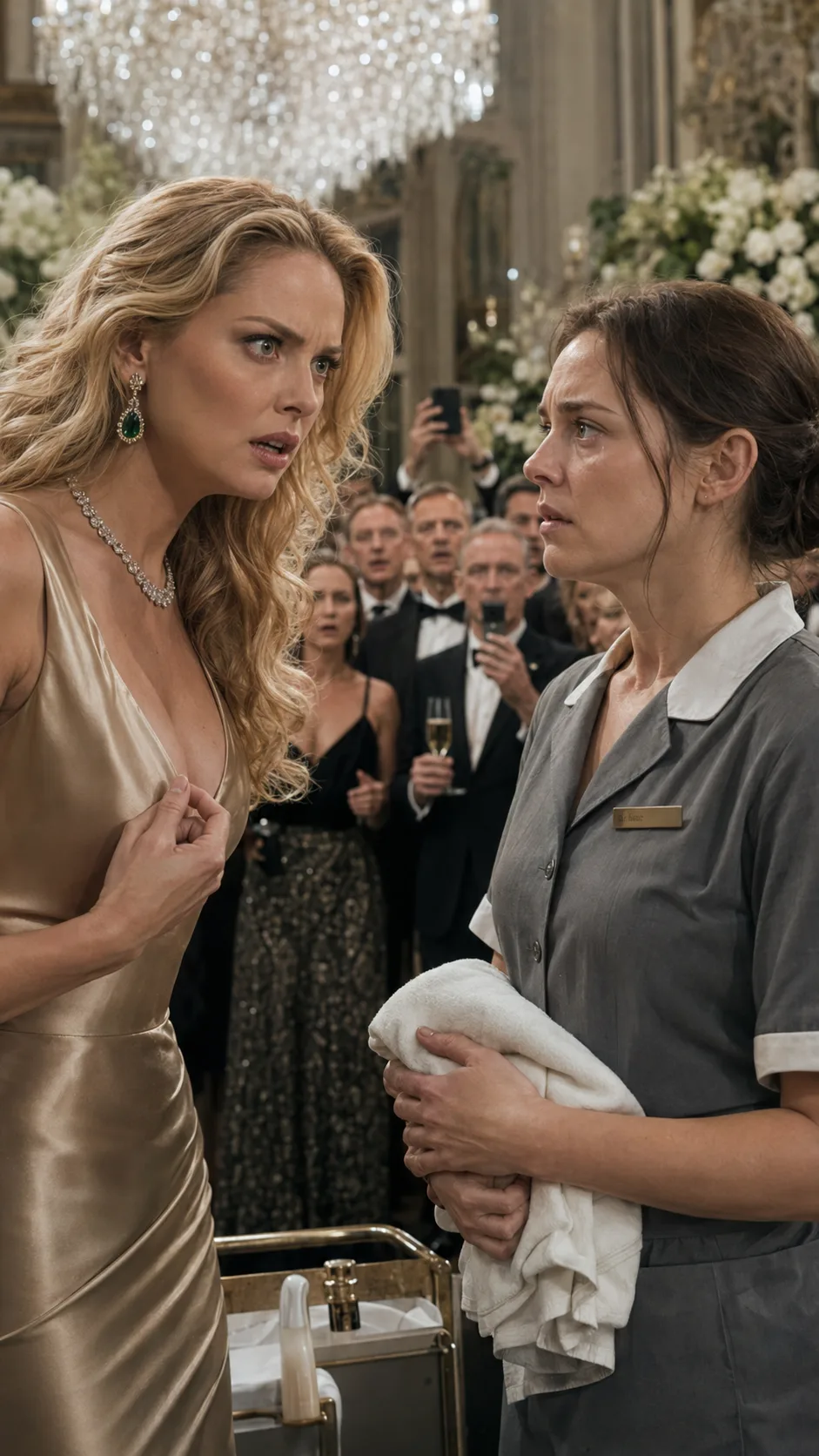
THE MAID WHO KNEW WHY ROOM 719 WAS NEVER CLEANED AFTER MIDNIGHT
PART 2 — THE PRIVATE LOSS REGISTER
Clara Bennett did not sleep after leaving The Marlowe Grand.
Chapter 2
Clara Bennett did not sleep after leaving The Marlowe Grand.
She sat at her small kitchen table in Queens until the sky turned gray, still wearing the same dark coat over her housekeeping pants, the red mark on her cheek fading into a dull ache.
The apartment was quiet except for the hum of the refrigerator and the pipes knocking inside the wall.
Normal sounds.
Poor sounds.
The kind of sounds that did not belong in rooms with champagne towers, diamond collars, and women who could accuse someone of theft before dessert was finished.
Clara’s phone lay on the table.
She opened the messages again.
The first photo showed the private room ledger.
Madison Vale.
Victor Harlan.
Room 719.
10:37 P.M.
NO HOUSEKEEPING ACCESS.
NO DIGITAL ENTRY LOG.
The second photo was older.
Five years earlier.
Lena Brooks.
And beside her name, in Julian Cross’s sharp black handwriting:
SCAPEGOAT PROTOCOL APPROVED.
USE HOUSEKEEPING IF NECESSARY.
Clara stared at that last
sentence until her eyes burned.
Use housekeeping.
Not call housekeeping.
Not question housekeeping.
Use housekeeping.
As if a woman in a gray uniform was not a person. As if she were a mop, a towel, a trash bag, something pulled out when the rich needed a mess to disappear.
She thought of Madison’s hand around her wrist.
The guests laughing.
The woman in red velvet saying, “Check her shoes too.”
Julian’s voice, soft and polished.
Dignity is expensive. Tonight, cooperation is cheaper.
Clara had heard many cruel things in six years of hotel work, but that one stayed.
Because it had not been shouted.
It had been offered like advice.
At 6:18 a.m., her phone buzzed.
Unknown number.
THEY KEEP THE OLD REGISTER IN BASEMENT STORAGE C. NOT IN THE DIGITAL SYSTEM. THE BLACK BOOK. LOST PROPERTY ISN’T REALLY LOST PROPERTY.
Clara sat forward.
A second message appeared.
YOU ARE
NOT THE ONLY ONE WHO REMEMBERS WHITCOMB & REED.
Her fingers froze over the phone.
Whitcomb & Reed Asset Protection.
Her old workplace.
The company that handled insurance claims for the kind of people who called diamonds “assets” and poor women “risk exposure.”
Clara typed back:
WHO IS THIS?
The reply came after ten seconds.
SOMEONE WHO LOOKED AWAY WHEN LENA NEEDED ME.
Then another message.
LAUNDRY DOCK. 4:45 P.M. CHANGE SHIFT. DO NOT COME THROUGH THE FRONT.
After that, silence.
Clara should have called a lawyer.
She should have gone to the police.
She should have done something clean and official.
But clean and official belonged to people with retainers, publicists, and family lawyers who answered on Sunday mornings.
Clara had four dollars in her coat pocket and a folder somewhere inside The Marlowe Grand with her name already written on it.
So at 4:43 p.m., she stood across
the street from the hotel wearing black jeans, a dark coat, and a knitted hat pulled low over her hair.
The Marlowe Grand looked untouchable in daylight.
Gold revolving doors. Black cars. White-gloved doormen. Women stepping onto the sidewalk in heels that cost more than Clara’s monthly rent.
No one looked toward the laundry dock.
Luxury always had a front entrance for applause and a back entrance for labor.
Clara waited until a delivery truck rolled in, blocking the side camera, then crossed quickly and slipped through the laundry entrance.
The smell hit her first.
Steam.
Detergent.
Hot metal.
Wet linen.
Beneath the orchids and crystal chandeliers, this was what the hotel really smelled like.
Work.
A supervisor she recognized, Mr. Pike, looked up from a clipboard.
His eyes narrowed.
“Well, look who came back.”
Clara kept walking.
He stepped into her path.
“You lost the uniform, Clara,” he said loudly enough for two laundry workers to hear. “Don’t lose the last piece of dignity you have left.”
One worker looked down.
Another pretended to sort towels.
Clara stopped.
Pike smiled, enjoying the audience.
“They’re saying you had expensive taste for a woman eating staff-room sandwiches.”
Clara looked at him.
“Move.”
His smile faltered.
Maybe because she did not sound ashamed.
Maybe because he expected begging and got nothing.
Before he could answer, Nora Fields appeared behind a tower of folded linens.
“She’s with me,” Nora said.
Pike turned.
Nora’s face was pale, but she did not lower her eyes.
“With you?” he said. “You should choose better company.”
Nora’s hand shook around the laundry cart handle.
“She’s here to collect her things.”
Pike leaned close to Clara.
“Collect them fast. Thieves make people nervous.”
Clara felt the words strike, but she did not give him the satisfaction of seeing blood.
Nora grabbed her arm and pulled her into the service corridor.
Only when they were around the corner did Nora let go.
“I’m sorry,” Nora whispered.
Clara looked at her.
“For Pike?”
“For all of it.”
Nora’s voice broke.
Clara said nothing.
Nora wiped her cheek quickly.
“I watched them take Lena downstairs five years ago,” she said. “I was holding a tray exactly like last night. She looked at me like she knew I could save her.”
Her breath caught.
“And I looked away.”
The corridor seemed to go still.
Clara’s anger shifted.
Not gone.
Changed.
Nora swallowed hard.
“I told myself I was new. I told myself I had rent. I told myself someone else would speak. Then nobody did. Lena disappeared from the hotel, and everyone repeated the story until it sounded true.”
“She stole the watch,” Clara said.
Nora flinched.
“That’s what they made us say.”
“And now they made you watch it happen again.”
Nora nodded, tears sliding down her face.
“This time, when Madison slapped you, I saw Lena’s face instead of yours.”
Clara studied her.
Fear was not courage.
Guilt was not redemption.
But sometimes guilt was the first honest thing a person had left.
“Where is the register?” Clara asked.
“Basement Storage C.”
They moved quickly.
The service corridors narrowed as they went deeper into the hotel. The carpet disappeared. Marble became concrete. Gold trim became exposed pipes. The music from the lobby faded into the distant roar of washing machines.
The underground part of The Marlowe Grand did not appear in brochures.
There were no influencers here.
No donors.
No women in satin gowns holding champagne and talking about restoring dignity.
Only staff lockers, bleach buckets, old pipes, and doors with numbers that meant nothing unless you worked there long enough to know which ones held danger.
Nora stopped at a gray metal door.
STORAGE C — ARCHIVAL LINEN / EVENT PROPERTY
She pulled a small brass key from her pocket.
Clara looked at it.
“Lena gave it to you?”
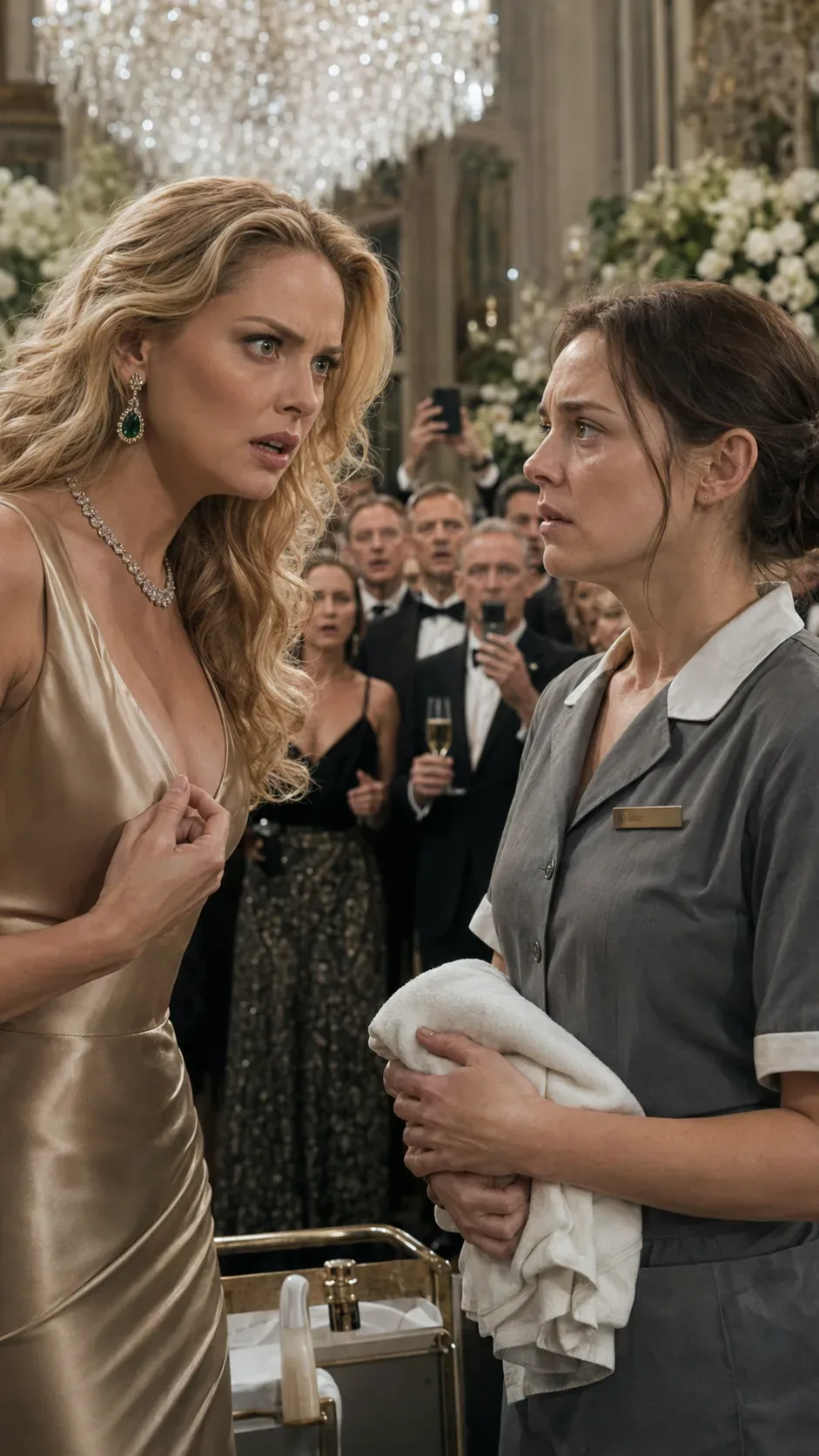
Nora nodded.
“The day before she left. She said if another woman got blamed, I would know which door to open.”
“And you kept it for five years?”
“I kept it because throwing it away felt like killing her twice.”
The key turned.
The door opened.
Inside, dust floated under fluorescent light. Boxes rose to the ceiling, labeled in careful handwriting.
Winter Gala Inventory.
Private Bridal Suite Disputes.
Damaged Guest Property.
VIP Linen Reserve.
At the back of the room sat a locked black cabinet.
Nora opened it with the same key.
Inside was a thick leather book.
Black cover.
No hotel logo.
No title printed on the spine.
Only three words embossed on the front.
PRIVATE LOSS REGISTER.
Clara touched the cover.
“Lost Property,” Nora whispered, “is for guests who leave scarves and sunglasses. This is for things the hotel cannot afford to officially find.”
Clara opened the book.
The first pages looked normal.
Pearl earring.
Returned.
Passport.
Returned by courier.
Cufflink.
Held for guest pickup.
Then the handwriting changed.
The words became colder.
Transferred.
Settled privately.
Guest reputation exposure risk.
Staff proximity noted.
Confidentiality executed.
Clara turned the pages slowly.
She did not need fifty examples.
Three were enough.
A ruby brooch belonging to a foundation chairwoman.
A housekeeper named Maria Santos accused, terminated, and marked “unstable.”
A sealed envelope containing cash from a senator’s aide.
A bellman named Elliot Kim blamed, paid two weeks severance, and labeled “not eligible for rehire.”
A platinum watch belonging to Victor Harlan.
Lena Brooks.
Room 719.
Settled privately.
Do not rehire.
Confidentiality executed.
And beneath it, Julian’s note:
SCAPEGOAT PROTOCOL APPROVED.
USE HOUSEKEEPING IF NECESSARY.
Nora turned away, covering her mouth.
Clara kept reading.
The next entry made her stop.
Three years earlier.
Item: Diamond bracelet, white gold, twelve-carat center pattern.
Owner: Madison Vale.
Insured appraisal value: $180,000.
Status: Reported destroyed after private incident.
Claim referral: Whitcomb & Reed Asset Protection.
Private note: Original retained under Victor Harlan custody pending donor settlement.
Clara read the line twice.
Original retained under Victor Harlan custody.
The bracelet had never been destroyed.
If Madison had been paid on a claim for a bracelet that still existed, then the missing bracelet was not simply jewelry.
It was fraud.
And if Victor Harlan had kept the original, Madison was not only lying.
She was trapped inside someone else’s ledger.
Nora whispered, “Is that the bracelet?”
“Yes,” Clara said. “And no.”
“What does that mean?”
“It means the bracelet is only the thing they let everyone see.”
Clara stared at the words Whitcomb & Reed.
The earlier text message returned to her mind.
You are not the only one who remembers Whitcomb & Reed.
Someone else had already understood what Clara understood.
If an item declared destroyed resurfaced, an insurer could reopen the file.
Demand appraisal.
Demand custody records.
Demand signatures.
Madison could cry in a ballroom.
Julian could threaten a maid.
Victor Harlan could buy silence from half of Manhattan.
But an insurance file, once reopened, did not care about perfume, charity photos, or who sat on which museum board.
It asked for proof.
Then footsteps sounded outside Storage C.
Both women froze.
Voices approached.
One belonged to a security guard.
The other was Julian Cross.
“Check Storage C,” Julian said. “If Bennett came back, she would look for records. She was useful when she was invisible. She became dangerous when she started reading.”
Nora’s face drained.
Clara closed the register carefully.
The door handle moved.
Locked.
The guard said, “No recent card entry.”
“Use the manual key,” Julian replied.
Clara looked toward the cabinet.
Nora whispered, “There’s no other exit.”
Clara knelt and felt inside the cabinet. Her fingers found a loose panel at the bottom.
She pushed.
The false bottom shifted.
Inside were folders.
Dozens of them, tied with white string.
Names written in black ink.
SANTOS, MARIA.
KIM, ELLIOT.
BROOKS, LENA.
BENNETT, CLARA.
Clara stopped.
Her name was already there.
Not created after an investigation.
Prepared before she had been searched.
Nora stared at it.
“Oh my God.”
The manual key scraped in the hallway lock.
Clara grabbed her own folder and Lena’s, slid both under her coat, pushed the black register back into place, and closed the cabinet.
The door opened.
Julian Cross stood in the doorway.
Black suit.
Polished shoes.
Corporate calm.
A security guard waited behind him.
For one second, nobody spoke.
Julian looked at Nora first.
His disappointment was gentle.
That made it worse.
“Nora,” he said. “I expected better.”
Nora stepped back as if struck.
Julian turned to Clara.
“You were instructed not to enter hotel property.”
“You instructed me not to enter guest floors.”
“This is trespassing.”
“This is a basement.”
His smile thinned.
“Still correcting language.”
Clara said nothing.
Julian stepped into the room, eyes moving quickly over the shelves, the cabinet, Nora’s hands, Clara’s coat.
“You don’t understand what you are touching,” he said.
“I understand enough.”
“No,” Julian replied. “You understand forms. Old paper. File codes. You think a little procedure makes you powerful.”
He moved closer.
“The people upstairs do not live by procedure. They fund hospitals. They build museums. They decide which neighborhoods get saved and which ones get sold. They do not fall because a former housekeeper found a dusty book.”
Clara looked at him.
“Then why are you down here?”
For the first time, Julian’s smile cracked.
Only slightly.
But enough.
He held out his hand.
“Give me what you took.”
“I didn’t take anything.”
His eyes dropped to her coat.
“Do not insult both of us.”
The guard moved forward.
Julian raised one hand to stop him.
Then he looked at Nora.
“Nora, your mother’s medical coverage comes through this hotel, correct?”
Nora froze.
Clara’s body went cold.
Julian continued softly.
“And your brother is applying for concierge transfer. Competitive role. Excellent benefits. Very difficult without management support.”
Nora’s lips parted.
No sound came out.
“That is the trouble with moral courage,” Julian said. “Poor people rarely get to spend it alone.”
Clara stepped between them.
“You’re threatening her family.”
“I am explaining context.”
“You mean consequences.”
“Yes,” Julian said. “Consequences.”
Then his eyes returned to Clara.
“And you should think about yours. Your apartment building in Queens was recently sold, wasn’t it? New ownership group. Rent-controlled tenants can find those transitions uncomfortable.”
Clara did not move.
But inside her, something dropped.
They knew.
Her address.
Her building.
Her rent.
Her weakness.
The Marlowe Grand did not simply protect the rich.
It studied the poor.
Every sick parent.
Every brother needing a job.
Every immigration status.
Every overdue bill.
Every apartment lease.
Every person who could be used as leverage when the rich needed silence.
Julian removed a folded document from his jacket and placed it on a box.
“Sign the revised separation agreement. Return any hotel property. Ms. Vale will not pursue charges if you cooperate.”
“She framed me.”
“Ms. Vale is prepared to show mercy.”
Clara almost smiled.
Mercy.
A rich woman could plant a box, slap an employee, lie in front of two hundred people, and then sell silence as mercy.
“No,” Clara said.
Julian’s eyes hardened.
“No one is coming to save you.”
“I know.”
Then Clara did the thing he did not expect.
She walked toward him.
The guard shifted.
Clara stopped inches from Julian and lifted both empty hands.
“Search me.”
Julian stared at her.
“You want drama?”
“No,” Clara said. “I want you to decide how badly you need those files.”
His expression changed.
Not much.
Enough.
If he searched her and found nothing, he looked afraid.
If he searched her and found the folders, he confirmed the folders existed.
If he let her walk out, he would have to wonder what she had taken and what she had already copied.
Powerful men hated not knowing.
Before Julian could answer, a young staff member appeared in the doorway, breathless.
“Mr. Cross?”
Julian did not turn.
“What?”
“The Vale party is asking for you upstairs.”
“I’m occupied.”
The staff member swallowed.
“Ms. Vale is screaming at the front desk.”
Julian finally turned.
“About what?”
“There’s an insurance representative here. From Whitcomb & Reed. They’re asking to speak with whoever reported the bracelet missing.”
The room went quiet.
Clara’s pulse changed.
She had not called Whitcomb & Reed.
Not yet.
Nora slowly looked at her.
Julian looked back at Clara, and for the first time since the ballroom, something close to uncertainty moved across his face.
Clara remembered the message.
You are not the only one who remembers Whitcomb & Reed.
Someone else had opened the door before she even reached the register.
Julian stepped closer, voice low enough that only Clara could hear.
“This is not over.”
Clara held his gaze.
“It never was.”
He walked out.
The guard followed.
Nora waited until the footsteps faded before she exhaled.
“What now?”
Clara pulled the two folders from beneath her coat.
Nora stared.
“You took them.”
“I let him think I might have taken more.”
Clara opened the folder marked BENNETT, CLARA.
Inside were copies of her employee ID, address, emergency contact, schedule history, and a printout of her old work background.
A yellow note was clipped to the front.
BENNETT HAS LEGAL/INSURANCE EXPERIENCE.
DO NOT ALLOW DIRECT POLICE CONTACT.
CONTAIN THROUGH HR.
IF NECESSARY, CONNECT TO VALE BRACELET INCIDENT.
Clara’s hands went still.
Connect to Vale bracelet incident.
Not investigate.
Not discover.
Connect.
The incident had been waiting for a person.
Last night, Clara had been chosen.
Nora opened Lena’s folder with trembling fingers.
There was an old termination form.
A confidentiality agreement.
A photograph of a platinum watch.
A staff statement Lena had never signed.
And on the last page, a handwritten note:
BROOKS SAW HARLAN WORLDWIDE DONOR TRANSFER IN ROOM 719.
CLAIM WATCH THEFT.
RESOLVE BEFORE MORNING.
Behind the note was a photocopy from a charity auction catalog.
The item listed was not a watch.
It was a painting.
Anonymous donor.
Estimated value: $3.2 million.
Sold during a women’s charity benefit at The Marlowe Grand.
The same week Lena Brooks had been accused.
Clara stared at the page.
The ruby brooch.
The cash envelope.
The watch.
The bracelet.
The painting.
The hotel was not simply hiding affairs or embarrassing behavior.
The rich were moving assets.
Turning dirty ownership into clean generosity.
Using charity auctions like laundry for money with better lighting.
Nora whispered, “What does it mean?”
Clara closed the folder.
“It means Madison’s bracelet is not the secret.”
“Then what is?”
Clara looked up toward the ceiling.
Toward the ballroom.
Toward the seventh floor.
“The charity is.”
Her phone buzzed again.
Unknown number.
LENA IS ALIVE.
SHE NEVER LEFT NEW YORK.
ASK WHY THE WATCH WAS WORTH LESS THAN THE PAINTING.
Then an address appeared.
Queens.
Not far from Clara’s apartment.
Nora’s voice shook.
“Is that her?”
Clara looked at the address.
“The woman they blamed before me.”
“Are we going to find her?”
Clara thought of Madison’s bare wrist.
Julian’s soft threats.
Victor Harlan’s initials.
The ledger.
The folders.
The charity banners outside the hotel.
EMPOWERING WOMEN. RESTORING DIGNITY.
And somewhere in Queens, a woman named Lena Brooks had lived five years with the world believing she was a thief because Nora had looked away and Clara had not yet arrived.
Clara slipped the folders inside her coat and walked toward the door.
“Yes,” she said. “Before they decide which one of us disappears next.”
Behind them, the laundry machines roared.
Upstairs, champagne was still being poured.
And on the seventh floor of The Marlowe Grand, Room 719 remained closed.
But for the first time in years, the room had made a mistake.
It had chosen a woman who knew how to read what rich people forgot to burn.
TO BE CONTINUED — PART 3
Chapter complete
You have reached the end of this chapter.
Continue reading
A few more worlds to get lost in after this chapter.




