PART 4 — What the Bond Was Really Worth
My son came up to Sudbury in March alone.
Chapter 4
My son came up to Sudbury in March alone.
We spent the weekend the way we used to: badly beaten at Scrabble, long walks, cooking things that take too long.
He asked me carefully about the estate restructuring. I told him it was ongoing and that it was mine to manage.
He said he understood.
He said he was sorry, not for the letter, not for any specific thing, but sorry in the large, undifferentiated way that sometimes means everything.
I put the savings bond in the middle of the kitchen table between us.
I said, “This is still yours. It always was. But you’re going to have to do something to earn it back, and I don’t mean anything financial.”
He looked at it for a long time.
He said, “What do I have to do?”
I said, “Be the person I know you are. The rest will follow.”
He took the bond and put it in his
jacket pocket.
We played Scrabble until midnight. He won the second game, which I allowed and will deny.
I drove him to the station on Sunday morning.
It was cold, the kind of cold that comes off Lake Huron and gets into everything. We stood on the platform and he hugged me for a long time before the train came.
Not the quick shoulder squeeze he’d been giving me for the past few years.
A real one.
I drove back through town and stopped at Tim Hortons for a coffee.
I sat at the window table with my medium double-double and watched the parking lot. I thought about the duplex on Lauren Street, which is currently renting well, and the one on Spruce, and the units in the Sault, and the investments, and the trust documents in the filing cabinet at home.
And the gray silk dress in my closet
that still has a little tag that says $5 more than I paid for it, because the woman at the consignment shop knocked off the extra.
I thought about my son’s face at the kitchen table, and I thought, this is what patience looks like.
Not weakness. Not forgiveness as surrender.
Patience that knows its own worth and knows also when to be still and when to move.
I finished my coffee. I had a good drive home.
I still have things I haven’t told him.
Some of them he’ll find out eventually through the trust, through the will, through the way life unfolds these things in its own time.
Some of them he already knows in the way sons know things about their mothers, not in facts, but in the marrow of what they learned growing up.
He knows, for instance, that I have never wasted a single thing
I was given.
He knows that the most powerful move is often the quietest one.
He knows that a savings bond from 1998, held carefully for 25 years, is worth more than anyone at that table thought.
And he knows, I believe he knows, that so am I.
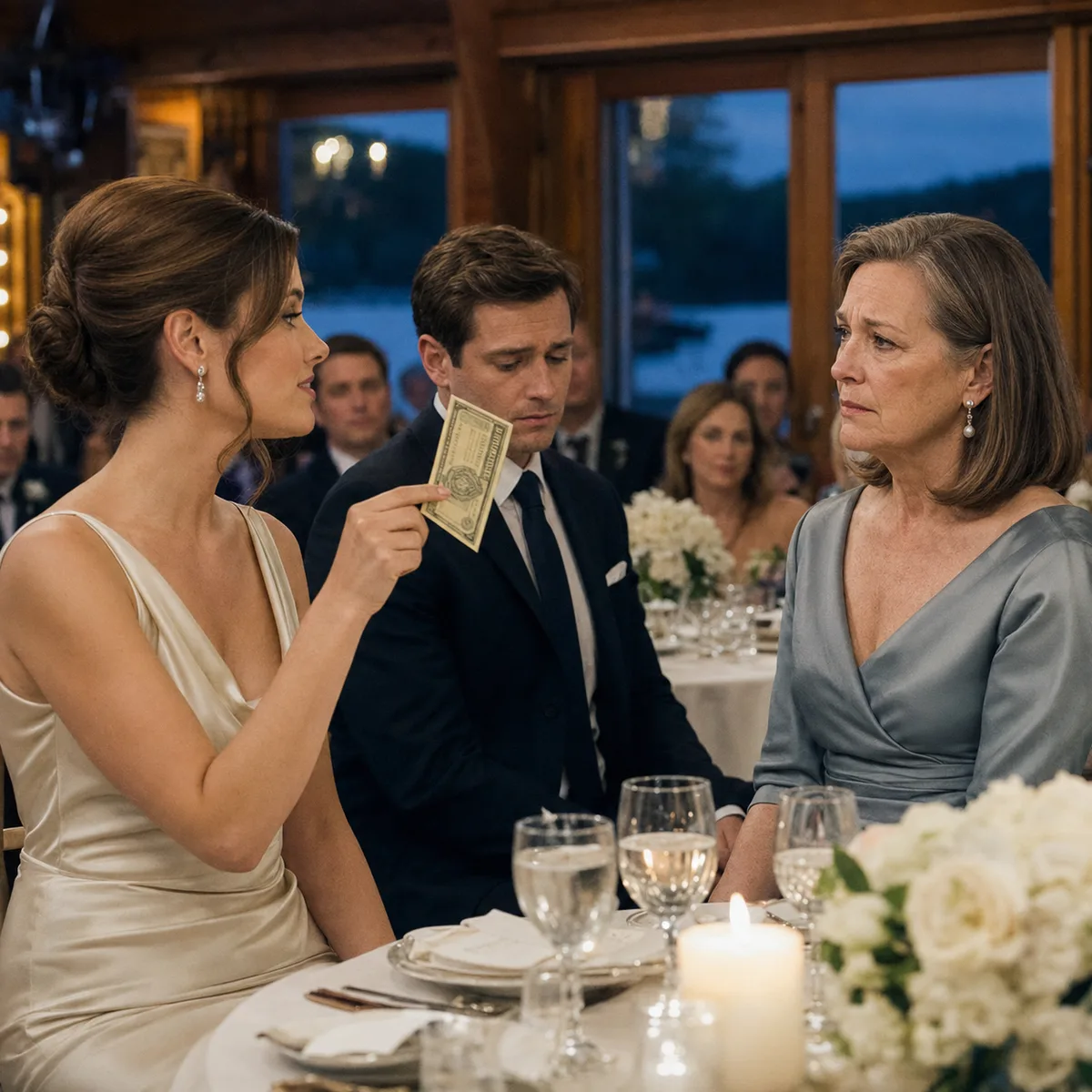
I’ve thought a lot about what that evening at the boathouse actually cost me.
Not the bond.
$4,000 is $4,000, and money I’ve always been able to account for.
What it cost me was something harder to put a number on.
The assumption I’d been carrying for 30 years that the way I raised my son would be enough. That the values I’d tried to plant in him — patience, honesty, the understanding that a thing’s worth has nothing to do with how it looks — would hold up under the pressure of a new life and new people and a table full of lanterns and linen.
They didn’t hold up.
Not that night.
And here’s what I’ve come to understand about that.
It wasn’t a failure of my son’s character, not entirely. It was a failure of my silence.
I had spent so long building quietly: the properties, the accounts, the life I made from 30 years of careful, unglamorous work.
And I had built my relationship with my son on the same principle.
Quietly.
Assuming it was solid. Never testing it out loud.
That’s not wisdom. That’s avoidance dressed up as patience.
What I know now is that the people we love don’t become who we hoped they’d be through inheritance.
They become it through friction.
Through being called back, gently and honestly, to the version of themselves they’ve started to drift away from.
I should have been doing that for years.
Instead, I kept driving four hours home from dinners where I’d been dismissed, telling myself it was normal. That he’d find his way. That I didn’t need to say anything because the truth would eventually be obvious.
The truth is never just obvious.
You have to be willing to say it.
My son, when we finally talked, really talked, on the phone for two hours in November, said the thing that stayed with me the most.
He said the person he felt most like himself with was still me.
Still our kitchen table.
Still the way I’d shown him, years ago, how to read what numbers actually say about a life.
He’d been performing a different version of himself for so long that he’d almost forgotten that other version existed.
That’s what happens when we choose belonging over honesty.
We lose track of ourselves, and the people who love us most can see it happening.
But if they stay quiet, if I stay quiet, nobody says a word. The drift continues. And one day a savings bond becomes a symbol of everything that went unspoken.
I’m not interested in bitterness. I never have been.
What I restructured was not a punishment. It was a recalibration, a decision to stop building a future around assumptions and start building it around clarity.
The bond is still with my son. It’s in his jacket pocket or somewhere safe by now, I hope.
He earned it back, not by doing anything grand, but by showing up to Sudbury in March and sitting at my kitchen table and being, for a whole weekend, completely and honestly himself.
That’s the only thing I’ve ever actually asked of him.
And if you’re listening to this and you recognize something in it — the quiet accumulation, the swallowed words, the moment where someone you love chose the wrong thing, and you didn’t know what to say — I’d ask you to consider whether the silence has been protecting the relationship or just postponing the conversation it actually needs.
In my experience, the things we build in silence eventually have to be spoken out loud.
That’s not a threat.
That’s just how it works.
THE END.
Chapter complete
You have reached the end of this chapter.
Continue reading
A few more worlds to get lost in after this chapter.




