PART 3 — THE CLAUSE THAT TOOK EVERYTHING BACK
I hadn’t known.
Chapter 3
PART 3 — THE CLAUSE THAT TOOK EVERYTHING BACK
I hadn’t known.
Hadn’t read that far.
Hadn’t realized my original lawyer—the one who’d handled the initial deed before Garrett’s lawyer took over—had included protection for me.
“What kind of clause?” I asked.
“A reversion clause,” he said. “It states that if you’re ever asked to leave the property or charged rent for the mother-in-law suite, the house immediately reverts to your ownership. It’s ironclad. They signed it. They agreed to it. They just didn’t read it carefully enough to notice.”
I sat back in my chair and felt something warm spread through my chest.
Not quite happiness.
Something quieter.
Something that felt like justice.
“So the house is legally mine again?” I asked.
“The moment they demanded rent—yes,” he said. “You’d need to file paperwork to enforce it, but legally you own that property. They breached the agreement. The house reverts to you.”
I thanked him and told him I’d think about
what to do with that information. He said to take my time, said the law was on my side whenever I was ready to use it.
I left his office and sat in my car for ten minutes just thinking.
I could take the house back.
Could file the paperwork and force them out.
Could watch them scramble to find a new place.
Could enjoy their panic.
Or I could hold on to that information.
Keep it like a secret weapon.
Let them think they’d won.
Let them keep struggling with a mortgage they probably couldn’t actually afford.
Let them keep wondering where I was and how I was surviving.
Let the uncertainty eat at them.
I decided to wait.
To keep that card hidden until I knew exactly the right moment to play it—if that moment ever came.
Two weeks after Christmas, I ran into Celeste at the grocery
store. I was standing in the produce section examining avocados when I felt someone staring at me.
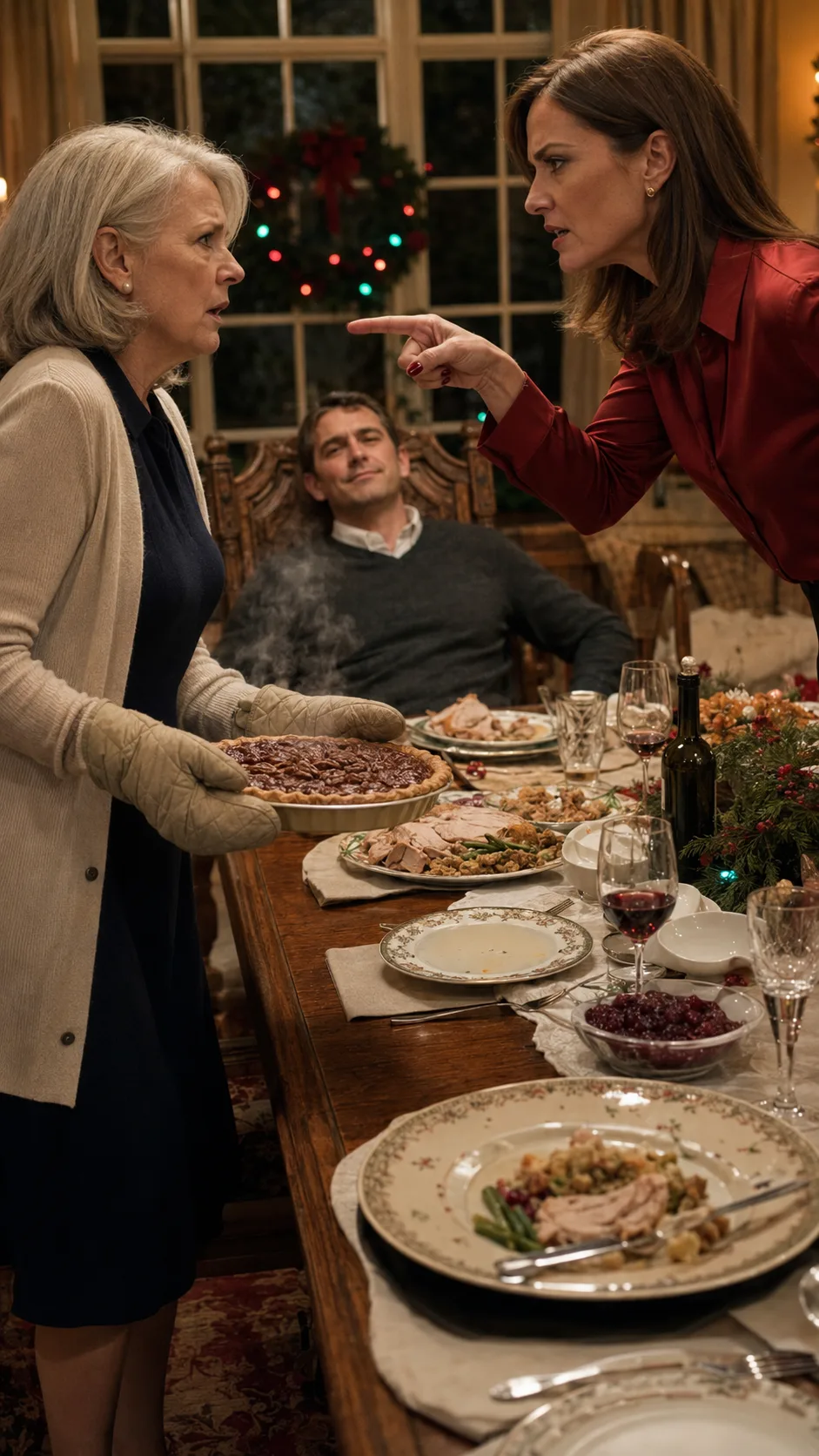
I looked up and there she was—my former daughter-in-law, the woman who’d screamed in my face at Christmas dinner, who’d demanded $1,200 while wearing the designer sweater I’d helped pay for.
She looked different.
Tired.
Her hair was pulled back in a messy ponytail instead of the sleek style she usually wore.
No makeup.
Yoga pants and a sweatshirt instead of the carefully coordinated outfits she preferred.
Her expensive purse hung from her shoulder but somehow looked cheaper now.
Or maybe she looked cheaper—worn down, worried.
She froze when she saw me, her mouth opened like she was going to say something, then closed, then opened again.
“Rhonda,” she finally managed.
My name sounded strange coming from her now—uncertain, almost respectful.
“Celeste,” I said.
I selected two avocados and placed them carefully in
my cart. I moved toward the tomatoes like this was a normal Tuesday morning and I hadn’t seen the woman who tried to destroy me.
“We’ve been trying to reach you,” Celeste said.
She followed me.
Her cart was nearly empty—just some generic pasta and sauce, the cheap kind.
No organic vegetables.
No expensive cuts of meat.
No specialty items.
Her whole grocery budget was probably what I used to give them every month for free.
“I know,” I said.
I examined tomatoes, checking each one for firmness, taking my time, not looking at her.
“We need to talk about what happened—about Christmas.”
“There’s nothing to talk about,” I said.
I selected four tomatoes and placed them in a bag. Tied it carefully.
Set it in my cart next to the avocados.
“I was upset that day,” she said. “I said things I didn’t mean. The holidays are stressful.”
“And you meant every word,” I said.
I looked at her directly now.
Met her eyes.
Let her see that I wasn’t the same woman who’d lived in her garage.
That something had changed.
That she’d changed me—and not in the way she’d expected.
“And that’s fine,” I said. “You wanted me to pay rent or leave. I left. Problem solved.”
“But you cut off everything,” she said. “The insurance, the phone, the credit card. We’re struggling now. Garrett’s business hasn’t been as good as we thought it would be. We actually really need—”
“That’s not my problem anymore,” I said.
I pushed my cart forward, moved toward the meat section, let her follow if she wanted to, but didn’t slow down for her.
“The kids miss you,” she tried.
Her voice got higher, desperate.
“They ask about you all the time. They want to know when Grandma’s coming home.”
I stopped pushing my cart.
I turned to face her.
I let her see my face.
Let her read what I was thinking.
“No, they don’t,” I said quietly. “They don’t even know me well enough to miss me. And whose fault is that?”
She opened her mouth to argue, to make excuses, to explain how busy they were and how kids were different now and how technology made everything complicated.
How she’d meant to encourage a better relationship.
But things just got away from her.
I didn’t wait to hear it.
I walked away, left her standing in the grocery store with her nearly empty cart and her tired face and her designer purse that suddenly seemed like a costume she couldn’t afford to keep wearing.
I finished my shopping.
Bought everything I wanted without checking prices.
Fresh salmon.
Good cheese.
Real butter.
Expensive coffee.
A bouquet of flowers just because they were pretty.
I paid with my own money.
Money I’d earned.
Money I’d saved.
Money that was mine and nobody else’s.
That night, I video-called my friend Norma. She’d moved to Florida five years ago after her husband died.
Sold her house in the cold and moved somewhere warm where she could see the ocean and feel the sun.
We’d been friends since nursing school, had worked together for thirty years, had raised our kids in the same neighborhood, had survived loss and change and everything life threw at us.
We talked for two hours about everything and nothing.
Books we were reading.
Shows we were watching.
Her new hobby of collecting seashells.
My painting class.
And the watercolor of lilacs I’d completed yesterday.
Memories from our nursing days when we were young and strong and thought we could save everyone.
Near the end of the call, Norma tilted her head and looked at me through the screen with that look she’d always had.
The one that saw through walls.
“You sound different,” she said. “Lighter, like something lifted off you.”
“I feel lighter,” I admitted. “I feel free.”
And I did.
For the first time since Philip died, since Garrett and Celeste had convinced me to sign over my house, since I’d moved into that converted garage and started living like I was a burden instead of a blessing, for the first time in three years, I felt like myself again.
Not the mother trying desperately to please a son who didn’t value her.
Not the grandmother tolerated but not loved.
Not the convenient source of free labor and money.
Just Rhonda.
A woman who’d worked hard her whole life, who’d saved and invested wisely, who’d loved deeply and lost greatly, who’d survived betrayal and come out stronger.
I’d learned an important lesson.
One I wished I’d learned sooner, but was grateful to know now.
Family wasn’t just about blood.
It was about respect.
About appreciation.
About showing up and meaning it.
Garrett and Celeste had shown me they were family in name only.
So I’d quietly, calmly, completely cut them out of my life.
No drama.
No angry confrontations.
No begging them to see my value.
I’d simply removed myself and all my resources from their reach.
And I’d never felt better.
Three days after running into Celeste at the grocery store, my phone rang.
Unknown number.
I almost didn’t answer, but something told me to pick up.
“Rhonda, it’s Patricia from across the street from your old house.”
Patricia—my former neighbor, the woman who’d lived across from Philip and me for twenty years, who’d brought casseroles when he died, who’d asked if I was okay when she saw me taking out trash in the cold, wearing a thin jacket because the garage had no heat.
“Patricia,” I said. “How are you?”
“I’m fine, honey, but I’m calling because I thought you should know something about Garrett and Celeste.”
My stomach tightened.
“What about them?”
“They’re struggling, Rhonda. Bad. The house is falling apart. Gutters hanging off, lawn overgrown.
I hear them fighting all the time—loud enough the whole street can hear.
And I saw Celeste crying in the driveway last week, just sitting in her car crying.”
I should have felt something.
Sympathy, maybe.
Concern for my son.
Worry about my grandchildren.
But I felt nothing.
Just a calm curiosity about what came next.
“They’re trying to sell the house,” Patricia continued. “Put up a for sale sign yesterday. Did you know they were selling?”
Something cold moved through me.
“No,” I said. “I didn’t know.”
“I thought it was strange,” Patricia said. “Didn’t you sign that house over to them? Can they sell it without your permission?”
I smiled.
Actually smiled, sitting alone in my kitchen holding my phone.
“Patricia, I need to go. Thank you for calling.”
I hung up and immediately called my real estate attorney.
He answered on the second ring.
“Mrs. Winters, what can I do for you?”
“They’re trying to sell the house,” I said. “The one that reverted back to me. Can they do that?”
“No,” he said, “not legally. They’d need to disclose the reversion clause to any buyer.
And no title company would approve the sale once they discovered you’re the actual owner.
The sale would fall through.”
“What happens if I enforce the clause now?”
“You file the paperwork. The court reviews it. Given how clear the language is, you’d have ownership back within thirty days.
They’d be required to vacate.”
“Do it,” I said. “File the paperwork today.”
“Are you sure?”
“I’ve never been more sure of anything.”
I hung up and sat at my kitchen table, feeling something I hadn’t felt in years.
Not revenge, exactly.
More like justice.
Like the universe correcting itself.
Like consequences finally catching up to people who’d forgotten consequences existed.
The paperwork was filed that afternoon. The attorney said they’d be served within forty-eight hours.
That a court date would be set.
That barring any complications, the house would be legally mine again by the end of January.
I waited for guilt to arrive, for second thoughts to creep in, for that voice in my head that said, Good mothers don’t do this to their children.
The guilt never came.
Neither did the second thoughts.
And that voice finally shut up because I’d realized something important.
Good mothers don’t let their children treat them like trash either.
Garrett called me four days later from yet another unknown number.
I answered because I wanted to hear his voice when he realized what I’d done.
“What the hell did you do?”
No greeting.
No pretense of civility.
Just raw anger.
“You’re taking the house back? You can’t do that.”
“Actually, I can,” I said calmly. “There was a reversion clause in the transfer agreement. You signed it.
You agreed that if you ever asked me to leave the property or charged me rent for the mother-in-law suite, the house would revert to my ownership. You did both. So now it’s mine again.”
“That’s not— you can’t. We have a realtor. We have buyers interested.”
“Then you’ll need to explain to them why the sale can’t go through,” I said.
“Might I suggest telling them the truth? That you kicked out your elderly mother and tried to charge her rent in violation of your agreement.
See how sympathetic they are?”
“Mom, please. We made a mistake. We’re sorry. We need this house.
We need the money from selling it. We’re drowning here.”
“You should have thought of that before you told me to survive on my own,” I said.
“We have kids,” he said, voice sharp with panic. “Your grandchildren. What about them?”
“What about them, Garrett?” I said. “Did they say one word to me at Christmas dinner?
Did they thank me for the gifts I bought them? Did they even look up from their phones when you told me to get out?
Those kids don’t know me because you never let them—because you were too busy using me as a bank account to teach them about respect or gratitude or family.”
“This is cruel,” he said. “Taking our house, cutting us off. You’re being cruel.”
“No,” I said. “Cruel was screaming at me over Christmas dinner.
Cruel was smirking when you told me to see how I’d survive.
Cruel was taking sixty thousand dollars from me over three years while I lived in a garage.
I’m not being cruel.
I’m being fair.”
I hung up before he could respond.
Before he could beg or threaten or try to manipulate me the way he’d been manipulating me for three years.
The court date arrived two weeks later.
I didn’t go.
My attorney handled everything.
Garrett and Celeste showed up with a lawyer they probably couldn’t afford.
It didn’t matter.
The documents were clear.
The signatures were valid.
The clause had been violated.
The judge ruled in my favor.
The house was mine.
They had thirty days to vacate.
I still didn’t go to see it.
Didn’t drive past.
Didn’t want to see their faces or their packed boxes or their lives falling apart.
I just wanted it over.
My attorney handled the eviction process, made sure it went smoothly, made sure they had time to find somewhere else.
I wasn’t heartless.
I didn’t want them homeless.
I just wanted justice.
The house was emptied by the end of February. My attorney did a walkthrough and sent me photos.
They’d left it in decent shape, surprisingly.
Cleaned before they left.
Fixed the minor damage they’d caused.
Maybe they’d finally realized they should show some respect, even if it was three years too late.
I listed the house for sale immediately.
Priced it fairly.
It sold in eight days to a young couple expecting their first baby.
They loved the oak dining table Philip had built.
Promised to take care of it.
I sold it to them for below market value because they reminded me of who Philip and I had been forty years ago—hopeful and happy and full of dreams.
The sale brought in $380,000 after paying off the mortgage Garrett had taken out and covering all the fees.
I took that money and donated every penny to organizations that helped elderly people who’d been abused or abandoned by their families—shelters, legal aid funds, programs that provided housing and support and dignity to people who deserved better.
I kept a copy of the donation receipt—not because I needed it for taxes.
Because I wanted to remember.
Wanted proof that something good had come from something painful.
That Garrett’s cruelty had been transformed into help for people who needed it.
Six months passed, then a year.
My life settled into a rhythm that felt right.
Book club on Tuesdays.
Painting on Wednesdays.
Volunteering on Thursdays and Fridays.
Time with friends.
Time alone.
Time to read and think and exist without being needed for something.
Norma came to visit from Florida. She stayed for two weeks in my guest bedroom.
We cooked together and laughed together and cried together when we talked about Philip and her late husband, Robert.
And all the ways we’d loved and been loved and survived when we thought we couldn’t.
“You did the right thing,” she told me one evening as we sat on my back porch watching the sunset. “Cutting them off, taking the house, all of it. You did exactly the right thing.”
“Sometimes I wonder,” I admitted, “if I was too harsh, if I should have given them another chance.”
“How many chances did they give you?” Norma asked. “How many times did they thank you?
How many times did they show you respect or gratitude or love?
They had three years of chances, Rhonda.
They used every one to take advantage.
You didn’t punish them.
You just stopped letting them hurt you.”
She was right.
I knew she was right.
But it still helped to hear someone else say it.
Someone who’d known me for forty years.
Someone who’d seen me at my best and worst.
Someone who had no reason to lie to make me feel better.
I never heard from Garrett again after the court date.
No calls.
No letters.
No attempt to reconcile.
Maybe he was embarrassed.
Maybe he was angry.
Maybe he’d finally realized what he’d lost and couldn’t face it.
I didn’t know.
And I didn’t ask.
I was okay with that.
With the silence.
With the absence.
With building a life that didn’t include him because he’d made it clear I shouldn’t be included in his.
I learned something important in those months.
Something I wished I’d known sooner.
That being alone wasn’t the same as being lonely.
That having less family contact didn’t mean having less love.
That sometimes the healthiest thing you could do was walk away from people who treated you like you were worthless.
I’d spent three years trying to earn my son’s love and respect, trying to prove I was valuable, trying to show I deserved better treatment.
And I’d been doing it all wrong.
Because the problem wasn’t me.
It never had been.
The problem was them.
Their greed.
Their selfishness.
Their complete inability to see me as a person instead of a resource.
So I stopped trying.
Stopped hoping.
Stopped waiting for them to change.
And in that stopping, I found something unexpected.
Peace.
Freedom.
Joy.
A life that was mine and nobody else’s.
If you’ve ever been told you’re a burden, that you’re asking too much, that you should be grateful for whatever scraps of attention and respect people throw your way, I need you to know something.
You’re not the problem.
The people making you feel that way are the problem.
And you have permission to walk away.
To cut them off.
To choose yourself.
To anyone who’s ever been in that converted garage—literally or metaphorically—living small so someone else can live large, giving everything while getting nothing, staying quiet while being disrespected.
Your life is worth more than that.
You are worth more than that.
And it’s never too late to save yourself.
What lesson hit you hardest from this story?
And if you were in my shoes, what would you have done?
Would you have given Garrett another chance, or would you have cut him off even sooner?
I want to hear your thoughts.
Tell me in the comments below.
Don’t stop here.
Click the next video on your screen right now and watch another powerful story from our channel.
There’s one about a woman who inherited everything when her family thought she had nothing.
You’re going to want to see how that turned out.
Hit subscribe and turn on notifications so you never miss a story like this.
These stories matter.
Your story matters.
And maybe by sharing mine, I can help you find the courage to choose yourself, too.
Drop your thoughts in the comments below.
I read every single one.
I’m Rhonda Winters.
I’m sixty-eight years old.
I survived being treated like nothing by people who should have treasured me.
THE END.
Chapter complete
You have reached the end of this chapter.
Continue reading
A few more worlds to get lost in after this chapter.




