One by one, the cars disappeared down the dirt road.
Chapter 2
One by one, the cars disappeared down the dirt road.
No one apologized. No one asked whether I was all right.
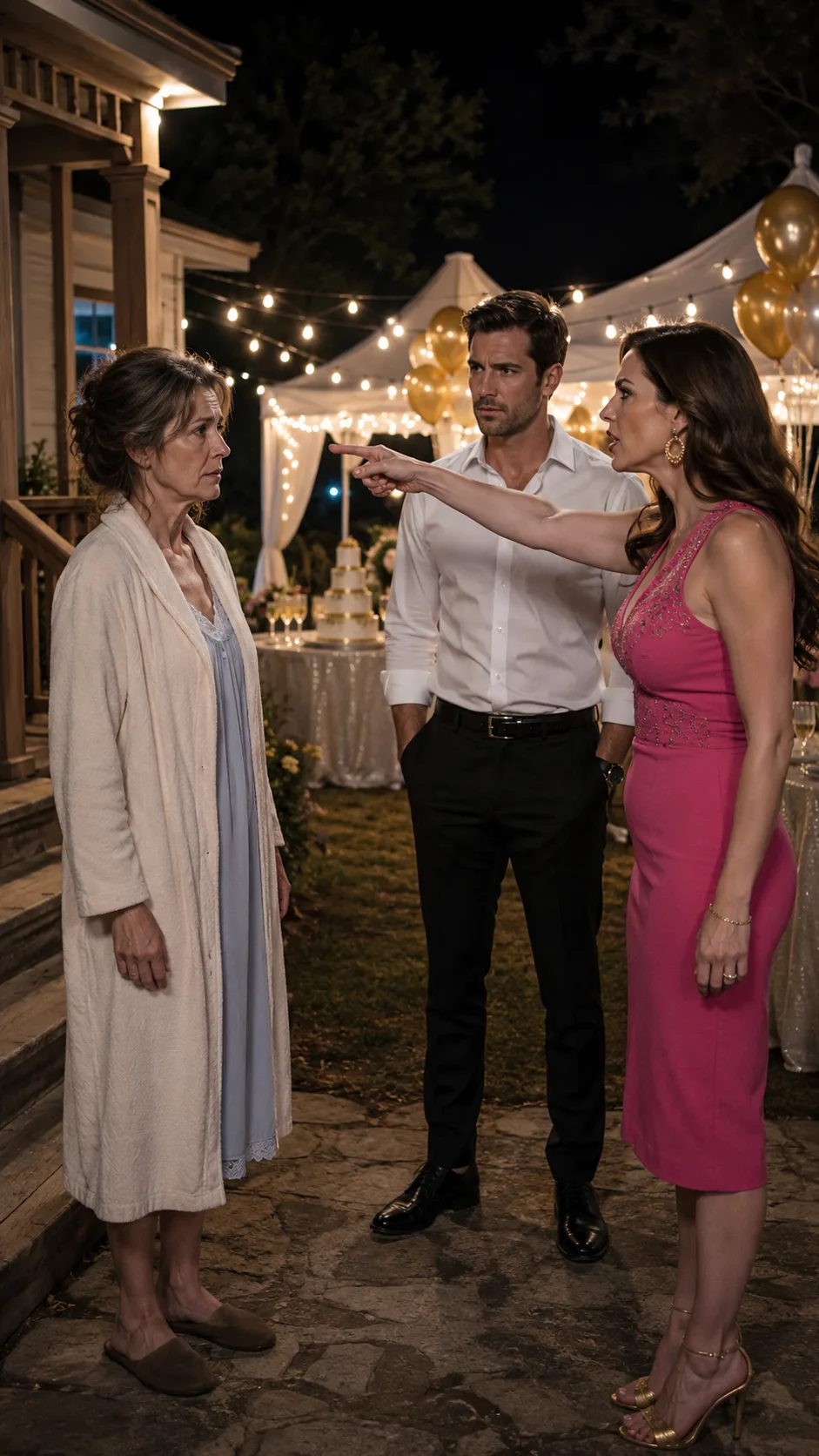
Vivien passed me in her hot-pink dress without meeting my eyes. Robert followed her to his truck.
“You humiliated us,” he said.
“You held a party on my property without permission.”
“I live here too.”
“No, Robert. You visit when you want something.”
He stared at me as though I had struck him. Then he climbed into the truck and left with his wife.
I stayed on the porch until sunrise, wrapped in my mother’s old shawl. I remembered Robert as a barefoot little boy chasing chickens across the yard. He used to sit on a wooden stool while I cooked and promise that one day we would run the ranch together. After his father died, I built my entire life around him. I mistook giving him everything for teaching him love.
By morning, I understood that my silence
had never protected our family. It had only trained my son to believe I would always surrender.
The ranch had never been an investment to me. It was where my father taught me to ride before I was ten, where my husband Richard learned to repair tractors, and where Robert took his first steps between the porch and the rose garden. My father had died beneath a mesquite tree while repairing a fence. Richard had taken his final breath in the upstairs bedroom with my hand wrapped around his. Every room held someone I loved.
Vivien never saw any of that. The first weekend Robert brought her home from college, she called the house “authentic” and said it had “potential.” She complained about the well water, the heat, the livestock, and the food my mother taught me to cook. Before she left, she asked how much the acreage was worth
and whether Robert would inherit it soon.
I had smiled because I wanted my son to be happy. Later, when they announced their engagement, I allowed Vivien to tear out tiles my father had laid, uproot flowers my mother had planted, and paint every warm wall white. When she demanded fifty thousand dollars for the wedding, Robert told me that refusing would prove I did not support his marriage. I emptied my savings.
That was why the party hurt so deeply. They had not simply forgotten to invite me. They had learned that my money, my work, and my home were always available—even when my presence was not.
When I went inside, I found a leather notebook beneath the dining table. Vivien’s name was embossed across the cover.
I should not have opened it.
I did anyway.
The first page was titled: POST-WEDDING CHANGE LIST.
Complete kitchen remodel.
Knock down
the wall between the living and dining rooms.
Build a swimming pool.
Sell the cattle.
Convert the stables into rental lofts.
Talk to lawyers about the deed.
My hands began to shake.
On the next page, she had written a budget totaling two and a half million dollars. Their main source of funding was a bank loan secured by the ranch.
They planned to mortgage land that did not belong to them.
I hid the notebook beside the deed and my father’s will. Three days later, Robert came alone.
“Are you still mad?” he asked, sitting at my kitchen table as though we had only argued over dinner.
“I’m disappointed.”
He offered an apology without taking responsibility. Vivien was “intense.” She wanted their future to be perfect. I should understand.
Then I placed the notebook on the table.
Robert turned pale.
“You read that?”
“I read enough.”
“They’re only ideas.”
“Budgets, loan amounts, construction dates, and lawyers are not ideas.”
He pushed his chair back. “The ranch could make real money. You wouldn’t have to work so hard.”
“I like my work.”
“You’re wasting the property.”
“It is mine to waste.”
His jaw tightened. “It’s my inheritance.”
There it was—the sentence hiding beneath every demand.
“An inheritance belongs to the living person until she dies,” I said. “And I am still very much alive.”
Robert stood. “You’re selfish. You would rather let this place rot than give your own son a future.”
“You already had a future. I paid for it. You chose to gamble it on someone else’s ambition.”
He stormed out, but this time his threat followed him.
“You’ll regret this.”
A week later, a lawyer called on behalf of Robert and Vivien. They wanted an “accelerated distribution” of Robert’s inheritance.
I laughed once because the alternative was screaming.
“My son has no inheritance while I am alive.”
The attorney advised me to get representation. I hung up and drove directly to Mr. Miles, the lawyer who had handled my father’s estate.
He read the deed, the will, and Vivien’s notebook.
“They cannot legally take the ranch,” he told me. “But they can exhaust you with lawsuits. Do not sign anything. And change your will.”
Until that moment, I had assumed Robert would receive everything after my death because blood had always meant legacy in my family.
But what is blood without respect?
I asked Mr. Miles to place a legal lock on the property. No sale, transfer, mortgage, or business agreement could proceed without my verified consent.
Two weeks later, Robert came to my door holding bank documents.
He looked thinner, but not remorseful.
“We need your signature.”
“No.”
“Mom, listen. The bank approved two million dollars. This is our chance.”
“You applied using my ranch without permission.”
“It will be mine someday.”
“Not anymore.”
His face emptied. “What does that mean?”
“It means I am changing my will.”
Robert stared at me as if the floor had disappeared beneath him.
“You can’t do that.”
“I can, and I did.”
He stepped closer. “Vivien and I are married. We have debts. Investors are waiting. You can’t destroy our lives because you’re angry.”
“I am not destroying anything. I am refusing to let you destroy mine.”
He left with the documents, and the next letter arrived in November.
This time, they claimed I was mentally incompetent.
According to the filing, I was senile, irrational, emotionally unstable, and incapable of managing family assets. They asked the court to appoint Robert as my guardian.
My only son was trying to declare me unfit so he could control me while I was still breathing.
The case dragged through winter. Three psychologists tested my memory, judgment, reasoning, and financial understanding. I answered every question. I identified every account, every parcel boundary, every ranch expense, and every lie in Robert’s petition.
The humiliation was deliberate. Robert’s attorney asked whether I had ever misplaced keys, forgotten an appointment, or left a stove burning. Vivien submitted photographs of me wearing my robe during the party as evidence that I was “confused and socially withdrawn.” She left out the fact that I had been in my nightclothes because they had excluded me from the celebration.
Mr. Miles made them explain every claim under oath. Robert could not identify the ranch’s annual feed costs, the number of cattle I owned, the location of the water rights, or the amount I paid in property taxes. The son asking to control my estate knew almost nothing about maintaining it.
On Christmas Eve, I ate alone at the dining table. I placed an extra plate where Robert used to sit, then removed it before dessert.
That small act broke something inside me—but it also released me.
In January, I signed a new will. The ranch would go to a historical land foundation dedicated to preserving working family properties. Robert would receive nothing connected to the land.
When he found out, he and Vivien came pounding on my door.
“This property belongs to Robert!” she screamed.
I watched them through the window and drank my coffee.
For the first time, their anger did not frighten me.
At the final hearing, the judge looked directly at Robert.
“Mrs. Mary Johnson is fully competent and retains the absolute right to control and dispose of her property.”
The gavel fell.
Robert lost.
I thought that would be the end.
Then, in March, Mrs. Lupe arrived at my ranch with a look I had never seen before.
“Mary,” she said, lowering her voice, “their business collapsed. The money is gone. Robert lost his job. And Vivien’s family wants every dollar back.”
I felt no victory. Only the quiet certainty that consequences had finally found the right address.
But the most unexpected knock on my door came one month later.
Robert stood there alone, thinner than I had ever seen him, with tears already running down his face.
To be continued… Click “PART 3” to read the final part: 👉 PART 3 👈
Chapter complete
You have reached the end of this chapter.
Continue reading
A few more worlds to get lost in after this chapter.




