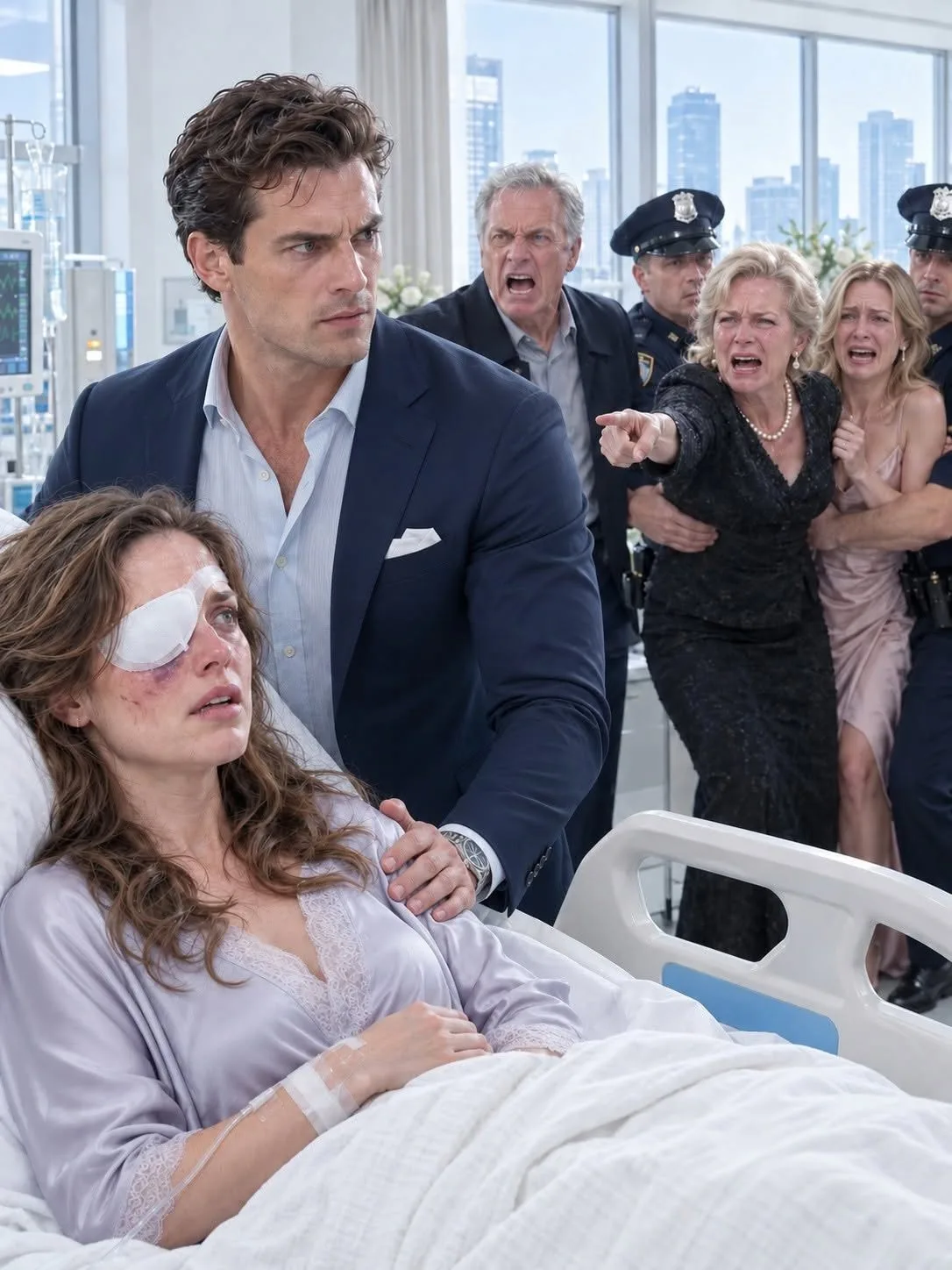
Three days later, I walked into the probate conference room with twenty-two stitches near my eyebrow, a titanium plate beneath my cheekbone, and Wyatt's hand wrapped carefully around mine.
Chapter 4
Three days later, I walked into the probate conference room with twenty-two stitches near my eyebrow, a titanium plate beneath my cheekbone, and Wyatt's hand wrapped carefully around mine.
I could see only a blur through my left eye.
But I could see enough.
I saw Harold Bennett seated at the long oak table.
I saw retired Judge Eleanor Shaw beside him.
And I saw Walter Mercer, the elderly man from behind my parents' curtain, wearing a navy suit that hung loosely from his shoulders.
When I entered, he stood.
His eyes filled.
“You have Arthur's eyes,” he said.
“I should have found you sooner,” he whispered.
“You tried.”
“No. I should have tried harder.”
That was the first apology anyone in my family had given me without adding a reason why I was partly to blame.
I sat across from the trustees.
Detective Larson and an assistant prosecutor were present as observers.
Wyatt sat behind me.
Melanie had agreed to cooperate with investigators in exchange for consideration of her role, but no promises had been made.
My parents
were not allowed in the room.
They had attorneys now.
Expensive ones.
According to Harold, those attorneys had already filed emergency motions arguing that the will was invalid, the trust had been mismanaged, Walter was senile, Melanie's recordings were illegally obtained, and my injuries were the result of a “family misunderstanding.”
Harold had smiled when he told me that last part.
“Six independent witnesses make misunderstandings difficult.”
The meeting began.
For nearly two hours, they reviewed documents.
The original will.
The trust instrument.
The medical trigger clause.
Police photographs.
My hospital records.
The statements from the electrician, the neighbors, the mail carrier, the delivery driver, the woman walking her dog, and the paramedic.
Then Harold played Melanie's recording.
My father's voice filled the room.
“If she signs, we're done. If she doesn't, I'll scare her until she does.”
My mother's voice came next.
“And if Wyatt gets in the way?”
“He won't after he sees her.”
Then Melanie asked, “What does that mean?”
My father laughed.
“You'll see.”
I stopped breathing.
The recording continued.
My mother said, “Don't be stupid, Gregory. We just need her shaken up.”
My father replied, “Arthur wrote that ridiculous clause because he thought I'd hurt her. Fine. Then she won't remember enough to use it.”
No one in the room moved.
The recording clicked off.
Judge Shaw removed her glasses.
“I have heard enough.”
Walter looked at me.
“So have I.”
Harold slid a document across the table.
The three trustees signed.
At 11:42 that morning, control of the Mercer Family Trust transferred to me.
Immediately.
Irrevocably.
My parents' occupancy rights to the Columbus house were terminated.
Gregory's business lease on the distribution yard was canceled under the fraud provision.
All discretionary payments to Brenda were frozen.
The property company holding Melanie's rentals was placed
under audit.
And every questionable transfer from the previous seventeen years was referred to forensic accountants and prosecutors.
Harold looked at me.
“There is one more decision.”
“What?”
“The trust owns the house.”
The house where I had grown up.
The porch where my father struck me.
The living room where Walter had been held without his phone.
The kitchen where my mother had spent years telling me I was lucky they tolerated me.
“You may take possession immediately.”
I looked at Walter.
Then at Wyatt.
Then at Harold.
“I don't want it.”
Harold nodded slowly.
“What would you like done with it?”
I thought about the girl I had been in that house.
Quiet.
Careful.
Always trying to earn affection that was never going to come.
Then I thought about the women I'd seen in the emergency room hallway while waiting for imaging.
One woman had been wearing sunglasses indoors.
Another had kept apologizing to a nurse because her husband might get angry if she stayed too long.
“Sell it,” I said. “Put the proceeds into a fund for emergency housing for women leaving violent homes.”
Walter's eyes filled again.
Harold smiled.
“I think Arthur would have approved.”
He described eleven days without his phone.
Medication hidden in a kitchen cabinet.
Doors locked from the inside.
My mother repeatedly placing documents in front of him and telling him that if he signed them, everyone could “go back to normal.”
Then came the financial audit.
The preliminary six point four million became eight point one million.
Money had moved through shell companies, sham consulting fees, inflated invoices, and real-estate purchases.
Gregory and Brenda had treated the trust like a private bank.
Melanie had benefited enormously.
But she had not controlled the transfers.
Her cooperation, recordings, and decision to surrender two properties voluntarily changed the way prosecutors viewed her role.
Six months after the attack, she asked to meet me.
We sat in a quiet café.
She looked older.
Not physically.
Just stripped of entitlement.
“I hated you,” she said.
I didn't react.
“I know.”
“No. I mean I really hated you. Mom told me my whole life that Grandpa loved you more. She said everything you had should have been mine.”
I stirred my coffee.
“You had almost everything.”
She looked down.
“That was the point. It never felt like enough because she kept telling me you had something bigger.”
“The trust.”
She nodded.
“And Wyatt.”
I looked at her.
She swallowed.
“I didn't love him.”
“I know.”
“I wanted him because he chose you.”
That sentence hurt more than I expected.
Not because it surprised me.
Because it explained us.
My sister had not spent her life trying to become happy.
She had spent it trying to become more chosen than I was.
And my mother had built that hunger inside her.
“I'm sorry,” Melanie said.
I didn't tell her it was okay.
It wasn't.
I didn't tell her I forgave her.
I wasn't there yet.
I only said, “If you want a different life, build one.”
She nodded.
Then she left.
My parents never apologized.
Gregory eventually pleaded guilty to aggravated assault, attempted coercion, and financial crimes after his attorney failed to suppress the recordings and trust records.
Brenda accepted a separate plea involving unlawful restraint, conspiracy, and financial fraud.
They lost the house.
They lost the business property.
They lost access to the trust.
They lost the reputation they had protected more carefully than they ever protected me.
And for the first time, they had to live without using my inheritance to finance their version of success.
My left eye recovered enough for me to see clearly again, though bright light still bothers me.
The scar remained.
At first, I covered it with concealer.
Then one morning, months later, I stopped.
Wyatt and I married in a small garden behind Walter's restored farmhouse.
No ballroom.
No hundred-person guest list.
No family performance.
Walter walked me down the aisle.
Harold sat in the front row.
The electrician who called the ambulance was there too, because Wyatt had tracked him down and insisted that the man who refused to look away deserved an invitation.
So did the woman with the dog.
So did the delivery driver who kept recording when my mother screamed at him to stop.
Six witnesses had once stood outside my parents' house and watched the worst moment of my life.
At my wedding, several of them stood beneath string lights and watched me begin again.
Before the ceremony, Walter handed me a small envelope.
Inside was a letter my grandfather Arthur had written twenty-three years earlier.
Harold had found it in a sealed trust box after control transferred to me.
The letter was short.
Arthur wrote that he didn't know what kind of woman I would become, but he hoped money would never be the most important thing he left me.
He hoped the trust would give me one thing my mother had never learned to give anyone.
Choice.
I read that word three times.
Choice.
My parents had spent my entire life trying to take it from me.
Where I studied.
What I deserved.
What I was worth.
Who I should marry.
Even what should happen to my own face if I refused them.
But they had failed.
At the altar, Wyatt touched the faint line above my eyebrow.
“You ready?”
I smiled.
“Yes.”
Not because my face had healed perfectly.
Not because every betrayal had stopped hurting.
Not because the money had fixed anything.
I was ready because, for the first time, the life in front of me belonged completely to me.
And when Wyatt kissed me, I didn't think about my mother's laughter.
I didn't think about the brick.
I thought about the old man behind the curtain, six strangers who refused to look away, and a grandfather who had protected a little girl long after he was gone.
My family had tried to destroy my future over an inheritance.
Instead, they handed me the evidence that finally set me free.
THE END.
Chapter complete
You have reached the end of this chapter.
Continue reading
A few more worlds to get lost in after this chapter.




