PART 3 — THE TRUTH DEREK COULD NOT EVICT
Then I walked away.
Chapter 3
PART 3 — THE TRUTH DEREK COULD NOT EVICT
Then I walked away.
I will remember that walk for the rest of my life.
Not because it was grand. It was just a hallway with beige carpet and a vending machine humming near the exit. But my steps felt like they belonged to me again.
That autumn, Claire and I rebuilt carefully.
Not quickly.
Carefully.
We made Thursday dinners official again, but different. No assumptions. No guilt. If I wanted a quiet evening, I said so. If Claire needed help with pickups, she asked, not expected. If money came up, it came with numbers and documents, not hints and pressure.
One evening in October, Lily brought home a family tree assignment.
She sat at the big kitchen table with crayons spread everywhere. At the top, she drew herself, Cooper, Claire, me, Daniel and his family overseas, and Paul, even though she barely remembered him. She drew Derek too, smaller and off to one
side, because children are honest cartographers of emotional distance.
Then she looked at me.
“Grammy, should I draw the Clover Street house?”
I felt the old ache.
“What made you think of that?”
“Mommy said you had roses there.”
“I did.”
“Do you miss it?”
I looked out the window. Cooper was chasing leaves in the yard. Claire was at the sink, very still, listening.
“Yes,” I said. “Sometimes.”
Lily nodded with the seriousness of a judge.
“Then I’ll draw roses here too.”
So she did. Purple ones. Completely botanically impossible.
They were perfect.
By Christmas of the next year, the house felt different.
Not healed. I do not like that word for things that leave scars. But honest.
The tree stood in the same corner. The cranberry candles were back on the table because I decided Derek did not get to own every object from that night. Claire invited
me to help hang ornaments, and when she asked, there was no desperate brightness in her voice. Just invitation.
I brought the ginger cookies Cooper loved and a cranberry pound cake Lily now claimed was “tradition,” even though she had only recently learned the word. Daniel called from overseas while we were frosting cookies, and the children shouted into the screen until the connection crackled.
At dinner, Claire raised a glass.
“To paperwork,” she said.
The children giggled.
I laughed harder than anyone expected.
Then Claire looked at me.
“To Mom,” she said more quietly. “For trusting us enough to come here. And for protecting herself when we failed to protect her.”
The table went still.
This time, stillness did not frighten me.
I lifted my glass.
“To telling the truth before Christmas Eve.”
Claire’s eyes filled, but she smiled.
Later, after the children went to bed, we sat on
the back porch under blankets even though it was far too cold. No fireflies this time. Just the quiet Ohio dark and the pale reflection of the Christmas tree in the window behind us.
Claire said, “I still hate that I didn’t answer you when you asked if you were on the deed.”
“I know.”
“I knew something was wrong. I didn’t know what, exactly. But I knew enough to be afraid.”
I thought about that.
“Fear makes silence feel like safety.”
“It wasn’t.”
“No.”
She pressed her hands around her mug.
“Thank you for not giving up on me.”
I looked toward the yard, where the swing set moved slightly in the wind.
“I gave up on being unprotected,” I said. “Not on you.”
We sat with that for a while.
There are things I lost that I will never get back. Clover Street. The original rose bushes. The version of my daughter’s marriage I wanted to believe in. The simple confidence I used to have that family agreements did not need independent review.
But I gained some things too.
A stamped lien in county records.
A locked filing cabinet with copies of everything.
A daughter who now reads documents before signing them.
Grandchildren who know Grammy’s door is still there at 7:30 for pancakes.
A garden that is smaller than the one I left, but mine enough.
And a lesson I wish I had learned before Christmas Eve instead of after it.
Love is not a legal structure.
Trust is not a deed.
A promise is not ownership.
And when someone says, “Don’t worry, it’s all taken care of,” that is exactly when you should slow down, take the paper home, and let someone who works only for you read every line.
Not because you are suspicious.
Because you are worth protecting.
I raised Claire to be honest. I raised her to be kind. I raised her to believe that family should show up for one another. Derek found those beliefs and tried to turn them into open doors he could walk through with both hands in our pockets.
He almost succeeded.
Almost.
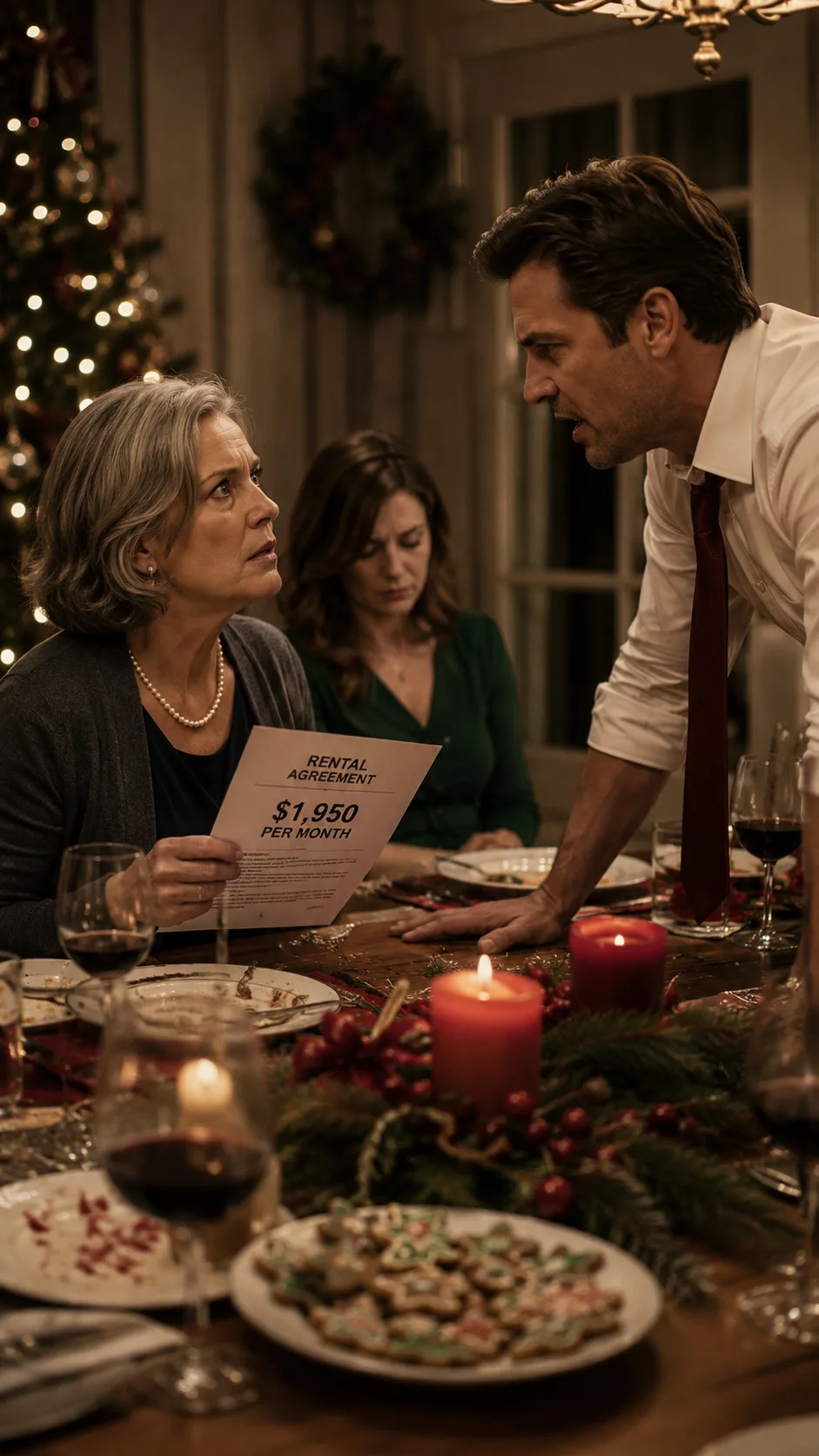
But a rent bill slid across a Christmas table became the paper trail that led us back to the truth.
And the truth, once recorded properly, is very hard to evict.
That should have been the end of it, or at least the end most people would have wanted me to tell. The clean ending. The kind where the lawyer wins, the son-in-law loses, the daughter apologizes, and the grandmother keeps her suite with a stamped document in a filing cabinet.
But real family stories do not end cleanly. They echo.
The first echo came two weeks after that second Christmas, when a certified letter arrived from Derek’s attorney. I recognized the envelope before I opened it, because by then my body had learned the shape of legal mail. My shoulders tightened. My breathing slowed. I set the letter on my little kitchen table, made tea, and called Patricia before I read a single line.
She answered herself.
“Please tell me you are calling to say happy New Year.”
“I wish I were.”
She sighed. “Read it to me.”
Derek was claiming that the occupancy agreement had been signed under pressure. He argued that he had been emotionally overwhelmed at mediation, financially distressed, and insufficiently aware of “future implications.” He wanted the agreement reopened. He wanted my occupancy converted into a “reasonable family contribution.” He did not use the word rent, because Patricia had taught him that word could cut both ways. But he meant rent.
When I finished reading, Patricia was quiet for a moment.
Then she said, “He is trying to make you tired.”
That sentence landed harder than the letter.
Because she was right.
There are people who try to win by being correct, and then there are people who try to win by making the other person exhausted enough to surrender. Derek had moved from charm to pressure, from pressure to paperwork, from paperwork to delay. He had discovered that he could not easily erase me, so he wanted to wear me down one certified envelope at a time.
“What do we do?” I asked.
“We answer once. Firmly. Then we ask for fees if he keeps going.”
Her reply was shorter than his demand and twice as sharp. It quoted the signed agreement. It quoted the independent counsel acknowledgment. It quoted the non-retaliation clause. It attached the mediation settlement, the recorded lien, and the court order denying his motion about the suite. Then, in one clean paragraph, Patricia wrote that any further attempt to relitigate the same settled issues would be considered bad-faith conduct and grounds for recovery of legal fees.
Derek did not answer.
For three weeks.
Then he tried something else.
He sent Claire a message saying he wanted the children to know “the truth about why Grammy broke up the family.” Claire showed it to me with shaking hands at the kitchen table.
I read it once.
Then I handed it back.
“This is not for you to answer alone,” I said.
“I don’t want them dragged into this.”
“Then we give them language before he gives them fear.”
We called the children’s therapist, a woman named Maribel who had warm eyes and the unflappable calm of someone who spent her days helping children put words around storms. She helped Claire prepare a simple explanation: adults had disagreements about money and honesty, Daddy and Mommy were living separately, Grammy did not break the family, and children were not responsible for fixing grown-up problems.
The next Sunday, Derek told Lily anyway.
He did it during a custody exchange in the driveway. Claire had stepped inside to get Cooper’s backpack, and Derek leaned down beside Lily’s booster seat and said something too low for me to hear. I only saw Lily’s face change.
When she came inside, she did not run to the kitchen like usual. She walked straight to my suite and stood in the doorway, still wearing her winter coat.
“Did you make Daddy leave?” she asked.
I felt every year of teaching rise in me at once. Every child who had repeated something ugly an adult had said. Every little face holding a question too heavy for its age.
“No,” I said. “I did not make Daddy leave.”
“He said you made papers.”
“I did make papers. The papers said the truth about my home and my money.”
“Were they mean papers?”
“No. They were honest papers.”
She frowned, struggling.
“Daddy said honest papers can still hurt people.”
“That is true,” I said.
She looked startled. She had expected me to defend myself, maybe because grown-ups often think children need certainty more than truth.
“Sometimes honest things hurt,” I continued. “But hurting because a truth is finally said is different from being hurt by a lie.”
She was quiet.
“Did Daddy lie?”
I did not want to answer. I wanted to protect her from the sentence. But I also knew that children feel lies even when adults wrap them in soft cloth.
“Yes,” I said gently. “Daddy lied about some grown-up things. That does not mean he does not love you. It means the grown-ups are working with helpers to make better rules.”
Her eyes filled.
“I don’t want rules. I want pancakes.”
That broke my heart more than the rent bill.
So we made pancakes.
Not because pancakes fix betrayal. They do not. But because children deserve rituals that keep surviving adult failures. Because flour and eggs and blueberries can become a tiny island. Because Lily needed one place where no one asked her to choose a side.
In February, the court appointed a parenting coordinator. Derek objected, of course. He said it was unnecessary. Then he sent three conflicting messages about pickup time in one week and blamed Claire for each misunderstanding. The coordinator’s first report used the phrase “pattern of avoidable ambiguity.”
Patricia loved that phrase.
“Pattern of avoidable ambiguity,” she repeated when Claire read it aloud in my suite. “That is a polite way of saying he creates fog and then complains people can’t see.”
Claire laughed, but she looked exhausted.
That winter was the hardest part for her. Harder than the separation itself, I think. The first months after leaving a controlling person can feel strangely clear because everything is urgent. Attorneys. Accounts. Passwords. School schedules. Temporary orders. Then the emergency pace slows, and a person is left with the long quiet work of realizing how much of their own life they had stopped hearing.
Claire began remembering things.
A vacation Derek insisted they could afford, though she had felt uneasy.
A credit card statement he said he had handled.
A night he told her she was “bad with numbers,” and she believed him because he said it gently.
A dozen small moments that had seemed like marriage friction at the time and now arranged themselves into a map.
One evening, she sat in my suite while snow tapped against the windows and said, “I think I let him make me smaller.”
I put down my knitting.
“I think he convinced you smallness was peace.”
She nodded slowly.
“Yes.”
Then she said, “Did Dad ever make you feel that way?”
The question surprised me.
“No,” I said. “Your father and I had our faults. We argued about money, about your brother’s college choices, about whether the roof could last one more winter when it absolutely could not. But he never made me feel foolish for noticing reality.”
Claire looked down at her hands.
“I want that someday.”
“You deserve that now, even alone.”
She cried then, but not like before. These were quieter tears. Less panic. More mourning.
In March, a year after the mediation, the lien did exactly what Patricia said it would do.
Derek tried to refinance one of his remaining properties to cover attorney fees and overdue obligations. The lender’s title search revealed my recorded lien on the marital home and the questionable gift letter attached to the earlier transaction. Suddenly, people who had treated the issue as family drama began using colder words.
Documentation concern.
Title cloud.
Potential misrepresentation.
The lender paused.
Then Derek’s divorce attorney called Claire’s attorney. Claire’s attorney called Patricia. Patricia called me.
“Are you sitting down?” she asked.
“I am now.”
“Derek wants to negotiate satisfaction of your lien early.”
I looked around my suite. The Lake Erie watercolor. The quilt. The tiny kitchen where the children had learned that pancake batter should be lumpy. The door to the garden where Cooper’s marigolds had not survived the frost but had left behind a small empty pot that he insisted would be “reborn in spring.”
“With what money?” I asked.
“His mother is helping. Possibly to keep the lender from digging too deeply.”
Elaine Mercer. Again.
I thought of her sitting at my table with those check copies, her hands trembling around the truth she should have told sooner.
“How much?”
“All of it. Plus a contribution toward your fees.”
My throat tightened.
All of it.
For months, the lien had been a shield. Suddenly it might become a door.
I did not answer right away.
Patricia understood.
“This does not require you to move,” she said. “The occupancy agreement is separate unless you choose otherwise.”
“I know.”
“But money changes emotional weather. I want you to take time before deciding what you want.”
That was another sentence I wrote down.
Money changes emotional weather.
For two days, I did not tell Claire. Not because I wanted secrets, but because I needed to hear my own mind before I heard anyone else’s need. I walked around the little suite touching things. The back of the chair. The edge of the counter. The doorframe where Cooper had once measured himself with a crayon before Claire made him apologize and I secretly wished she had not erased it so quickly.
I realized something uncomfortable.
The lien money mattered. Of course it did. It was my retirement, my years with Paul, the house we had paid off month by month when interest rates were high and our salaries were not. But the money was no longer the only question.
I had to decide where I wanted to grow old.
Not where fear wanted me.
Not where guilt wanted me.
Where I wanted.
When I finally told Claire, she cried again, but this time she did not ask me to stay.
That was how I knew she had changed.
She sat across from me and said, “I want you here because you want to be here. Not because your money is trapped here. Not because I need help. Not because you feel responsible for me.”
I looked at my daughter, really looked at her.
“That is the first clean invitation I have had since this started.”
She smiled through tears.
“Then I’m late, but I’m learning.”
The lien was paid in April.
The wire arrived on a Thursday morning. Patricia confirmed it before noon. I drove to her office, and she handed me the final paperwork: lien released upon payment, funds secured in my separate account, occupancy rights intact unless voluntarily modified.
I sat in her parking lot afterward with both hands on the steering wheel, and for a long moment I could not start the car.
Paul and I had bought Clover Street with a loan that felt impossible at the time. We painted the nursery ourselves before Claire was born. We replaced the furnace the year Daniel broke his arm falling out of the maple tree. We hosted graduations, wakes, birthday parties, and one terrible Thanksgiving when the turkey was raw at noon and Paul solved the crisis by ordering pizza.
That house had become money.
Then that money had become leverage.
Now it was mine again.
Not the house.
Not the roses.
But the proof of the life that built them.
When I returned to Cincinnati, Cooper was waiting outside my suite with a plastic shovel.
“Grammy, the marigolds are dead.”
“I noticed.”
“But Mommy said spring means try again.”
“She’s right.”
He held out a seed packet.
“Can we plant these?”
I looked at the packet. Zinnias. Bright, stubborn, cheerful flowers.
“Yes,” I said. “We can.”
He frowned. “Are they fancy?”
“No.”
“Good. Fancy flowers sound bossy.”
I laughed.
We planted them in the pot by my door.
That night, I told Claire I would stay through the summer and decide after that. Not because I was unsure of her, but because I owed myself the dignity of choosing slowly.
She said, “That’s fair.”
Those two words felt like another kind of document.
Fair.
Summer came green and loud. The zinnias grew. Lily turned eight. Cooper lost a front tooth and spoke with a whistle for three weeks. Daniel visited from overseas in July, and for the first time in years both my children sat at the same kitchen table with me, laughing about Paul’s old habit of labeling every cord in the house with masking tape.
Daniel walked the property with me one morning.
“So,” he said, “are you staying?”
“I think so.”
He nodded.
“You don’t have to.”
“I know.”
“That’s why it matters if you do.”
We stood by the side garden. The suite windows caught the morning light. Inside, I could see the edge of my little table, the place where the first folder had opened, where Claire had cried, where the children had mixed batter, where legal language had somehow helped return human language to us.
“I’m not staying in Derek’s arrangement,” I said. “I’m staying in mine.”
Daniel smiled.
“Good.”
By August, Claire’s divorce was nearly final. Derek had agreed to a parenting schedule. He had stopped trying to challenge my occupancy, mostly because every attempt cost him money and gained him nothing. He moved into a rented townhouse on the other side of the school district and began presenting himself as a man rebuilding after “a difficult chapter.”
That was fine.
Let him have chapters.
I had records.
One afternoon, while I was picking Lily up from a birthday party, I saw Derek across the parking lot. He was standing beside his car, talking to another father. He looked over and saw me. For a moment, the old contempt flickered in his face.
Then it disappeared.
He nodded once.
Not friendly.
Not apologetic.
But careful.
I returned the nod.
Careful was enough.
A year and a half after the Christmas Eve envelope, Claire hosted dinner on the back porch. Nothing fancy. Burgers, corn on the cob, a salad from a grocery store bag because not every scene needs to prove something. Dorothy came from Columbus with a jar of homemade jam and stories about her new neighbor’s badly behaved dog. Elaine Mercer came too, which surprised everyone, including her.
She stood awkwardly near the steps holding a peach cobbler.
Claire glanced at me.
I nodded.
Elaine crossed the porch and said, “Margaret, I don’t expect—”
“I know,” I said.
She looked down.
“I should have spoken sooner.”
“Yes.”
“I am sorry.”
I studied her face. There was no performance in it. Just age, regret, and the tired knowledge that loving someone does not absolve you from naming what they do.
“Thank you,” I said.
Not forgiveness. Not yet.
But acknowledgment.
Sometimes that is the first honest brick.
After dinner, the children chased fireflies in the yard the way they had the summer before, tiny lights blinking on and off over the grass. Claire sat beside me and handed me a glass of lemonade.
The porch boards creaked. Somewhere down the street, a lawn mower started and stopped. Dorothy laughed at something Daniel said. Cooper ran past shouting that he had caught “a whole constellation,” though his jar was empty.
Claire leaned toward me.
“Do you ever wish you hadn’t come here?”
I watched Lily cup her hands around a firefly, her face glowing with triumph before she opened her fingers and let it go.
“Yes,” I said.
Claire flinched.
I took her hand.
“And no.”
She waited.
“I wish I had protected myself before coming. I wish I had brought my own attorney to the beginning instead of the wreckage. I wish I had kept Clover Street until the ink was exactly right. I wish you had not had to learn your marriage this way. I wish the children had never heard any of it.”
She nodded, tears gathering.
“But I do not wish away the pancakes,” I said. “Or the zinnias. Or the Thursday dinners we rebuilt honestly. I do not wish away knowing that you can come back to yourself.”
She squeezed my hand.
“I’m still coming back.”
“I know.”
“So am I.”
That was the truest thing I had said in a long time.
Because this was not only Claire’s recovery. It was mine too. I had spent widowhood teaching myself to need less, ask less, occupy less space. Derek did not invent my silence. He simply found it useful. The legal fight taught me more than how to protect money. It taught me that I was allowed to be inconvenient in defense of my own life.
Allowed to ask.
Allowed to verify.
Allowed to say no.
Allowed to make a room uncomfortable when comfort depended on my erasure.
The zinnias bloomed until October.
They were loud flowers, orange and pink and red, completely lacking the polite elegance I once tried to cultivate in containers. Cooper loved them because bees came. Lily loved them because they looked “like fireworks that decided to behave.” I loved them because they had grown in soil I chose, after a year when everything had to be replanted with intention.
On the next Christmas Eve, no one slid an envelope across the table.
There were no surprise documents.
There was, however, a folder on the sideboard.
Mine.
Claire teased me about it when she saw it.
“Do you travel with that now?”
“Only emotionally.”
“What’s in it?”
“Copies.”
“Of what?”
“Everything.”
She laughed.
Then she grew serious.
“I’m glad.”
“So am I.”
Before dinner, Cooper handed me a handmade ornament. It was a popsicle-stick house with crooked glitter on the roof and a tiny paper flower glued beside the door.
“It’s your house,” he said.
“My suite?”
“No,” he said, with the impatience of a child correcting an adult who has missed the obvious. “Your house. Wherever you are.”
I held the ornament carefully.
I thought of Clover Street. Of the colonial. Of legal descriptions and deed books and lien releases. Of the difference between property and belonging.
Then I hugged him.
At dinner, Claire put the serving bowl down, sat beside me, and said, “Before we eat, I want to say something.”
The children groaned because children are allergic to speeches when rolls are visible.
Claire ignored them.
“Last Christmas, we were still living inside what we had not said. This year, I want our house to be different. No hidden documents. No quiet resentment. No pretending money does not matter. No pretending love fixes bad paperwork.”
She looked at me.
“Mom, this is your home as long as you choose it. Not because we need you. Not because you paid. Because we want you here and because the agreement says exactly what everyone understands.”
Lily raised her hand.
“Can agreements also say dessert happens soon?”
Everyone laughed.
I looked around that table and realized the old ache had not vanished, but it had become part of something larger. There was room for it now. Room for grief, caution, forgiveness, boundaries, children, paperwork, and cranberry pound cake.
That is what Derek never understood.
He thought control was ownership.
He thought a signature gathered in confusion could replace consent.
He thought a retired teacher would be too embarrassed, too loving, too afraid of family fracture to push back.
He thought wrong.
Because the woman he tried to turn into a tenant had spent her entire adult life teaching children how to read carefully.
Eventually, I remembered to read for myself.
And once I did, every line changed.
THE END.
Chapter complete
You have reached the end of this chapter.
Continue reading
A few more worlds to get lost in after this chapter.




