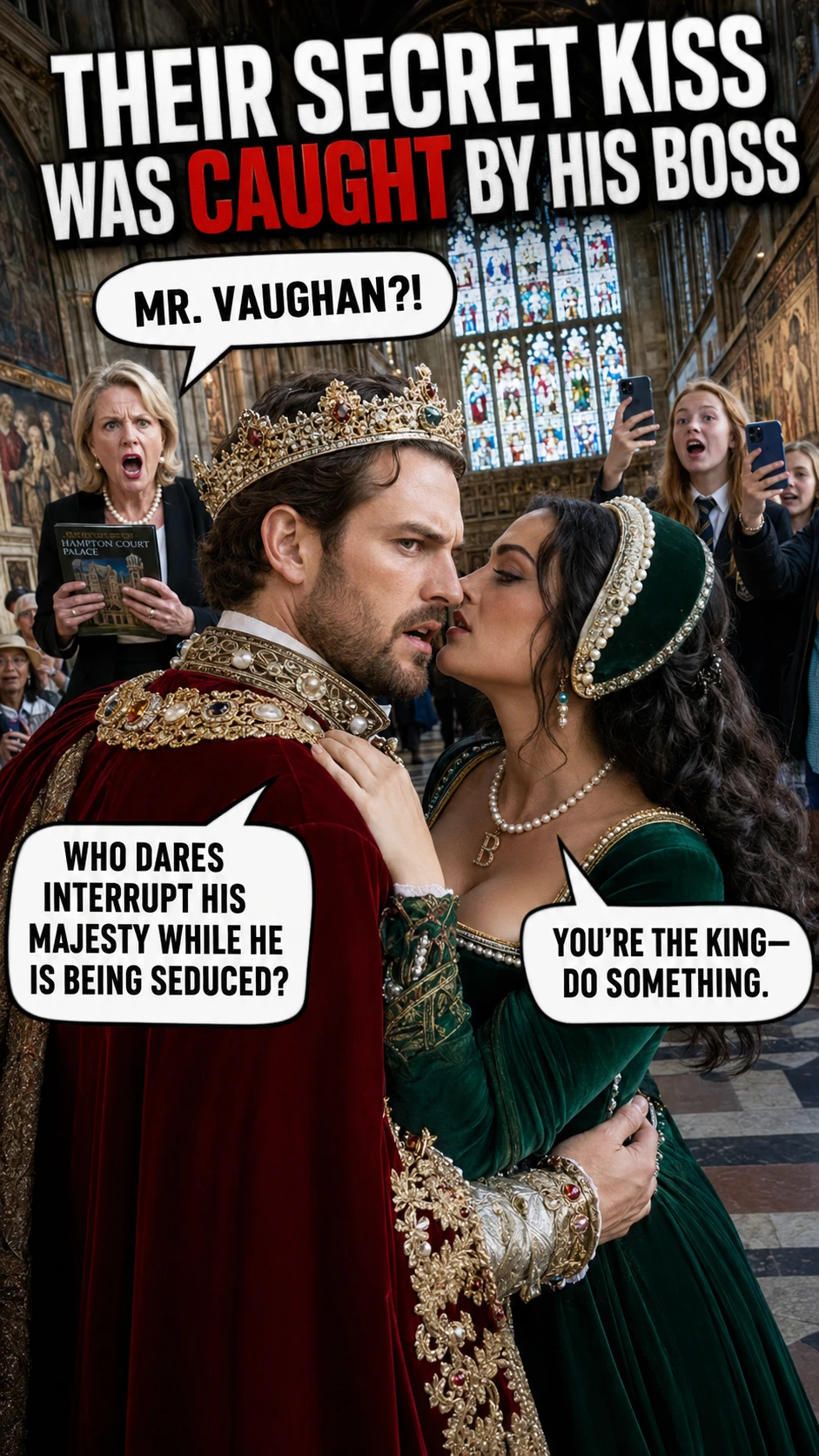
THEIR SECRET KISS WAS CAUGHT BY HIS BOSS
Opening Hook: The Kiss That Could Ruin Everything
The first time Elodie Peach kissed me, I was wearing a crown, a velvet robe, and a historically inaccurate codpiece large enough to frighten small children.
Chapter 1
The first time Elodie Peach kissed me, I was wearing a crown, a velvet robe, and a historically inaccurate codpiece large enough to frighten small children.
She was dressed as Anne Boleyn.
Three hundred tourists were watching.
And one of them was the headteacher of our school.
Elodie’s mouth was still against mine when a familiar voice cut through the Great Hall of Hampton Court Palace.
“Mr. Vaughan?”
Every muscle in my body froze.
Elodie slowly pulled away, her green eyes sparkling with the kind of wicked delight that had probably started wars.
“Oh,” she whispered, barely suppressing a smile. “Is that your boss?”
I stared over her shoulder.
Dr. Margaret Finch stood beneath a portrait of Henry VIII, clutching a souvenir guidebook like she intended to beat me to death with it.
Beside her were two Year Eleven students.
Both had their phones raised.
Both were recording.
My professional career flashed before my eyes.
History teacher.
Head of Department.
Respected educator.
Unemployed man found wandering the Thames in velvet tights.
Elodie leaned closer, her lips
brushing my ear.
“You’re the king,” she murmured. “Do something.”
I swallowed.
Then I turned toward the crowd, lifted my chin, and shouted in my most commanding Tudor voice:
“Who dares interrupt His Majesty while he is being seduced?”
The tourists erupted in laughter.
Dr. Finch did not.
One of the students zoomed in.
And Elodie—traitorous, beautiful Elodie—slipped her hand into mine.
That was the moment I realized two things.
First, the video would be online before sunset.
Second, I was already hopelessly in love with her.
Unfortunately, she was also the one woman I could never allow myself to have.
Monday to Friday, I was Mr. Vaughan.
Not Oliver.
Never Ollie.
Mr. Vaughan.
Head of History at St. Bartholomew’s Academy.
I wore gray suits, corrected grammar in staff emails, and had perfected a facial expression capable of silencing thirty teenagers
without saying a word.
“If today were your last day… what song would you choose to hear?”
The students called it “the execution stare.”
I pretended not to know.
I also pretended not to know about the T-shirt they had bought me the previous Christmas.
It read:
I HAVE A HARD-ON FOR REVISIONIST HISTORY.
The shirt lived at the bottom of my wardrobe, beneath several respectable sweaters and what remained of my dignity.
My reputation at school was simple: brilliant teacher, miserable human being.
Then Elodie Peach joined the department.
She arrived twelve minutes late to Monday briefing, carrying three coffees, a broken umbrella, and absolutely no shame.
“I’m so sorry,” she announced, breathless. “A pigeon attacked me.”
No one spoke.
Elodie looked around the room.
“I’d like to clarify that I didn’t provoke it.”
A few
teachers laughed.
I did not.
I was too busy staring.
She had clear green eyes, dark curls damp from the rain, and a long, graceful neck that immediately made me think of Anne Boleyn.
That should have been my first warning.
My second warning came when she dropped into the empty chair beside me and offered me one of the coffees.
“Peace offering?”
“You haven’t offended me.”
“Not yet.”
I looked at her.
She smiled.
It was not a safe smile.
It was the smile of a woman who had already identified every wall I had built around myself and was deciding which one would be the most entertaining to destroy.
Dr. Finch began introducing her.
“Elodie Peach will be teaching early modern history and assisting Mr. Vaughan with the Year Twelve curriculum.”
Elodie turned to me.
“Lucky you.”
“I don’t believe in luck.”
“No. You look like you believe in filing systems.”
I should have disliked her.
Instead, something hot and dangerous tightened in my chest.
I opened my notebook.
“You’re late,” I said.
“A pigeon attacked me.”
“You mentioned that.”
“You don’t seem sympathetic.”
“I reserve sympathy for documented historical casualties.”
She leaned closer.
“Careful, Mr. Vaughan. One day, I might become one.”
Her voice was playful.
But the way she looked at me was not.
For one reckless second, the entire staffroom seemed to disappear.
Then Dr. Finch cleared her throat.
“Mr. Vaughan?”
I looked up.
“Yes?”
“You’re holding your pen upside down.”
Elodie covered her smile with her coffee cup.
I hated her immediately.
Which was unfortunate, because I wanted her just as quickly.
Elodie was chaos in red lipstick.
She encouraged students to debate historical figures as if they were contestants on reality television.
She brought replica weapons into school without warning me.
She once began a lesson by writing:
WAS HENRY VIII A MONSTER, OR JUST A MAN WITH TERRIBLE COPING SKILLS?
across the whiteboard.
I stopped in the doorway.
“What,” I asked carefully, “is this?”
“Education.”
“It looks like a cry for help.”
“Same thing, depending on the school.”
The students laughed.
Elodie tossed me a marker.
“Come on, Mr. Vaughan. Defend your king.”
“He is not my king.”
“You spend a suspicious amount of time talking about him.”
“I am a historian.”
“You’re obsessed.”
“I am thorough.”
“You know his waist measurements.”
“That information is relevant to understanding the physical deterioration of—”
“You know his waist measurements,” she repeated.
The class began chanting.
“De-fend the king! De-fend the king!”
I should have shut the lesson down.
Instead, I walked to the board and wrote:
ANNE BOLEYN WAS MORE DANGEROUS THAN HENRY.
Elodie’s eyebrows lifted.
“Dangerous?”
“Intelligent. Ambitious. Charismatic. She understood the effect she had on powerful men.”
Elodie crossed her arms.
“And that made her dangerous?”
“It made her unforgettable.”
The room went silent.
Her gaze met mine.
Something shifted between us.
The students felt it too.
A boy in the back whispered, “This is better than Netflix.”
I capped the marker.
“Textbooks open. Page one hundred and eighty-seven.”
The class groaned.
Elodie waited until the students were occupied before stepping beside me.
“You’re frightened of me,” she whispered.
I did not look at her.
“Don’t be absurd.”
“You haven’t looked directly at me for more than four seconds since I arrived.”
“I’m looking at you now.”
“Yes.”
She stepped closer.
Five seconds.
Six.
Her perfume was warm and faintly floral.
Seven.
Her eyes dropped to my mouth.
Eight.
Then she whispered, “Run, Henry.”
I moved away so quickly I walked into a desk.
The students applauded.
That evening, I stayed at school until nearly eight, pretending to organize examination papers.
The truth was much less respectable.
I was afraid that if I went home, I would dream about her.
I went home.
I dreamed about her.
Every Saturday, I became someone else.
At Hampton Court Palace, I was not the silent, severe Head of History.
I was Henry VIII.
I shouted at traitors.
Flirted with tourists.
Threatened imaginary ambassadors.
I wore rings on every finger and walked as if England itself belonged to me.
There was power in the costume.
The crown made me taller.
The robe made me broader.
The codpiece made me deeply concerned about historical fashion.
Most importantly, no one there knew me as Mr. Vaughan.
Until Elodie Peach appeared in the courtyard.
I saw her halfway through a performance.
She stood among the tourists wearing jeans, boots, and an expression of pure astonishment.
I forgot my next line.
My fellow performer, playing Cardinal Wolsey, nudged me.
“Your Majesty?”
Elodie slowly smiled.
“Oh,” she mouthed.
I recovered just in time.
“Wolsey,” I roared, “remove that smirking woman from my sight!”
The tourists turned toward her.
Elodie pressed a hand to her chest.
“Me, Your Majesty?”
“You appear to find your king amusing.”
“I find your codpiece ambitious.”
The courtyard exploded with laughter.
I felt heat rise beneath my collar.
Wolsey whispered, “Do you know her?”
“Unfortunately.”
Elodie walked forward.
“Perhaps His Majesty is compensating for something.”
A collective gasp swept through the crowd.
I descended the steps until I stood directly in front of her.
At school, I would have retreated.
But I was not at school.
I was the king.
I leaned down.
“Careful,” I said. “Women who challenge me tend to lose their heads.”
Her eyes glittered.
“Only because you can’t stand women who get inside yours.”
For one breathless moment, neither of us moved.
Then a little girl in the crowd shouted, “Kiss her!”
Her mother looked horrified.
Elodie laughed.
I stepped back.
“The king does not take orders from children.”
The little girl folded her arms.
“Coward.”
The crowd laughed again.
Elodie stared at me as if she had finally found the real man hidden beneath my gray suits.
When the performance ended, she waited near the archway.
I approached her, still in costume.
“How did you find me?”
“I didn’t. I came for the exhibition.”
“You hate Tudor portraiture.”
“I said it was propaganda with expensive sleeves. That doesn’t mean I hate it.”
“You cannot tell anyone at school.”
Her smile faded slightly.
“Why not?”
“Because I am their department head.”
“And?”
“And department heads do not wear tights in public.”
“You should put that in the staff handbook.”
“Elodie.”
She studied me.
“Why are you ashamed of this?”
“I’m not ashamed.”
“You look more alive here than you ever do at school.”
“That is irrelevant.”
“No, Oliver. It’s the only relevant thing.”
It was the first time she had used my first name.
The sound of it on her lips felt indecent.
“Don’t call me that,” I said.
“Why?”
“Because I’m your line manager.”
Her expression changed.
There it was.
The boundary.
The cold splash of reality.
“Of course,” she said quietly. “Mr. Vaughan.”
She turned to leave.
I should have let her go.
Instead, I said, “We need an Anne.”
She looked back.
“What?”
“Our actress is ill. The afternoon performance needs an Anne Boleyn.”
“And you’re asking me?”
“You know the history.”
“I also know how she ends.”
“Most people do.”
Elodie walked toward me.
“And what exactly would I have to do?”
“Challenge me.”
“I already do that for free.”
“Flirt with me.”
Her gaze sharpened.
“That might cost you.”
My pulse stumbled.
“I mean in character.”
“Of course you do.”
She moved so close that the embroidered edge of my robe brushed her arm.
“Tell me, Your Majesty,” she whispered. “Are you afraid I’ll be too convincing?”
I looked down at her.
“No.”
It was the most obvious lie I had ever told.
Elodie emerged from the costume room in a black velvet gown edged with pearls.
Every coherent thought left my head.
Her curls had been pinned beneath a French hood. A delicate gold “B” rested against her throat.
She looked elegant.
Defiant.
Doomed.
She looked like a temptation history had failed to bury.
“Well?” she asked.
I said nothing.
“Oliver?”
“You look…”
“Historically accurate?”
“Dangerous.”
Her smile returned.
“Good.”
The performance began with an argument.
At least, it was supposed to be an argument.
Elodie turned it into a public execution.
“You promised me a crown,” she declared before the crowd. “But promises from kings are merely lies wearing jewelry.”
A murmur rippled through the tourists.
I stepped toward her.
“You forget yourself.”
“No. I finally remembered myself.”
“That line isn’t in the script,” I muttered.
“Neither is your panic.”
The crowd thought it was part of the show.
She circled me slowly.
“Tell me, Henry. Do you desire me because you love me—or because I am the only woman who refuses to kneel?”
I knew the correct scripted answer.
I did not use it.
“I desire you,” I said, “because every room becomes unbearable the moment you leave it.”
Her smile disappeared.
The air changed.
Even the tourists went quiet.
Elodie swallowed.
Then she whispered, “That line isn’t in the script either.”
“No.”
“Say it again.”
“I can’t.”
“Coward.”
Something in me snapped.
Five weeks of restraint.
Five weeks of pretending.
Five weeks of watching her laugh with other teachers and feeling irrationally furious at men who had done nothing wrong except stand too close to her.
I took her hand.
“Every room,” I said, louder this time, “becomes unbearable the moment you leave it.”
Her breath caught.
Then she kissed me.
It was not scripted.
It was not gentle.
It was the kind of kiss that destroys plausible deniability.
Her fingers gripped the front of my robe. My hand found her waist. The crowd gasped, then cheered.
For three glorious seconds, I forgot the school.
I forgot professionalism.
I forgot that Henry and Anne were one of history’s worst examples of workplace romance.
Then Dr. Finch spoke.
“Mr. Vaughan?”
And the entire Tudor dynasty collapsed around me.
By Monday morning, the video had thirty-eight thousand views.
The title was:
STRICT HISTORY TEACHER GOES FULL HENRY VIII AND MAKES OUT WITH COWORKER
By lunchtime, it had reached ninety thousand.
Someone added dramatic music.
Someone else slowed down the kiss.
A Year Nine student created an edit with flames, crowns, and the words:
THE CHEMISTRY DEPARTMENT COULD NEVER.
I considered changing my name and moving to Scotland.
Dr. Finch summoned us at eight fifteen.
Elodie sat beside me in the headteacher’s office.
Our knees almost touched.
Neither of us moved.
Dr. Finch placed her tablet on the desk.
The video was paused at the worst possible moment.
My hand was around Elodie’s waist.
Her mouth was against mine.
The codpiece was prominently visible.
Dr. Finch removed her glasses.
“I have several questions.”
Elodie raised her hand.
“Before you begin, I’d like to state that the codpiece is not his.”
I closed my eyes.
Dr. Finch inhaled very slowly.
“Elodie.”
“It belongs to the palace.”
“Elodie, stop helping.”
“I’m trying to protect your reputation.”
“You are setting fire to what remains of it.”
Dr. Finch tapped the screen.
“Are the two of you in a relationship?”
“No,” I said.
“Yes,” Elodie said.
I turned to her.
“What?”
She turned to me.
“What?”
Dr. Finch stared between us.
“Would either of you care to revise your answer?”
Elodie’s face hardened.
“No. Apparently Mr. Vaughan would.”
“That isn’t what I meant.”
“Then what did you mean?”
“I meant we are not in a relationship.”
“You kissed me.”
“You kissed me.”
“You kissed me back like the palace was sinking.”
Dr. Finch raised a hand.
“Please. I am still responsible for safeguarding, and this conversation is becoming medically uncomfortable.”
Elodie looked away.
I could see the hurt beneath her anger.
Dr. Finch folded her hands.
“There is no policy preventing two adult colleagues from having a consensual relationship. However, Oliver, you directly supervise Elodie.”
“I know.”
“If this continues, the reporting structure must change.”
“This will not continue,” I said.
Elodie went completely still.
The silence that followed was worse than shouting.
Dr. Finch studied me.
“Are you sure?”
I looked at Elodie.
Her eyes were bright, but she refused to blink.
I wanted to tell the truth.
I wanted to say I had spent every night imagining the impossible shape of a life with her.
Instead, fear spoke for me.
“Yes.”
Elodie stood.
“Wonderful.”
“Elodie—”
“No, Mr. Vaughan. You’re right. It was a performance.”
She smiled, but it looked painful.
“And you were very convincing.”
Then she walked out.
Every room becomes unbearable the moment you leave it.
I had told her that in front of three hundred strangers.
Yet when it mattered, I had let her go.
Elodie stopped teasing me.
That was how I knew I had truly wounded her.
She remained polite.
Professional.
Distant.
She no longer brought me coffee.
No longer leaned into my classroom with some scandalous theory about medieval politics.
No longer called me Oliver.
The students noticed.
Of course they did.
Teenagers could ignore a homework deadline announced twelve times, but they could detect romantic misery from across a football field.
After one painfully silent department meeting, Year Twelve student Mia Collins remained behind.
“Sir?”
“Yes?”
“Can I say something inappropriate?”
“You usually do without permission.”
“You’re an idiot.”
I looked up.
“Detention.”
“Worth it.”
She folded her arms.
“Ms. Peach likes you.”
“That is not an appropriate topic.”
“And you like her.”
“Mia.”
“You look at her like she’s the last primary source on earth.”
I stared at her.
She shrugged.
“You taught us metaphor.”
Then she left before I could assign the detention.
That Saturday, I returned to Hampton Court.
I put on the crown.
It felt heavier than usual.
During the performance, a tourist asked where Anne was.
I nearly answered, “Gone.”
Instead, I gave the historical explanation.
Afterward, I sat alone in the costume room.
My colleague, Hannah, who normally played Catherine of Aragon, entered and began removing her jewelry.
“You’ve been unbearable all day,” she said.
“Thank you.”
“The woman from last week?”
I said nothing.
Hannah looked at me in the mirror.
“You know Henry VIII’s biggest problem?”
“I suspect you’re about to tell me.”
“He confused power with courage.”
I frowned.
“He had the power to change England,” she continued. “But when it came to his own fear, he behaved like a frightened child with an axe.”
“That is a grotesque oversimplification.”
“Is it inaccurate?”
I removed the crown.
“No.”
Hannah smiled.
“Then stop playing the worst version of him.”
I looked at my reflection.
Without the crown, without the robes, I was just Oliver Vaughan.
A man who could command a hall full of tourists but could not tell one woman the truth.
So I changed my clothes.
And for the first time in years, I made a decision that had nothing to do with caution.
I found Elodie in her classroom on Monday morning.
She was pinning essays to a display board.
She did not turn around.
“Your meeting isn’t until nine.”
“I’m not here for a meeting.”
“Then you’re six months early for the Christmas party.”
“Elodie.”
She faced me.
Her expression was guarded.
“I asked Dr. Finch to change the department structure.”
She blinked.
“What?”
“You will report directly to her for the remainder of the year. I will no longer conduct your observations or review your performance.”
“Why?”
“Because I was a coward.”
She said nothing.
I moved closer.
“I told myself I was protecting your career. And mine. Perhaps part of me was.”
“Oliver—”
“But mostly, I was afraid.”
“Of the video?”
“Of you.”
Her eyes narrowed.
“That’s not romantic.”
“Let me finish.”
I took a breath.
“I am good at history because history cannot surprise me. The endings are already written. The dead stay dead. The kings make the same mistakes every time I open the book.”
Elodie’s expression softened.
“But you,” I continued, “walk into a room and nothing stays predictable. You make students care. You make me laugh when I am determined not to. You make me want things I have spent years convincing myself I do not need.”
Her lips parted.
“I don’t know how our story ends,” I said. “And that terrifies me.”
She stared at me for a long moment.
Then she asked, “Is there a point coming?”
“Yes.”
“Good. Because the speech is lovely, but I have photocopying.”
I almost laughed.
The tension cracked.
I stepped closer until only inches separated us.
“The point is that every room becomes unbearable when you leave it.”
Her eyes shone.
“And?”
“And I am in love with you.”
The words hung between us.
Elodie looked down.
“You humiliated me.”
“I know.”
“You rejected me in front of Dr. Finch.”
“I know.”
“You let the entire internet believe I seduced you because of a codpiece.”
“In fairness, the codpiece had a supporting role.”
She fought a smile.
I reached for her hand, then stopped before touching her.
“You do not owe me forgiveness.”
“No,” she said. “I don’t.”
“I will accept whatever you decide.”
Her gaze lifted to mine.
“Really?”
“Yes.”
“Even if I decide to make you suffer?”
“I assumed that was inevitable.”
She stepped forward.
“Good.”
Then she grabbed my tie and pulled my face close to hers.
My heart stopped.
Her mouth hovered over mine.
“One condition,” she whispered.
“Anything.”
“You never call Anne Boleyn more dangerous than Henry again.”
“That is academic censorship.”
“Oliver.”
“Fine.”
“And you wear the T-shirt.”
I froze.
“What T-shirt?”
Her grin became devastating.
“Oh, I know about the T-shirt.”
“How?”
“The students showed me a photograph.”
“I will have them expelled.”
“You’ll wear it at the department barbecue.”
“Absolutely not.”
She released my tie.
“Then I suppose we have nothing more to discuss.”
She turned away.
I caught her gently by the waist.
“Elodie.”
She looked back.
I kissed her.
This time, there was no crowd.
No costumes.
No king.
No queen.
Just two terrified people choosing something unpredictable.
When we finally separated, she rested her forehead against mine.
“You’re still wearing the shirt,” she whispered.
I sighed.
“For you, I would survive public execution.”
The video eventually reached two million views.
For several weeks, students bowed whenever I entered a classroom.
Someone placed a plastic crown on my desk.
Dr. Finch banned the phrase “royal chemistry” from official school communications.
Elodie and I took things slowly.
At least, we tried.
She was still infuriating.
I was still, according to her, “emotionally constipated with excellent posture.”
We argued over curriculum choices, historical interpretations, and whether my kitchen needed more than one kind of tea.
But we also laughed.
Constantly.
She taught me that a life built entirely around control was not really a life.
I taught her that deadlines were not suggestions invented by oppressive institutions.
The following spring, Hampton Court needed an Anne Boleyn again.
Elodie agreed on one condition.
“No surprise executions.”
“I make no promises,” I told her.
She adjusted my crown.
Tourists gathered in the courtyard as we took our places.
A little girl near the front pointed at us.
“Are you really married?”
Elodie glanced at me.
“Not yet.”
My breath caught.
She smiled innocently, as if she had not just detonated a bomb in the center of my chest.
The performance began.
I delivered my opening speech.
Elodie swept into the courtyard dressed in velvet and pearls, beautiful enough to alter the course of nations.
She approached the throne.
“Kneel,” I commanded.
The crowd waited.
Elodie lifted her chin.
“Make me.”
Laughter erupted.
I descended the steps until I stood before her.
For a moment, we were Henry and Anne again.
The king and the woman who refused to fear him.
But I knew better now.
Love was not conquest.
It was not surrender.
It was standing before another person without armor, crowns, or carefully rehearsed lines.
I held out my hand.
Elodie took it.
And when she looked at me, I understood something history books rarely admitted:
The most powerful moments are not always the ones that change kingdoms.
Sometimes, they are the quiet moments that change one stubborn heart.
“Careful, Ms. Peach,” I whispered. “People are watching.”
She rose onto her toes, her lips close to mine.
“Let them.”
Then she kissed me beneath the red-brick towers of Hampton Court Palace.
The tourists cheered.
The children laughed.
Somewhere in the crowd, a phone began recording.
And this time, I did not care how the story looked to anyone else.
Because for the first time in my life, I was not studying history.
I was living it.
Chapter complete
You have reached the end of this chapter.
Continue reading
A few more worlds to get lost in after this chapter.




