PART 4 — IT WAS NEVER ABOUT THE CANDLE
They came back the next morning.
Chapter 4
PART 4 — IT WAS NEVER ABOUT THE CANDLE
They came back the next morning.
Jacob’s knock was not loud this time. It was deliberate, controlled.
I stood on the other side of the door, waiting, not because I was unsure, but because I wanted to be calm.
When I opened it, both Jacob and Lindsay stood straighter than yesterday. Less rage, more calculation.
Lindsay held a folder in her hand.
“We’re not here to fight,” she said. “We just want to talk. We were wrong, okay? Everyone makes mistakes.”
Hope stood behind me, watching quietly.
Walter leaned against the porch rail, arms crossed.
Jacob’s voice dropped.
“Just a week, Mom. We have nowhere else. Just let us stay until we figure things out.”
I stepped aside, but only long enough to pick up something from the hallway table.
A small wooden box.
I walked past them and set it gently on the porch table. Then I opened the lid.
Inside was a candle.
Lavender.
The same scent they had mocked for years.
Beside it was a USB drive.
They stared at it.
“What is that?” Jacob asked.
I picked up the drive and turned it over in my hand.
“Something I never meant to use,” I said. “Until you came here talking about betrayal.”
Lindsay scoffed.
“Seriously? You’re playing videos now?”
I nodded toward Walter.
“He helped me recover it from the old house. The security system I installed after your father fell twice. The one you never knew recorded sound.”
Jacob’s jaw twitched.
“You’re bluffing.”
“No,” I said. “I kept the worst one. Just one.”
I walked back inside and returned with my laptop. I clicked.
The screen came alive.
It was grainy footage, but clear enough. The living room. My late husband, Harold, on the recliner, thin and coughing. Jacob standing over him, arms crossed.
“You just sit there all day, don’t
you?” Jacob said in the video. “You’re not even trying. Why don’t you go to a nursing home or something? You’re dragging Mom down with you.”
Harold did not answer in the clip. He just looked away.
Jacob again, louder this time.
“You’re not a father anymore. You’re a burden. You’re sucking the life out of this house.”
The clip stopped.
Silence replaced it.
Jacob’s face had gone pale.
Lindsay stammered, “That’s out of context.”
“No,” I said softly. “That is the context you gave us. Your father cried that night. Told me he felt invisible. You did that, Jacob. You called him worthless before the cancer took him. And when I lit candles to remember him, you said I was crazy.”
Hope stood at my side, small and fierce.
She said, “Mama, is that the man you loved?”
I nodded.
She stepped in front of me and looked up
at Jacob.
“You hurt her and him. You don’t deserve this house.”
Walter had not moved, but he stepped forward now, placing his hand on my shoulder. Quiet. Steady.
He did not need to speak.
Jacob took a step forward.
“You don’t get to judge me. You think you’re some hero now because of a kid in a cabin? You were nothing until that baby showed up.”
I looked at the broken man in front of me. The boy I once bathed in a tin tub. The one I sat beside during storms. The boy who grew into a man I no longer recognized.
“You talk about betrayal,” I said. “But how can you betray something you never honored to begin with?”
He did not answer.
Lindsay snapped, “This is insane. You’re choosing a candle and a memory over your real family.”
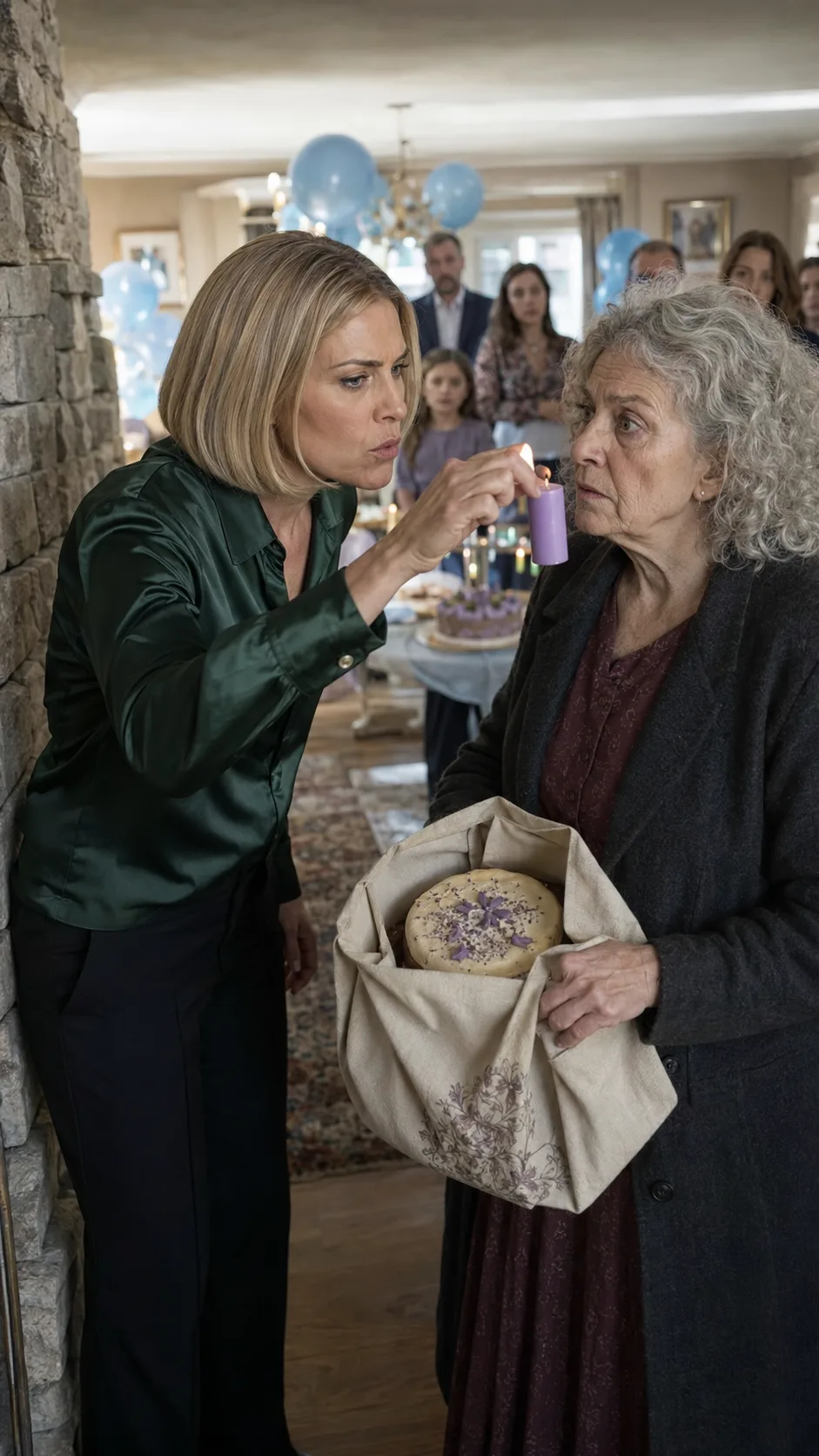
I picked up the lavender candle and held it between both hands.
“You never understood. It was never about the candle. It was about respect.”
Jacob slapped the laptop shut. Then, in a burst of anger, he swiped the candle from my hands and hurled it onto the porch.
It shattered. Glass and wax everywhere.
Hope flinched.
Walter stepped in finally.
“That’s enough,” he said. “You’re done here.”
Jacob glared.
“This isn’t over.”
“Yes,” I said calmly. “It is.”
He stormed off the porch. Lindsay followed, muttering under her breath about lawyers, consequences, and how we would see who ended up alone.
They left in silence, kicking up dust as they disappeared into the trees.
I bent down to pick up the broken candle pieces.
Hope helped, gathering the wax into her tiny palms.
She whispered, “We can light a new one, Mama.”
I smiled.
“We already have.”
The sound of their tires crunching over the gravel faded until the forest reclaimed the silence.
I stood still for a moment, not angry, not triumphant, just resolved.
I closed the door gently, not with rage, not with vengeance, but with finality.
Then I turned the lock.
A simple click. Not loud, but firm.
Hope looked up at me, her little hands still dusted with broken candle wax.
“Mama,” she asked, “do we still light the lavender tonight?”
I smiled, smoothing her hair back.
“Of course, my love. We light it for the people we carry in our hearts, not the ones we had to leave behind.”
She beamed.
I took the new candle from the drawer.
Lavender. Always lavender.
That night, we sat at the table as the warm scent curled into the air, wrapping around us like a lullaby.
Walter joined us, pouring three small mugs of tea.
Hope insisted on making a toast with her juice box held high.
“To family that sees you,” she said, “and loves you anyway.”
I clinked my cup to hers.
“To quiet strength,” Walter added. “To beginnings disguised as endings.”
The candle flickered gently as we sipped.
Outside, the snow began to fall again. Soft, slow, undisturbed.
That week, a journalist returned to do a follow-up story.
The headline read, “From Forgotten to Fierce: The Grandma Who Lit a Candle in the Cold.”
They wrote about my years in silence. My banishment. The baby girl by the dumpsters. The man I once saved during wartime who gave me the gift of a second life. And the little girl who saved me in return simply by needing someone.
They called me a symbol, a survivor, a force they had not seen coming.
But I did not feel extraordinary. Just determined, like a root that keeps growing even in frozen soil.
I did not feel like something risen from ashes.
I felt like someone who had stopped apologizing for surviving.
Hope and I continued our life in the villa.
Walter built her a little treehouse near the pines. She called it the Lavender Lookout.
Every morning, she left drawings of her dreams taped to the windows as if giving them wings.
And I began to write again.
Letters. Memories. Lessons I had once swallowed out of fear of being too much.
I submitted a column to a local paper called Wisdom from the Porch. It was picked up statewide within six months.
Soon after, I was invited to speak at a conference for women over 60 who were starting over.
And when they asked me the title of my talk, I told them, “You Are Not a Burden. You Are the Roots.”
The day I stood on that stage, I wore a pin that Hope had made from dried lavender stems.
As I looked out at the crowd of silver-haired warriors, I said, “I once thought silence made me noble, but it only made me invisible. Now I speak, not loudly, but clearly.”
I heard from thousands of women afterward.
Women who had been erased in their own families. Women who had been told they were strange for lighting candles. Women who were called difficult for daring to mourn the people they loved in peace.
And I told every single one of them, “You do not need permission to remember or to begin again.”
One spring evening, as Hope and I walked the trail behind our home, she looked up and said, “Mama, do you think the people who hurt us ever feel sorry?”
I thought about Jacob. About Lindsay.
I had not heard from them since that final day.
I imagined them wandering, still blaming the world, still unable to see the root of their own collapse.
“I don’t know,” I answered honestly. “But I know it is not ours to carry anymore.”
She nodded as if that made perfect sense.
When we returned to the house, there was a package on the porch.
No return address.
Inside was a single typed note, unsigned.
We saw you on TV. We were wrong.
There was no doubt in my heart who it was from.
Regret has a certain scent, the same desperation I once saw on their faces. But now it arrived in silence, in shame.
There was no name. No real apology. Just the weight of regret wrapped in cowardice.
I burned the note in the fireplace and whispered a prayer, not for them, but for anyone still living in shame that does not belong to them.
On the fifth anniversary of finding Hope, we hosted a gathering at the villa.
We invited neighbors, old friends, even the fire chief who had responded to my call that night.
There was lavender cake, candles lining the porch, and music that Harold once loved.
Hope ran up to me halfway through the evening and pulled on my sleeve.
“Mama,” she said. “Can I tell everyone why we light the candles?”
I bent down and looked her in the eyes.
“Of course you can, my heart.”
She stood on the porch steps and cleared her throat.
“We light them,” she said, “because some people don’t want to see the light. They say it smells weird or makes them sad. But Mama says when something smells like love, you keep it lit no matter what.”
The crowd clapped. Some cried.
Walter placed his arm around my shoulder.
As the sun dipped low and the candles danced in the breeze, I looked out over the woods, the sky, the future.
And I thought, this is what legacy really is.
Not the money. Not the house. Not even the story on the news.
It is the scent your life leaves behind when no one is watching.
And mine smells like lavender, strength, and second chances.
I do not just survive.
I bloom every night with every flame.
Thank you for listening to my story.
If you have ever been called too quiet, too emotional, too much, or not enough, remember this. Your voice matters, even if they tried to silence it.
And if someone ever made you feel like you did not belong, light your own candle, take up your own space, and never apologize for the light you carry.
This was my truth.
And every woman who has been overlooked, underestimated, and left standing in the cold deserves to know this: revenge does not always have to shout. Sometimes it simply remembers, rebuilds, and opens the door only for those who come with love.
THE END.
Chapter complete
You have reached the end of this chapter.
Continue reading
A few more worlds to get lost in after this chapter.




