PART 2 — THE CANDLE IN THE BLIZZARD
I tried to make myself useful in other ways.
Chapter 2
PART 2 — THE CANDLE IN THE BLIZZARD
I tried to make myself useful in other ways.
I did laundry. I vacuumed. I cleaned bathrooms when they were out. I watched my grandson when they needed a date night. I folded towels with care. I ironed Jacob’s shirts the way he liked when he was in high school.
But the day I accidentally broke one of Lindsay’s fancy wine glasses, thin as spiderweb, I saw something shift in Jacob.
“Ma,” he snapped, “can you go one week without breaking something? You’re worse than a toddler.”
I apologized and offered to replace it. He waved me off and stormed upstairs.
That was the first night no one said good night to me.
Then came the house papers.
Jacob said he had a business opportunity. A friend in construction. A can’t-miss flipping deal. He needed to take out a second mortgage on the house, but the bank needed proof of full ownership.
He asked if I could sign over
my share, the part I had paid when we first bought the house together.
“Just temporary,” he said. “On paper only. Nothing is changing.”
And I believed him.
He was my son.
I sat at the kitchen table and signed my name where he pointed. He did not even let me read it fully, just smiled and said, “It’s all boilerplate, Ma. You trust me, right?”
I did.
And then, slowly, things did change.
They stopped telling me about family plans. My grandson stopped calling me Grandma and started calling me her.
I asked once if he wanted to bake cookies with me, and he said, “My mom says your food tastes like old people.”
One afternoon, I came home from the grocery store to find my boxes, my sewing kit, my framed photo of Harold, and my winter coats piled by the basement door.
Jacob sat at the kitchen
island sipping a beer.
“We need to talk,” he said.
I sat.
“It’s not working anymore, you being here.”
I opened my mouth, but he raised his hand.
“Look, you don’t have a legal claim to this place. You signed your share over, remember?”
I stared at him, at the boy I had once rocked to sleep through fevers. The man who had cried on my shoulder when his first girlfriend left him.
“I don’t want to fight,” he continued. “We’ve carried you for three years, Ma. That’s a long time. You’ve got to figure out what comes next.”
I nodded slowly.
Lindsay came down the stairs, her arms folded.
“She’s not going to get it, Jacob. Just tell her.”
Jacob took a breath.
“You’re not welcome here anymore. You have to leave today.”
They gave me until nightfall. No offer to help, no warmth, just a cold decision they
had clearly made long before I arrived home that day.
I spent the next hour packing only what I could carry. They did not look at me.
I found $50 in my coat pocket, my emergency stash, and kept it clenched in my fist like a life raft.
Everything I had done, every diaper changed, every hour of babysitting, every spoonful of soup, every gentle prayer over a fading photograph, none of it mattered now.
My presence had become inconvenient, uncomfortable, embarrassing.
All those years, I thought I was part of their story. Turns out I was just a chapter they were eager to close.
The night before my grandson’s fifth birthday party, I stayed up late making his favorite honey apple spice cake. It was the same recipe Harold used to love. I baked two, just in case one did not turn out right.
My hands shook slightly from the cold, and arthritis made the frosting slow work, but every swirl was done with care.
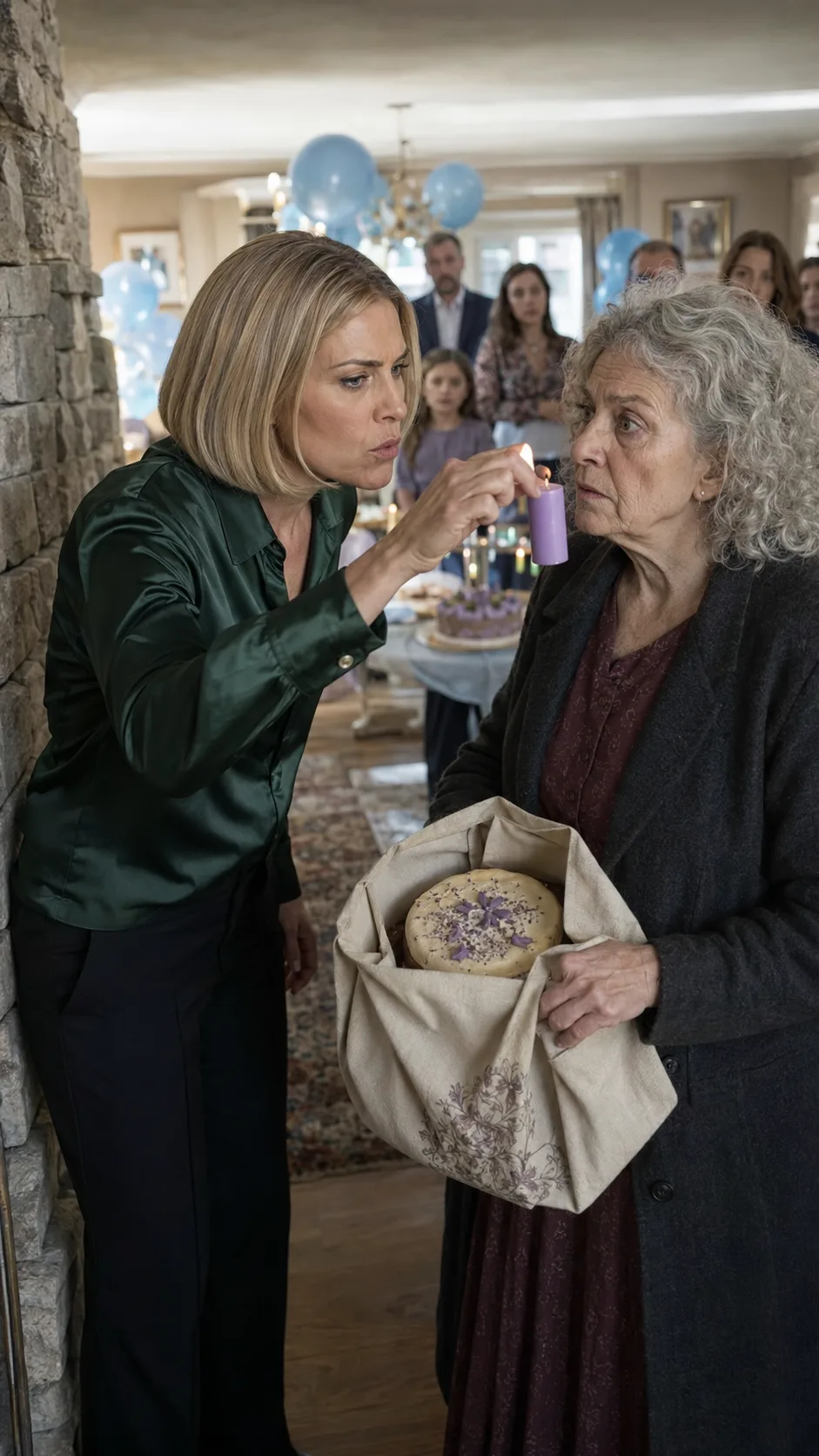
In the morning, I tied the cake in a cloth bag nestled with an ice pack and slipped a single lavender candle into my pocket.
Not for the cake. Not for attention. Just something small to light in the corner, away from the noise. A quiet way to remember that Harold never missed one of Jacob’s birthdays.
I lit it every year. Never once had anyone noticed or cared before.
The party was loud. Balloons, plastic cups, cartoon music, shouting kids. I walked into the house I no longer lived in, my arms full, the scent of fresh cake following me like a prayer.
Lindsay spotted me first. She said nothing, just raised an eyebrow at the bag.
I placed the cake carefully on the edge of the dessert table. There were already store-bought cupcakes and a generic sheet cake that said, “Happy Birthday, Grayson,” in blue frosting.
I knew better than to compete.
I only wanted him to have a piece of something real, made by hands that remembered his first steps.
In the corner of the living room near the fireplace, I lit the candle. The scent of lavender barely lifted above the fried chicken and ketchup smells.
I sat on the armrest of a chair, watching the chaos, smiling when Grayson ran by in his superhero cape.
Then Lindsay noticed it.
She walked over, nostrils flaring, her voice sharp.
“What is that smell?”
I turned, surprised.
“Just a small candle for Harold. I always…”
She stomped past me, snatched the candle, and blew it out with a theatrical huff.
“I told you, do not bring that graveyard smell into my house. This is a birthday party, not one of your gloomy little rituals.”
People turned. Some laughed nervously.
I stood, unsure what to say.
“I didn’t mean…”
Jacob appeared behind me, eyes cold.
“Enough, Ma.”
He grabbed my arm, not roughly, but firmly enough to move me, and started walking me toward the door.
“Jacob,” I whispered, humiliated. “Not now. Please, not here.”
He kept walking.
“Today is about Grayson, and you’ve made it about you again. We’ve had enough.”
The front door opened, and the cold hit my face like a slap. Laughter bubbled from inside. A phone camera was raised. I saw a flash.
Jacob’s voice followed behind me, loud enough for the guests to hear.
“This is the day we set the house free. No more guilt. No more drama. Goodbye, Mother.”
The door shut behind me.
I stood outside, my coat too thin for the season, the cake still inside, my grandson still inside, the lavender candle extinguished and left behind on the mantel like a discarded relic.
I could hear the party continue without me. Music, laughter, wrapping paper tearing, a woman’s voice giggling.
“Well, that was awkward.”
And someone else responding, “She’s always been kind of off.”
I walked down the icy steps, holding the cloth bag that now felt empty.
The snow had begun to fall, delicate flakes landing on my gray curls. I did not cry, not because I did not want to, but because it felt like even my tears had been taken from me.
I had no more left to shed.
They had erased me, not just from their home, but from their lives, from their memories, from the family portrait I once helped paint, stroke by stroke, with quiet hands and humble love.
That night, I sat in the back corner of a public bus station, the only warm place I could find.
The candle was still in my pocket, its wick slightly bent. I turned it over in my hand, feeling the wax smooth and cool.
In my lap sat the leftover cake I had managed to carry with me.
I took one bite. Sweet, soft, spiced with cinnamon and sorrow. It tasted like grief.
But I ate the slice anyway because I had made it. Because it was mine. And because someday, somehow, I knew this would not be the last birthday candle I lit.
The bus station closed at midnight.
I had nowhere to go.
After that, I walked.
The wind had picked up, sharp as glass against my cheeks. Snow flurried down in icy curtains, painting the sidewalks bone white. I pulled my coat tighter, the zipper broken, and kept my eyes low.
I was too cold to think, too humiliated to cry, too tired to hope.
My hands were stuffed into the lining of my coat, holding the last thing I had not surrendered.
The candle. My last lavender candle. The one I lit every year for Harold. The one Lindsay snuffed out and tossed aside like it meant nothing.
I had no home now, no family, but I had that candle.
I clutched it like a compass.
It smelled like love, like the old house before it filled with judgment. Like nights when Harold read aloud and Jacob fell asleep in his arms.
I was trying to hold on to a life that no longer existed.
It must have been around one in the morning when I passed the old freight terminal on Third Street, a place long forgotten, windows broken, graffiti on the bricks.
It looked abandoned, but it blocked the wind, so I stepped behind it for a minute’s relief.
And that was when I heard it.
At first, I thought it was a cat, a thin sound, high-pitched and shivering. But then it came again, a wail, raw and aching, not feline at all.
I froze.
The sound was coming from the dumpsters.
I hesitated and looked around. No one. Only the swirling snow and the distant echo of a siren somewhere downtown.
The crying came again.
I moved slowly, numb fingers trembling as I lifted the broken lid of the first bin.
Nothing.
The next one, still nothing.
But the third, my heart stopped.
Inside, lying on top of a plastic bag half covered in frost, was a newborn baby girl. No older than a few hours. Her skin was turning blue at the edges, her tiny fists clenched, her mouth barely strong enough to cry.
She was wrapped only in a damp hospital receiving blanket.
She had been left there to disappear.
I gasped, not from the cold, but from the horror.
My body moved before my mind could catch up. I pulled off my scarf, wrapped her in it, and tucked her close to my chest.
Her skin felt like ice against mine.
“It’s okay, baby,” I whispered. “It’s okay. Grandma’s got you.”
She did not open her eyes.
I needed warmth. I had no phone, no car, no heat source.
Only the candle.
I always carried matches in a little pocket inside my left glove, an old habit from my camping days with Harold.
He used to say, “Never trust a fire to show up unless you bring it yourself.”
I fumbled them out, shielding the match with my hands, and lit the candle.
The little flame sputtered, flickered in the wind, then held.
I crouched, curled around her tiny body, cupping my hands near the flame. It was not much, but it was enough.
The scent of lavender rose around us, soft and surreal, a lifeline.
I started singing a lullaby, the one I used to hum to Jacob when he was a baby.
“Sleep, my child, and peace attend thee…”
She stirred just barely.
I looked down. Her fingers twitched. Her lips moved.
I screamed for help, loud and desperate. My voice cracked into the silence of the night.
And then, thank God, a passing sanitation worker heard me.
He called 911.
The ambulance arrived six minutes later. It felt like 60.
They took her from my arms and placed her in a warm incubator box. I could hardly breathe.
“She’s still alive,” one paramedic said, astonished.
“It’s a miracle,” the other added. “She would have frozen if she had been out here much longer.”
“How did you even find her?”
I did not answer.
I just showed them the candle.
The hospital said she was severely hypothermic, but stable. No one knew who her parents were. The tags had been cut off her blanket.
The nurses called her Baby Angel.
But I knew her name the moment I saw her open those eyes in the NICU, glassy and blinking as if looking for something she had not yet found.
I named her Hope.
That morning, the story spread everywhere.
A janitor had taken a photo of me huddled in the snow, candle glowing beside a tiny bundle wrapped in scarves.
It went viral.
Click the blue “PART 3” below to read the next part: 👉 PART 3 👈
Chapter complete
You have reached the end of this chapter.
Continue reading
A few more worlds to get lost in after this chapter.




