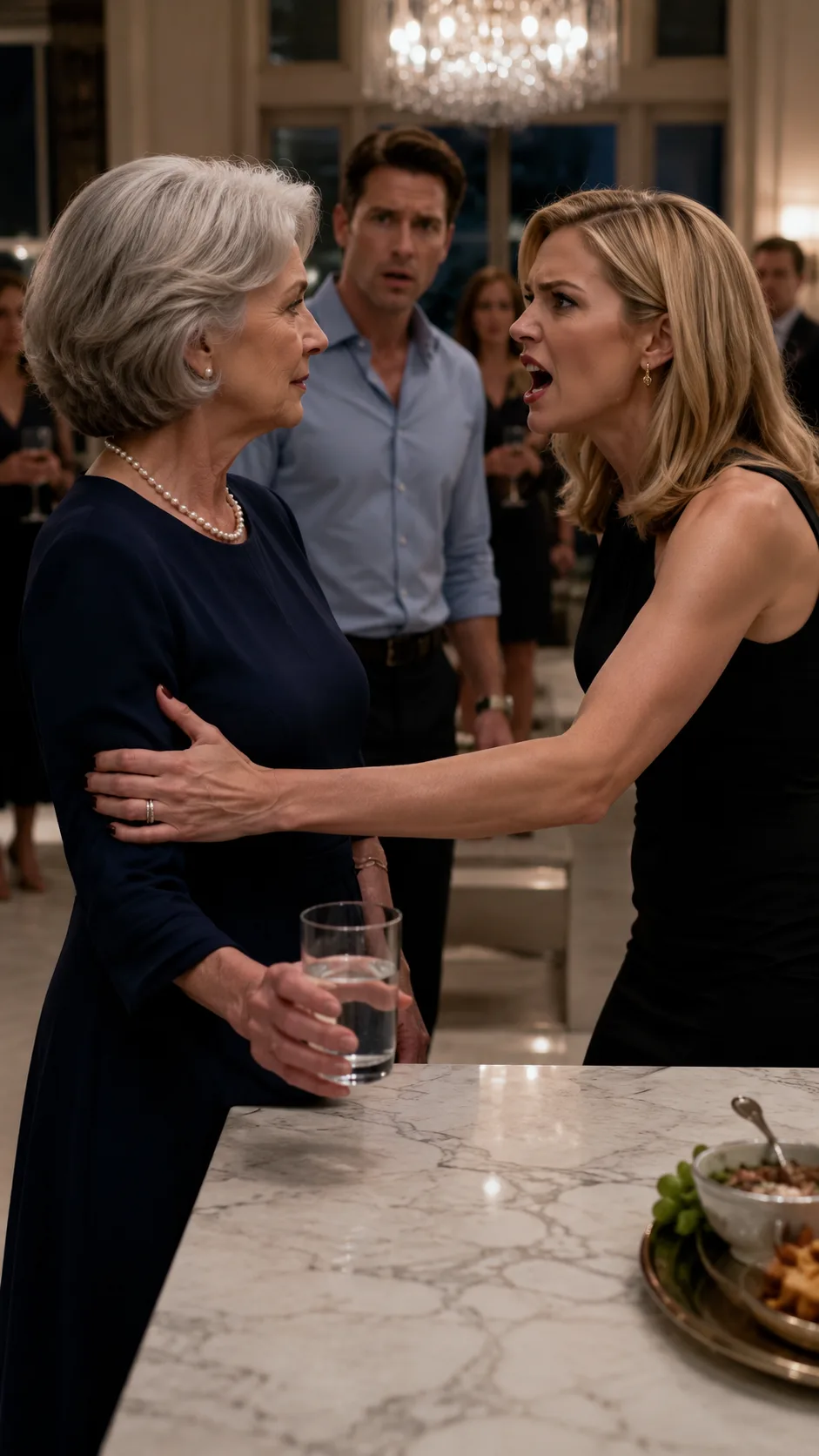
WHEN SHE ENTERED THE BOARDROOM, EVERYONE FINALLY LEARNED WHO THE WOMAN IN THE OLD NAVY DRESS REALLY WAS
Camille sat on my couch with her hands locked together so tightly that her knuckles turned white.
Chapter 3
WHEN SHE ENTERED THE BOARDROOM, EVERYONE FINALLY LEARNED WHO THE WOMAN IN THE OLD NAVY DRESS REALLY WAS
Camille sat on my couch with her hands locked together so tightly that her knuckles turned white.
Poppy played with wooden blocks on the rug between us, unaware that her mother’s marriage, career, and future relationship with me had all reached a breaking point.
“Theo told me about the company,” Camille said. “The buildings. The firm. The house.”
I nodded.
“I don’t know what to say.”
“Try.”
She looked down.
For several minutes, she spoke in the polished language of a lawyer: stress, insecurity, pressure, alcohol, misunderstanding.
I listened without interrupting.
Then she stopped.
“No,” she whispered. “That’s not honest.”
She wiped her face with the heel of her hand.
“I was ashamed of you because you reminded me of my mother.”
That surprised me.
Camille told me about growing up above her father’s hardware store in Indiana. Her parents had worked six days a week. Her mother wore the same winter coat for ten years, saved aluminum foil, and packed leftovers into old containers.
Camille had
loved them.
She had also spent her entire childhood terrified that people would pity her.
“When I met you,” she said, “I saw the small house, the old car, the repaired appliances. I thought I knew everything about you.”
“You thought I was beneath you.”
“Yes.”
The honesty hurt more than another excuse would have.
“I wanted to become someone people respected,” she continued. “Somewhere along the way, I decided respect meant being better than people like my parents.”
“And people like me.”
“Yes.”
Poppy’s tower fell over. She laughed and began rebuilding it.
Camille looked toward her daughter.
“I don’t want her to become me.”
For the first time that morning, I believed she understood what was at stake.
“What happened at the party was not only one cruel sentence,” I said. “You decided years ago that there was nothing in me worth discovering. Every dinner, every condescending smile,
every time you ordered my food for me—you were telling me the size of my life before you bothered to ask.”
Camille cried without trying to hide it.
“I’m sorry.”
“I know.”
“I don’t expect forgiveness.”
“Good. Forgiveness should never be demanded.”
She nodded.
Then she said, “I don’t care about the inheritance or the firm. I know you may never believe that. But I want Theo to be okay. I want Poppy to know her grandmother. And I want the chance to become someone better than the woman who spoke to you that night.”
I leaned back.
At sixty-seven, I had learned that silence was not always weakness. Sometimes it was simply the space where truth waited to see whether it would be taken seriously.
Finally, I said, “I will forgive you.”
Camille looked up.
“But forgiveness is not pretending nothing happened. We are not returning to the old
arrangement.”
“I understand.”
“You will never speak to me that way again.”
“I won’t.”
“You will never use Theo as a shield between us.”
“I won’t.”
“And I will attend the partnership review next week.”
Her face tightened, but she did not argue.
“I will confirm your promotion,” I said. “Then I will formally remove myself from all future decisions involving your career.”
“Why would you still approve me?”
“Because you earned the position. Your character failed at my party. Your professional work did not.”
Camille covered her mouth.
I continued.
“I am also forgiving the eighty-thousand-dollar house loan. It will become a gift on paper.”
She began to protest.
I raised my hand.
“That is for Poppy. Not for you.”
She closed her mouth.
“In exchange, I want one thing.”
“What?”
“Dinner on the first Sunday of every month. You, Theo, Poppy, and me. Three hours. No phones. No excuses unless someone is ill.”
Camille stared at me.
“That’s all?”
“That is not a small thing.”
Her face crumpled again.
“No,” she said. “It isn’t.”
She crossed the room and hugged me.
I did not hug her back immediately.
Forgiveness is sometimes a decision the heart makes before the body can follow.
Then Poppy lifted a block and called, “Gamma Hazel.”
I placed my arms around Camille.
One week later, I walked into the conference room at Drysdale, Hewitt & Marsh.
The room sat on the twenty-third floor of a tower I had owned for twelve years.
The managing partners were already seated. Camille sat near the end of the table in a navy suit, looking straight ahead.
Geraldine entered beside me in her red glasses.
The managing partner smiled politely.
“Mrs. Voorhees, are you representing Lakeshore Glen’s principal?”
Geraldine placed her folder on the table.
“She is the principal.”
The room changed.
One man dropped his pen.
Another stood halfway, sat down, then stood again.
Camille finally looked at me.
For the first time since I had known her, there was no pity in her expression.
Only recognition.
I took my seat at the head of the table.
The managing partner cleared his throat.
“We were not aware of your direct involvement.”
“That was intentional,” I said.
The compensation review began.
The committee asked Camille about her clients, revenue, courtroom performance, and leadership record. She answered clearly and professionally.
When the discussion ended, the managing partner turned to me.
“Does Lakeshore Glen object to Ms. Voorhees Marsh’s partnership package?”
Camille’s hands remained still, but I saw her fingers press against each other beneath the table.
“No objection,” I said. “Her promotion stands.”
She closed her eyes for one second.
Then I added, “For the record, I am recusing myself from every future matter directly involving her employment or compensation.”
Geraldine wrote the statement down.
After the meeting, Camille waited beside my Buick in the parking garage.
She looked at the car, then at me.
“I used to think this car told me who you were,” she said.
“And now?”
“Now I know it only tells me what you choose to drive.”
I almost smiled.
“Good answer.”
She hugged me briefly and left.
Fourteen months passed.
The Sunday dinners continued.
Camille brought dessert every time, though she was a terrible baker. Her first apple pie could have been used as roofing material. Her brownies were so dry Theo called them “historic.” Poppy ate everything with complete loyalty.
Theo joined the board of Lakeshore Glen in a junior position. I made him study six months of financial statements before allowing him to vote.
He complained exactly as much as he had complained when I made him save for his first car.
Walter would have been proud.
One Sunday, Poppy and I baked cookies in my old kitchen. Flour covered her hair, her nose, the floor, and somehow the inside of my slipper.
Camille stood in the doorway.
She did not correct us.
She did not take over.
She simply took a photograph.
That evening, she sent it to me with four words.
“Two Voorhees women working.”
I printed the picture and placed it on my refrigerator.
I kept the sealed envelope Geraldine had prepared—the one containing the mortgage call and partnership objection drafts.
I never used it.
I probably never will.
I did not keep it because I was waiting for Camille to fail.
I kept it because forgiveness does not require amnesia.
A woman may forgive the person who wounded her and still remember where the floor once gave way.
Camille had judged my life by the size of my house, the age of my car, and the casserole in my hands.
I had allowed her to do it for too long.
That was my mistake.
But the night she called me an embarrassment, I finally understood something.
Being kind does not require becoming invisible.
Being patient does not require accepting humiliation.
And being powerful does not mean destroying everyone who once underestimated you.
Sometimes power is simply walking into the room, placing the truth on the table, and refusing to hide it again.
I built fifty-three buildings.
But the most important thing I built was not made of brick, steel, or money.
It was the second chance my family chose to deserve.
THE END
Chapter complete
You have reached the end of this chapter.
Continue reading
A few more worlds to get lost in after this chapter.




