PART 2
I opened the door before they knocked.
Chapter 2
PART 2
I opened the door before they knocked.
“Mom,” Julian said, forcing a smile. “It’s just for a few weeks until the new place is ready.”
He was already reaching into the back for a box.
I stood in the doorway with my hands in the pockets of my cardigan.
“A few weeks,” I repeated.
“Yeah,” he said quickly. “The closing got delayed, and the short-term rental fell through. It’s complicated.”
Brooke brushed past him with her phone in her hand.
“Julian, put the kitchen stuff near the dining room, not by the stairs,” she said. “And grab the kids’ bags first. They’re exhausted.”
She did not greet me.
She did not ask whether this was a good time.
She did not ask if I had room, if I was well, if I had plans, if I minded opening my home to four people and everything they had packed in panic or entitlement. She simply walked onto my
porch, past my hanging ferns, and into my foyer as though she had made a reservation.
Julian lifted a heavy box and carried it inside.
I watched him.
That was the first moment I understood this was not a request. It had been decided somewhere else, in some other room, in some conversation where I had been discussed as an available resource instead of a person.
The children tumbled in after them.
Lily, seven, came first, carrying a stuffed rabbit by one ear. Mason, five, followed with a plastic dinosaur in his hand and peanut butter on his sleeve. They were sweet children, and none of this was their fault. I kissed their foreheads and told them I was glad they were safe.
Brooke was already in the hallway.
“What’s the Wi-Fi password?” she called.
I looked at Julian.
His eyes slid away.
“Mom, I know this is sudden,” he
said. “But we really didn’t have anywhere else to go tonight.”
Tonight.
That word was supposed to soften me.
It did not.
Because I knew my son. I knew when he was unprepared and when he was hiding behind helplessness. This was not one bad night. This was a plan they had failed to present until refusal became inconvenient.
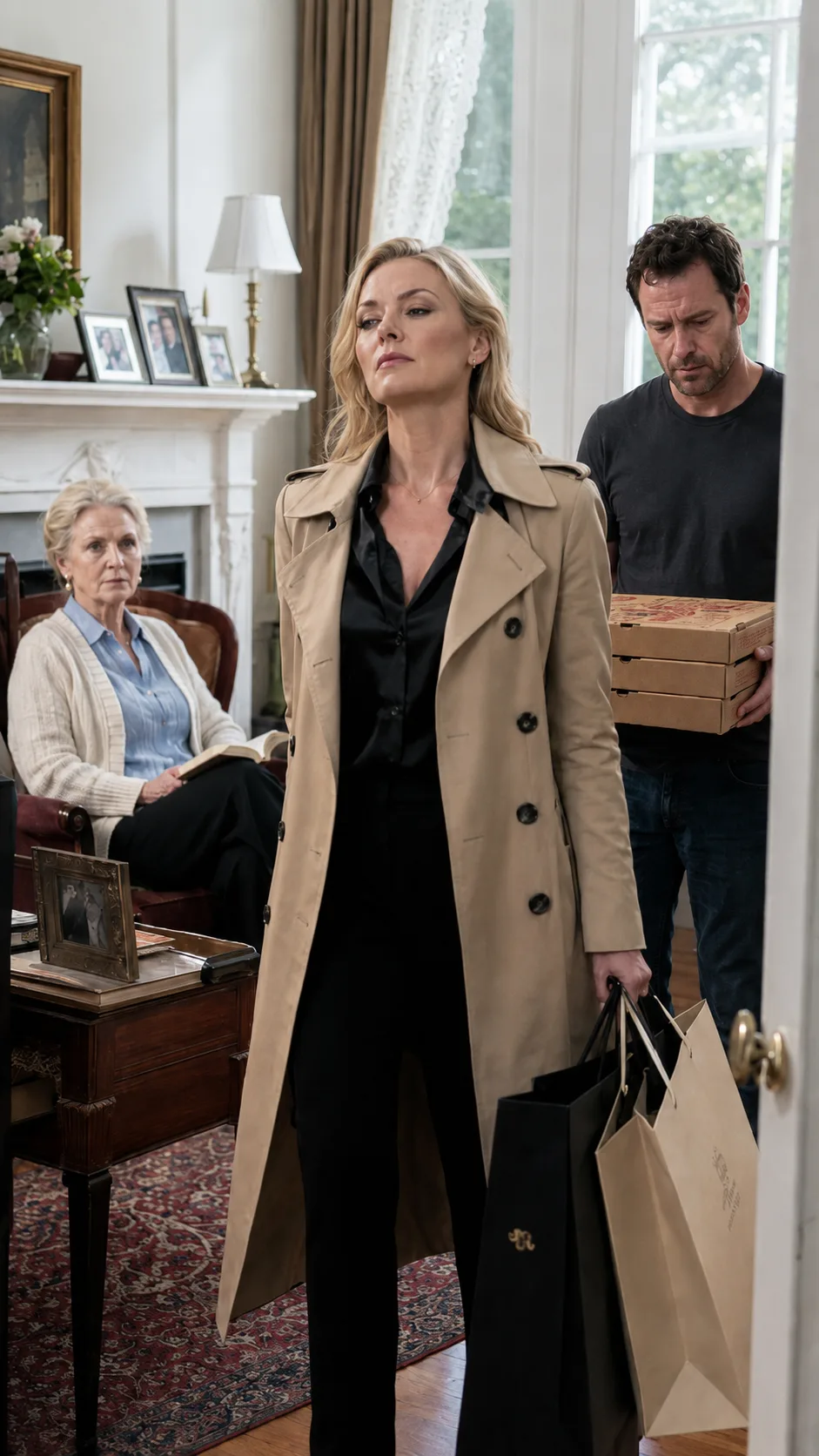
Brooke dropped her trench coat over my antique mahogany desk, the one my late husband had refinished by hand the year Julian graduated high school.
“We’re starving,” she said from the hallway. “Did you go grocery shopping?”
I stared at the coat on the desk.
Then at my son.
Julian gave me a small, embarrassed shrug, as if to say, You know how she is.
Yes.
I was beginning to.
I gave him the Wi-Fi password. I told the children where the bathroom was. I pointed Julian toward the guest room.
Then I walked into the kitchen, poured myself a glass of water, and stood beside the sink while the first wave of their lives spread through my house.
Boxes in the foyer.
Shoes under the side table.
A tablet charging on my kitchen counter.
A jacket thrown over the back of my reading chair.
Brooke moved through the house quickly, scanning each room like she was evaluating a property. Her eyes paused on my sofa, my curtains, the framed photographs on the mantel, the porcelain lamp beside the window. I could almost see her rearranging everything in her head.
Julian carried box after box upstairs.
He looked like a man doing what he had been told.
Not by me.
I did not ask why they had not called first. I already knew the answer. They had not called because a phone call would have given me a chance to say no.
That evening, I made tea for myself. Not dinner. Not sandwiches. Not a tray of snacks laid out like I was hosting a holiday weekend. Just tea.
Brooke came into the kitchen and opened my refrigerator.
“There’s not much ready-to-eat stuff in here,” she said.
“I cook for myself,” I replied.
She glanced at me over the refrigerator door.
“Well, with the kids here, we’ll need more practical food.”
“We,” I said.
She did not answer.
Julian came in behind her, rubbing his forehead.
“Mom, we’ll get groceries tomorrow,” he said. “Tonight’s just been a lot.”
I nodded.
Then I watched Brooke take my good brie from the cheese drawer and carry it away without asking.
That was when the hurt left me.
People think hurt is the strongest feeling in moments like that. It is not. Hurt comes first, soft and hot. But if you are lucky, if age has taught you anything, hurt can harden into clarity.
I saw the shape of the days ahead.
They thought I would be grateful to be needed.
They thought I would become the built-in grandmother, housekeeper, cook, childcare provider, and financial cushion. They thought my quiet life meant emptiness. They thought the absence of a husband made me available for occupation.
They had mistaken peace for vacancy.
Late that night, as I passed the guest room, I heard Brooke whispering.
“We can sleep in tomorrow. Your mom is here for the kids.”
She said it quietly, but not quietly enough.
I paused in the hallway.
Julian murmured something I could not make out.
Brooke laughed under her breath.
I kept walking.
Inside my bedroom, I locked the door. I rarely did that. I live alone, and until that night, every room in my home had felt like mine without needing proof. But the click of that lock sounded good. Clean. Final.
I slept deeply.
The first domino had tipped.
At seven sharp the next morning, I sat at my kitchen table with Earl Grey tea, buttered toast, and a boiled egg. Sunlight poured through the window over the sink. The house was still, except for cartoons playing softly in the living room.
I had set the table for one.
Brooke came downstairs two hours later in silk pajamas, her hair swept into a loose knot, her face still marked with sleep and annoyance. She looked at the table, then at me.
“Where’s breakfast for the kids?” she asked.
I folded the newspaper.
“The pantry is there. The refrigerator is there. Help yourself.”
She stared.
“And we need someone to pick them up from daycare this afternoon,” she continued. “Julian and I are going downtown. We need to shop for a few things and decompress.”
Her tone was not rude in the loud way. It was worse. It was managerial. As if I had missed a task on a list she had every right to assign.
I lifted my cup.
“The grocery store is a ten-minute walk,” I said. “And my calendar today is full.”
Brooke’s face flushed in patches.
“Your calendar?” she repeated.
“Yes.”
Julian entered then, wearing yesterday’s jeans and a wrinkled T-shirt. He looked from Brooke to me and immediately understood there was trouble.
“Come on, Mom,” he said gently. “It’s just for today. The move was a nightmare. We need to unwind.”
I looked at my son.
I loved Julian. I loved the boy who had once brought me dandelions from the schoolyard and called them roses. I loved the teenager who used to leave his sneakers in the hall and apologize before I even noticed. I loved the man he might still become if he remembered how to stand upright inside his own life.
But love does not require blindness.
“Relaxation is a luxury adults organize for themselves,” I said. “I am not your plan for the day.”
Brooke gave a short laugh.
“Wow.”
Julian closed his eyes briefly.
“Mom,” he said.
“No,” I replied. “Not today.”
It was a small word. One syllable. But in that kitchen, it struck like a glass dropped on tile.
Lily appeared near the doorway, holding her rabbit. Mason peeked around her shoulder. I softened my face for them.
“There’s cereal in the cabinet, sweetheart,” I told Lily. “And bananas on the counter.”
Brooke turned sharply.
“I can handle my own children,” she said.
“Good,” I said.
That ended the conversation.
Or it should have.
Instead, Brooke muttered something about stubborn old women as she began banging cabinet doors. Julian whispered for her to stop. She told him not to start. The children watched.
I put my plate in the dishwasher.
Only my plate.
Then I picked up a small notebook from the drawer by the phone and walked through the house.
In the laundry room, I wrote down the electric meter reading from the digital panel. In the garage, I checked the water heater closet. In the basement, I noted the thermostat settings and the freezer inventory. Filet steaks, organic chicken, frozen blueberries from the farmers market, three containers of soup I had made the week before.
I was not being petty.
I was taking inventory of my life.
There is a moment, when people cross a boundary, that a woman has to decide whether she will spend her energy begging them to step back or quietly begin building a fence.
I chose the fence.
In the basement, I turned the guest room heater down to its lowest comfortable setting. Not cruel. Not unsafe. Just enough to remove the luxury of behaving like spoiled hotel guests.
Upstairs, Brooke had finally made breakfast. Cereal was scattered across the table. Milk dripped from the counter. A sticky spoon lay on the floor. Julian stood near the doorway, scrolling his phone with the face of a man hoping silence would do the parenting for him.
“We’re leaving,” Brooke announced. “You can at least do the dishes.”
I looked at the sink.
Then I looked at her.
I said nothing.
She waited.
I still said nothing.
Julian cleared his throat.
“Brooke, let’s just go.”
The front door shut behind them fifteen minutes later.
As soon as the SUV pulled away, I went upstairs and pulled my travel bag from the closet.
I laid it on the bed and packed calmly.
Two sweaters.
Three blouses.
Comfortable shoes.
Medication.
Phone charger.
Bank notebook.
A small pouch of jewelry I did not want lying around.
The house felt different already. Not ruined. Not taken. But challenged.
I had spent too many years keeping peace by absorbing other people’s chaos. My husband had been a kind man, but illness had made me a nurse before it made me a widow. Julian’s college years had made me a bank before he learned what bills looked like. Family holidays had made me a cook, mediator, decorator, and cleanup crew, usually while everyone else watched football.
I had not minded helping.
That was the trap.
When you are useful for long enough, some people forget you are also human.
That evening, Julian and Brooke returned with bags from King Street boutiques and three pizza boxes. Brooke swept into the foyer, her arms loaded with purchases, cheeks bright from shopping.
“We brought pizza,” she called. “You can grab plates.”
I was in the living room reading.
I did not move.
“The plates are in the cabinet,” I said. “You know where the kitchen is.”
The silence that followed was thick enough to touch.
Julian stepped into the living room. “Mom, what’s up? You’re being so cold.”
I placed my bookmark carefully between the pages.
“I’m not being cold, Julian. I am retired. You are guests in my home, not the new owners.”
Brooke laughed.
It was sharp, artificial, and meant to make me sound ridiculous.
“Guests don’t usually pay for things,” she said. “You should be happy we’re here to liven the place up.”
There it was.
The truth beneath the polish.
She believed my life needed them to matter.
She believed my house was a stage waiting for her noise.
She believed free shelter was something I should feel honored to provide.
I looked at her for a long moment.
“You may want to remember whose name is on the deed,” I said.
Her smile thinned.
Julian looked miserable.
The children were already reaching for pizza, unaware that something important had shifted in the room.
The next morning, I installed a lock on the basement chest freezer.
It was a simple thing, purchased from the hardware store before Brooke woke. I kept the key on a small ring beside my car key. In the upstairs refrigerator, I left milk, eggs, apples, sandwich meat, and the basics. I moved the wine, specialty cheeses, expensive cuts of meat, and prepared meals downstairs behind the lock.
When Brooke discovered it that afternoon, the sound of her footsteps came fast through the house.
“Are you seriously hiding food now?” she demanded from the kitchen doorway. “That is not normal.”
I was at the counter slicing a tomato.
“It is my property,” I said. “If you have specific cravings, buy them.”
“We are family.”
“Family asks.”
She stared at me, trying to force me into discomfort.
I kept slicing.
Brooke was used to people responding to her temperature. If she became angry, they cooled the room. If she became dramatic, they rushed in with pillows. If she accused, they defended. She had built an entire household around emotional weather.
I had lived through hurricanes.
This was humidity.
Julian appeared behind her and said my name in a weary voice.
“Mom.”
I set down the knife.
“Tomorrow, you and Brooke will drive the children yourselves,” I said. “I am not available for school runs, errands, appointments, shopping trips, or last-minute childcare.”
Brooke’s eyes flashed.
“You are unbelievable.”
“No,” I said. “I am clear.”
That night, I stayed awake later than usual.
From my room, I could hear them whispering in the guest room. Brooke’s voice rose and fell like a saw. Julian’s stayed low. At one point, she said something about how I was acting “unstable.” At another, she said, “Once she calms down, we’ll talk about making the house more functional.”
More functional.
My hand rested on the quilt.
That house had functioned beautifully for me.
It had held a marriage, raised a child, hosted Thanksgiving dinners, sheltered grief, and given me a place to rebuild myself after my husband died. It did not need to be redesigned around Brooke’s convenience.
I smiled in the dark.
The next morning, I left at six.
The sky was still pale, and dew clung to the hydrangeas. I carried my travel bag out through the side door, placed it in the trunk, and backed quietly out of the driveway before the children woke.
I drove three hours to my friend Martha’s beach cottage near Edisto. Martha had been a nurse with me years earlier, and she had the rare gift of listening without immediately trying to fix things. We had spoken the day before. She told me the guest room was ready, the coffee was strong, and the ocean was doing what the ocean always did: reminding people how small their problems were when seen from a distance.
By nine-thirty, I was sitting on her back deck with a mug in my hands, watching sunlight scatter over the water.
My phone was on silent.
Not off.
Silent.
There is a difference.
Turning it off would have been escape. Keeping it on silent was control.
By noon, I had five missed calls from Julian and nine text messages from Brooke.
Where are you?
The kids are upset.
This is irresponsible.
You can’t just disappear.
We had plans today.
Call your son.
Then Julian:
Mom, please pick up.
Brooke has an appointment.
I have work.
We need to figure this out.
I read them all while a gull cried overhead and Martha placed a plate of shrimp salad in front of me.
“You going to answer?” she asked.
“In a minute.”
She smiled. “Good for you.”
I typed one reply.
I’m on vacation. The children have two parents. Good luck with the daily routine.
Then I set the phone facedown.
It rang again less than a minute later.
I let it ring.
There are people who do not understand labor until it disappears. They think clean towels happen. They think dishes return to cabinets by instinct. They think children get fed, dressed, comforted, transported, and entertained by some invisible current that has nothing to do with a person’s time, knees, back, patience, or bank account.
For two days, I let them meet the current.
Brooke tried anger first.
Then accusation.
Then guilt.
The children miss their grandma.
We need to talk like adults.
You’re making this harder than it has to be.
I knew what she meant.
Come home.
Resume service.
Apologize for noticing.
Julian called on the second afternoon while I was sitting at a seaside café, watching tourists buy saltwater taffy from a shop with blue awnings.
This time, I answered.
“Mom,” he said, breathless. “Brooke is losing it.”
“That is unfortunate.”
“She has a hair appointment, and I have work. We can’t keep juggling everything.”
“Then you will have to prioritize.”
He was quiet for a second.
“We were counting on you.”
“I know,” I said. “That was the problem.”
He exhaled sharply.
“Mom, don’t do this.”
“Julian, I am no longer your backup plan.”
I ended the call before he could turn the conversation into a courtroom.
That evening, after dinner with Martha, I opened my laptop and logged into my bank account.
I had not planned that part in advance. Not exactly. But the thought had been gathering strength for months, maybe years.
Julian was forty-two.
A grown man.
A father.
A husband.
And I was still paying for things that should have stopped long ago.
His cell phone plan had started in college. It had been easier to keep the family plan than change it. His car insurance had stayed linked to mine after a rough patch when he changed jobs. Then there had been a medical bill, a late mortgage payment, a vacation they “really needed,” and school fees for the children.
None of it had seemed enormous by itself.
That is how dependence grows. Not as a mountain. As teaspoons.
A little here.
A little there.
A mother helping.
A son accepting.
A daughter-in-law assuming.
I opened the autopay page.
Cell phone plan.
Canceled.
Auto insurance contribution.
Stopped.
Gas card connected to my account.
Frozen.
Streaming services I did not use but somehow paid for.
Canceled.
The total was not a fortune. Around three hundred dollars a month, sometimes more when Julian leaned on the gas card. Enough for groceries. Enough for electricity. Enough for the small luxuries Brooke treated as evidence that life was “finally manageable.”
I did not feel cruel.
I felt awake.
The explosion came before sunset.
Julian called three times. Then a text.
Mom, my card was declined at the gas station. My phone service is suspended. What is going on?
I waited ten minutes before calling back.
When he answered, traffic roared behind him.
“Mom, what happened?” he demanded. “I’m standing at a gas pump with the kids in the car.”
“I restructured my budget,” I said.
“What does that mean?”
“It means I am paying my own bills. You will be paying yours.”
He made a sound somewhere between disbelief and panic.
“You can’t just cut things off without telling me.”
“You showed up at my house with an SUV full of boxes without telling me.”
“That’s different.”
“It is,” I said. “Mine was a correction.”
There was rustling, then Brooke came on the line.
Her voice was no longer polished.
“You are ruining us,” she snapped. “We have commitments. We have children. How are we supposed to get through the month?”
I looked out at the water.
A pelican skimmed low over the waves.
“Perhaps with fewer shopping trips,” I said.
She inhaled sharply.
“I cannot believe you.”
“I know.”
“You are punishing us.”
“No. I am resigning from a position I never agreed to hold.”
Brooke said my name like a warning.
I almost laughed.
For years, I had mistaken intensity for authority. I had let louder people convince me that their urgency outranked my peace. But sitting there by the coast, with salt in the air and my own money under my own control, I heard her clearly.
She was not powerful.
She was inconvenienced.
I ended the call and ordered key lime pie.
Martha looked at me over her glasses.
“Everything all right?”
I picked up my fork.
“It is now.”
After a week, I drove home.
I expected chaos, and chaos had certainly visited. The house smelled like burned food, stale laundry, and children’s cereal. A sticky trail crossed the kitchen floor. The trash was overflowing. Someone had used my good copper pans and left them spotted and dull beside the sink. A throw pillow had been kicked under the coffee table. Crayons were scattered near the fireplace.
Brooke sat in the living room with her arms crossed, wearing the expression of a queen forced to wait in a bus station.
“Well,” she said, “nice of the lady of the manor to grace us with her presence.”
I walked past her.
Julian was on the floor trying to fix Mason’s toy car. He looked up at me, ashamed and relieved at the same time.
“Hi, Mom.”
“Hello, Julian.”
I went upstairs, placed my bag in my bedroom, and locked the door behind me while I unpacked.
Then I came back down to the kitchen.
The copper pans sat exactly where I had seen them. My husband had given me those pans for our thirty-fifth anniversary because he said I treated cooking like music. They were beautiful, heavy, and meant to be cared for.
I lifted them one by one, placed them in a plastic bin, and carried them to the private hall closet where I kept holiday linens.
Julian appeared in the doorway.
“What are you doing?”
“Protecting my property.”
Brooke entered behind him.
“Oh, come on.”
I closed the closet door and turned the key.
“Those who do not care for my things do not get to use them.”
Brooke put both hands on her hips.
“We can’t live like this.”
“You are free to live elsewhere.”
Her laugh was brittle.
“We don’t have another place yet. You know that.”
“I know you have not made it a priority.”
Julian looked pained.
“Mom, please.”
I faced him fully.
“Julian, I love you. But I love myself enough not to let you throw away my dignity.”
He looked down.
Brooke did not.
“This is psychological warfare,” she said.
“No,” I replied. “This is reality. You are living in my house under my rules. If you do not like the rules, you are free to leave.”
She opened her mouth, then shut it.
For the first time, she had no immediate angle.
That night, I took a hot bath and played jazz from the small speaker on the shelf. Through the bathroom door, I heard Brooke and Julian arguing in the hall. She accused him of being weak. He told her she had made everything worse. She said his mother was impossible. He said she should have asked before packing the car.
The cracks were showing.
They had arrived as a team. An occupying force wrapped in family language. But pressure reveals alliances. Brooke had counted on Julian’s loyalty to cover her entitlement. Julian had counted on my love to cover his lack of courage.
I was removing the covers.
The next morning, I found scratches on the pantry door.
Small ones near the lock.
Fresh.
I stood there for a long moment, my coffee cooling in my hand. The lock was still intact, but the message was clear. Someone had tried to open what I had closed.
I called them both into the living room.
Julian came first. Brooke followed slowly, already defensive.
“Someone tried to damage my pantry door,” I said.
Brooke rolled her eyes. “Nobody damaged anything.”
“I did not ask for a debate. I am telling you what I found. If it happens again, your stay here ends immediately.”
Her face brightened with mean confidence.
“And what are you going to do?” she asked. “Put your own grandchildren out?”
There it was.
Her ace.
The children.
She believed my love for them could be used as a leash. She believed she could tie any demand to their little faces and make me carry it.
I placed my coffee on the side table.
“The children are welcome to stay with me if they ever need safety, food, or care,” I said. “You and Julian are adults. You are responsible for your own roof.”
Julian went pale.
Brooke’s eyes narrowed.
I reached into the pocket of my cardigan and pulled out an envelope.
Inside was a printed list of local extended-stay hotels, short-term apartment rentals, and two modest units across town that were available immediately. I had spent the previous evening gathering options. Not perfect options. Not glamorous ones. Real ones.
I handed it to Julian.
“Here are your choices. You have three days to make a plan.”
“Mom,” he said. “You can’t be serious.”
To be continued… Click “PART 3” to read the final part : PART 3
Chapter complete
You have reached the end of this chapter.
Continue reading
A few more worlds to get lost in after this chapter.




