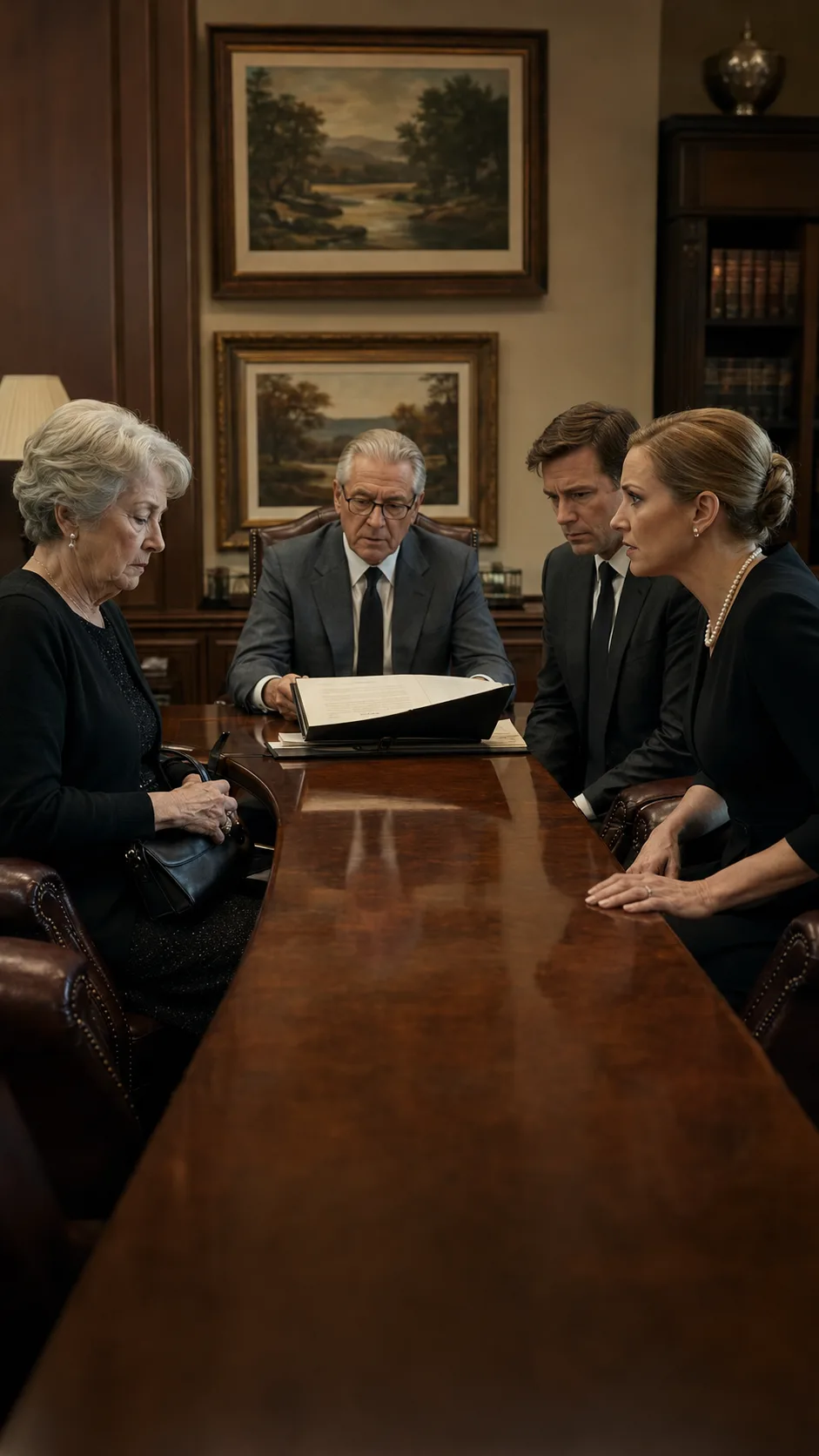
Part 3 — The Family Truth at the Kitchen Table
I ushered Emma into the kitchen, my mind racing.
Chapter 3
Part 3 — The Family Truth at the Kitchen Table
I ushered Emma into the kitchen, my mind racing.
How much should I tell my 16-year-old granddaughter about the tension between her parents and me?
She was perceptive, too perceptive sometimes, but she was still young.
“Would you like some lemonade?” I asked, buying myself time.
“Grandma,” Emma said, dropping her backpack on a chair. “Please don’t treat me like a kid. Something’s wrong, and I want to know what.”
I sighed, pouring us both glasses of lemonade.
“Your mother thinks I should move to an assisted living facility.”
Emma’s eyes widened.
“But why? You’re perfectly fine here.”
“She believes the house is too much for me to manage alone.”
“That’s ridiculous,” Emma scoffed. “This house isn’t even that big.”
I smiled sadly.
“I think there are other considerations involved.”
“Like what?”
I hesitated, not wanting to speak ill of Diana to her daughter.
“Financial ones, perhaps.”
Emma’s face darkened with understanding.
“The house. They want to sell it,
don’t they?”
I nodded slightly.
“Your grandfather anticipated this might happen. He put a clause in his will to prevent me from being forced out.”
“Good for Grandpa,” Emma said fiercely.
Then her expression shifted to worry.
“But Mom won’t give up easily. I’ve seen how she gets when she wants something.”
That was an understatement.
Diana had always been determined, calculating. It was partly what had made her successful in her career as a real estate agent. She saw opportunities where others didn’t, and she pursued them relentlessly.
“I can handle your mother,” I assured Emma with more confidence than I felt.
Emma took a long sip of lemonade, her brow furrowed in thought.
“You know,” she said finally, “I could move in with you.”
I nearly choked on my drink.
“What?”
“Just hear me out. I’m going to State next year. It’s only 20 minutes away. I could
live here instead of the dorms. I’d help with the house. And Mom couldn’t argue that you’re all alone.”
I was touched by her offer, but shook my head.
“Emma, that’s very sweet. But your first year of college should be about making friends, having the full experience.”
“I’d still have all that,” she insisted. “But I’d have free housing and you’d have company. It’s practical.”
Practical.
Diana’s favorite word.
Before I could respond, the front door opened.
Diana’s voice called out, “Emma, are you here?”
Emma rolled her eyes.
“In the kitchen, Mom.”
Diana appeared in the doorway, her professional smile firmly in place despite the tension I could see in her shoulders.
“There you are. I thought you were helping Grandma sort through Grandpa’s clothes.”
“We were just about to start,” Emma said, her tone suddenly defensive.
Diana glanced between us, clearly suspicious.
“What were you two discussing
so intently?”
“College plans,” I said smoothly. “Emma was telling me about the programs at State.”
Diana nodded, though she didn’t look entirely convinced.
“Emma, can you give Grandma and me a few minutes? There’s something we need to discuss.”
Emma crossed her arms.
“If it’s about Grandma, I think I should stay.”
“Emma,” Diana said, her voice sharpening, “this is an adult conversation.”
“I’m not a child, Mom.”
I placed a hand on Emma’s arm.
“It’s all right, sweetheart. Why don’t you start looking through the closet upstairs? I’ll join you in a bit.”
Emma hesitated, then grudgingly picked up her backpack.
“Fine, but I’m not going far.”
She gave her mother a pointed look before heading upstairs.
When we were alone, Diana sat across from me, her smile fading.
“Eleanor, we need to talk about what happened at the lawyer’s office.”
“I thought we agreed to discuss it another day.”
“This can’t wait,” Diana insisted. “That clause William added, it’s manipulative and unfair.”
I raised an eyebrow.
“Unfair? How so?”
“It’s clearly designed to prevent us from helping you make necessary decisions about your future.”
“Or designed to prevent you from making those decisions for me,” I countered gently.
Diana’s eyes narrowed.
“You think I’m the villain here, don’t you? That I’m just after the house.”
“I think you have strong opinions about what should happen to me and this property,” I said carefully. “Opinions you expressed quite clearly at the funeral.”
Her cheeks flushed.
“I was emotional that day. We all were.”
“Yes,” I said quietly. “Grief often reveals our true thoughts.”
Diana leaned forward, her voice dropping.
“Eleanor, be reasonable. This house is worth at least $450,000 in today’s market. That money could do so much for Robert and Emma’s future. Instead, it’s just sitting here underutilized.”
“This is my home, Diana, not an investment property.”
“And it could be someone else’s home, a young family who needs the space. Meanwhile, you could be in a beautiful apartment with people your own age, activities, dining options…”
“All the things you think a woman of 70 should want,” I said quietly.
She sighed in exasperation.
“I’m trying to be practical.”
“So am I. That’s why I’ve asked a home modification specialist to assess what changes might make aging in place safer for me.”
Diana’s eyes widened.
“You what?”
“Sandra referred me to someone. They’re coming next week. Grab bars in the bathroom, better lighting, perhaps a first-floor laundry conversion. Small changes that can make a big difference.”
“That’s throwing good money after bad,” Diana protested. “You’re spending money to stay in a house you’ll eventually have to leave anyway.”
“According to whom?” I asked. “Dr. Patterson says I’m perfectly capable of living independently.”
“For now,” Diana said dismissively. “But what about in five years? Ten?”
“If and when I need additional help, William’s trust will cover in-home care.”
Diana stood abruptly, pacing the kitchen.
“You’re being stubborn and selfish. Robert is trying to do what’s best for everyone, including you, and you’re making it impossible.”
“Is it selfish to want to stay in my own home?” I asked. “To honor William’s wishes for me?”
“William isn’t here anymore,” Diana snapped. “The rest of us need to move forward.”
I felt a flash of anger, sharper than any emotion I had allowed myself to show since this began.
“It’s been two weeks, Diana. Two weeks since I buried my husband of 45 years, and you’re already talking about moving forward with selling the home we built together.”
She had the grace to look momentarily abashed.
“I didn’t mean…”
“Yes, you did,” I said, rising to my feet. “You’ve made your priorities very clear. Now, let me make mine clear. I am staying in this house. I am mentally and physically capable of doing so, and any attempts to suggest otherwise will only damage your relationship with me, and potentially with Emma, who isn’t nearly as oblivious as you seem to think.”
Diana stared at me, clearly not used to such direct confrontation from her mother-in-law. For a moment, I glimpsed uncertainty in her eyes.
Then the front door opened again, and Robert called out, “Hello? Mom? Diana?”
Diana stepped back, composing herself just as Robert appeared in the kitchen doorway.
One look at our faces told him he had walked into the middle of something.
“What’s going on?” he asked wearily.
“Your mother and I were just discussing some options,” Diana said, her professional mask sliding back into place.
“What options?” Robert asked, looking between us.
Before either of us could answer, Emma appeared on the stairs.
“They’re arguing about whether Grandma should be forced into a nursing home so you guys can sell her house.”
The kitchen fell silent.
Robert stood frozen in the doorway, his gaze shifting from Diana to me, then up to Emma on the stairs.
“That’s not…” Diana began, but Emma cut her off.
“Don’t lie, Mom. I heard you on the phone with that real estate agent yesterday. You said the house could go on the market by summer if you played your cards right.”
Robert’s face paled.
“Diana, is that true?”
Diana straightened her shoulders.
“I was exploring options. That’s what responsible adults do.”
“Behind my back?” Robert asked, his voice unnaturally quiet. “When we agreed to wait?”
I had never seen my son look at his wife with such disappointment.
In that moment, I realized how much Diana’s ambition had shaped their marriage, perhaps without Robert fully recognizing it.
“I think,” I said carefully, “we all need to sit down and have an honest conversation. No more schemes. No more whispers. Just truth.”
Robert nodded slowly.
“You’re right, Mom.”
He pulled out a kitchen chair and sank into it, suddenly looking exhausted.
“Emma, come down here, please.”
Emma descended the stairs, her expression a mix of defiance and anxiety. She took the seat beside me, a silent declaration of allegiance.
Diana remained standing a moment longer, as if maintaining the higher ground, before finally taking the last chair.
“I know you think I’m the villain here,” Diana began, looking directly at me. “But I’m just being practical about a situation none of us asked for.”
“Mom,” Emma interjected. “There’s practical and then there’s cruel.”
“Emma,” Robert warned.
“No, let her speak,” I said. “Everyone deserves a voice in this conversation.”
Emma straightened.
“Grandma is perfectly capable of living here. She’s not sick, she’s not confused, she doesn’t need to be in a home. You just want the money from selling the house.”
Diana’s face flushed.
“That’s not fair.”
“Isn’t it?” Emma challenged. “We see how you are with money, Mom. Always talking about upgrading, investing, moving up. But this isn’t just a house. It’s Grandma’s home.”
Robert ran a hand through his hair, looking more like his father than I had ever noticed before.
“Diana, we talked about this. We agreed not to pressure Mom.”
“And when exactly was I supposed to bring it up?” Diana demanded. “When she’s 80? 90? After she falls down those stairs and breaks her hip?”
“Stop it,” I said firmly. “I’m sitting right here. Don’t talk about me like I’m not in the room or incapable of understanding.”
Diana had the grace to look embarrassed.
“I’m sorry, Eleanor, but my concerns are valid.”
“They are,” I conceded, “which is why I’m taking steps to make this house safer as I age. The modifications Sandra recommended are sensible. I’m getting a medical alert system, and yes, someday I may need more assistance, but that day is not today. And when it comes, there are options beyond selling this house and moving me to a facility.”
Robert looked at me with new respect.
“You’ve really thought this through.”
“Of course I have. William and I discussed it extensively when he got sick.”
I folded my hands on the table.
“Now, I understand that you’re disappointed about the house, Diana. You saw it as an asset, an inheritance, but it’s my home, and William wanted me to stay here as long as I wished. He made that legally clear.”
Diana’s expression tightened.
“That clause was manipulative.”
“It was protective,” I corrected, “and necessary, apparently.”
The tension between us stretched hot.
Then, surprisingly, it was Robert who broke it.
“I’m sorry, Mom,” he said quietly. “Dad was right. I didn’t see what was happening.”
Diana turned to him, betrayal flashing in her eyes.
“Robert, no.”
“Diana, this isn’t right.” He met her gaze steadily. “How would you feel if someone decided your home, your life choices weren’t valid anymore? If they discussed sending you away as if you weren’t capable of having a say?”
“That’s different,” Diana protested. “I’m not 70.”
“And 70 isn’t 90,” I reminded her. “I could live here independently for another decade or more.”
Emma, who had been watching the exchange intently, spoke up.
“And I’ve been thinking, my offer to live here during college is serious. It would be good for both of us.”
Robert looked surprised.
“You want to live with Grandma instead of the dorms?”
“Why not?” Emma shrugged. “State is close, the commute is easy, and I’d save thousands in housing costs. Plus, I’d be here at night if Grandma needed anything.”
I hadn’t expected Emma to bring up her offer in front of her parents, but I was touched by her determination to help.
Diana looked between her daughter and me, clearly calculating this new development.
“That could actually work,” she admitted reluctantly, “at least for a few years.”
I could almost see the gears turning in her head.
If Emma lived with me, Diana couldn’t push the nursing home narrative. And if she waited until Emma graduated, perhaps the housing market would be even better.
“I’m not asking for your permission, Mom,” Emma said firmly. “I’m telling you my plans.”
Robert smiled slightly at his daughter’s boldness.
“It’s not a bad idea, and Mom wouldn’t be alone in the house.”
Diana nodded slowly, recognizing defeat for now.
“Fine, if that’s what everyone wants.”
“What I want,” I said, looking at each of them in turn, “is for this family to heal. William would hate seeing us torn apart like this.”
Robert reached across the table for my hand.
“He would, and I’m sorry we’ve added to your grief, Mom.”
Diana didn’t apologize—I hadn’t expected her to—but something in her posture eased slightly.
“We should go,” she said, standing. “Emma has homework, and Eleanor probably needs to rest.”
“Actually,” I said, “I was hoping Emma could still help me with William’s clothes. It’s time to start letting go of some things.”
Diana hesitated, then nodded.
“All right. Robert and I will come back for her later.”
After they left, Emma and I spent the afternoon sorting through William’s wardrobe. Each shirt, each pair of shoes held memories. I cried sometimes, but it felt cleansing rather than devastating.
“You know she hasn’t given up,” Emma said as we folded a sweater I had decided to keep. “Mom, I mean. She’s just regrouping.”
“I know,” I said. “But I’m prepared now, and I have allies.”
The months that followed brought changes, but not the ones Diana had planned.
The home modifications were completed, making the house safer without changing its character.
Emma graduated high school and moved into the second bedroom that fall, bringing youthful energy to the quiet house.
Robert came by more often, sometimes without Diana, reconnecting with me in a way we hadn’t managed since he was young. Our conversations grew deeper, more honest.
One evening, as we sat on the porch swing William had hung decades ago, he confessed that his marriage was struggling.
“Dad’s letter made me think about a lot of things,” he said, “about the kind of man I want to be, the kind of example I want to set for Emma.”
I squeezed his hand, offering silent support.
Diana remained Diana—practical, ambitious, focused on appearance and advancement. But something had shifted in the power dynamic of their relationship.
Robert stood up to her more, especially regarding me. And when she brought up the house again, as I knew she would, he shut the conversation down firmly.
“Mom stays where she wants to stay,” he told her. “End of discussion.”
As for me, I discovered that 70 was not the end, but another beginning.
I joined a water aerobics class at the community center, reconnected with old friends, and even started volunteering at the local library’s literacy program.
The grief of losing William never fully disappeared, but it softened, making space for new experiences.
On the anniversary of William’s death, I visited his grave alone, placing fresh flowers against the headstone.
“You were right,” I whispered. “I didn’t break. I bent, but I didn’t break.”
Walking back to my car—still driving, despite Diana’s concerns—I felt a sense of peace wash over me.
William had given me one final gift: the space and time to discover my own strength, to remember who I was beyond being someone’s wife, someone’s mother.
I was Eleanor Bradley, 71 years old, still living in my own home, still making my own choices, still finding joy in each day.
That night, Emma and I had dinner on the patio, watching fireflies blink in the gathering twilight.
Her first year of college had been full of new friends and challenges, but she seemed content with our arrangement.
“Do you ever regret turning down the dorms?” I asked her.
She shook her head.
“Never. This was right for both of us.”
She smiled mischievously.
“Plus, it drives Mom crazy, which is a bonus.”
I laughed, a full, rich sound that filled the evening air.
William would have loved hearing it.
The battle wasn’t over, of course.
Diana would try again someday.
But I was no longer afraid.
I had found my voice, my strength, my dignity, and I wasn’t letting go.
THE END.
Chapter complete
You have reached the end of this chapter.
Continue reading
A few more worlds to get lost in after this chapter.




