PART 3 — The Day My Son Finally Saw Who Had Been Holding The Strings
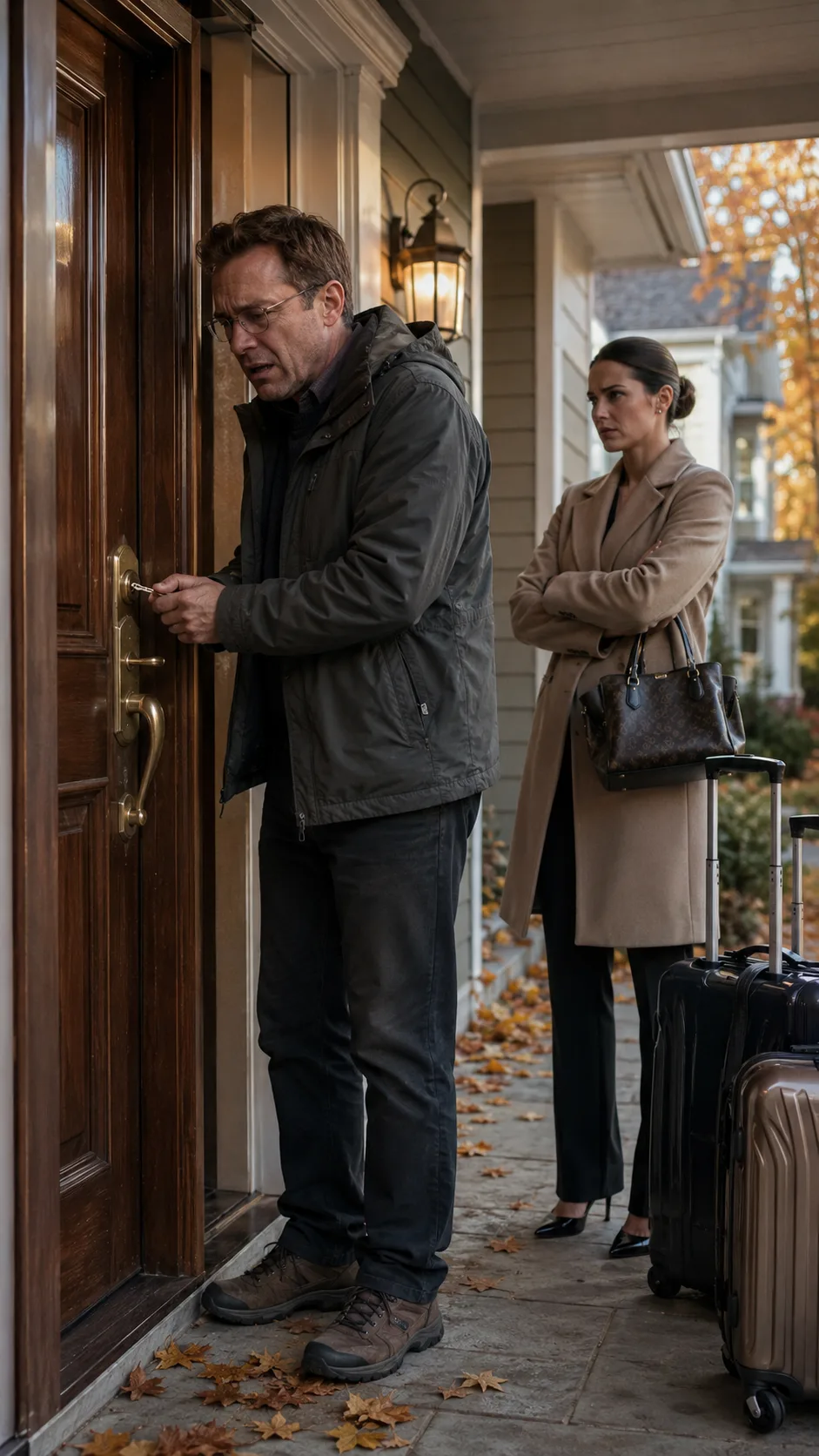
I heard Brooke strike the lower panel of my door with her palm once, hard enough to rattle the chain.
Chapter 3
PART 3 — The Day My Son Finally Saw Who Had Been Holding The Strings
I heard Brooke strike the lower panel of my door with her palm once, hard enough to rattle the chain.
Ryan told her to stop.
Their voices rose and fell on the porch, then moved away.
A few minutes later, the taxi door closed again.
I went to the kitchen and made myself dinner.
Chicken soup from the freezer.
Toast.
Hot tea.
Nothing fancy.
It tasted like freedom.
The days of arranging my life around their comfort were over.
They had believed I was a constant, something fixed and available, like electricity or running water. Something they could use without seeing. Something that would keep working no matter how it was treated.
But even a constant can become a wall.
The next few days were full of texts and calls.
Ryan called repeatedly. I let most of them go unanswered. Brooke sent messages that swung from outrage to accusation to sudden sweetness and back again.
Then relatives began calling.
My sister-in-law, Marlene, was first.
“Helga, what on earth happened? Brooke
says you stranded them and locked them out.”
“That is an interesting version,” I said.
“She says they had nowhere to go.”
“They have an apartment.”
“She said you cut them off financially without warning.”
“I paid for half their vacation, the car, and several ongoing bills. They repaid that by seating me alone in a restaurant and treating me like a problem to be managed.”
There was silence.
Then Marlene said, “Well, young couples can be thoughtless.”
“They can be,” I said. “And older women can stop paying for it.”
Marlene cleared her throat. “I just think family should help.”
“Wonderful. I’ll tell Ryan you’d like to cover their hotel and rent this month.”
The call ended politely but quickly.
After that, the relatives slowed down.
It is amazing how fast moral concern fades when a bill might be attached.
On Friday, Ryan texted and asked if we could
meet on neutral ground.
There was a café downtown I liked, with brick walls, mismatched chairs, and good coffee. I agreed to meet him there at two.
When I arrived, he was already sitting at a table near the back.
Alone.
That mattered.
He looked pale and tired, but not defensive. There was a paper cup in front of him, untouched. His hands were wrapped around it as if he needed the warmth.
“Brooke is at her mom’s,” he said when I sat down. “She says she can’t be under the same roof as someone so calculating.”
I took off my coat and folded it neatly over the chair.
“Ryan, I am not calculating. I am consistent.”
He looked down.
“You watched her treat me like I was invisible,” I said. “You said nothing because you wanted peace. But my peace was the price.”
His face tightened.
“I know,” he
said.
I had expected denial.
I had prepared for excuses.
His answer took some of the breath out of me.
He rubbed both hands over his face.
“I was a coward,” he said. “I kept thinking if I just kept everyone calm, it would be okay. But she puts so much pressure on me, Mom. Everything becomes a test. If I disagree, I’m choosing someone else over her. If I defend you, I’m not loyal. Even my paycheck goes into her account.”
There it was.
The deeper truth.
For a moment, pity rose in me so quickly it almost weakened my spine. This was my son. My boy. The child who once crawled into my bed during thunderstorms and asked if the house would blow away.
But he was not a child now.
And pity had already cost both of us too much.
“You are a grown man, Ryan,” I said. “If you let her control you, that is your choice. But I will not let her control me through you.”
He swallowed hard.
“I don’t know how to fix it.”
“You start by telling the truth. To yourself first.”
I opened my purse and removed an envelope.
His eyes flicked toward it with a painful old hope, as if part of him still expected money whenever paper moved across a table.
I slid it to him.
Inside were not bills.
Inside were printed confirmations for every automatic payment I had canceled.
Phone.
Insurance.
Rent assistance.
Subscriptions.
Transfers.
Ryan opened the envelope slowly. He read the first page, then the next.
“This,” I said, “is your freedom.”
He looked up.
“Freedom?”
“Yes. Because now you get to decide who you are without hiding behind my help or Brooke’s control. You can be angry with me if you need to. But you cannot say I am holding the strings anymore.”
He stared at the papers for a long time.
He did not look angry.
He looked like someone waking from a long and uncomfortable dream.
It was not a soft moment.
It was necessary.
Sometimes the ground has to disappear before a person learns whether he can stand.
Brooke made one last desperate move three days later.
My bank called just before lunch.
It was Elaine, a teller who had known me for nearly twenty years.
“Helga,” she said carefully, “there’s a woman here asking about access to your account. She says she has verbal power of attorney.”
I closed my eyes.
“Brooke?”
“Yes.”
“There is no power of attorney. Verbal or otherwise. Please note the account and block any third-party access.”
“Already done,” Elaine said. Her voice lowered. “I thought you should know.”
“Thank you.”
After I hung up, I sat very still in the kitchen.
Brooke had crossed from entitlement into something more alarming. She had been counting on my money not just as support, but as infrastructure. My savings, my house, my quiet compliance—she had built imaginary plans on all of it.
I decided it was time to clean house.
There were boxes of Ryan and Brooke’s things in my basement. Seasonal decorations they had no room for. Old kitchen appliances. Brooke’s extra luggage. Ryan’s college books. A set of golf clubs he had not used in years. Framed photos from their apartment before they redecorated.
I made a list and sent it to Ryan.
Your belongings will be boxed by the side door Sunday morning. Please pick them up by noon. No need for a personal visit.
He replied only, Okay.
On Sunday, I stacked everything neatly beneath the covered side entry. The morning was cool. Leaves skittered across the driveway. I went upstairs to the bedroom window, where I could see without being seen.
Ryan arrived alone in his small car.
Not the Audi.
Not a borrowed luxury vehicle.
His own car.
The one he now had to pay for himself.
He looked thinner. Or maybe simply less padded by illusion. He loaded box after box into the trunk and back seat. Several times, he glanced up at the house.
I stayed behind the curtain.
It hurt.
Of course it hurt.
Anyone who says boundaries do not hurt has probably never had to build one across the path to her own child. But pain is not always a warning to stop. Sometimes it is proof that the cut has reached the infection.
After Ryan loaded the last box, he stood beside the car for a moment.
Then he walked to the mailbox and slipped something inside.
He drove away without knocking.
I waited until his car turned the corner before going downstairs.
The envelope in the mailbox was plain white. My name was written on the front in Ryan’s handwriting, the same slanted letters I had seen on school forms and birthday cards for decades.
I opened it in the kitchen.
The note was short.
Mom,
You were right about the table in the mountains. I was ashamed, but I was too weak to say anything. I kept telling myself silence was keeping peace, but it was really just making you carry the cost. I’m moving into a small place near work. I need to figure things out on my own for a while. I’m sorry.
Ryan
I read it twice.
Then I sat down.
For the first time since the trip, my eyes filled.
Not because everything was fixed.
It was not.
Not because an apology erased what had happened.
It did not.
But because my son had finally named the truth without asking me to pay for it afterward.
That was more than I had expected.
A month passed.
Life became quieter, but in a cleaner way.
I joined a local hiking club for older adults and discovered, to my surprise, that I could keep up just fine when no one was insulting me before breakfast. We walked greenways, state park trails, and gentle ridge paths. I met a retired nurse named Vivian who told stories better than any novelist, and a widower named Sam who brought homemade granola bars for everyone.
No one seated me in a corner.
No one treated my presence like a scheduling problem.
My bank account breathed easier, too.
Without the automatic payments, I had money left at the end of the month. I used part of it to replace the aging heating system in my house. The contractor told me I had made a smart investment.
I liked the word investment.
For years, I had invested in other people’s comfort.
Now I was investing in my own future.
Brooke sent occasional messages. I deleted most of them unread. The previews were enough: accusations, blame, dramatic declarations about betrayal. She claimed I had destroyed her marriage. She claimed I had poisoned Ryan against her. She claimed I had always hated her.
That was Brooke’s way.
If she lost control, someone else had to become the villain.
I refused the role.
One afternoon, Ryan called.
I almost let it go to voicemail, but something made me answer.
“Hi, Mom,” he said.
His voice sounded different.
Not happy, exactly.
Stronger.
“Hi, Ryan.”
There was no small talk.
“I filed for divorce,” he said.
I held my breath.
“It wasn’t just because of you,” he continued quickly. “The trip opened my eyes, but after that I started seeing everything. She was treating me the same way she treated you. Just more quietly. I wasn’t her husband anymore. I was a means to an end.”
I sat at the kitchen table, looking at the afternoon light on the floor.
“I’m sorry,” I said.
“So am I.”
We talked for a long time that day.
Not about money.
Not about blame.
About practical things. A new apartment near his work. Separate bank accounts. Counseling. Overtime shifts. Groceries. A budget he had made himself on a spreadsheet that sounded clumsy but honest.
He did not ask for help.
That mattered more than any apology.
At one point, he said, almost shyly, “I put the deposit down myself. Used overtime pay.”
I smiled into the phone.
“Good.”
“I wanted to tell you that.”
“I’m glad you did.”
There was a pause.
Then I said, “Sunday dinner is still available, but only on one condition.”
“What’s that?”
“We sit at the same table.”
For the first time in months, Ryan laughed.
A real laugh.
“Preferably by the window,” he said.
“Exactly.”
That first Sunday dinner was in autumn.
The air had turned crisp. Sunlight came through the kitchen window in wide golden bars. I made pot roast, Ryan’s favorite, with carrots, onions, mashed potatoes, and gravy. The house smelled the way it had when he was young and came home from school hungry enough to eat before taking off his backpack.
I set the table carefully.
Two plates.
Two glasses.
Two cloth napkins.
Both chairs by the window.
When the doorbell rang, I did not even check the peephole.
I knew who it was.
Ryan stood on the porch holding a small bouquet of grocery-store flowers. They were not expensive. That made me like them more.
He looked healthier. The dark circles under his eyes had faded. His shoulders seemed lower, as if he had finally set down a bag he had carried too long.
“Hi, Mom,” he said.
“Hi, sweetheart.”
He stepped inside.
For a second, we both stood there awkwardly.
Then he hugged me.
Not quickly.
Not out of habit.
He hugged me like he meant it.
We ate at the kitchen table by the window.
The conversation was careful at first, then easier. He told me about his new apartment, how he had burned toast twice because the toaster was too strong, how he was learning to cook chicken without drying it out, how strange it felt to know exactly how much money was in his account and where it went.
I listened.
I did not offer to pay.
He did not ask.
That was the new peace between us.
“You know,” he said as he helped himself to more gravy, “that trip to the mountains was the worst thing that could have happened to us.”
I raised an eyebrow.
He smiled faintly.
“But it turned out to be the best thing that ever happened to me.”
I nodded.
“Sometimes everything has to crash before you can clear away the rubble.”
After dinner, we took a walk in the park near my house. The leaves had turned gold and rust. Children played near the swings. A man tossed a tennis ball for a dog that had no interest in giving it back. The air smelled like dry leaves and woodsmoke.
Ryan walked beside me with his hands in his jacket pockets.
No rushing.
No checking his phone.
No Brooke waiting somewhere, measuring his loyalty by how quickly he came back.
I thought about that first night in the hotel dining room, when Brooke had tried to make me invisible. The little table. The shadow. The water glass. Ryan’s silence. My cold, clear calm.
In the end, Brooke was the one who disappeared from my life.
I was still there.
Rooted firmly in my own reality.
When we returned to the house, Ryan hugged me again at the door.
“See you next Sunday, Mom?”
“Yes,” I said. “Next Sunday.”
I watched him walk to his own car, the one he now owned, paid for, and drove without anyone else holding the strings.
Then I went back inside, locked the door with my new key, and stood for a moment in the quiet hallway.
It was not the lonely quiet I had feared.
It was not the heavy quiet of being pushed aside.
It was the quiet of a woman who knows her worth.
I had found my own path that night in the restaurant, the moment I sat in the shadows and understood exactly what my silence had been costing me.
That path led me home.
It led me back to my own door, my own table, my own sunlight.
And it taught Ryan something he should have remembered long ago.
You only truly understand someone’s value once you stop financing their disrespect.
THE END.
Chapter complete
You have reached the end of this chapter.
Continue reading
A few more worlds to get lost in after this chapter.




