PART 5 — WHEN I FINALLY CHOSE MYSELF
Rebecca smiled when she explained it.
Chapter 5
PART 5 — WHEN I FINALLY CHOSE MYSELF
Rebecca smiled when she explained it.
It was not a friendly smile.
It was the smile of an attorney who had just discovered that a dead woman had anticipated an enemy twenty years in advance.
“Your grandmother was exceptionally cautious.”
“That’s one word for lying to me from beyond the grave.”
Dad winced.
Rebecca ignored him.
“The trust distributes upon marriage, yes. But only after a ninety-day verification period.”
I blinked.
“What?”
“Marriage triggers eligibility. It does not trigger immediate transfer.”
My father slid the trust document forward.
Rebecca tapped one paragraph.
“If there is credible evidence that the beneficiary entered the marriage through fraud, financial coercion or predatory misrepresentation, distribution is suspended.”
I slowly sat back.
“So Julian gets…”
“Nothing.”
A laugh escaped me.
For the first time in two days, it was real.
Rebecca continued.
“More importantly, because the trust assets never entered your ownership during the marriage, Julian’s forged agreement wouldn’t give him
access even if it were genuine.”
Nineteen million dollars had been dangling inches from his fingers.
And he had destroyed his own plan fourteen hours after saying I do because he couldn’t resist humiliating me.
But the story did not end there.
Three days later, investigators executed a search warrant connected to the suspected identity and document fraud.
Victoria’s safe was seized.
So were two laptops.
A printer.
Prescription medication.
Handwriting practice sheets.
And a notebook.
The notebook was devastating.
There were dates beside my name stretching back eleven months.
My work schedule.
My parents’ travel dates.
My financial adviser’s office address.
Notes about which foods upset my stomach.
And one grotesque entry:
After wedding: gradually isolate. Encourage anxiety diagnosis. J manages appointments.
When Rebecca showed it to me, I had to leave the room.
I vomited in the courthouse restroom.
It wasn’t the money.
It was the planning.
Every
tender moment became contaminated.
When Julian brought me tea after I had the flu, had he cared?
When Victoria insisted I call her “Mom,” had she already been calculating my assets?
When Julian held me the night my grandmother died, had he been wondering what she left me?
There is a particular kind of grief reserved for discovering that your happiest memories may have been evidence.
Mara came to see me that evening.
She looked pale.
“I’m sorry.”
“You didn’t do this.”
“I knew they were obsessed with your money.”
“You didn’t know how far it went.”
She stared at her hands.
“I knew enough to hate myself.”
I reached across the table.
“You called me.”
Her eyes filled.
“Too late.”
“No.”
I squeezed her hand.
“Fourteen hours was late enough to hurt me. It wasn’t late enough to ruin my life.”
She began sobbing.
Then she told me something unexpected.
She was leaving too.
Victoria had controlled Mara’s bank account for years. Chosen her jobs. Read her messages. Sabotaged two relationships because the men “weren’t good enough.”
“I thought that was what families did,” Mara whispered.
“So did Julian.”
“No.” Her expression changed. “Julian knew.”
That distinction mattered.
The next morning, my annulment petition was filed.
Julian responded by claiming I had abandoned him over a “minor domestic disagreement.”
Then discovery began.
And the minor disagreement became very difficult to explain once his text messages were recovered.
Especially the one he had sent Victoria the night before our wedding:
Tomorrow she becomes ours.
The mediation room had no windows.
I appreciated that.
It gave Julian nowhere to look except at me.
Seven weeks had passed.
He looked thinner.
Victoria sat beside him in a navy suit, her lips compressed into a rigid line.
Their attorney looked like a man reconsidering every decision that had brought him into the room.
Rebecca placed a folder in front of me.
Julian leaned forward.
“Elena, before we start, can I say something?”
Rebecca murmured, “You don’t have to listen.”
“I want to.”
Julian swallowed.
“I was wrong.”
I waited.
“My mother influenced me.”
Victoria snapped her head toward him.
He continued.
“I was under enormous pressure.”
“From whom?”
He hesitated.
“You know how families can be.”
“No, Julian. Explain it.”
His jaw tightened.
“I wanted us to have financial security.”
“With my inheritance.”
“With our future.”
There it was.
Even now.
Our.
He still could not imagine something existing beyond his entitlement.
Rebecca opened her folder.
“Mr. Vale, you previously stated you believed Ms. Hart’s inheritance totaled approximately $380,000.”
“Yes.”
“Yet investigators recovered documents from your computer estimating her assets between fifteen and twenty-five million dollars.”
His attorney whispered sharply to him.
Too late.
Julian’s eyes flicked toward me.
And I saw it.
The question he had been dying to ask.
Finally he couldn’t resist.
“How much is it?”
Nobody answered.
He stared at me.
“Elena.”
I leaned back.
“You really want to know?”
His breathing changed.
Victoria leaned forward almost imperceptibly.
I smiled the same eight-tooth smile I had given them in the kitchen.
“Nineteen million dollars.”
Victoria’s face emptied.
Julian actually whispered, “Jesus.”
For three seconds, complete silence.
Then greed overwhelmed caution.
“But we’re married.”
Rebecca closed her eyes briefly, almost delighted.
Julian turned toward his attorney.
“That means I have rights, doesn’t it?”
His attorney looked miserable.
“No.”
“What do you mean, no?”
“The trust did not distribute.”
Julian turned toward me.
I watched comprehension arrive slowly.
“The money…”
“Still protected.”
“When does it distribute?”
I smiled.
“It was supposed to begin ninety days after my marriage.”
His pupils widened.
“Was?”
“The fraud clause suspended it.”
Victoria shot upright.
“What fraud clause?”
Rebecca answered.
“The one your documents activated.”
Victoria sank back into her chair.
For the first time since I had known her, she had nothing to say.
Julian stared at the table.
Then he laughed softly.
Once.
Twice.
It became almost hysterical.
“You’re telling me…”
He looked at Victoria.
Then at me.
“If we had just acted normal…”
Nobody answered.
He whispered:
“We would have…”
“No,” I said.
He looked up.
“You still wouldn’t have had nineteen million dollars.”
His face hardened.
“But I would’ve been your husband.”
“Yes.”
“And you would’ve shared it.”
I thought about that.
Before the rag?
Before the notebook?
Before discovering the forged signature?
Perhaps I would have.
That was the cruelty of it.
If Julian had genuinely loved me, he might eventually have enjoyed everything he schemed to steal.
Instead, he lost me because possession mattered more to him than partnership.
The agreement finalized that afternoon.
He withdrew his claims.
The annulment proceeded.
The criminal investigation continued separately.
Victoria left without looking at me.
Julian lingered outside.
“Elena.”
I turned.
His eyes were red.
“Did you ever love me?”
That question hurt more than all the others.
“Yes.”
He flinched.
I continued.
“That’s why what you did worked for as long as it did.”
He stared at me.
“What am I supposed to do now?”
There was a time when I would have solved that problem for him.
I would have found him a therapist, job contacts, a place to stay, a path forward.
Instead I said:
“Figure it out.”
Then I walked away.
And I believed, finally, that it was over.
I was wrong.
Because two months later, my father called me into his study and handed me a sealed envelope written in my grandmother’s handwriting.
On the front were six words:
For Elena, when she chooses herself.
My grandmother had been dead for two years.
Yet when I touched that envelope, I could smell lavender.
She used to keep sachets between every stack of clothes in her dresser.
My hands shook as I opened it.
Inside was a three-page letter.
The first line broke me.
My darling Elena, if you are reading this, someone has mistaken your kindness for weakness.
I covered my mouth.
Dad turned away.
I continued reading.
Grandmother explained why she had hidden the size of the inheritance.
Not because she distrusted me.
Because she had once been exactly like me.
At twenty-six, she had been engaged to a man who became fascinated with her money after learning about her early investments.
She ended the engagement one week before the wedding.
“Money does not change people,” she wrote. “It gives impatient people a reason to reveal themselves.”
Then came the part none of us expected.
The trust did not merely contain nineteen million dollars.
That was its current value.
Grandmother had also created a charitable foundation funded separately.
Its mission was to provide emergency housing, legal assistance and financial support to people escaping coercive domestic relationships.
She had never activated it publicly.
She had left the decision to me.
At the bottom of the final page:
If you ever understand why I built this protection for you, then you will also understand why others deserve one.
I cried for nearly an hour.
Six months later, the Evelyn Hart Independence Foundation opened its first emergency residence.
Mara became one of its earliest employees after completing training in victim advocacy.
My father handled investments.
My mother oversaw community partnerships.
Naomi, who had watched me arrive at her apartment carrying a suitcase and fourteen hours of marriage, became communications director.
And me?
I went back to work.
That surprised everyone.
People seemed to assume that inheriting millions should make a person instantly abandon ordinary life.
But I liked my work.
I liked coffee from the terrible machine in our office kitchen.
I liked arguing over fonts with coworkers.
I liked choosing my own mornings.
A year passed.
Then another.
Julian and Victoria eventually entered plea agreements related to document fraud and identity-related offenses. I followed the proceedings only as much as necessary.
I stopped searching Julian’s name.
Stopped wondering whether he regretted me or merely regretted the money.
That question no longer belonged to my life.
On the third anniversary of the wedding that barely existed, I was standing inside the foundation’s newest housing center when a woman approached me.
She was perhaps sixty.
Gray hair.
Yellow coat.
Trembling hands.
“You’re Elena Hart?”
“Yes.”
She stared at me strangely.
Then she hugged me.
I froze.
She pulled away quickly.
“I’m sorry.”
“No, it’s okay.”
She wiped her eyes.
“My daughter stayed here.”
I nodded.
“She and her little boy.”
Something tightened in my chest.
“She told me your foundation got her a lawyer. Helped her rent an apartment.”
“That’s what we’re here for.”
The woman smiled.
“No.”
She shook her head.
“You don’t understand.”
She reached into her purse and handed me a photograph.
Her daughter stood beside a small boy holding a red balloon.
They were laughing.
“She was going back to him,” the woman whispered. “She thought she had no choice.”
I looked at the photograph.
Then at the building around me.
Suddenly I was standing again in Julian’s kitchen.
The smell of bacon grease.
Victoria smiling.
The dirty rag sliding down my face.
Julian telling me to earn my keep.
For years, I had thought that morning was the ugliest moment of my life.
I had been wrong.
It was the door.
An ugly door.
A humiliating door.
But a door nonetheless.
If Julian had waited six months before revealing himself, the damage might have been enormous.
Instead, arrogance made him impatient.
Fourteen hours.
That was all he could manage.
That evening, I drove to my grandmother’s old house.
Dad had kept it.
I sat on the porch steps as the sunset burned copper behind the trees.
Someone came through the side gate.
I looked up.
It was my father.
He sat beside me without asking.
For several minutes, neither of us spoke.
Finally I said, “You should’ve told me.”
“I know.”
“I might’ve hated you.”
“I know.”
“I might’ve married Julian anyway.”
“I know.”
I glanced at him.
“You’re annoying when you do that.”
He smiled.
“I know.”
I laughed.
Then rested my head against his shoulder the way I had when I was ten years old.
“I thought Grandma left me nineteen million dollars.”
Dad looked toward the sunset.
“She did.”
“No.”
I watched light move across the porch.
“She left me an exit.”
He was quiet.
Then he nodded.
Months later, there was one final surprise.
Rebecca called me.
“I received something odd.”
“What?”
“A cashier’s check.”
I laughed uneasily.
“From whom?”
“Julian.”
I stopped.
The amount was small compared with everything that had happened.
$2,500.
Exactly the amount of wedding cash I had packed into my backpack the morning I escaped.
There was a note attached.
Three words.
You were right.
I stared at the scanned message for a long time.
I felt no triumph.
No longing.
No anger.
Only distance.
“Return it?” Rebecca asked.
“No.”
“Keep it?”
“No.”
I smiled.
“Put it into the foundation’s emergency transportation fund.”
Rebecca laughed softly.
“Perfect.”
And that was where the last money associated with my marriage went.
Not toward Julian.
Not toward Victoria.
Not toward revenge.
It bought bus tickets, train fares and gasoline cards for people trying to leave.
Three years after a man threw a dirty rag in my face and ordered me to become his maid, I stood in front of a room filled with women receiving keys to new apartments.
Mara stood beside me.
Naomi was taking photographs.
My parents sat in the front row.
Behind us, engraved into a simple brass plaque, were words taken from my grandmother’s letter:
KINDNESS IS NOT PERMISSION.
I touched the edge of the plaque.
For fourteen hours, I had been Julian’s wife.
For much longer, I had believed leaving meant I had failed.
But sometimes the shortest marriage can save an entire lifetime.
Sometimes losing the future you planned makes room for one you never could have imagined.
And sometimes the person trying hardest to trap you makes one catastrophic mistake.
They show you exactly who they are while the door is still unlocked.
That morning, Julian and Victoria thought my smile meant surrender.
They thought I was frightened.
They thought I was obedient.
They thought upstairs I was preparing to clean their house.
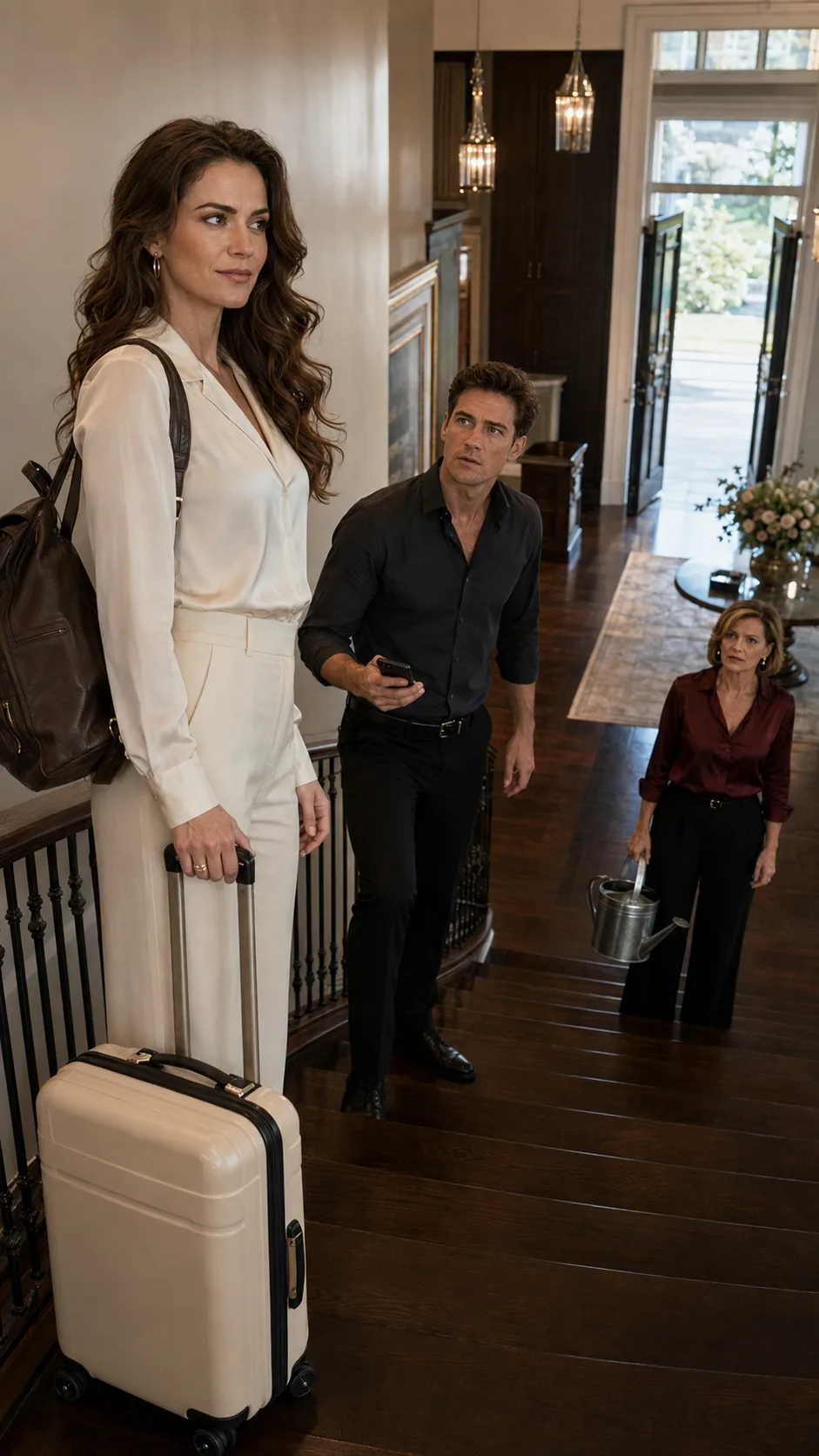
Instead, I had been packing a suitcase.
A passport.
A marriage certificate.
Forty-five thousand dollars.
And without realizing it yet—
the rest of my life.
THE END.
Chapter complete
You have reached the end of this chapter.
Continue reading
A few more worlds to get lost in after this chapter.




