PART 2 — I CANCELED EVERYTHING AND CLOSED THE PIPELINE
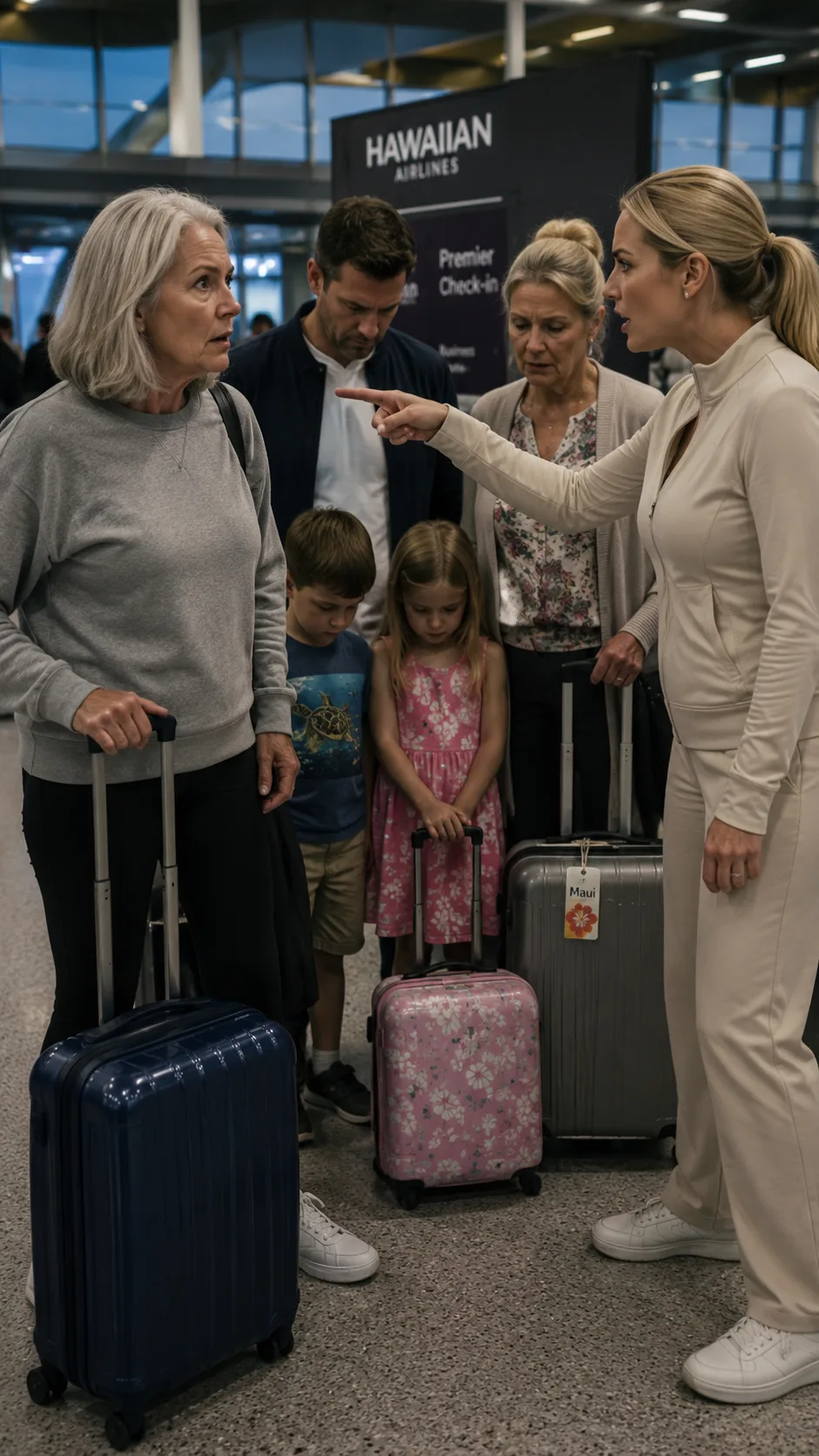
An older woman stood beside them, an overnight suitcase at her feet.
Chapter 2
PART 2 — I CANCELED EVERYTHING AND CLOSED THE PIPELINE
An older woman stood beside them, an overnight suitcase at her feet.
I recognized her instantly from birthday parties and school events.
Linda. Sixty-three. Jessica’s mother.
She wore a comfortable travel outfit—elastic-waist pants, a floral blouse, a light cardigan—and a look that hovered somewhere between excitement and mild discomfort. Her hair, more gray now than blonde, was pulled back into a neat bun. Her suitcase had a Maui luggage tag.
A small warning bell went off in my mind.
Why was Linda here?
She wasn’t part of this trip. This was my family vacation, my gift to my son and his family. I’d paid for everything—every ticket, every room, every activity—with money I had earned over four decades of fourteen-hour shifts, middle-of-the-night codes, and early-morning rounds.
I approached, forcing a smile to my face.
“Good morning,” I called out cheerfully. “Everyone ready for paradise?”
Tyler and Emma glanced up at me but didn’t run over like they usually did. Tyler gave me
a quick, tight smile. Emma clutched the handle of her suitcase.
Jessica turned toward me, her expression oddly flat.
Not excited. Not warm.
Cold.
“Margaret, there’s been a change of plans,” she said.
I stopped, my hand still wrapped around the suitcase handle, fingers suddenly numb.
“A change of plans?” I repeated. I heard my own voice from far away, like it was coming through a hospital intercom.
Jessica sighed as if I were already inconveniencing her.
“We gave your ticket to my mother,” she said, tilting her head toward Linda. “The kids love her more and she deserves a vacation. You understand, right?”
For a heartbeat, I thought I must have misheard her. Maybe it was the noise. Maybe it was the flight announcements echoing off the high ceiling. Maybe she’d said something about the rental car, the room type, anything else.
“You what?” I asked.
Jessica’s tone stayed
casual, almost bored, like she was rearranging dinner reservations and not rewriting a forty-seven-thousand-dollar family trip I had planned down to the last snorkel fin.
“We changed your reservation,” she said. “Linda’s going instead. You can just go home.” She smiled like she was being reasonable, generous even. “The grandkids love her more. They’re closer to her. It makes sense for her to be the one on the beach with them.”
The sentence landed harder than any blunt force trauma I’d ever seen on a CT scan.
I turned to Kevin.
For thirty-eight years, I’ve watched emotion move across my son’s face the way I watched EKG waves march across monitors. Fear, joy, teenage arrogance, first-love stupidity, the quiet pride when he opened his Northwestern acceptance letter. I know every version of that face.
The version looking back at me at O’Hare was one I’d never seen before.
Avoidance.
Cowardice.
“Kevin,” I said. “Tell me this is a joke.”
He shifted his weight, staring somewhere over my shoulder at a United sign like he wanted to disappear into it.
“Mom, it makes sense,” he mumbled. “Linda rarely gets to spend time with the kids. You see them all the time. It’s just one trip.”
Just one trip.
The trip I’d planned for six months. The trip I’d paid forty-seven thousand dollars for. The trip I’d built in my head as the big Hayes family memory, the one my grandchildren would talk about when I was gone.
“Just one trip,” I repeated.
Jessica crossed her arms over her designer athleisure jacket.
“We already changed the reservation with the airline,” she said. “Linda’s seat is confirmed. Your ticket is canceled. Look, it’s not a big deal, Margaret. Stop being dramatic. You’re too old for Hawaii anyway. All that sun and activity, you’d just slow us down.”
Too old.
I am sixty-seven years old. I have cracked open chests at three in the morning and put beating hearts back together while residents half my age nearly fainted. I run four miles three times a week on the lakefront trail, dodging cyclists and college kids. I can walk the stairs to the top of the museum campus without stopping.
But to my daughter-in-law, I was “too old” to sit by a pool and watch my grandchildren play.
I looked at Tyler and Emma, hoping—praying—for some flicker of confusion, some crease of a frown that said this felt wrong to them too.
They stared at the floor.
Their little carry-ons stood at attention beside them like loyal soldiers. Tyler chewed his lip. Emma twisted the sleeve of her sundress. Someone had clearly told them not to say anything.
My grandchildren, who I’d pictured splashing next to me in the Pacific, wouldn’t look at me.
Around us, the hum of O’Hare shifted. A couple at the next check-in kiosk slowed their typing. A TSA agent looked our way, then quickly away. A teenager in a Chicago Bulls hoodie unabashedly watched the show.
“It’s not a big deal,” Jessica repeated, flicking invisible lint from her clothing. “We’ll send you pictures from the trip.”
She actually said that.
We’ll send you pictures from the trip you paid for, the trip you’re being cut out of like a tumor.
I stood very still and felt my heart rate climb. Not into the danger zone; I know those numbers. Just high enough to remind me I was angry.
Forty years as a cardiologist teaches you to separate panic from decision. In code situations, there is always a moment—a single breath—where everything slows down and you either freeze or move.
I moved.
I looked at Kevin.
At the boy I’d sat with in emergency rooms. At the teenager whose college tuition I’d paid. At the man whose mortgage and kids’ tuition I was supplementing every month.
He stared at a scuff on the airport floor.
“Kevin,” I said quietly. “Is this really what you want to do?”
It would have been so easy for him to fix it. One sentence: Mom paid, Mom comes. One move: walk over to the counter, tell the airline there’d been a mistake, reinstate my ticket.
“Yes,” he said finally. “It’s just one trip, Mom.”
There it was.
Not Jessica’s cruelty.
Kevin’s choice.
I felt something very old and very deep inside me crack, the way old plaster cracks in a house when you finally slam the door too hard.
I took in all of them in one long, steady look.
Kevin, who couldn’t meet my eyes.
Jessica, impatient and dismissive, already mentally on the beach.
Linda, clutching her boarding pass like a golden ticket, uncomfortable but not enough to walk away.
Tyler and Emma, learning this is how you treat someone who loves you.
“I understand,” I said.
My voice came out smooth and clinical, the voice I used to deliver bad news in family conference rooms at Chicago Memorial.
Kevin’s head snapped up at my tone. Jessica relaxed, thinking she’d “handled” me.
“Have a wonderful trip,” I said.
Then I turned and walked away, pulling my suitcase behind me. My back was straight, my chin up, the same posture I used when walking into hospital board meetings, malpractice depositions, and ethics committee hearings.
Behind me, I heard Jessica say to Kevin, half-laughing, “See? She’s fine with it. Let’s go check in.”
But I wasn’t fine.
I was finished.
I was done.
I walked to a quiet corner of the terminal near a bank of tall windows overlooking the tarmac. Planes trundled across the concrete in the blue pre-dawn light, tails painted with the logos of airlines from all over the country.
I set my suitcase beside a row of empty seats, took a deep breath, and pulled out my phone.
First call.
I scrolled to a number labeled Elite Travel Services, the high-end agency I’d used for complicated conferences and once-in-a-lifetime trips during my working years.
The line rang twice before a calm, professional voice answered.
“Elite Travel Services, this is Amanda speaking. How may I help you?”
“This is Dr. Margaret Hayes,” I said. “I have a reservation—confirmation number HW2847. I need to make an immediate cancellation.”
I heard typing.
“One moment, Dr. Hayes…” Another pause. “All right, I see your reservation here. This is a comprehensive booking—flights, hotel, activities—for five passengers.” She hesitated. “I should inform you this is a non-refundable package. If you cancel now, you’ll lose the entire amount of forty-seven thousand dollars. Are you sure you want to proceed?”
“I’m aware,” I said. “Cancel everything. All five passengers. All rooms. All activities. Everything.”
“But ma’am, you’ll lose—”
“Cancel it,” I repeated. “Now. I’ll hold while you process it.”
There was another pause. More typing.
“Dr. Hayes, are you certain? Once I process this, it cannot be undone.”
I watched a Hawaiian Airlines plane taxi toward the runway.
“I’m absolutely certain,” I said. “Cancel it all.”
More typing. A few clicks.
“All right. Processing cancellation now,” she said. “This will take approximately two minutes.”
Two minutes to erase six months of planning and forty-seven thousand dollars.
I stood by the window, watching the planes. I thought about how excited I’d been that morning, how I’d barely slept the night before, how I’d imagined Tyler’s face when he saw his first sea turtle.
I thought about how Jessica had told me I was too old and that the kids loved her mother more, and how my son had stood there and said it was “just one trip.”
“Dr. Hayes?” Amanda’s voice came back on the line. “Cancellation is complete. All reservations have been canceled—flights for all five passengers, hotel rooms, all booked activities. I’m so sorry about your trip.”
“Don’t be sorry,” I said. “This worked out perfectly. Thank you for your help.”
I hung up.
Second call.
“Chen and Associates, how may I direct your call?” a receptionist answered.
“Patricia Chen, please,” I said. “This is Dr. Margaret Hayes.”
“One moment, Dr. Hayes.”
I’d known Patricia for twenty years. She’d helped me when I sold my medical practice. We’d met in a conference room high above the Chicago River, floor-to-ceiling windows framing the bridges and the El trains, and I’d liked her immediately—sharp, methodical, and unafraid to tell me the truth.
“Margaret?” Patricia’s voice came on the line, warm and concerned. “What’s wrong?”
“I need you to draft new estate documents today,” I said. “This afternoon, if possible.”
“What kind of documents?” she asked.
“A new will,” I said. “Removing Kevin as beneficiary. Completely. Everything goes to charity. American Heart Association, medical scholarship funds, women’s shelters. I want him explicitly disinherited.”
There was a beat of silence.
“Margaret… what happened?” she asked quietly.
“I’ll explain when I see you,” I said. “Can you have the documents ready by this afternoon?”
“Of course,” she said. “I’ll clear my schedule. Margaret, are you sure? Once you sign—”
“I’m sure,” I said. “I also need you to prepare revocation of all powers of attorney. Kevin no longer has any authority over my affairs. And I need to dissolve the education trust I set up for Tyler and Emma.”
“The five-hundred-thousand-dollar trust,” she said.
“Yes,” I replied. “Dissolve it. Return the funds to my general estate.”
“All right,” Patricia said slowly. “I can do that. I’ll have everything ready by two p.m.”
“Thank you,” I said. “I’ll see you then.”
I hung up.
Third call.
“First Chicago Bank Wealth Management, this is David Richardson. How can I help you today?” a man’s voice said.
“David, this is Dr. Margaret Hayes,” I said. “Account ending in 7074. I need to freeze all authorized users on my accounts immediately.”
“Of course, Dr. Hayes,” he said. “Let me pull that up. Authorized users… You only have one. Your son, Kevin Hayes.”
“Yes,” I said. “Remove him from all accounts. All credit cards where he’s listed as an authorized user. All access. Everything. Effective immediately.”
“Dr. Hayes, are you sure?” he asked gently. “This will cancel his cards.”
“I’m sure,” I said. “Do it now. And I want confirmation via email within the hour.”
“I’ll process this immediately,” he said. “Is everything all right?”
I watched another plane lift off into the morning sky.
“Everything is fine,” I said. “I’m just making some overdue changes. Thank you, David.”
When I hung up, my hands were steady.
My heart wasn’t pounding from stress. It was pounding from clarity.
For the first time in years—maybe decades—I was thinking clearly about my relationship with my son.
How much I’d given. How much I’d sacrificed. How much I’d supported him financially and emotionally, only to be told at an airport that I was too old and that my grandchildren loved someone else more.
I pulled my suitcase toward the exit and called for another car.
I didn’t look back.
By 7:15 a.m., I was back in my quiet house in Lincoln Park, the Chicago sky outside my windows just starting to lighten.
I made coffee in my stainless-steel kitchen, the one I’d remodeled myself ten years earlier, and sat at my small table with the mug warming my hands.
My phone started ringing.
Kevin.
I let it go to voicemail.
He called again immediately. Then again. Then again.
Text messages started coming through in quick succession.
Mom, please call me back. There’s been a misunderstanding. The reservations are all canceled. We need to fix this ASAP.
Mom, please. The kids are crying. The airline says you canceled everything. This isn’t funny.
Mom, call me now.
I turned my phone on silent and set it face down on the table.
Let him panic.
Let him scramble.
Let him explain to Jessica why his mother—the same woman he’d just allowed to be humiliated at an airport—had canceled their entire forty-seven-thousand-dollar vacation.
I had an appointment at two p.m. in the Loop to sign documents that would change everything.
Until then, I ran a hot bath, poured in lavender oil, and let myself sink into the water. Later, I would have a nice lunch at a little café on Clark Street, the kind frequented by professors from DePaul and retired lawyers reading the Wall Street Journal.
And I would start planning the solo trip to Paris I’d been putting off for years.
At exactly two p.m., I walked into Patricia Chen’s law office on a high floor of a glass tower overlooking the Chicago River. The reception area smelled faintly of coffee and toner, the soundtrack a soft mix of printer hum and distant traffic from Wacker Drive below.
Floor-to-ceiling windows framed the river, half-frozen in the lingering Midwestern cold. A tour boat crawled beneath the Michigan Avenue bridge, its guide talking into a microphone no one could hear from up here.
“Margaret,” Patricia said, appearing in the doorway to her office. “Come in.”
She’s in her fifties now—sharp black bob, sharp gray suit, sharp mind. The kind of woman opposing counsel underestimates exactly once.
I sat in the leather chair across from her desk. The same chair where, years ago, we’d talked about selling my practice, structuring retirement, making sure Kevin would be “taken care of” if anything happened to me.
Funny how plans age faster than people.
“Tell me what happened,” she said.
So I did.
I told her about the early-morning alarm and my careful packing. About O’Hare and the suitcases and the little turtle shirt I’d bought Tyler. About Jessica’s words, Kevin’s silence, the way strangers at the airport had more empathy for me than my own son.
By the time I finished, Patricia’s jaw was clenched so tight I could see the muscle ticking in her cheek.
“They gave your ticket to Jessica’s mother,” she repeated slowly, as if she needed to taste every word to believe it, “on the trip you planned and paid forty-seven thousand dollars for. And then they told you the grandchildren love her more.”
“Yes,” I said. “In front of strangers. While I stood there with my suitcase like… like a driver who’d been dismissed.”
Patricia let out a breath that was almost a laugh but not remotely amused.
“Margaret, I’m so sorry,” she said. “That’s… I don’t even have a word for how cruel that is.”
“I don’t need a word,” I said. “And I don’t need sympathy. I need documents.”
That got a quick smile out of her, the professional kind.
“I thought you might say that,” she said.
She pulled a thick folder from a neat stack on her desk.
“I have everything ready,” she went on, “but before you sign, I need to make sure you understand exactly what you’re doing.”
“I understand better than I’ve understood anything in a long time,” I said.
“Your current will,” she said, slipping on reading glasses, “leaves your entire estate to Kevin. Current estimated value, approximately five-point-eight million dollars, not including future growth. This new will completely disinherits him. He will receive nothing. Everything goes to the charities you specified. With the language I’ve included, it will be very difficult for him to contest.”
“Good,” I said.
“I’m also dissolving the education trust you established for Tyler and Emma,” she continued. “That’s five hundred thousand dollars returning to your general estate.”
“I’m aware,” I said. My voice didn’t even wobble on the number.
“And,” she said, “you’re revoking all powers of attorney. Which means Kevin will have no legal authority over your medical decisions, financial decisions, anything, if you become incapacitated.”
“That’s exactly what I want,” I said.
Patricia took off her glasses and studied me for a long moment.
“Margaret, you’re one of the most rational people I know,” she said. “But I still have to ask. Are you sure you’re not making this decision in the heat of the moment? In my line of work, I’ve seen people punish themselves long-term because of a short-term explosion.”
“This isn’t an explosion,” I said.
I picked up the pen she’d placed by the first signature line.
“This is an autopsy.”
She tilted her head. “Go on.”
“That airport incident didn’t cause this decision,” I said. “It clarified it. For thirty-eight years, I’ve put Kevin first. I raised him alone after Thomas died. I took extra shifts. I drove an old car so I could pay for his new textbooks. I paid his college tuition—one hundred eighty thousand dollars. His medical school tuition—three hundred twenty thousand. I helped with his down payment—one hundred fifty thousand. I supplement his mortgage every month. I pay his kids’ private school tuition. On average, I send him eight thousand dollars a month in help and emergency money.”
I signed the first document.
“And this morning,” I continued, “when I needed him to stand beside me—not even to yell, not to create a scene, just to say ‘Mom paid, Mom comes’—he looked at the floor and agreed with his wife that I should go home. That I’m too old. That my grandchildren love someone else more.”
I signed the next page.
“That moment didn’t come out of nowhere,” I said. “It was the final data point in a forty-year study. It showed me the truth about our relationship. It’s not a relationship. It’s a pipeline. Me giving, him taking. And I am closing the pipeline.”
I signed the final page with a firm stroke.
Patricia gathered the documents, flipping through to make sure every line was signed.
“This will is ironclad,” she said. “You’re clearly of sound mind; we’ll document that with a memo and, if necessary, a psychiatrist’s evaluation. We have witnesses. The language explicitly disinherits him and explains why. If he tries to contest it, he will almost certainly lose.”
“Good,” I said again. The word felt clean in my mouth.
I stood.
“Now,” I said, “I need you to arrange for a locksmith to come to my house today. Kevin has keys. I want all locks changed. And I need a security system upgrade—cameras, motion sensors, something that alerts the police if he tries to enter.”
“I’ll arrange it immediately,” Patricia said, already making notes.
“One more thing,” I added. “Draft a formal cease-contact letter. Kevin is no longer welcome at my home. All financial support is terminated. Any attempt to pressure or harass me will be documented.”
Patricia nodded.
“Done,” she said. Then, softer: “Margaret, are you sure you don’t want to at least hear him out? People do terrible things when they’re under the influence of a spouse. Sometimes—”
“There’s no explanation that matters,” I said. “He made his choice at that gate. Now I’m making mine.”
I left her office, rode the elevator down with two men in expensive coats arguing about a merger, and stepped out onto the street.
The late-afternoon light bounced off the river and the glass buildings. The wind off the water cut through my wool coat. A young couple hurried past, laughing, a to-go coffee in each hand.
I pulled my scarf tighter around my neck and realized something strange.
For the first time in a very long time, my shoulders weren’t up by my ears.
I felt… lighter.
Not happy. Not yet.
But lighter.
The next morning, I woke up at seven, made coffee, and sat in my sunroom overlooking the small backyard garden I’d tended for years. The tulips were just starting to push through the soil.
At 7:30, there was pounding on my front door.
I glanced at the new security monitor installed above my kitchen counter. The image flickered and then sharpened.
Kevin, standing on my front porch, looking exhausted and desperate. He was still in the clothes he’d worn the previous day, hair mussed, dark circles under his eyes.
He pounded again.
“Mom!” His voice echoed through the speaker. “Mom, I know you’re in there. Please, we need to talk.”
I pressed the intercom button.
“Kevin, you’re trespassing,” I said. “I’ve changed the locks. If you don’t leave immediately, I’m calling the police.”
“Mom, please,” he said. “Just let me explain.”
“There’s nothing to explain,” I said. “You made yourself very clear yesterday. Now leave.”
“The vacation is canceled,” he said, like this was new information. “Everything. The hotel, the flights, all of it. The kids are devastated. Jessica is—”
“I don’t care about Jessica,” I said. “And I’m sorry the children are disappointed, but that’s not my problem. It’s yours. You chose to give my ticket to Linda. Now deal with the consequences.”
“Mom, I’m sorry,” he said. “Jessica didn’t mean it the way it sounded.”
“Yes, she did,” I said. “And you stood there and let her say it. That tells me everything I need to know. Now get off my property.”
“Mom—”
I picked up my phone and held it up so he could see it through the camera.
“I’m dialing 911,” I said.
His eyes widened.
“Fine,” he said. “Fine. I’m leaving. But we need to talk.”
“No,” I said. “We don’t. Goodbye, Kevin.”
He stood there for another moment, shoulders slumped, then turned and walked back to his car.
I watched him drive away, then called Patricia.
“He came to my house,” I said. “I need that restraining order filed.”
“I’ll have it done today,” she replied.
Over the following week, Kevin tried everything.
He sent flowers. I had them delivered straight to the hospital where I used to work and asked the nurses to put them in the waiting room.
He sent letters. I returned them unopened.
He had the children call my number. Once, I heard Tyler’s voice on the voicemail.
“Grandma, please call us back,” he said. “We miss you.”
My heart broke.
But I didn’t call back.
Because the issue wasn’t with Tyler and Emma.
It was with their parents.
Kevin left voicemail after voicemail. The early ones were angry. The later ones were pleading. The last one I heard, by accident, came when I was checking messages from my book club.
“Mom,” he said, his voice broken and exhausted. “I know you won’t call back. I know you’ve made up your mind, but I need you to know… I understand now. I understand what I did, what I didn’t do at the airport. I should have stood up for you. I should have told Jessica she was wrong. I should have… I should have been your son. And I wasn’t. I chose to avoid conflict instead of protecting you, and I’ll regret that for the rest of my life.”
There was a long pause.
“I’m not calling to ask you to change your mind,” he continued. “I’m calling to tell you I’m sorry and that I love you and that I understand if you never want to see me again.”
He hung up.
I sat with my phone in my hand for a long moment.
He sounded genuinely sorry.
But “sorry” doesn’t undo what happened.
“Sorry” doesn’t erase the memory of standing at that airport, suitcase in hand, being told I was being replaced by someone else’s mother.
“Sorry” doesn’t change the fact that for thirty-eight years, I’d been giving and giving and giving, and the one time I needed basic respect, he couldn’t give it to me.
I deleted the voicemail and went back to my book.
To be continued… Click “PART 3” to read the final part: 👉 PART 3 👈
Chapter complete
You have reached the end of this chapter.
Continue reading
A few more worlds to get lost in after this chapter.




