PART 2 — SEVENTY-TWO CALLS AND THE TRUTH BEHIND THEIR PANIC
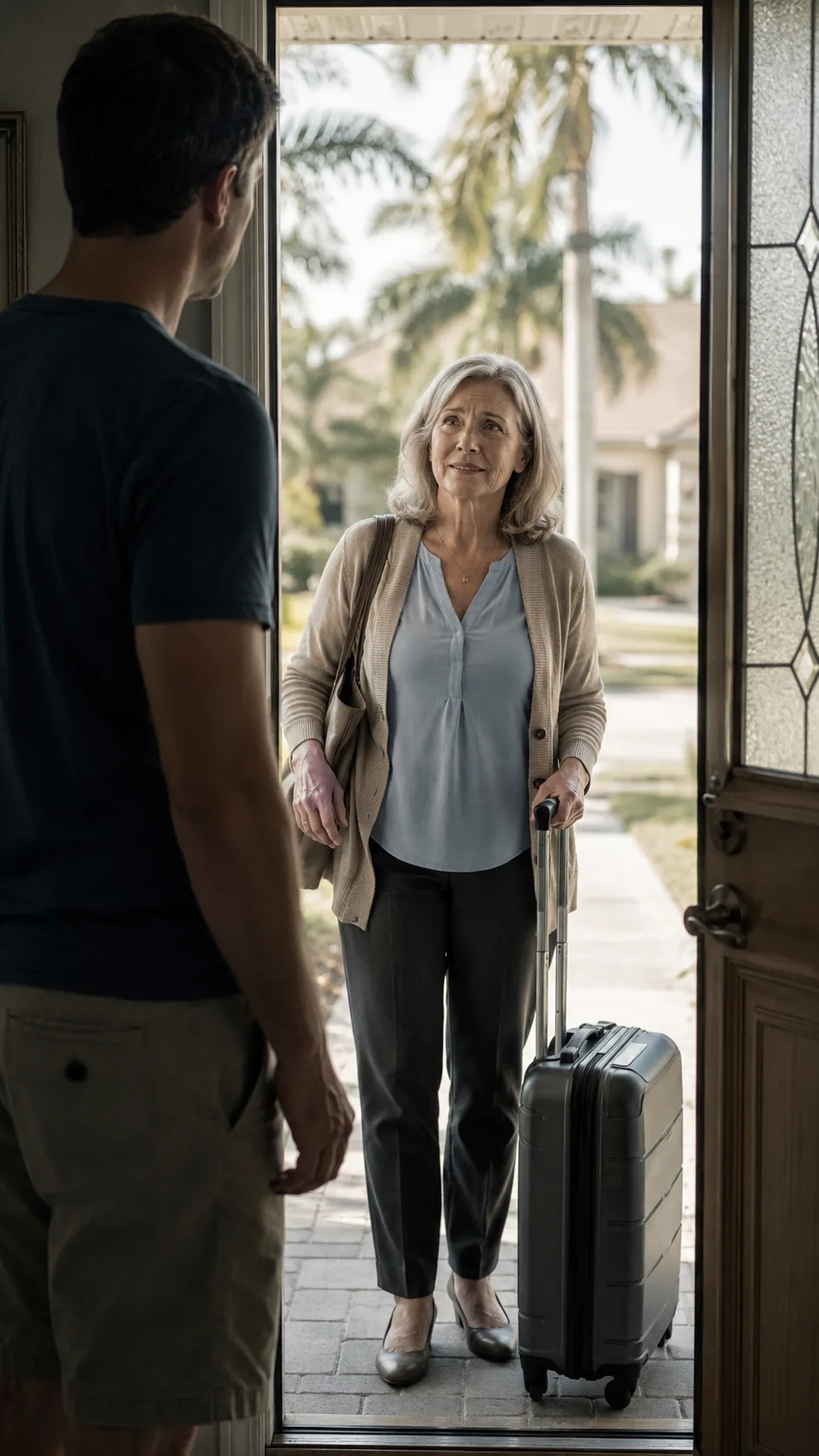
I stood there on that clean porch with my bag next to my feet and birds singing in the trees.
Chapter 2
PART 2 — SEVENTY-TWO CALLS AND THE TRUTH BEHIND THEIR PANIC
I stood there on that clean porch with my bag next to my feet and birds singing in the trees.
Everything outside was peaceful.
But inside me, something cracked.
And for the first time ever, I knew what it felt like to be totally alone.
My hands were shaking.
My chest felt empty.
I didn’t knock again.
I didn’t cry.
I picked up my bag, walked back down those steps, and called another taxi.
But I didn’t go to the airport.
Not yet.
I went to a small hotel nearby.
The room smelled like bleach and old air-conditioning. The curtains were thin. The bedspread was stiff. I sat down on the edge of the mattress and stared at my phone like it might finally explain itself.
Something was very, very wrong.
And I was going to find out what it was.
The next morning, my phone showed seventy-two calls I didn’t answer.
Seventy-two calls.
All from Marcus.
I stared at my phone in the dark hotel room, watching it buzz
and light up again.
Call number seventy-three.
I didn’t pick up.
The messages started around midnight last night and kept coming until seven in the morning.
I listened to the first one.
Marcus’s voice sounded scared.
Not worried.
Scared.
“Mom, where are you? Call me back right now. Jessica is very worried.”
The second one.
“This isn’t funny. You need to tell us where you’re staying.”
The fifth one.
“Mom, we’re sorry about before. Come back. The kids want to see you.”
The twentieth one.
Jessica’s voice this time.
Sweet like honey.
“Carol, sweetheart. We got too upset. Marcus has been stressed from work. Please call us back. We want to fix this.”
I listened to ten more, then stopped.
Not one of them asked if I was safe.
Not one of them said, “Are you okay?”
Not one of them sounded like they cared about how I felt.
Every
single message was about their worry, their stress, their need to know where I was.
Why did they care so much now?
Yesterday, I was someone they didn’t want.
Today, I was something they had to find.
I opened my computer and started looking for answers.
I typed words like grandparent rights, can’t see grandchildren, family pushing away.
What I found made my heartbeat fast.
Page after page of stories just like mine.
Grandmas and grandpas cut off for no good reason.
Tricked by sons-in-law or daughters-in-law.
Made to think they were the problem.
One phrase kept showing up.
Grandparent separation.
I found a website called Separated Grandparents Together and spent four hours reading stories that sounded exactly like mine.
The way it happened was always the same.
Slow pulling away.
Excuses.
Then total cutting off.
And always there was someone making it happen.
Someone who saw the grandparent as
dangerous to their control.
Jessica.
I thought back over the last three years.
How Jessica always stood between me and Marcus when we talked.
How she would answer questions I asked him.
How she would end our calls early—always with Emma or Tyler doing something right when I showed up on the screen.
How Marcus’s messages got shorter and sounded more formal.
Less like my son.
My phone rang again.
Marcus.
I turned off the sound.
I needed proof.
I needed to know exactly what was happening before I did anything.
I couldn’t just be the “crazy mother-in-law” saying mean things.
I needed facts.
I took out a notebook.
Yes, a real paper notebook.
I wasn’t going to leave computer proof they could find.
And I started writing down everything.
Dates.
Times.
Calls.
Texts.
The little changes that, at the time, looked harmless.
The big pattern they made when you stepped back.
I looked back through three years of messages with Marcus and Jessica, taking pictures of everything, seeing the way we got more and more distant.
February 2022: video calls every week.
July 2022: every two weeks, often stopped early.
December 2022: once a month, always cut short.
April 2023: last video call.
Emma said,
“Grandma, when are you visiting?”
Jessica’s hand came on the screen, covering the camera.
“Emma, go play.”
May to November 2023.
Excuses.
Always excuses.
My phone buzzed with a text.
Marcus.
“Mom, you’re scaring us. Please let us know you’re okay.”
I typed back.
“I’m fine. I’ll call when I’m ready.”
And then I blocked his number.
The quiet that came after felt both freeing and terrifying.
Like stepping out of a burning house into the night and realizing you don’t know where you are.
I spent the next three days in that hotel room, not eating much, making my case like I was getting ready for court.
Because maybe I would be.
I found a law office in Florida that helped with grandparent rights.
Baker and Sons Legal.
I read every article they wrote.
Every story about cases.
Florida had laws about grandparent visitation.
Not many.
Not easy.
But some.
On day four, I did something that felt both strong and sad.
I made a new email that Marcus and Jessica didn’t know about and wrote to Marcus’s old friend from high school, Robert, who had kept in touch with me over the years.
Kept it simple.
“Have you seen anything different about Marcus lately?”
His answer came in an hour.
“Actually, yes. He stopped talking to our group. Jessica doesn’t like his old friends, I guess. She says we’re a bad example.”
“Why?”
“Just curious,” I wrote back.
“Thanks.”
Another piece of the puzzle.
I looked at myself in the hotel mirror.
My hair was gray now.
My face had lines from sixty-one years of living.
But my eyes were clear.
I had survived a mean husband.
Raised a son by myself.
Worked until my back ached and my hands stiffened.
I wasn’t going to let some controlling woman erase me from my grandchildren’s lives.
I picked up my phone and called Baker and Sons Legal.
“I need to talk to someone,” I said when the secretary answered. “It’s about grandparent visit rights.”
“Of course,” she said warmly. “Can I get your name?”
“Carol Henderson.”
“And this is very important.”
The offices of Baker and Sons Legal were on the tenth floor of a glass building in the center of Florida.
The lobby was all marble and quiet fountains, cold air, polished surfaces that reflected your face back at you—like the building itself was asking who you were when nobody was clapping for you anymore.
I got there twenty minutes early for my meeting, wearing my nicest jacket.
The one I bought for Marcus’s wedding.
The irony wasn’t lost on me.
Thomas Baker turned out to be a man in his sixties with kind eyes and a strong handshake.
He pointed to a chair across from his desk, which was covered in files and law books.
“Tell me everything,” he said simply.
I did.
I showed him my notebook.
Three years of getting more and more distant.
The sudden stops.
The mean welcome at their door.
The seventy-two scared calls the second I became impossible to find.
When I finished, he sat back in his chair.
“Mrs. Henderson, I’m going to be honest with you. Florida law does let grandparents visit, but it’s hard. You’ll need to prove that you had a real relationship with your grandchildren, and that visiting helps them.”
“I was there when Emma was born,” I said. “I stayed with them for three weeks helping Jessica feel better. I was at every birthday until they stopped asking me. I have photos and videos.”
“That’s good. Very good.”
Thomas opened a folder.
“Here’s what worries me about your case—and what might help you. The sudden change from regular grandma to someone they don’t want. Then their panic when you took control. That looks like control, not concern.”
“What do we do?”
“First, we send a formal letter asking for regular visits with specific days and times. We keep it fair. If they say no, we file papers with the court.”
Then he leaned forward.
“Mrs. Henderson, this will get ugly. They will fight hard. Jessica will probably paint you as crazy or pushy. Are you ready for that?”
I thought of Emma’s face looking around the corner.
The way she whispered, “Grandma,” before Jessica pulled her away.
“Then let’s start.”
The letter was sent by special mail five days later.
I stayed in Florida, moving from the small hotel to a cheaper place I could stay longer.
I wasn’t going home until this was done.
Three days after the letter was delivered, my new email got a message from an address I didn’t know.
The subject said,
“We need to talk.”
It was from Marcus, but not his normal email.
He must have gotten my new address from Robert.
Or maybe he just guessed different versions until one worked.
“Mom, I don’t know what game you’re playing, but you need to stop. Jessica is so upset. You’re breaking our family apart. If you want to see the kids, all you have to do is say sorry and visit like a normal person. This legal threat is crazy. Are you having some kind of mental problem?”
I read it four times.
Each sentence was perfect manipulation.
You’re breaking the family apart.
You need to say sorry.
You’re crazy.
I sent it to Thomas without answering.
His response came fast.
“Perfect. Save everything.”
That night, I got a series of text messages from numbers I didn’t know.
Pictures of me going into my hotel.
Pictures of me at a coffee shop.
A message said,
“We know where you are.”
My skin went cold.
I called hotel security.
Then the police.
A bored officer took my report and said there wasn’t much they could do unless someone directly threatened me.
“Ma’am, you’re in public places. Anyone could take these pictures. It’s scary behavior. File for a protection order if you feel unsafe.”
After he left, I sat on my hotel bed and realized I was in over my head.
This wasn’t just a custody fight.
Jessica was fighting a mind war.
And Marcus was her willing soldier.
My phone rang from a blocked number.
Against my better judgment, I answered.
“Carol.”
Jessica’s voice.
No longer sweet.
“I think we need to talk, woman to woman.”
“I have nothing to say to you.”
“You’re making a mistake. Marcus doesn’t want you in our lives. He told me you were always too controlling, always critical. He’s happy you’re finally gone. But I’m willing to let you see the kids sometimes—on our rules—if you drop this crazy legal action.”
My hand tightened on the phone.
“If Marcus truly felt that way, he wouldn’t need you to talk for him.”
“Carol, you separated him from his friends. You’ve separated him from me. And now you’re using my children as power.”
Then her voice sharpened.
“But here’s what you don’t understand. I’m not some problem you can remove. I’m their grandmother. And I have rights.”
“Rights?”
She laughed.
Sharp.
Mean.
“You’re a bitter old woman who can’t accept that you’re not needed anymore. We’ll see what the court says about your rights.”
She hung up.
I immediately called Thomas’s emergency number and told him the whole conversation, word for word.
“She showed her hand,” Thomas said, and for the first time I heard a note of confidence in his voice. “She’s scared. Now comes the hard part: proof. Do you have people who saw you with the children?”
“Yes,” I said, my mind working fast. “Yes, I do.”
The next morning, I started making calls.
Marcus’s old neighbors in Texas who saw me babysit when Marcus and Jessica visited.
The waitresses at the diner where I worked who met Emma when she was a baby.
Robert, who was at Tyler’s baptism and saw Jessica pull me aside to criticize how I was holding the baby.
Each conversation revealed another piece of the pattern.
Another quiet squeeze.
Another subtle shove.
Another moment where love was treated like a threat.
By the end of the week, Thomas had fifteen written statements from people willing to testify about my relationship with my grandchildren and the sudden, unexplained cutoff.
“Mrs. Henderson,” Thomas said during our next meeting, “I think we have a case. A strong one. But you need to get ready. When we file this petition, they’re going to get worse. Jessica will fight mean.”
I looked at the stack of statements on his desk.
Real proof.
Real voices.
A paper shield against the word crazy.
“Let her try.”
The petition for grandparent visitation was filed on a cloudy Monday morning.
Thomas called me from the courthouse steps.
“Done. They’ll get the papers within two days.”
I sat in my hotel room, hands shaking, and waited for the explosion.
It came at 8:17 at night on Tuesday.
My hotel room phone rang.
They’d found me.
I don’t know how, but they had.
I picked up.
Marcus’s voice exploded through the speaker.
It was almost unrecognizable.
“What is wrong with you? Do you understand what you’ve done? We have to hire a lawyer now. Do you know how much that costs? Do you know how embarrassing this is?”
“Marcus—”
“You don’t get to talk. You’re suing us. You’re actually suing your own family for the right to see children who have two perfectly good parents. Do you understand how crazy that sounds?”
Behind him, I could hear Jessica crying loudly, like she was performing for an audience.
“I wouldn’t have to petition the court if you’d simply let me be a grandmother,” I said, keeping my voice steady. “Seven months, Marcus. You kept my grandchildren from me for seven months.”
“Because you’re controlling. Because you criticize Jessica all the time. Because every time you visit, you go against our parenting.”
“When have I ever—”
“You told Emma that four hours of TV was too much. You told Jessica she was giving Tyler the wrong baby food. You questioned our discipline rules every single visit.”
I closed my eyes.
None of this was true.
But he believed it was.
Or he’d been trained to repeat it.
“Marcus,” I said, “has Jessica ever let you talk to me alone? Even once in the past year?”
Silence.
That silence said more than any scream.
“You’re making my wife the bad guy now,” he snapped.
His voice got louder.
“Mom, stay away from us. Stop this lawsuit or I promise you’ll never see these kids again. Court order or not, I’ll make sure.”
He hung up.
My hands were shaking so hard I could barely hold the phone.
I called Thomas.
“They’re threatening me,” I said. “Marcus just called and said he’d make sure I never see the kids, even with a court order.”
“Don’t tell me over the phone,” Thomas said. “Write down everything he said word for word right now while it’s fresh. Time, date, how long the call was. Anyone who heard. This is proof, Carol.”
I wrote it all down.
My handwriting looked like it belonged to someone running.
The next day, a letter came to the hotel.
Someone had slipped it under my door.
It was from Jessica.
Handwritten on expensive paper.
“Carol,
I’m writing to you as a mother. One mother to another. I know you think I’ve turned Marcus against you, but that’s not true. He made his own choice to create distance because your behavior has been hurtful to our family. I’ve tried to be patient to give you chances, but you keep crossing boundaries.
However, I’m willing to offer you a deal. Drop this lawsuit and we’ll let you have watched visits once every three months for three hours at our house. You’ll see the children, they’ll see you, and we can all move forward.
But you must drop the legal action first. You must trust us.
If you keep going down this path, you’re forcing us to tell things about your past that might hurt your case. Things Marcus has told me in private. Things about your mental state, your drinking, your behavior when he was growing up.
I don’t want to do this, Carol, but you’re leaving us no choice.
Think carefully about what matters more—your pride, or your grandchildren.
Jessica.”
I read it twice.
Then I read it a third time.
My vision blurred with anger.
Mental state.
Drinking.
Behavior.
None of it was true.
I’d had a glass of wine at dinner like any normal person.
I’d never had a mental health crisis.
But that didn’t matter.
She was building a story.
And stories—when told in court, when repeated enough—can become cages.
I took pictures of the letter from every angle and sent them to Thomas.
His response came quickly.
“She’s desperate. This is actually good for us. Keep it safe.”
That night, I got a series of messages from numbers I didn’t know.
Pictures of me leaving my hotel.
Pictures of me at a grocery store.
A message said,
“We’re watching.”
I called hotel security.
Then the police.
The same bored officer came and said there wasn’t much he could do.
“Ma’am, these are public places.”
“File for a restraining order if you feel threatened.”
After he left, I sat in my room and realized how alone I really was.
Then I remembered something.
I wasn’t alone.
I found the website again.
Separated Grandparents Together.
I found their local Florida group meeting.
They met Sunday afternoons in a community center near the beach—low building, sun-bleached walls, folding chairs, coffee in a big metal urn. The room smelled like sunscreen and paper.
I decided to go.
Fifteen grandparents sat in a circle.
Ages ranging from fifties to eighties.
Some hadn’t seen their grandchildren in years.
Others were in the middle of legal fights like mine.
One woman, Linda, had won her case.
Watched visits every other weekend.
Her eyes were tired.
But there was steel underneath the tired.
“The hardest part isn’t the court,” she told the group. “It’s keeping your sanity while they try to paint you as the bad guy. My daughter-in-law told the judge I was emotionally crazy because I cried when they said they were moving to another state. Apparently, grandmothers aren’t allowed to have feelings.”
Nods went around the circle.
We all understood.
An older man, George, spoke next.
“My son stopped talking to me after his wife convinced him I’d hurt my granddaughter. Based on what? I gave the child a bath when she was two because she got paint all over herself. Eight years later, they’re still telling that story, twisting it into something terrible. I haven’t seen my granddaughter since she was three. She’s eleven now.”
My chest tightened.
These were good people.
Loving.
Normal.
Grandparents erased from their families by slow, practiced cruelty.
When it was my turn to share, I told them everything.
The surprise visit.
The door closing in my face.
The seventy-two calls.
The lawsuit.
The threats.
When I finished, Linda reached across the circle and held my hand.
“You’re doing the right thing,” she said. “Don’t let them make you doubt yourself.”
After the meeting, four of the grandparents—Linda, George, and a woman named Susan—asked me to lunch.
We sat in a restaurant near the water, watching gulls circle like they owned the sky.
We shared stories.
We shared strategies.
And for the first time since this started, I didn’t feel like I was drowning alone.
“They’ll try to break you before the hearing,” Susan warned.
She’d lost her case.
Hadn’t seen her grandchildren in six years.
“They’ll offer deals, then take them back. They’ll be sweet, then mean. They’ll make you question your own memory.”
“Stay strong.”
“How do you survive it?” I asked.
“You remember why you’re fighting,” Linda said. “Not for your son. Not for your daughter-in-law. For those kids. Because even if they don’t remember you now, someday they’ll be grown and they’ll wonder where their grandmother was.”
“And you’ll be able to say, ‘I never stopped fighting for you.’”
That night, I wrote a letter to Emma and Tyler.
Not to send now.
To keep.
To prove.
To promise.
I wrote about the day Emma was born.
How I held her tiny fingers.
How she looked like Marcus when he was a baby.
About Tyler’s first smile.
About the way love can keep breathing even when it’s locked outside.
I sealed it in an envelope and put it in my hotel safe.
Proof.
Or maybe hope.
Monday morning came cold and bright.
I wore a simple dress and the necklace Marcus had given me for my sixtieth birthday, before Jessica.
I got to the coffee shop fifteen minutes early and picked a table by the window where I could see Marcus coming.
He walked in at 11:03.
He looked thinner than I remembered.
Dark circles under his eyes.
A man who hadn’t slept in his own head for a long time.
When he saw me, something moved across his face.
Relief.
Guilt.
Then the mask.
Then control.
“Marcus,” I said.
We ordered coffee.
Neither of us wanted food.
Marcus wrapped his hands around his coffee cup, not drinking—just holding it like it was the only warm thing in the room.
For a long moment, neither of us spoke.
The coffee shop buzzed with Monday noise—keyboards clicking, espresso steaming, someone laughing too loudly at a phone call.
But our table felt sealed off.
“I miss you,” he said finally. “I miss how things used to be.”
“Then why did you close the door in my face?”
He flinched.
“I was stressed. Jessica had just told me her dad was coming to visit. Her dad’s been sick. And then you showed up without warning and I just—I got angry. I shouldn’t have. Sorry.”
It sounded practiced.
Not quite real.
Not quite fake.
Like he’d repeated it to himself until it stopped hurting.
“Marcus, I’ve been trying to visit for seven months. Seven months of excuses.”
“We’ve been busy. The kids are a lot of work. My job is crazy.”
“Has Jessica told you what I supposedly did wrong?”
“The criticism she says I made?”
He hesitated.
And in that hesitation, I saw everything.
To be continued… Click the blue “PART 3” link to read the final part:
👉 PART 3 👈
Chapter complete
You have reached the end of this chapter.
Continue reading
A few more worlds to get lost in after this chapter.




