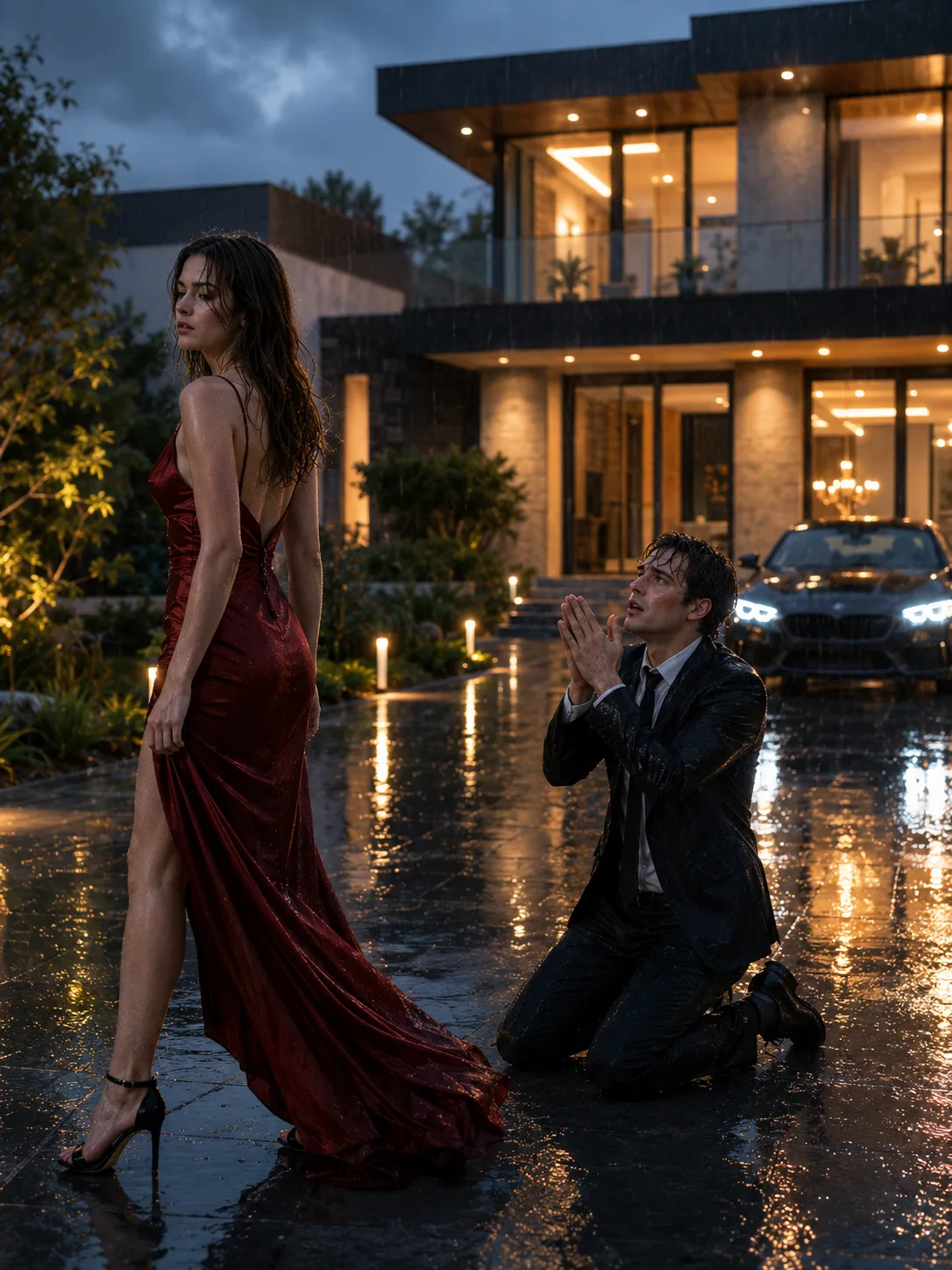
He Married the Girl Everyone Mocked for Revenge and Ended Up Begging Her Not to Leave in the Rain
He turned.
Chapter 1
He turned.
The look he gave her traveled down her body and back up again with surgical cruelty.
“You weren’t expecting mine.”
Her cheeks burned.
“I didn’t know what to expect.”
“Expect nothing.” Lorenzo stepped closer. “Let’s make this simple. You are here because your father needed a shield and I needed a door into his empire. This is not a marriage. It is a strategy. Do not expect affection. Do not expect loyalty. Do not expect me to touch you.”
The words hit harder than she wanted them to.
“I understand,” she said.
“No,” he said. “You don’t. I will use you to ruin Roberto Romano. When people see you beside me, they will remember that your father handed me what he loved least to save what he loved most. You are not my wife, Cassandra. You are his insult. And I intend to throw that insult back in his face.”
Cassandra swallowed.
For a moment, her eyes shone.
Then she looked past him, up the staircase, toward the dark house that was now supposed to be hers.
“My mother used to say men reveal themselves most clearly when they think no one can hurt them,” she said.
Lorenzo’s expression hardened. “Your mother is dead.”
“Yes,” Cassandra said. “Because my father broke her slowly. I recognize the method.”
Something flickered in Lorenzo’s eyes.
Then he walked away.
Mateo appeared from the shadows, his expression unreadable.
“This way, Mrs. Bianco.”
The room they gave her was in the west wing, far from Lorenzo’s bedroom, far from the heated heart of the mansion. Once alone, Cassandra stood in front of the mirror.
The dress had torn under one arm. Her makeup was ruined. Red marks crossed her skin where the corset had bitten her.
She looked like exactly what they had called her.
The fat girl.
The unwanted daughter.
The joke.
She sank to the floor.
For the first time that day, she cried.
She cried for her mother, who had once brushed flour from Cassandra’s cheek and told her she was made of more than other people’s hunger. She cried for the girl she had been, hiding in the pantry while Vivian and her friends mocked the lunches she packed for school. She cried for every dress altered to hide her, every family photo taken without her, every dinner where her father watched her plate like her body was a crime scene.
Then, slowly, the crying stopped.
The silence in the west wing was deep.
Different from the Romano house.
There, silence meant someone was about to hurt her.
Here, silence meant no one was watching.
Cassandra rose.
She wiped her face.
Her father had sold her to the devil.
Lorenzo wanted
to use her to destroy Roberto Romano.
Fine.
Let him.
Part 2
Six months later, the Bianco mansion smelled like bread.
It was the first thing people noticed.
Not the marble floors. Not the armed guards. Not the oil portraits of dead Bianco men glaring from gilded frames.
Bread.
Warm focaccia brushed with rosemary oil. Braised short ribs. Lemon cookies cooling on racks. Espresso bubbling on the stove. Fresh basil torn by hand. Garlic roasting until the whole kitchen felt like a place where even killers remembered they were human before they became useful.
Cassandra had found the kitchen on her third morning in the mansion.
By the end of the first week, she had learned the names of every guard.
By the end of the first month, she knew who had children, who sent money to an aunt in Queens, who hated mushrooms, who drank coffee black, and who pretended not to like sweets until she left almond biscotti near the security monitors.
The men were suspicious at first.
She was Romano blood.
Worse, she was the boss’s unwanted wife.
But kindness has a way of slipping past armor when it arrives with warm food and no demand attached.
“Mrs. Bianco,” one young guard named Nico said one night, standing awkwardly by the kitchen door, “my daughter has a birthday tomorrow.”
Cassandra looked up from rolling pastry dough. “How old?”
“Seven.”
“What’s her favorite color?”
“Purple.”
The next morning, Nico found a small lavender-frosted cake boxed on the counter with his daughter’s name written in careful white icing.
He stared at it like Cassandra had handed him a miracle.
After that, the kitchen was never empty.
Men who had once laughed at her from across gala rooms now stood in line for her lasagna and looked ashamed when she remembered their wives’ names.
Mateo came most often.
He never said much at first. He simply appeared, accepted coffee, and watched.
“You’re studying me,” Cassandra said one afternoon.
Mateo’s mouth twitched. “You’re in a house where everyone studies everyone.”
“Fair.”
She slid a plate toward him.
He looked down. “What is this?”
“Ricotta cake.”
“I didn’t ask for cake.”
“No one asks for the thing that saves them.”
He looked at her for a long moment, then picked up the fork.
That was how their strange friendship began.
Not warm. Not exactly.
Honest.
Mateo noticed what Lorenzo refused to see. Cassandra was not meek. She was careful. Her softness was not weakness. It was discipline. She listened when people forgot she was in the room. She remembered numbers. Schedules. Names. Routes. She asked questions that sounded harmless until Mateo realized she had just mapped half a smuggling operation while dusting powdered sugar over cannoli.
One rainy evening, he found her alone at the kitchen table with a notebook open.
He glanced down.
Shipping times.
Union contacts.
Warehouse access codes.
Romano routes.
Mateo went still.
Cassandra closed the notebook calmly.
“Are you going to tell him?” she asked.
“Tell him what?”
“That his punchline knows where the bodies are buried.”
Mateo sat across from her.
“Why?”
Cassandra’s face changed.
Not anger exactly.
Something older.
“My mother’s name was Elena Moore before she married my father,” she said. “She had a bakery in Milwaukee. Small place. Blue awning. She was happy there. My father loved her because she was beautiful and useful. Then he hated her because she stayed kind.”
Mateo said nothing.
“When I was fourteen, she found records. Offshore accounts. Payments to the men who killed Lorenzo’s father’s brother years before. Proof my father had been betraying half the Commission for decades.” Cassandra traced one finger over the edge of the notebook. “She tried to leave. She died two weeks later.”
“Accident?” Mateo asked.
“That’s what the police report said.”
“And you kept the proof?”
“My mother taught me recipes. She also taught me never to trust a man who smiles while locking a door.”
Mateo leaned back.
“Lorenzo needs to know.”
“No,” Cassandra said. “Lorenzo needs to think this is his revenge. If his pride gets in the way, he’ll ruin it.”
Mateo studied her.
“And what do you get?”
Cassandra looked toward the dark window, where her reflection hovered over the rain-streaked glass.
“Freedom.”
Meanwhile, Lorenzo watched his house betray him.
That was how it felt.
The west wing wife he had meant to break had become the quiet center of his estate. Men lowered their voices around her, not in mockery but respect. Guards smiled when she entered. The housekeeper consulted her. Even his oldest captains accepted her coffee like communion.
It irritated him beyond reason.
One afternoon, Lorenzo came home early and found Mateo laughing.
Actually laughing.
In the kitchen.
With Cassandra.
She sat at the counter in a deep blue dress, her hair pinned messily, flour on one cheek. Mateo held a tiny espresso cup and looked more relaxed than Lorenzo had seen him in years.
The sight lodged under Lorenzo’s ribs like a knife.
Mateo stood at once. “Boss.”
Cassandra did not.
She met Lorenzo’s gaze calmly.
“Coffee?” she asked.
“No.”
“Cake?”
“No.”
“Then you’re just here to glare?”
Mateo looked like he wanted the floor to open.
Lorenzo stepped closer. “Careful, Cassandra.”
She wiped her hands on a towel. “Why? Will you exile me to a colder wing?”
His eyes narrowed.
She held his stare.
For six months, he had dressed her in ugliness for public events. Oversized jewel-toned gowns. Loud necklaces. Clothing chosen not to fit her but to display his contempt. He wanted the underworld to see Romano’s discarded daughter beside him and laugh at Romano through her.
At first, Cassandra had endured it with stiff silence.
Then something changed.
She stopped shrinking.
At one charity dinner, Vivian whispered, “That shade makes you look like a sofa.”
Cassandra smiled. “And yet men still sit when I tell them to.”
At a Commission luncheon, an old capo joked that Lorenzo must have gotten “a wife and a refrigerator in one deal.”
Cassandra looked at his plate.
“That’s your third serving of my eggplant parmesan, Mr. DeLuca. Should I take it away before you insult the refrigerator again?”
The table went silent.
Then Mateo coughed into his napkin.
Lorenzo should have been furious.
Instead, he found himself fighting the corner of his mouth.
That angered him more.
He began avoiding the kitchen.
Then he began finding excuses to pass it.
He hated her laugh because it made the house feel less dead.
He hated the way she remembered his men’s grief.
He hated that the first decent meal he had eaten since his father died had been cooked by the woman he had sworn to despise.
Most of all, he hated the way she looked at him.
Not with longing.
Not with fear.
With pity.
The annual Winter Commission Gala arrived in December, hosted in the grand ballroom of the Palmer House Hotel. Neutral territory. Gold ceilings, crystal chandeliers, city power dressed in black tie.
This was the night Lorenzo had been waiting for.
For six months, he had tightened a noose around Romano’s empire.
Or so he believed.
Judges flipped. Dock managers changed sides. Two Romano captains vanished into protective silence. Bankers who had once answered to Robert Romano now took Lorenzo’s calls before the second ring.
Tonight, Lorenzo would announce the takeover publicly.
Tonight, he would avenge his father.
An hour before they left, he walked into Cassandra’s room and dropped a garment bag on her bed.
“Wear this.”
She unzipped it.
Silver fabric spilled out.
Cheap-looking. Shapeless. Huge. Cruel in its intention.
She touched it once, then looked up.
“You want me to look ridiculous.”
“I want you to look exactly like what this marriage is.”
“A joke?”
His eyes were flat. “A message.”
Something in her face went very still.
“For six months, I cooked for your men, kept your house running, attended your events, smiled beside you while people laughed, and gave you no trouble.”
“I didn’t ask for gratitude.”
“No,” she said. “You asked for a target.”
He said nothing.
Cassandra lifted the dress.
“I’ll wear it.”
For one second, Lorenzo felt no victory.
Only unease.
At the gala, the whispers began immediately.
Vivian saw the silver dress and nearly spilled her champagne laughing.
Robert Romano looked satisfied, as if Cassandra’s humiliation had restored order to the universe.
Lorenzo led her through the ballroom with her hand barely touching his arm. Cameras flashed. Men murmured. Women smiled behind glasses.
Cassandra walked with her head high.
Halfway through the evening, Lorenzo tapped a spoon against his glass.
The ballroom quieted.
He stepped onto the stage.
“Friends,” he began, his voice carrying with polished danger. “Associates. Family.”
A few men chuckled.
“Six months ago, the Commission demanded peace between Bianco and Romano blood. Don Romano offered me his daughter.”
He gestured toward Cassandra.
Every eye turned.
“A woman he believed would shame my house simply by entering it.”
Laughter moved through the crowd.
Cassandra closed her eyes once.
Then opened them.
Lorenzo continued. “Robert thought he could hand me what he considered his burden and call it a treaty. He thought I would choke on the insult.”
Romano’s smile faded.
“But here is the thing about burdens,” Lorenzo said, his voice sharpening. “Sometimes they open doors.”
The room stilled.
“As of tonight, Romano warehouses on the South Branch belong to me. The west-side ports belong to me. Three offshore accounts have been frozen. Two judges have recanted their protection. The Romano empire is over.”
Chaos erupted.
Romano surged to his feet. “You son of a bitch!”
Bianco guards moved instantly.
Vivian screamed as her father was restrained.
Lorenzo looked down at Cassandra.
He expected tears.
Humiliation.
Maybe rage.
Instead, she walked toward the stage.
The crowd parted because no one knew what else to do.
Cassandra climbed the steps slowly, the silver dress whispering around her body. She approached Lorenzo and took the microphone from his hand.
He let her because he was too surprised not to.
She reached into her clutch and pulled out a small black flash drive.
“The Cayman accounts are not frozen,” she said.
The ballroom went silent.
Lorenzo stared.
Cassandra held up the drive.
“They were moved two years ago into shell companies under names my father thought no one knew. My mother knew. Then I knew. As of this morning, everything Robert Romano still owned was copied, traced, and transferred into escrow controlled by three lawyers who are not afraid of him.”
Romano’s face turned gray.
“Cassandra,” Lorenzo whispered.
She looked at her father.
“You called me a burden,” she said, her voice steady. “You called me disgusting. You locked the pantry when I was twelve because you said hunger would make me pretty. You let Vivian tear me apart because cruelty entertained you. And then you sold me to the man whose father you helped murder because you believed no one would ever choose me.”
Her voice did not break.
“That was your mistake. You forgot I was in every room you thought I didn’t deserve to enter.”
Vivian’s lips parted.
Cassandra turned to Lorenzo.
“And you.”
The word struck him harder than Romano’s rage.
“You thought you were using me. But for three months, I gave Mateo schedules, manifests, passwords, driver names, payoff ledgers, and warehouse routes. I helped you destroy my father because he deserved to be destroyed. Not because you deserved my loyalty.”
Lorenzo looked toward Mateo.
Mateo gave a single solemn nod.
The world beneath Lorenzo shifted.
The kitchen conversations.
The cake.
The coffee.
The questions.
Cassandra had not been surviving inside his house.
She had been operating.
“You wanted revenge,” she said. “Now you have it. My debt is paid.”
She slipped the diamond ring from her finger.
The ring Lorenzo had chosen because it was too large, too gaudy, too humiliating.
It hit the wooden stage with a sharp, tiny sound that somehow filled the ballroom.
“You got your empire, Don Bianco,” Cassandra said. “And I got mine back.”
Her eyes softened, but only for a second.
“Thank you for taking me out of my father’s house. But I will never again live in a home where I am treated like a punishment.”
Then Cassandra Romano Bianco turned her back on the most powerful man in Chicago and walked out.
No one stopped her.
Not the guards.
Not Mateo.
Not Lorenzo.
The ballroom doors closed behind her.
Lorenzo stood on the stage with victory in his hand and ruin in his chest.
Part 3
The Bianco estate was silent when Lorenzo returned.
Not peaceful.
Silent.
There was a difference.
Peace had warmth in it. Peace smelled like bread, sounded like women laughing in kitchens, felt like someone remembering how you took your coffee even when you had done nothing to deserve being remembered.
This house was just silent.
Lorenzo went straight to the west wing.
Cassandra’s room was spotless.
The bed made. The closet empty except for every ugly dress he had forced her to wear. The jewelry remained lined in velvet boxes like evidence at a trial.
On the nightstand sat a white envelope.
His name was written on it in her elegant hand.
Lorenzo opened it with fingers that did not feel like his own.
Lorenzo,
I hope the victory tastes the way you imagined.
I did not help you because I loved you. I did not help you because I wanted you to finally see me. I helped you because my father was a monster, and monsters do not stop until someone takes away their teeth.
You are cruel. You are proud. You are dangerous.
But your men respect you, and that means something. My father’s men only feared him.
That was the difference.
I am leaving with the only things I have ever truly owned.
My freedom.
My dignity.
Do not look for me.
Cassandra.
Lorenzo read the letter once.
Then again.
Then a third time, as if the words might change if he punished them with his eyes.
Do not look for me.
He crushed the paper in his fist and went to the kitchen.
Three guards sat at the staff table in the dark, drinking whiskey without speaking. One of them had red eyes.
Mateo stood near the pantry holding a wrapped bundle.
“She baked for the night shift before she left,” Mateo said quietly. “Enough for three days.”
Lorenzo looked at the bundle.
Something inside him cracked.
“You knew.”
Mateo did not deny it.
Lorenzo crossed the kitchen and grabbed him by the jacket. “You knew what she was doing.”
“Yes.”
“You let her leave.”
“Yes.”
Lorenzo’s voice dropped. “Give me one reason not to put you through that wall.”
Mateo looked him dead in the eye.
“Because she saved your empire while you were too arrogant to save your marriage.”
The kitchen went still.
Lorenzo released him.
Mateo straightened his jacket.
“You called her a joke, boss. You dressed her like one. You made men laugh at her because you were angry at her father. But she was never weak. She was never stupid. And she was never yours just because a priest said so.”
Lorenzo braced both hands on the steel counter.
His reflection stared back at him from the polished surface.
A powerful man.
A victorious man.
A man who had won everything except the one person who had made winning matter.
“Find her,” he said.
Mateo exhaled. “She asked us not to.”
“I don’t care.”
“You should.”
Lorenzo turned.
His eyes were dark and wild. “Find my wife.”
It took eight months.
Cassandra Romano disappeared so completely that even men who specialized in making people vanish were impressed.
She used no cards connected to her name. No old contacts. No family lawyers. No phones long enough to trace. No airport cameras after Denver. No hotel check-ins. No hospital visits. Nothing.
Lorenzo became a ghost haunting his own empire.
The Romano territories made him richer than his father had ever been. Men bowed lower. Politicians answered faster. Enemies hesitated before breathing in his direction.
He didn’t care.
Food tasted like dust.
Women who once would have thrilled him seemed painted and hollow.
He spent nights in his study with Cassandra’s letter unfolded under one hand and the black flash drive under the other.
Sometimes he went to the kitchen at three in the morning and sat in the dark.
Once, a new cook made ricotta cake.
Lorenzo took one bite and threw the plate against the wall.
“No one makes that again,” he said.
After that, no one did.
The break came in late October.
Mateo entered Lorenzo’s study with a folder.
“We found her.”
Lorenzo stood so fast his chair hit the floor.
Mateo placed a photograph on the desk.
A small bakery on a coastal street in Monterey, California.
The Golden Crumb.
And there, standing outside beneath a striped awning, was Cassandra.
Her hair was loose. Her apron was dusted with flour. She was laughing as she handed a paper bag to a little boy in a raincoat.
She looked unchanged and transformed.
Still full-bodied. Still soft. Still Cassandra.
But the woman in the photograph was not hiding.
She was radiant.
Lorenzo touched the edge of the image.
“She’s happy,” Mateo said.
Lorenzo’s jaw tightened.
“She is my wife.”
“She is a woman who ran from you because you made staying unbearable.”
Lorenzo looked up.
Mateo did not step back.
“If you go there like a boss, you’ll lose her forever. You cannot seize her like a port.”
Lorenzo stared at the photograph.
“I’m going.”
“I know.”
“Prepare the jet.”
Mateo hesitated. “And if she refuses?”
Lorenzo’s face hardened by instinct.
Then he looked down again.
At her smile.
At the easy way she stood in front of the bakery she had built.
Something painful moved behind his ribs.
“If she refuses,” he said quietly, “then I hear her refuse.”
Thirty hours later, Lorenzo stood across the street from The Golden Crumb.
Monterey was nothing like Chicago.
The air smelled of salt, pine, and rain-soaked stone. The Pacific rolled gray and endless beyond the rooftops. The street was quiet, lined with small shops and warm windows. No armed men on corners. No black sedans idling under dead streetlights. No old blood hiding under new snow.
The bakery glowed like a promise.
Lorenzo watched through the glass.
Cassandra stood behind the counter, wiping down display cases. She wore a green dress under a cream apron. Her curves filled the fabric beautifully, naturally, without apology. Her hair was pinned loosely, strands falling around her face. She hummed along to a radio.
A man came in late, holding a little girl by the hand.
Cassandra smiled, gave the child a cookie, and waved away the father’s attempt to pay.
The child hugged her waist.
Cassandra laughed.
Lorenzo put one hand against the cold window.
For months, he had told himself he wanted her back because she was his wife.
Because she had humiliated him.
Because she had walked away in front of the Commission.
Because no one left Lorenzo Bianco.
But standing there, watching her exist in peace, the lie finally died.
He wanted her back because he loved her.
Not the idea of owning her.
Not the usefulness of her mind.
Her.
The woman who had fed his men when he forgot they were human. The woman who had survived two cruel families and still chosen kindness. The woman whose body he had mocked because he had been too blind to understand beauty that did not ask permission to take up space.
Lorenzo opened the bakery door.
The bell chimed.
Cassandra looked up.
The cloth slipped from her hand.
For a moment, neither of them spoke.
Then she backed toward the counter.
“No.”
Her voice was calm, but her face had gone pale.
Lorenzo stopped immediately.
“Cassandra.”
“No.” She shook her head. “You do not get to say my name in this place.”
Pain crossed his face.
“I looked for you.”
“I told you not to.”
“I know.”
“Then why are you here?”
He swallowed.
Every speech he had prepared vanished.
The demands. The explanations. The promises.
All useless.
“I missed you,” he said.
She laughed once, sharp and wounded.
“You missed the woman you threw away?”
“Yes.”
“You missed your transaction?”
He flinched.
“Your tax write-off?”
“Cassandra.”
“Your symbol? Your insult? Your burden?”
Each word was a knife he had sharpened himself.
He took it.
“All of it,” she said, stepping around the counter. “You said all of it. You made sure I understood exactly what I was to you.”
“You were never those things.”
“I was to you.”
The truth silenced him.
Cassandra’s eyes shone now, but she did not cry.
Not yet.
“I built a life here,” she said. “People know my name. They don’t whisper it like it’s a disease. Children come in after school. Mrs. Hargrove next door brings me mystery novels. The fisherman down the block fixes my awning even when I tell him I can do it myself. I sleep through the night here.”
Lorenzo’s voice roughened. “I’m glad.”
“No, you’re not. You’re furious because I survived you.”
He looked at the floor.
“I was,” he admitted. “At first.”
She stared at him.
“And now?”
“Now I’m ashamed that surviving me was something you had to do.”
The bakery went quiet.
For one brief second, Cassandra’s face softened.
Then headlights swept across the window.
She saw the black SUVs.
Her expression changed.
“You brought them.”
“For protection.”
“For control.”
“No.”
“Don’t lie to me in my own bakery.”
Lorenzo turned sharply toward the window and signaled with one hand.
The SUVs backed farther down the street.
Cassandra watched, breathing hard.
“You need to leave,” she said.
“I will.”
She blinked.
“But I needed to say it once where you could walk away from me if you wanted.” Lorenzo’s hands curled at his sides. “I am sorry. Not because you left. Not because I suffered. I am sorry because I hurt you and called it strategy. I am sorry because I let other men laugh at you when I should have burned the room down for trying. I am sorry because you gave my house warmth and I answered with cruelty.”
Cassandra’s lips trembled.
“Words are easy.”
“I know.”
“You don’t get forgiveness because you finally discovered guilt.”
“I know.”
“You don’t get me back because you’re lonely.”
“I know.”
Her eyes filled.
“Then what do you want?”
Lorenzo looked at her as if the answer terrified him.
“A chance to earn the right to stand in the doorway. Nothing more.”
For a moment, the rain tapped gently against the windows.
Then Cassandra wiped her cheek angrily, as if furious at the tear that escaped.
“I can’t do this.”
She moved quickly.
Too quickly.
Through the kitchen door.
Lorenzo followed only two steps before stopping himself.
Then he heard the back door slam.
He ran outside.
Cassandra was already in an old blue Ford Bronco, reversing out of the alley. Mateo, who had been standing near the corner, stepped toward the vehicle.
“Do not touch her!” Lorenzo roared.
Mateo froze.
Cassandra sped away.
Lorenzo watched her taillights vanish into the rain.
“Where would she go?” Mateo asked.
Lorenzo closed his eyes.
A woman who had disappeared for eight months would always have a second exit.
“The airport.”
The storm hit before they reached Monterey Regional.
By the time Cassandra ran onto the private tarmac, rain was slamming sideways across the runway. Her duffel bag bounced against her hip. Ahead, a small charter plane waited with its propeller spinning.
She was almost there.
Almost free again.
Then black SUVs broke through the gate.
The plane’s engine cut.
Cassandra stopped in the flooded light.
Lorenzo stepped out of the lead vehicle.
No weapon.
No umbrella.
No command.
Just Lorenzo, soaked instantly by rain, walking toward her like every step cost him something.
“Stay away from me!” she screamed.
He stopped ten feet from her.
“You won!” she shouted. “You have the empire. The money. The fear. The city. Let me have this one life.”
His face twisted.
“You can have it.”
“Then why are you here?”
“Because I don’t know how to let you leave without telling you I love you.”
She shook her head, crying now.
“No. No, you don’t get to do that.”
“I know.”
“You don’t get to chase me across the country, corner me on a runway, and call it love.”
“I know.”
“Then leave!”
Lorenzo stared at her.
Then he lowered himself to his knees.
Every man behind him went still.
Cassandra’s breath caught.
The rain hit his shoulders. Water splashed around his polished shoes. The king of Chicago’s underworld put his hands on the wet concrete and bowed his head.
“Get up,” Cassandra whispered.
He didn’t.
“Lorenzo, get up. They’re watching.”
“Let them.”
His voice cracked.
“Let them see what I should have understood the first day. I am not above you. I never was.”
She pressed one hand to her mouth.
“I was cruel because cruelty was the only language I trusted,” he shouted over the storm. “I was proud because pride was easier than grief. I hated your father, and I punished you for having his name. But you were never him. You were never the insult. You were the only innocent thing in that whole rotten war.”
Cassandra cried harder.
“You broke me.”
“I know.”
“You made me feel disgusting.”
Lorenzo flinched as if she had shot him.
“I know.”
“You let them laugh.”
His head lowered.
“I know.”
“You don’t fix that on your knees in the rain.”
“No,” he said. “I fix it every day for the rest of my life if you let me. And if you don’t, then I live with what I did.”
She looked at the plane.
The pilot waited, uncertain and afraid.
Freedom was right there.
Then she looked at Lorenzo.
This was not victory. Not yet.
A powerful man begging could still be dangerous. Regret could become another kind of cage if she let his pain matter more than her own.
So Cassandra stepped closer.
Lorenzo looked up.
His face was wet with rain and tears.
“I am not going back to Chicago,” she said.
He nodded once. “Okay.”
“I am not living in that house.”
“Okay.”
“I am not giving up my bakery.”
“Never.”
“I am not becoming your redemption story so you can feel forgiven.”
His breath shook.
“Okay.”
“If I ever choose to see you again, it will be because I want to. Not because you found me. Not because you ordered cars around my street. Not because your men stand outside looking terrifying.”
“I’ll send them away.”
“You’ll do more than that.” Cassandra’s voice steadied. “You’ll leave me alone for thirty days. No calls. No guards. No gifts. No pressure. If after thirty days I want to talk, I’ll call Mateo.”
Lorenzo looked devastated.
But he nodded.
“Thirty days,” he said.
“And if I never call?”
His eyes closed.
“Then I will spend the rest of my life knowing the best woman I ever met was smart enough not to come back.”
Cassandra stared at him.
The answer hurt.
It also healed something small.
She reached down and touched his cheek.
Not forgiveness.
Not surrender.
Just proof that she was still human, and so was he.
Lorenzo leaned into her hand like a starving man.
“I do love you,” he whispered.
“I know,” she said.
His eyes opened.
“But love is not enough, Lorenzo.”
“I’ll make it enough.”
“No. You’ll make yourself better. Whether I’m there to see it or not.”
He bowed his head.
“Yes.”
Thirty days became forty-five.
Cassandra did not call.
Lorenzo kept his promise.
No cars appeared outside the bakery. No envelopes arrived. No flowers. No threats disguised as romance.
Instead, he changed things she never asked him to change because they were not gifts to her.
They were debts to himself.
He moved out of the Lake Forest mansion and turned it into a fund for families of men killed in syndicate violence. He cut ties with the ugliest parts of the empire, not all at once and not cleanly, because men like Lorenzo did not become saints in a month. But he began dismantling what he could. He paid for lawyers for women trapped in marriages arranged like Cassandra’s. He put Romano money into legitimate businesses and gave control to people who had spent years being used by men with last names like his.
Mateo sent one letter to Cassandra after sixty days.
Not from Lorenzo.
From himself.
He is trying, it said. Not perfectly. Not dramatically. Quietly. I thought you deserved to know.
Cassandra folded the letter and put it in a drawer.
Winter softened into spring.
The Golden Crumb bloomed with orange scones, wedding cakes, and tourists who lined up down the block.
Then one morning, Cassandra opened the bakery and found Lorenzo standing across the street.
Alone.
No suit.
No guards.
Dark jeans. Gray coat. Coffee in one hand.
He did not cross.
He simply stood there.
Cassandra watched him through the window.
He lifted one hand slightly, asking permission without words.
She could have turned away.
Instead, she unlocked the door.
The bell chimed when he entered.
“You have five minutes,” she said.
He smiled faintly.
“I only need two.”
He placed a folded paper on the counter.
“What is that?”
“Divorce papers,” he said.
Cassandra went still.
“I signed them. Everything is yours to decide. If you want freedom legally, completely, you have it. No contest. No condition.”
Her throat tightened.
“And if I don’t sign?”
“Then I’ll come back next week and buy one croissant. If you allow it.”
She looked at him for a long time.
“You hate croissants.”
“I’m learning humility.”
Despite herself, she laughed.
It was small.
But real.
Lorenzo’s face changed as if that laugh had given him back sunlight.
Cassandra looked down at the papers.
Then at him.
“I’m not forgiving you today.”
“I know.”
“I’m not promising tomorrow.”
“I know.”
“But you can sit by the window,” she said. “For one coffee.”
Lorenzo’s eyes shone.
“One coffee is more than I deserve.”
“Yes,” Cassandra said, turning toward the machine. “It is.”
He sat by the window.
She made him coffee.
Black, because she remembered.
And when she set it in front of him, his hand trembled.
Months passed.
He came every Tuesday.
At first, he sat alone.
Then he fixed the broken hinge on the back door.
Then he learned to knead dough badly.
Then better.
The town noticed him, of course. A man like Lorenzo did not disappear into ordinary life easily. But Cassandra never introduced him as a husband. Never as a boss. Never as anything grand.
“This is Lorenzo,” she would say. “He’s helping.”
And for the first time in his life, Lorenzo Bianco learned the dignity of being merely useful.
One year after the night on the runway, Cassandra returned to Chicago.
Not to stay.
To testify.
Robert Romano died in federal custody before trial, angry and alone. Vivian married badly, divorced worse, and vanished to Miami with less money than she believed she deserved.
The Commission changed because Lorenzo forced it to change, and because Cassandra had given the prosecutors enough evidence to make old men afraid of prison beds.
After the hearing, Cassandra stood outside the courthouse in a navy dress that fit her perfectly.
Lorenzo waited at the bottom of the steps.
No guards nearby.
No black SUVs blocking the street.
Just him.
“Are you ready to go home?” he asked.
Cassandra looked toward the city where she had been born, traded, mocked, and nearly broken.
Then she looked west, toward the life she had built by the ocean.
“Yes,” she said. “I am.”
On the flight back to California, she fell asleep with her head against the window.
When she woke, Lorenzo’s jacket was draped over her shoulders.
She looked at him.
He was reading quietly, pretending not to watch her.
“Lorenzo.”
He looked up.
“I’m still angry.”
“I know.”
“I may always be a little angry.”
“You’re allowed.”
She studied him.
“And I still love my bakery more than I love you.”
His mouth curved.
“That seems fair.”
“But I might love you a little.”
The book slipped from his hand.
Cassandra smiled.
“Don’t make me regret saying that.”
He reached for her hand slowly, giving her time to pull away.
She didn’t.
He kissed her fingers, not like a king claiming tribute, but like a man grateful to be trusted with anything fragile.
“You won’t,” he said.
Years later, people in Monterey would tell visitors the story in pieces.
They would say the owner of The Golden Crumb had once been married to a dangerous man from Chicago. They would say he came every morning before sunrise to carry flour sacks and burn the first batch of espresso. They would say he looked at her like she hung the moon with her own two hands.
Some versions claimed he had once ruled the underworld.
Some claimed he had begged for her in the rain.
Cassandra never corrected them.
She was too busy living.
Too busy laughing.
Too busy taking up every inch of space she had once been taught to apologize for.
And every time Lorenzo watched her move through the bakery, full-bodied, bright-eyed, adored by everyone who knew her, he remembered the night he had mistaken her softness for weakness.
He remembered the woman he married for revenge.
The woman who left with her dignity.
The woman who made a mafia boss kneel, not because she wanted power over him, but because she finally had power over herself.
THE END
Chapter complete
You have reached the end of this chapter.
Continue reading
A few more worlds to get lost in after this chapter.




