PART 2 — THE PROMISE SHE TRIED TO ERASE
I filed that phrase away.
Chapter 2
PART 2 — THE PROMISE SHE TRIED TO ERASE
I filed that phrase away.
I told myself I was overreacting.
Old men do that when they are afraid of becoming bitter.
We dismiss our instincts as grief, age, loneliness, pride.
I had been doing that for six years.
Vanessa kept talking.
She said I would love Florida.
She said I would make friends.
She said the community had activities, transport services, dining options, medical support, and “people my age.”
Then she said the sentence that turned the air around me cold.
“Carol would have wanted you to be happy.”
I looked at her then.
Really looked.
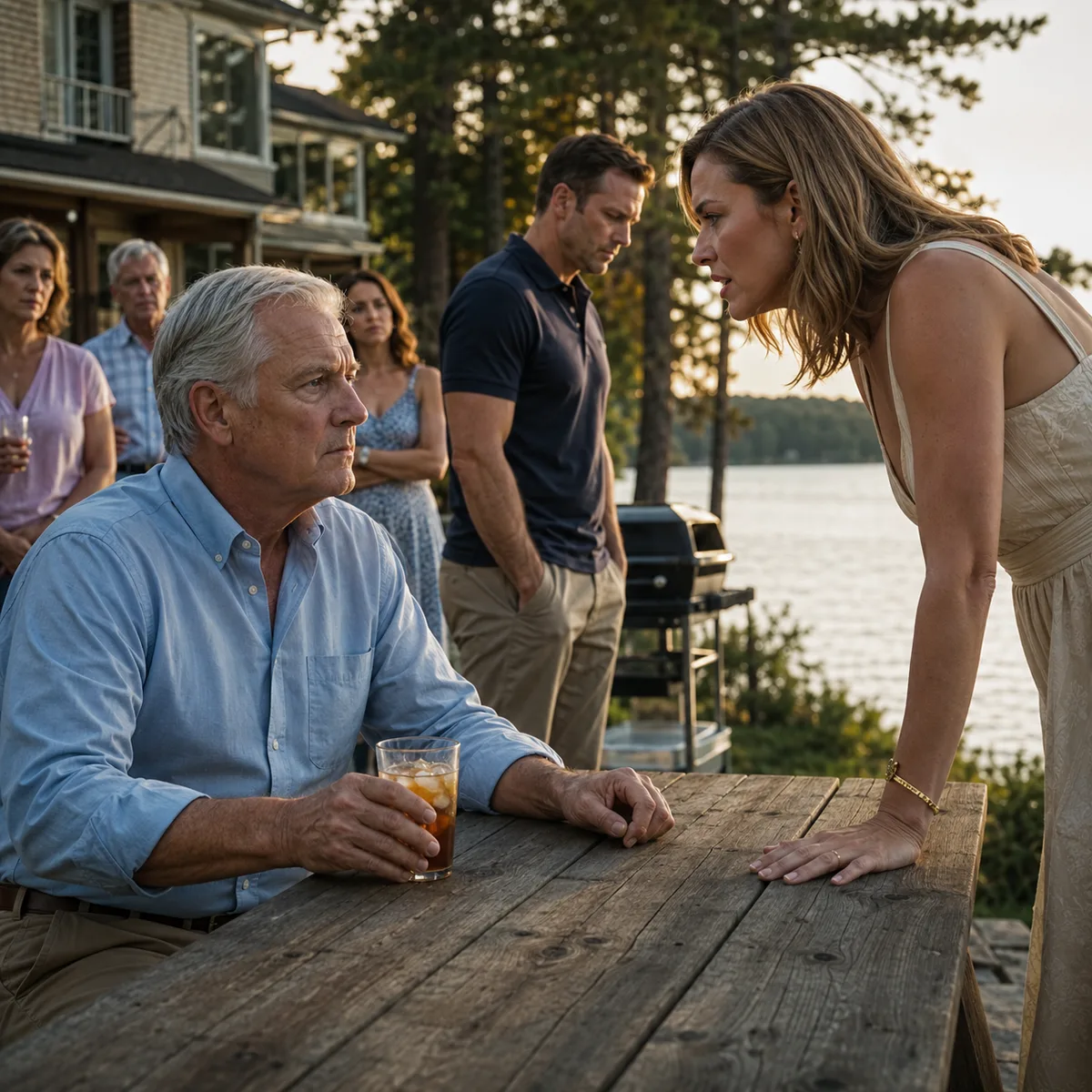
At the elegant sundress.
The gold bracelet.
The smooth performance of concern.
She had met Carol four times before the funeral and twice after. She had never sat with her during treatment. Never held her hair back when the medication made her sick. Never helped her into bed. Never listened to her talk about soil acidity while pretending
not to be afraid of dying.
And now she was using Carol’s name like a key.
Like she had earned the right to unlock whatever she wanted.
I set down my iced tea.
I looked at my daughter-in-law.
Then I said, very quietly, “You have made a serious mistake.”
She laughed.
It was not loud, but it carried.
A small laugh meant to tell the crowd I was confused, stubborn, out of touch.
“Ed,” she said gently, “this is exactly why Daniel and I wanted to handle it carefully. We knew this would be emotional for you.”
“I am not emotional.”
“Of course you are. This house is tied to Carol. Everyone understands that.”
Nobody moved.
Behind her, Carol’s oldest friend from the garden society stared down at her plate.
A neighbor from across the cove leaned closer to his wife.
My son kept his eyes on the grill.
“The
lake house is not for sale,” I said.
Vanessa tilted her head.
“The listing is already live.”
“No broker has legal authority to list it.”
Her smile did not waver.
She reached into the canvas tote bag beside her chair and pulled out a manila envelope.
She slid it across the table toward me with the confident elegance of someone who had rehearsed this moment many times.
I looked at the envelope.
I did not open it.
I did not need to.
Two weeks earlier, an account number connected to a brokerage transfer confirmation had appeared on my banking dashboard as an anomaly. I had not yet investigated it fully. At the time, I told myself it was probably some clerical issue tied to the property trust.
I had been telling myself things were probably nothing for too long.
I pushed the envelope back without touching it.
“The document inside,”
I said, “will be explained to you very soon by someone with a law degree.”
The party did not recover.
Vanessa began explaining my confusion to the guests.
My age.
My grief.
My difficulty adjusting since Carol’s death.
She spoke about me as if I were not sitting five feet away, listening to my own mind being declared unreliable.
Then she said, “We’re only trying to help him move forward.”
That was when I stood.
I did not yell.
I did not overturn the table.
I walked through the screen door into Carol’s kitchen and called a number I had kept in my phone for three years, hoping never to use it.
Before I tell you who answered, I need to tell you what happened two days after Carol’s funeral.
Forty-eight hours after we buried my wife, I sat in the office of an attorney named Margaret Whitcomb.
Margaret was sixty-one then, a small woman with silver-streaked hair cut close to her head and the calm, precise manner of someone who had spent decades watching people make catastrophic decisions during moments of grief.
She had been Carol’s attorney first.
Carol trusted her.
That alone was enough for me.
Margaret had helped Carol structure the inheritance of the lake house property, which had been in Carol’s family for seventy years. After Carol died, Margaret asked me to come to her office and review the documents.
I remember that morning clearly.
Rain streaking down the office windows.
A ceramic mug of coffee I never touched.
Margaret’s desk, immaculate except for one neat stack of papers.
She did not begin with condolences. We had already done that.
She began with a warning.
“Grief makes people generous in ways they later regret,” she said. “And people around grief often become certain they deserve what they ask for.”
I looked at her.
“Are you warning me about my son?”
“I am warning you about human nature.”
Then she explained what Carol had wanted.
The lake house would remain in a trust. I would be the founder and primary beneficiary during my lifetime. After my death, the property would be preserved for family use unless certain conditions were met.
But Margaret recommended one additional protection.
She called it a generation preservation clause.
It was not complicated.
The lake house could not be listed, sold, mortgaged, transferred, or used as collateral without two signatures: mine and Margaret’s, acting as independent trustee.
Any attempt to do so without both signatures would be null and void.
More than that, it would automatically trigger a title audit, emergency injunctive authority, and the right to pursue damages and criminal referral if fraud appeared.
“We need an anchor,” Margaret said.
I signed that document on a Tuesday morning while the world outside moved along without caring that I was putting the last promise I had made to my wife into legal language.
Now, standing in Carol’s kitchen while the birthday party continued outside, I told Margaret what had happened.
She listened without interrupting.
Then she said two words I had never heard her say before.
“I’m ready.”
She told me to stay inside for a few minutes, then return to the party.
“Be polite,” she said. “Be calm. Do not engage with the listing documents. Do not sign anything. Do not touch that envelope again.”
“How long?”
“Forty-five minutes.”
I looked at the clock on the kitchen wall, the one Carol bought at a flea market in Vermont with the crooked minute hand.
“Fine.”
Then I went back outside.
I ate a piece of birthday cake.
I spoke to Carol’s old friends about the willow tree and the water level after a dry summer.
I smiled when spoken to.
Vanessa watched me from across the yard with the expression of a person certain she had won and was simply waiting for the defeated side to acknowledge reality.
Daniel eventually came and sat beside me on the old bench at the edge of the dock.
We watched the water for a few minutes without speaking.
Then he said, “I’m sorry about how that came out.”
I looked at him.
“How it came out?”
“The timing was bad.”
“The timing.”
He rubbed his hands together.
“It’s been a hard decision. Vanessa and I have talked about it a lot. We really believe it’s the right thing.”
“For whom?”
“For everyone,” he said too quickly.
I waited.
“The upkeep is expensive,” he continued. “You’re alone here so much. Florida would be good for you. The place we found has amenities. You wouldn’t be isolated.”
“Did you read the trust documents?”
His mouth tightened.
“Our lawyer reviewed everything.”
“Which lawyer?”
He named a firm in Scottsdale I had never heard of.
For the first time that afternoon, he looked at me fully.
Something passed over his face.
Not guilt exactly.
The shadow of it.
A man realizing he may have memorized answers to the wrong test.
My phone buzzed.
Margaret.
On my way. Bringing two associates and anchor documents. Also bringing title audit results. You should see what I found.
I read the message twice.
Then I looked at my son.
“Did Vanessa mention the home equity line?”
He blinked.
“What?”
“The home equity line taken out against the lake house eighteen months ago.”
He went very still.
I told him Margaret ran annual title audits as part of trust maintenance, a detail I had never mentioned because I never imagined I would need to. The latest audit had flagged a financial instrument filed with the county recorder’s office. The property had been used as collateral for a line of credit worth $250,000.
“The signature appears to be mine,” I said. “It is not mine.”
Click the blue “PART 3” below to read the next part:
Chapter complete
You have reached the end of this chapter.
Continue reading
A few more worlds to get lost in after this chapter.




