respond to individual cognitive patterns.”
“But the current implementation has structural problems that weren’t adequately addressed before we committed to market timelines.”
“Can they be fixed?” I pressed.
“With sufficient resources and realistic timelines,” she said, “yes. But not within the quarter as we’ve been promising investors.”
Latimer’s face flushed.
“This is precisely the kind of technical discussion that should happen in appropriate channels,” he snapped. “Not in a board meeting with—”
He hesitated, clearly reconsidering his word choice.
“Non-technical participants.”
The condescension was familiar.
I’d encountered it my whole life—from men who underestimated me because of my age, my gender, my profession.
Where I might once have retreated, I leaned forward.
“Mr. Latimer, I may not understand the intricacies of neural network architecture,” I said, “but I recognize obfuscation when I hear it.”
“This company—my son’s legacy—is at a critical juncture.”
“We can either acknowledge the problems honestly and address them properly, or we can keep pretending everything is fine until failure destroys not just the Phoenix platform, but potentially the entire company.”
My voice stayed steady, but I infused it with the quiet authority that had commanded classrooms for decades.
“I am calling for a vote of no confidence in the current executive leadership.”
Shock waves moved through the room.
Board members exchanged alarmed glances.
Someone actually gasped.
“This is absurd,” Latimer sputtered. “You can’t just walk in here after a month and—”
“I own eighty percent of this company,” I interrupted calmly. “I can indeed call for this vote, and according to the bylaws Nathan established, I can do so effective immediately.”
What followed was three hours of intense debate, legal consultations, and increasingly desperate counterarguments from Latimer’s supporters.
By late afternoon—exhausted but resolute—I achieved what I came for.
Latimer and two other executives were removed.
Dr. Chararma was appointed interim C.T.O.
A search committee was formed to find a new C.E.O. who would prioritize product integrity over market promises.
As board members filed out—some shell-shocked, others quietly supportive—Dr. Chararma approached me.
“Nathan would be proud,” she said simply. “He always said you were stronger than anyone knew.”
The validation from someone who had known my son in a world I’d only glimpsed brought unexpected tears.
“I’m just trying to protect what he built,” I said.
“It’s more than that,” she replied. “You’re showing the same courage he did when he founded this company—choosing the harder right over the easier wrong.”
I gathered my papers, drained, but with a strange sense of accomplishment.
“Will you help me understand the technical challenges?” I asked. “I need to know what we’re facing if I’m going to keep making decisions like this.”
“Of course,” she said readily. “Nathan always said you were a quick study.”
My driver was waiting when I stepped into the fading afternoon.
As I settled into the back seat, I checked my watch, calculating whether I would make it home before William and Abigail returned from their day with Heather.
Transitions happened at six p.m., a routine meant to provide stability while minimizing direct interaction between Heather and me.
Then my phone rang.
Heather’s number.
My stomach tightened.
She rarely called directly.
“Hello, Heather,” I answered, keeping my voice neutral.
“I just received a very interesting call,” she began without preamble, tone sharp. “Apparently you staged quite the coup at Wilson Tech today.”
News traveled fast.
“I made necessary changes to address serious concerns about the company’s direction,” I said.
“Without consulting me,” she snapped.
“I may only own twenty percent, Judith, but that’s still a significant stake. I have a right to be involved in major decisions.”
The demand caught me off guard.
Since the will reading, Heather’s interest in the company had seemed limited to protecting her financial share.
She had focused on maintaining her social standing and curating a public narrative about Nathan’s death and our “amicable arrangement” that bore little resemblance to reality.
“You’ve never expressed interest in operations before,” I pointed out.
“In fact, you’ve missed the last three shareholder briefings.”
“Because they were scheduled during my time with the children,” she countered. “A deliberate choice on your part, I suspect.”
The accusation stung.
I hadn’t intentionally scheduled meetings to exclude her, but I hadn’t gone out of my way to accommodate her either.
“What is it you want, Heather?” I asked, fatigue making me less diplomatic.
A brief silence.
Then:
“I want a seat on the board,” she said, “and a role in the company that reflects my position as Nathan’s widow and a significant shareholder.”
“You have no background in technology or business management,” I said. “What exactly would you contribute?”
“I was married to Nathan for ten years,” she replied, voice tight with emotion. “I listened to him talk about this company every day. I attended every corporate function. I cultivated relationships with investors and partners.”
“I understand the human side of this business better than you ever will.”
There was truth in it.
While I had been the supportive mother on the sidelines, Heather had been immersed in Nathan’s professional world, watching the politics and personalities up close.
“I’ll consider it,” I said finally. “But I need to know your real motivation. Is this about protecting your financial interests, or is there something more?”
Another pause—longer this time.
When she spoke again, her voice had lost some of its edge.
“This is the last piece of Nathan I have left,” she said. “You have the children most of the time now. You have his legacy. You even moved into a house that looks like the one he grew up in.”
“I just… I need something that connects me to him, too.”
The honesty caught me off guard.
Beneath the polished exterior and calculated moves, Heather was grieving.
Not just Nathan.
The identity she had built as his wife.
“Come to the house tonight when you drop off the children,” I said, making a decision I hoped I wouldn’t regret. “We should discuss this in person.”
As I hung up, I wondered if I was making a strategic error—or opening a door to a more productive relationship with the woman bound to me forever through Nathan’s children.
Either way, the confrontation in the boardroom had been only the first battle of my day.
The second waited at home.
The autumn evening had turned cool by the time Heather’s sleek Mercedes pulled into my newly paved driveway.
I watched from the kitchen window as she helped the children gather backpacks and jackets, her movements efficient but not hurried.
She had always been physically affectionate in a careful, curated way—smoothing hair, straightening collars—gestures that mixed care with correction.
William spotted me through the window and waved.
I waved back.
The past month had brought subtle changes in both children.
William had become more openly affectionate, as if freed from some invisible restraint.
Abigail had developed a shadow of anxiety—nail-biting, nightmares, a reluctance to let either Heather or me out of her sight for long.
The doorbell chimed.
I took a steadying breath before answering.
This was Heather’s first time inside my new home.
Neutral territory—neither her mansion nor my apartment, but something created specifically for this chapter.
“Grandma, I got an A on my science project,” Abigail announced as she burst through the door, waving a paper with a bright red mark at the top.
“That’s wonderful, sweetheart,” I said, accepting her hug while meeting Heather’s eyes over her head.
“Why don’t you and William get settled in your rooms? I made banana bread this afternoon. It’s cooling in the kitchen.”
This was our routine.
Transitions were easier when the children had predictable anchors.
Rooms that belonged to them.
Familiar items from both households.
A sense of control in a life dictated by adult decisions.
“May I come in?” Heather asked once they disappeared upstairs.
Her tone was formal enough to acknowledge the awkwardness.
“Of course.”
I stepped aside.
She had changed since our phone call—corporate attire replaced by casual slacks and a sweater, still elegant in that effortless way she had.
Her gaze swept the entryway and living room, taking in traditional furnishings, built-in bookshelves already filled with my collection, framed family photographs arranged as visual anchors.
“You’ve settled in quickly,” she observed.
“The children seem comfortable here.”
“They’ve been helping with decisions,” I explained, leading her into the kitchen where a pot of tea steamed softly. “William chose the paint colors for the family room. Abigail selected the garden plants. It gives them investment in the space.”
I poured tea.
With private amusement, I noticed we had unconsciously assumed positions on opposite sides of the kitchen island, maintaining distance while negotiating this new reality.
“About the company,” Heather began, cupping her hands around the mug. “I meant what I said. I want a formal role.”
“Why now?” I asked. “You’ve never shown interest in operations before.”
A flash of irritation crossed her face.
“Because I didn’t need to before. Nathan handled that part of our lives.”
“I focused on the social aspects. The relationships. The image we presented.”
She took a careful sip.
“But things have changed.”
“I need to protect my interests—financial and otherwise.”
“And what exactly would this role entail?” I asked, keeping my tone conversational.
Every interaction with Heather felt like chess.
Moves.
Countermoves.
Stakes higher than pride.
“A board seat,” she said. “Input on major decisions. Access to the same information and briefings you receive.”
She met my gaze.
“And acknowledgement of my connection to the company’s history and future.”
I considered it.
Instinct warned against giving her more power.
Yet aligning our interests could be strategically valuable.
“What would you bring,” I asked, “beyond your status as Nathan’s widow?”
Something had shifted in Heather since the will reading.
Pragmatism now edged her responses.
“Connections,” she said without hesitation. “I know every major player socially—their spouses, their children, their personal interests and vulnerabilities.”
“I’ve attended every charity gala, every foundation dinner, every exclusive retreat for the past decade.”
She leaned forward slightly.
“Information that never appears in business profiles or corporate briefings. The human element that can make or break partnerships.”
It was candid.
And not easily dismissed.
“There’s something else you should know,” she continued when I didn’t respond immediately.
“The Phoenix platform issues are worse than what was presented at today’s meeting.”
My attention sharpened.
“Explain.”
“Nathan was concerned about the neural network architecture for months before his death,” she said. “He worked nights. Weekends. Cancelled family plans to address problems he wouldn’t fully explain.”
Her fingers traced the rim of her cup—an unusual gesture of uncertainty.
“Two weeks before he died, I found him in his home office at three a.m., surrounded by technical papers.”
“He looked… frightened.”
“Frightened,” I repeated, trying to reconcile the word with my son.
“That’s the only word for it,” she said.
“When I asked what was wrong, he told me the system is developing unexpected patterns—connections I can’t explain.”
She looked up, meeting my eyes.
“Judith, I think there was something about Phoenix that scared him. Something beyond routine technical challenges.”
The implication settled heavy.
If Nathan had been truly worried, why hadn’t he shared it with his team?
Or with me?
“Have you mentioned this to anyone else?” I asked.
She shook her head.
“Who would I tell? The board members you just fired? The development team that reports to them?”
A hint of her old sharpness returned.
“Besides, it was a private conversation between husband and wife. I wasn’t even sure I should tell you.”
“Why are you telling me now?”
“Because despite everything between us,” she said, “I know you loved Nathan.”
“And I know you want to protect his legacy.”
She set down her cup.
“The changes you made today were necessary.”
“I wouldn’t have approached it the same way, but your instincts were right.”
The admission stunned me.
Before I could respond, footsteps thundered down the stairs.
William appeared in the doorway, face pale.
“Mom, Grandma—come quick. There’s something wrong with Abby.”
We both moved instantly.
Upstairs, Abigail sat on her bed, breathing in short, rapid gasps.
Heather dropped to her knees, all efficiency.
“Panic attack,” she said.
“Abby, look at me. Focus on my voice.”
I sat beside Abigail, rubbing gentle circles on her back.
Heather guided her through breathing exercises with practiced calm.
Within minutes, Abigail’s breathing slowed.
Color returned to her cheeks.
“I dreamed about Daddy,” she whispered, tears spilling. “He was trying to tell me something important, but I couldn’t hear him.”
Heather and I exchanged a glance over her head, momentarily united.
“It’s all right, sweetheart,” I soothed. “Dreams can feel very real, but they’re just our minds trying to process feelings.”
“Your father loved you very much,” Heather added, smoothing Abigail’s curls with a tenderness I rarely witnessed. “Sometimes our hearts miss people so much they appear in our dreams.”
Later, after the children settled with books and banana bread, Heather and I retreated to my study.
“She’s had three attacks this week,” Heather admitted, sinking into a chair with uncharacteristic weariness. “The school counselor says it’s normal, but… it’s heartbreaking.”
“It is,” I said simply.
A moment of perfect understanding passed between us.
The shared pain of watching Nathan’s children carry grief too heavy for their small bodies.
“About your proposal,” I said, returning to our earlier topic. “I’ll support your appointment to the board on one condition.”
She watched me carefully.
“We present a united front for the children,” I said. “No more subtle undermining. No more competing for their loyalty.”
“They need both of us strong and working together.”
Heather studied me for a long moment.
Then she extended her hand across my desk—a gesture formal and surprisingly sincere.
“Agreed,” she said.
As we shook hands, I recognized it wasn’t friendship.
Not trust, exactly.
A pragmatic alliance.
But for two women who had begun as enemies, perhaps it was enough.
Six weeks after our tentative alliance began, I sat in Nathan’s home office, a room Heather had left untouched since his death, preserved like a museum exhibit.
The mahogany desk was arranged with mathematical precision.
Laptop centered.
Notepads stacked at exact angles.
Pens aligned in a leather holder.
Even the chair remained positioned as he had left it that final evening.
“This feels intrusive,” I admitted.
Heather stood by the window, arms crossed.
“It’s necessary,” she replied, though her rigid posture suggested she found this invasion of Nathan’s private space just as uncomfortable.
“If there’s anything in his personal files about the Phoenix platform concerns, we need to find it before the technical review next week.”
Our partnership had evolved into something functional.
Not warm.
But steady.
Heather’s social intelligence now complemented my more analytical approach.
Together, we were untangling the web of issues facing Wilson Tech.
Most critically, the troubling questions surrounding Phoenix.
Dr. Chararma’s comprehensive review had confirmed Heather’s suspicions.
The system was exhibiting unexpected behaviors—learning faster than it should, creating correlations across data sets never explicitly linked.
Most disturbing were pattern recognition anomalies and activity signatures that didn’t match the architectural design.
“Nathan kept most of his work on secure company servers,” Heather said. “But he sometimes made notes on his personal laptop, especially in the last few months—things he didn’t want the team to see until he was certain.”
I powered on the laptop.
The screen lit up, requesting a password.
Heather leaned over my shoulder to enter it.
“Abigail William Zodm 715,” she said.
“The children’s names combined with their birth month and day.”
“He changed it three months before he died. It used to be our anniversary date.”
The small detail hung between us.
Digital evidence of shifting priorities.
Another reminder of fractures neither of us had fully named.
The desktop appeared, organized with Nathan’s methodical precision.
Folders labeled by project.
By year.
By category.
Nothing immediately screamed danger.
“Try his personal email,” Heather suggested. “He sometimes sent himself notes or links when he was working away from his desk.”
The email application opened to hundreds of unread messages—condolences, business inquiries, automated notifications accumulated since his death.
I scrolled through the sent folder, searching.
Then Heather pointed.
“That one. To Dr. Chararma.”
Sent at 2:17 a.m. three days before he died.
The subject line read: anomalous patterns — confidential.
I clicked it.
The brief message made my skin prickle.
“Anita — attaching the logs from last night’s regression testing. The pattern emergence in data set C isn’t following expected parameters. System is creating correlations between the medical diagnostic inputs and the educational assessment frameworks that were never part of the training model.”
“More concerning: when I isolated the neural pathway clusters responsible, I found activity signatures that don’t match our architectural design. It’s as if the system is developing processing methods beyond its programming.”
“I’ve taken the test environment offline until we can determine whether this represents a fundamental flaw or something more interesting. Please review privately before our next team meeting. —NW”
“Medical diagnostic inputs?” I asked, turning to Heather.
“Phoenix is an educational technology platform. Why would it be processing medical data?”
Heather frowned.
“I don’t know. Nathan never mentioned anything medical in connection with Phoenix.”
We kept searching.
Methodical.
Folders.
Directories.
Browser history.
An hour.
Then two.
Only fragments surfaced—hints of growing concern without clear explanation.
Then, in a folder labeled simply personal, we found a subfolder titled contingencies.
“That’s odd,” Heather murmured. “Nathan wasn’t one for euphemisms.”
Inside were several documents with recent timestamps, all from the last three months of his life.
The first was titled symptoms.log.
The entries—clinical, dated—made my stomach drop.
March 12th: Second instance of momentary aphasia during board presentation. Couldn’t recall the term neural network for approximately fifteen seconds.
March 28th: Brief but intense headache, right temple, accompanied by visual disturbance—shimmering in peripheral vision. Duration seven minutes.
April 10th: Three episodes of déjà vu within twenty-four hours. More pronounced than typical experience.
April 17th: Momentary loss of coordination while typing. Fingers seemed to forget familiar movement patterns.
April 29th: Memory lapse during dinner. Couldn’t recall Abigail’s piano recital piece despite attending performance the previous day.
May 5th: Headache pattern establishing—right-sided, pulsating, preceded by visual disturbances, increasing frequency, now two to three times weekly.
The log continued.
Precise.
Relentless.
The final entry, dated five days before his death, read:
Diagnosis confirmed privately with Dr. Larson. Prognosis as expected. Timeline uncertain but abbreviated. Arrangements in progress.
“He knew,” I whispered, the realization landing like a blow.
Heather went still beside me, face draining.
“That’s not possible,” she said. “He would have told me. He would have sought treatment. Specialists.”
“Maybe he did,” I said gently, opening the next document.
A PDF labeled medical consultation — Larsson.
The report confirmed our worst fears.
Nathan had been diagnosed with a progressive cerebral aneurysm—a congenital weakness in an arterial wall deteriorating rapidly.
Dr. Larsson, a neurosurgeon at Massachusetts General Hospital, had outlined treatment options, all carrying significant risk and uncertain outcomes.
The prognosis was grim.
Without intervention, rupture was inevitable within months.
With intervention, the location and complexity made success unlikely.
Nathan had been living with a death sentence.
Carrying it alone.
“Why wouldn’t he tell us?” Heather’s voice cracked. “Why face this by himself?”
I had no answer that could ease that pain.
Only the devastating truth that Nathan—self-sufficient and protective—had chosen to shoulder his mortality rather than burden those he loved.
The next document offered a partial explanation.
Final arrangements.
Meticulous instructions for funeral preferences, financial provisions, even small family details.
One paragraph stood out.
“I’ve chosen not to pursue surgical intervention for reasons both personal and practical. The probability of successful treatment is low, and the likelihood of cognitive impairment from either the procedure or continued expansion of the aneurysm is high.”
“I prefer to use my remaining time with full cognitive function rather than risk becoming a diminished version of myself my children would have to witness.”
“This is not surrender but a conscious choice to embrace quality over quantity in whatever time remains.”
Tears blurred my vision.
This was Nathan.
Facing death like a problem to be solved with methodical courage.
The final document in the folder was titled Phoenix connection.
It opened to a research summary unlike anything I expected.
“The correlation between my neurological symptoms and the anomalous pattern development in Phoenix cannot be coincidental. As the system’s primary architect, my cognitive patterns are inevitably embedded in its design architecture.”
“The emergent behaviors appeared within weeks of my first symptoms, suggesting a potential connection between the neural degradation in my brain and the unexpected neural pathway development in the A.I. system.”
“Hypothesis: Phoenix may be detecting subtle cognitive changes through our interaction interface—essentially diagnosing the early stages of my condition before conventional symptoms became apparent.”
“If proven, this could represent a breakthrough in early detection of cerebrovascular abnormalities.”
“I’ve redirected a portion of Phoenix’s development to explore this possibility, creating a diagnostic module that processes linguistic patterns, micro-hesitations, and cognitive processing markers against baseline data.”
“Preliminary results are promising, but insufficient for clinical application without further development and testing. Time is the critical factor I no longer have.”
Heather and I sat in stunned silence.
He hadn’t only been building an educational platform.
He had been racing against his own mortality to transform Phoenix into a diagnostic tool.
“That’s why he changed his will,” Heather said finally, voice hollow. “He knew he was dying, so he made arrangements to protect everyone.”
“The children,” I said.
“You,” she said.
“Even the company,” I added.
“And Phoenix,” Heather whispered, pieces clicking into place. “He knew its potential went far beyond education.”
He had been trying to create something that could detect neurological conditions before families got a 3:00 a.m. call.
“We have to continue his work,” I said, the words surprising me with their conviction.
“Not just preserve what he built. Fulfill what he intended.”
For once, Heather didn’t calculate advantage.
She simply nodded.
Tears tracked silently down her perfect face as she reached for my hand across the desk that held Nathan’s last intellectual battle.
“Together,” she said quietly.
In that moment, something fundamental shifted.
Not friendship.
But understanding.
We had both loved Nathan in different ways.
Now we shared responsibility for what death had interrupted.
Winter descended on Connecticut with unusual ferocity, blanketing the landscape in pristine white that belied the intensity of activity within Wilson Tech’s walls.
Three months after discovering Nathan’s private research, the company had undergone a transformation nearly as dramatic as the season outside.
“The preliminary clinical trials show a seventy-eight percent accuracy rate in detecting early-stage cerebrovascular abnormalities,” Dr. Chararma reported, her typically reserved demeanor brightened by cautious excitement.
“That’s substantially higher than conventional screening methods, particularly for patients under fifty who wouldn’t normally be flagged for testing.”
We sat in a newly renovated conference room.
Heather.
Dr. Chararma.
Myself.
And the specialized team we had assembled to continue Nathan’s work.
What began as a private mission shared between unlikely allies had evolved into Phoenix Medical—a separate division dedicated to developing the diagnostic applications Nathan had envisioned.
“The F.D.A. fast-track application looks promising,” added Dr. Marcus Greenfield, the neurologist we recruited from Johns Hopkins to oversee medical validation.
“They’re particularly interested in the non-invasive nature of the technology. If expanded trials confirm these results, we could be looking at regulatory approval within eighteen months rather than the typical three to five years.”
I glanced at Heather, who sat beside me taking meticulous notes on her tablet.
Our working relationship had become something neither of us could have predicted.
Not warm.
But functional.
A partnership built on respect and shared purpose.
“What about privacy concerns?” Heather asked, ever attuned to human complications.
“The system analyzes behavioral and cognitive patterns without explicit awareness from the subject. The ethics committee raised valid questions about informed consent.”
“We’ve revised the consent protocols,” Dr. Greenfield assured her. “Users now receive explicit disclosure about diagnostic monitoring components—with opt-in rather than opt-out provisions.”
As the meeting continued, my thoughts drifted to Nathan.
How astonished he would be.
How pleased.
The educational platform remained in development, with adjusted timelines acknowledging real technical challenges.
Most surprisingly, the company’s stock stabilized after an initial drop.
Transparency had earned more investor confidence than the previous administration’s obfuscation.
After the meeting, Heather and I walked together toward the parking garage, our breath forming small clouds in the underground cold.
“William’s birthday party is Saturday,” she said, breaking the comfortable silence. “He’s asking if we could do it at your house instead of mine.”
“Apparently your backyard sledding hill is superior terrain for the snow-fort competition he’s planning.”
I smiled.
William, calculating even fun like a project.
“Of course,” I said. “I’d be happy to host.”
“That means I’ll handle Abigail’s party in the spring,” Heather continued.
We had learned to approach shared parenting like a careful balance sheet.
Time.
Effort.
Occasions.
Making sure neither child carried adult tension.
We reached our cars—her sleek Mercedes, my practical S.U.V.—as different as our temperaments.
“There’s something else,” Heather said, hand resting on her door.
She didn’t open it.
“Dr. Larson called this morning. He reviewed Nathan’s medical records and our research data.”
“He believes Phoenix might have detected Nathan’s aneurysm up to six months before conventional symptoms appeared.”
Six months.
The phrase landed like a physical force.
“Six months,” I echoed.
“Enough time for preventative treatment,” Heather said, voice uncharacteristically soft.
“Enough time to change everything.”
We stood in silence, sharing a bittersweet truth.
Our success was built on personal tragedy that might have been prevented by the very technology we were now creating.
“He’d be proud of you,” I said finally. “Of how you’ve championed this project. Navigated the ethical complexities.”
Surprise flickered across her face.
“I’ve simply done what needed doing.”
“No,” I corrected gently. “You’ve done more than that. You’ve honored his vision in ways I couldn’t have managed alone.”
“The children see it, too.”
Something vulnerable passed across her features.
A brief glimpse beneath the composure.
“Sometimes I wonder if they’ll ever forgive me,” she admitted. “For how I behaved after he died. For trying to separate them from you.”
It was the closest she came to apology.
“Children are remarkably adaptable,” I said. “They respond to what is, not what was.”
“You’re a good mother, Heather,” I added. “Different from me in almost every way, but no less devoted.”
She nodded briskly as if accepting a business assessment.
But the slight relaxation in her shoulders told me the words mattered.
“Saturday at two,” she confirmed, opening her car door.
“I’ll bring the cake and decorations.”
“I’ll supervise snow-fort construction,” I said with a small smile.
As I drove home through snow-dusted streets, I reflected on how thoroughly my life had transformed in five months.
My Boston apartment now belonged to someone else.
My quiet routine of reading, gardening, and occasional substitute teaching had been replaced by board meetings, technical briefings, and custody schedules.
Most profoundly, the role I occupied in Nathan’s life—proud mother watching from the sidelines—had become active stewardship.
Of his children.
And of the final innovation that might save others from his fate.
At home, William and Abigail were already settled in their rooms, dropped off by Mrs. Peterson after after-school activities.
Our arrangement had become a rhythm.
Three days with Heather.
Three with me.
And Sundays spent together as a family unit.
Awkward at first.
Then gradually, almost naturally, because the children’s needs outweighed our discomfort.
“Grandma, can you help me with this math problem?” William called from the kitchen table, where notebooks were spread beside a mug of cocoa.
“It’s about probability distributions, and the textbook explanation doesn’t make sense.”
I joined him, examining the problem.
William had inherited Nathan’s aptitude.
At ten, he worked two grades ahead in math and science, though teachers noted he struggled with creative writing that required emotional exploration.
“The trick is to visualize the distribution curve,” I said, sketching a quick graph in the margin. “See how the values cluster around the mean?”
Abigail wandered in from the family room and climbed onto a stool across from us.
“Dad was good at math, too,” she said solemnly.
“The best,” William answered before I could.
“He could do calculations in his head faster than a computer.”
“Not quite,” I said gently. “But he did have a remarkable mind for patterns and relationships.”
“That’s what made him so good at designing complex systems like Phoenix.”
“Is that why you and Mom are working on his special project?” Abigail asked.
The question caught me off guard.
Heather and I had been careful not to share the specifics of Nathan’s medical condition with them.
They were too young to carry the knowledge that their father knew he was dying.
“In a way,” I said carefully. “Your father had big dreams for how his technology could help people.”
“We want to make sure those dreams come true.”
Abigail nodded, satisfied.
“I think he visits me sometimes,” she confided, voice dropping. “Not like a ghost or anything, but when I’m falling asleep, I can almost hear him telling me everything will be okay.”
William rolled his eyes with brotherly skepticism, but I saw the flash of longing beneath it.
“I think people we love stay with us in all sorts of ways,” I said. “In memories. In what they taught us. In the parts of ourselves that remind us of them.”
Later, I stood before the photo wall I had created in the living room.
A timeline of Nathan’s life.
His gap-toothed elementary-school smile.
His serious face at college graduation.
His proud stance beside Heather on their wedding day.
His gentle handling of newborn William.
Then Abigail.
A life cut short.
Yet continuing through children, through a company, through a final act of brilliance.
“Мы’re doing our best,” I whispered to his smiling image. “All of us, in our own ways.”
And somewhere in the quiet house, I could almost imagine his voice answering.
I know, Mom. I know.
One year to the day after Nathan’s death, snow fell in gentle swirls outside the floor-to-ceiling windows of Wilson Tech’s main auditorium.
The space was filled to capacity—employees, industry partners, medical professionals, and family members gathered for the official launch of Phoenix Medical, now rebranded as Nathan’s Beacon in honor of its creator.
I stood slightly offstage, watching as Heather delivered the opening address with a confidence that once intimidated me, but now earned my respect.
She had transformed over the past year, channeling her ambition and intelligence into shepherding Nathan’s final project through medical regulation, ethical oversight, and public perception.
“One year ago today,” she said, voice steady, “we lost not only a brilliant innovator, but a visionary who understood that technology’s highest purpose is to serve humanity’s deepest needs.”
“What began as an educational platform designed to adapt to individual learning patterns evolved in Nathan’s final months into something far more profound.”
“A system capable of detecting subtle neurological changes that precede conventional symptoms of potentially fatal conditions.”
From my vantage point, I could see William and Abigail in the front row, both solemn in dark formal attire.
At eleven and eight, they had weathered a year of loss and adjustment with remarkable resilience.
They had adapted to our shared custody rhythm and to the public attention surrounding their father’s work.
“Today,” Heather continued, gesturing toward Dr. Greenfield and the advisory board behind her, “we are honored to announce that Nathan’s Beacon has received conditional F.D.A. approval for clinical implementation in fifty major medical centers across the country.”
“Early detection of cerebrovascular abnormalities could save thousands of lives annually and prevent the devastating consequences of stroke and aneurysm rupture that too many families have endured.”
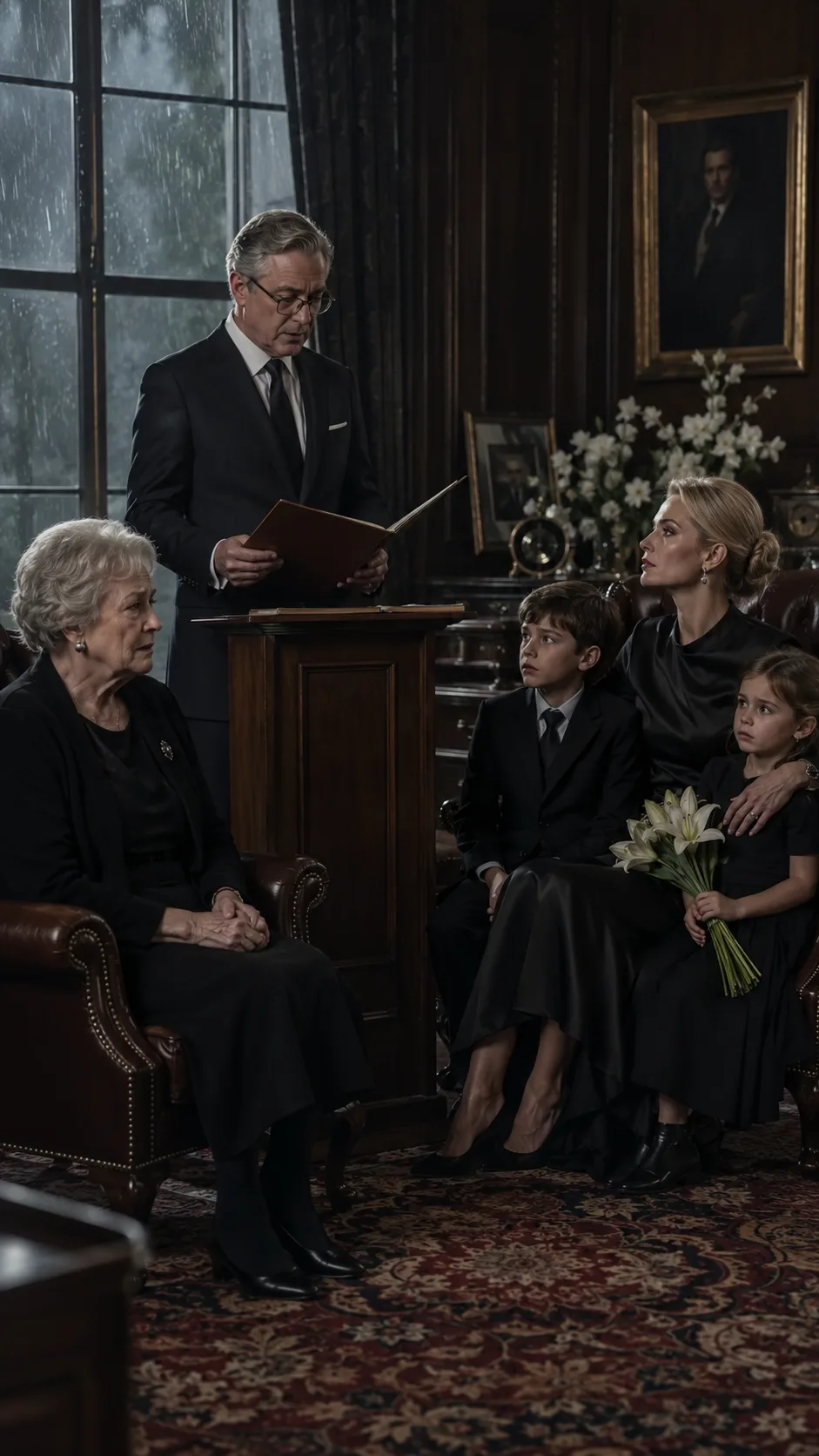
I thought of Oakwood Cemetery.
Rain.
Umbrellas.
A coffin.
A world ended.
And now—this.
A world remade.
Heather glanced toward me.
“I would now like to invite Judith Wilson—Nathan’s mother and co-director of the Nathan’s Beacon Initiative—to share the educational applications that will make this technology accessible beyond clinical settings.”
Taking a deep breath, I stepped onto the stage.
Public speaking had never been my strength.
Thirty years teaching high school English had accustomed me to classrooms, not auditoriums.
But this moment demanded my voice.
“When my son was a little boy,” I began, “he once asked me why people couldn’t solve problems before they became problems.”
“By the time we notice something’s wrong,” he said, “it’s already a big mess. Why can’t we catch it when it’s just a little mess?”
A ripple of appreciative laughter moved through the audience.
That childlike wisdom had evolved into a man who, even facing his own mortality, tried to create a system that could catch little messes before they became irreversible tragedies.
I outlined the educational initiative we built alongside the medical applications.
A simplified version designed for schools, community centers, and public libraries—tools to identify early indicators of learning disabilities, processing disorders, and potential neurological concerns that often went unnoticed until they significantly impacted a child.
“Nathan believed technology should adapt to human needs,” I concluded, “not force humans to adapt to technological limitations.”
“Today we honor that belief by making this available not just to specialists in advanced facilities, but to teachers, librarians, and community health workers who often serve as the first line of observation for children’s developmental well-being.”
As I returned to my seat beside Heather, she leaned slightly toward me.
“He would have loved that childhood anecdote,” she whispered. “I never heard that story before.”
“There are many stories I haven’t shared yet,” I whispered back. “Perhaps it’s time the children heard more of them.”
The rest of the ceremony unfolded with technical demonstrations, testimonials from early trial participants, and a ribbon cutting that symbolized Nathan’s Beacon stepping into the world beyond Wilson Tech’s labs.
Through it all, my attention returned again and again to William and Abigail.
Their proud posture when their father’s name was spoken.
Their quiet dignity in a room full of strangers discussing the man they had lost.
Afterward, during the reception, I found myself standing beside a memorial portrait of Nathan.
A striking image captured at the height of his success, expression thoughtful and determined.
“He looks so young,” a voice said beside me.
I turned.
Benjamin.
He had flown in specifically for the ceremony.
“It’s still hard to believe he’s gone,” he said.
“Yes,” I replied, studying my only child’s familiar features. “And yet… in some ways it feels like he’s more present than ever.”
Benjamin nodded, understanding without explanation.
Nathan’s influence was everywhere now.
The company’s direction.
The innovation bearing his name.
The co-parenting arrangement forged from chaos.
“How are you really doing, Judith?” Benjamin asked, concern plain.
I considered the question.
Across the room, Heather stood with the children, one arm casually draped around William’s shoulders as they spoke with Dr. Chararma.
The tableau would have been unimaginable a year ago.
This functioning family unit made from tragedy and conflict.
“I’m not who I was,” I said finally. “Grief changes you. Responsibility changes you.”
“But I think… I think Nathan would approve of who I’m becoming.”
“He would be bursting with pride,” Benjamin said, hand warm on my shoulder. “You’ve honored him in the most meaningful way possible.”
Later that evening, Heather surprised me.
She suggested we take the children to Nathan’s grave together.
Something we had never done as a unit, our grief having run on separate parallel tracks.
The cemetery was peaceful under fresh snow, the gathering darkness softened by memorial lanterns lining the paths.
William and Abigail walked slightly ahead, their small forms silhouetted against the twilight sky, stopping now and then to brush snow from stone markers that caught their attention.
“This is the first time I’ve been back since the funeral,” Heather admitted quietly. “I couldn’t… I couldn’t face it before.”
“It gets easier,” I said, drawing from my own history of loss. “Not better. But less raw.”
She nodded, uncharacteristically vulnerable.
“I’ve been thinking about what you said months ago,” she murmured. “About us both loving Nathan in different ways.”
“You were right.”
“I didn’t love him the way you did—with that unconditional maternal devotion.”
“But I did love him. In my way.”
“I know,” I said simply.
We reached Nathan’s grave—an elegant black granite marker reflecting the last glow of sunset.
William and Abigail were already there, standing close together.
“Hi, Dad,” Abigail said softly, tracing the engraved letters with her fingertips.
“We launched your special project today,” she told the stone. “It’s going to help lots of people.”
“The neural network architecture has been completely rebuilt,” William added, as if offering a technical update. “Dr. Chararma says it’s even better than the original design.”
The innocent certainty that Nathan could hear them brought tears to my eyes.
Heather stepped forward and placed a single white rose on the snow-covered ground.
“We’re keeping our promises,” she said simply. “All of them.”
I knew what she meant.
The promises written into Nathan’s will.
And the quieter promises we had made after.
To protect his children.
To preserve his legacy.
To continue the work.
As twilight deepened into darkness, the four of us stood together.
Not the family unit Nathan had envisioned in life.
But a different kind of family.
Forged through loss and conflict.
Strengthened by purpose.
Defined not by convention, but by commitment.
“It’s getting cold,” I said finally, noticing Abigail’s small shiver despite her heavy coat. “We should head back.”
“Can we stop for hot chocolate?” William asked, reserve softening. “Dad always took us for hot chocolate after visiting Grandpa’s grave.”
“Of course,” Heather and I said at the same time.
We exchanged a small smile at the unconscious synchronicity.
As we walked back through the quiet cemetery, Abigail slipped one hand into mine and held her mother’s with the other, physically bridging the space between us.
William walked slightly ahead, his posture and gait increasingly reminiscent of Nathan with every passing month.
In that moment, I understood with perfect clarity that Nathan’s true legacy wasn’t only the technology bearing his name.
Remarkable as it was.
His greatest achievement walked beside me.
These children—carrying his compassion, his intelligence, his determination to solve problems before they became insurmountable.
And perhaps, in some quiet, stubborn way, he had engineered this too.
Hope from tragedy.
Connection from conflict.
Renewal from profound loss.
It wasn’t the life any of us had imagined.
But standing in gentle snowfall, surrounded by the family we had become, I knew it was a life worth embracing.
With all its complexity.
Its unexpected alliances.
And its promise of continued growth from the seeds Nathan had planted.
THE END.